



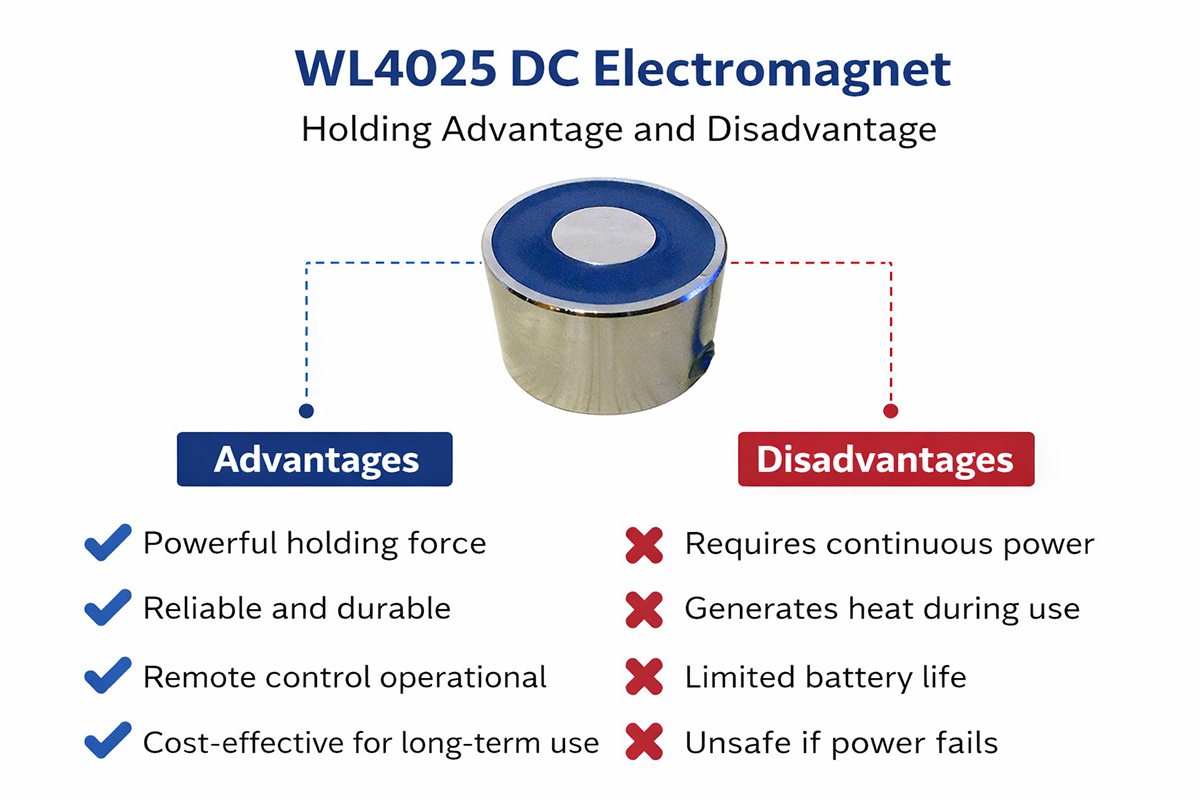
Tips For Choosing the Round Holding Magnet
The right choice of a round holding magnet, which is a type of DC electromagnet, is of critical importance in order to ensure that you have a product that is of high quality, one that is safe, and one that lasts for a long time. The following is a useful guide that you can use in order to make a good choice of an industrial product.
1️⃣ Set the Minimum Holding Force
Determine how much the load actually weighs (in kg or N).
Add a safety factor: 30 to 50%.
Include shock, vibration, or holding it vertically.
Assess the state of the real surface in contact (flat steel is the strongest).
📌 Important: The published holding force is tested under ideal conditions with a low-carbon steel surface.
2. Check the voltage and power supply
Standard voltages: 12V DC, 24V DC, 48V DC.
Verify the DC power supply is steady.
Verify the maximum current and power usage.
Verify the control method (driver board, relay, PLC).
The power supply must be on at all times for holding force.
3. Find out the duty cycle
Continuous duty (100% ED) is required for applications where power is needed 100% of the time.
Intermittent duty is for holding something for a short period.
If continuous duty is required:
Proper heat loss.
Within a safe temperature rise.
4. Check the installation and mounting
Room for installation (height and diameter).
How is it installed (through hole, threaded hole, or surface mount)?
How does the cable come out?
Flatness of the workpiece’s surface.
Full surface contact is the strongest grip.
5 Look at the environment where it will be used
Inside or outdoors?
How humid is the environment?
Were you around oil or dust?
What is the temperature range?
Think about the following for tough environments:
Nickel- or epoxy-coated
Sealing to keep water out
Class F or H for better insulating capabilities
6️ Think about how the materials will work together
Round holding magnets only work well with:
Steel which is not too hard
Steel which is made of carbon
Iron
They do not work well with:
Aluminum
Stainless steel, which is not magnetic
Copper
7️ Think about safety and compliance
For people who buy things in Europe:
Is there compliance to CE?
Is there RoHS compliance?
Reports on tests provided
Is there a process for quality control?
8️ Ask for Sample Testing
Before you make a lot of them:
Would you like to see test data on the holding force?
Would you like to see the report on the rise in temperature?
Would you like to see tests in real-world situations?
Checklist for Quick Selection
Required holding force (kg/N)
Voltage supply available
Continuous or intermittent duty
Is the mounting structure confirmed?
Environmental conditions assessed?
Is surface contact quality guaranteed?
Compliance requirements verified?
Tip for people who buy things for businesses
When picking a magnet, make sure to select one that has a holding force greater than you require. This is especially true if you’re going to use the magnet vertically. Conditions in the real world will lower the magnet’s effective holding power.


