Push Pull Solenoid for Automation
Solenoid DC 12V Push pull Supplier
igh Force Solenoid push pull
Industrial Push Pull Solenoid
WL0420 Custom Push Pull Solenoid
ush Pull Solenoid Actuator
Push Pull Solenoid for Automation
Solenoid DC 12V Push pull Supplier
igh Force Solenoid push pull
Industrial Push Pull Solenoid
WL0420 Custom Push Pull Solenoid
ush Pull Solenoid Actuator

WL0420 Solenoid Push Pull Manufacturer

Solenoid push pull actuators are small, compact devices that are meant to deliver linear movement through magnetic force. When a solenoid push pull actuator is connected to a power source, a magnetic force is developed, enabling a plunger to move forward or backward, thus providing a push or a pull action.

Solenoid push pull actuators are commonly utilized for a variety of applications, including automation systems, door locking systems, vending machines, medical devices, and automotive devices, among many others.

Manufacturers can vary the stroke length, mounting type, voltage, and duty cycle according to the requirements of the project. These actuators offer an efficient solution for the control of linear motion with reliable performance and long life.

OEM Push Pull Solenoid Factory

Product Overview

Solenoid push-pull actuators are electromagnetic devices that produce linear motion using magnetic force. These devices are operated by DC voltage. They offer reliable push-pull motion. These devices are highly compact and offer maximum output. These devices are highly suitable for use in automated systems, automotive systems, and security systems. These devices are highly durable.

WL0420 Solenoid Push Pull Video

Compact Push Pull Solenoid

WL0420 Solenoid Push Pull Datasheet

WL 0420L Mini Linear Solelnoid Push Pull For Smart Door Locks

Size: 20.5*12*11mm

plunger:φ4mm

Voltage: DC12V

Stroke: 0-5mm

Force: 0.2-2N

Power : 13W

Current: 1.09A

Resistance: 11Ω

Life: ≥1000,000 times

Working cycle: 0.5s on, 2s off

WL0420 Solenoid Push Pull

WL0420 Solenoid Push Pull Application +
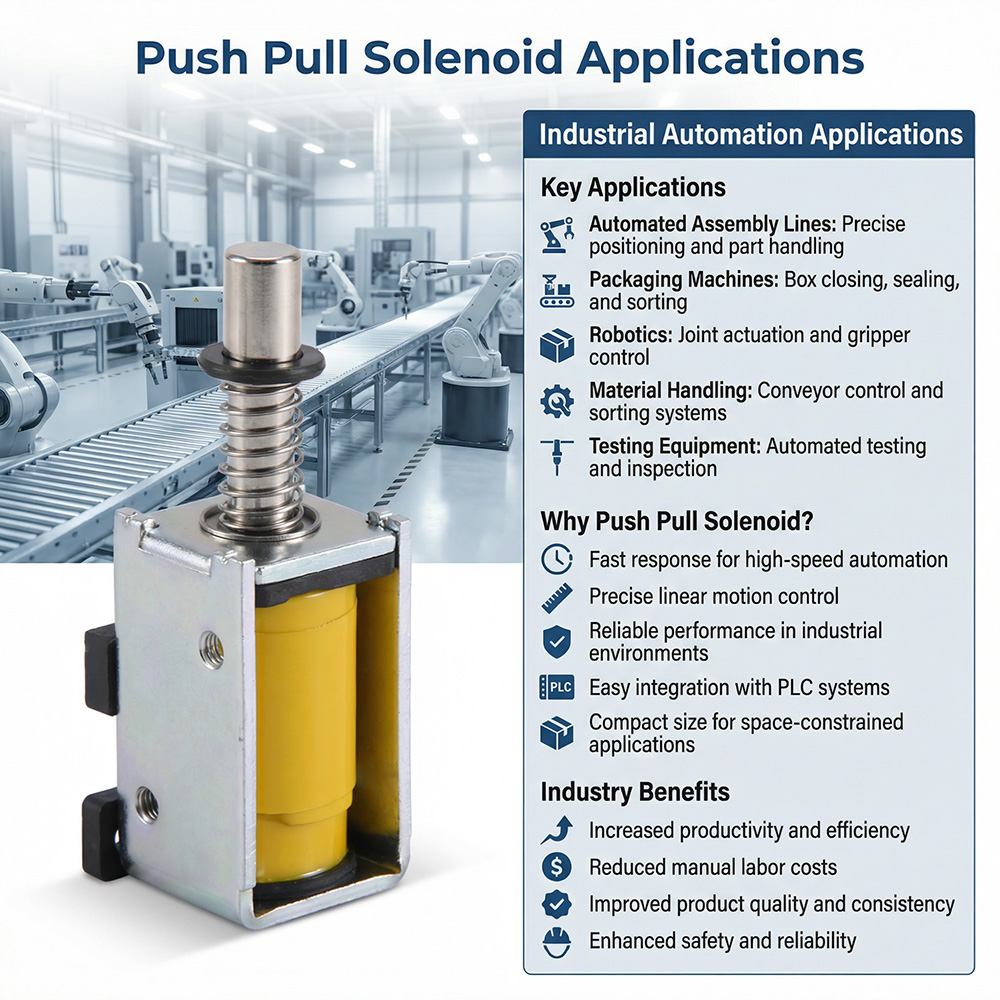
The Solenoid push pull actuators are used in many industrial automation systems to regulate mechanical motion. They are used to regulate vending machine locks and product release mechanisms. Electric door locks also use these actuators to ensure security.
Automotive systems utilize these actuators to regulate trunk release mechanisms, fuel door locks, and headlamps. Medical equipment also utilizes Solenoid push pull actuators to regulate valves and mechanical switches.
Home appliances incorporate these actuators to regulate washing machine mechanisms, coffee machine mechanisms, and printers. Industrial equipment utilizes these actuators to regulate sorting mechanisms, packaging mechanisms, and robot mechanisms.
Security systems incorporate these actuators to regulate cabinet locks and access panels.


WL0420 Solenoid Push Pull Advantage and Disadvantage

Solenoid Push Pull Advantage and Disadvantage

Advantages and Disadvantages

Advantages

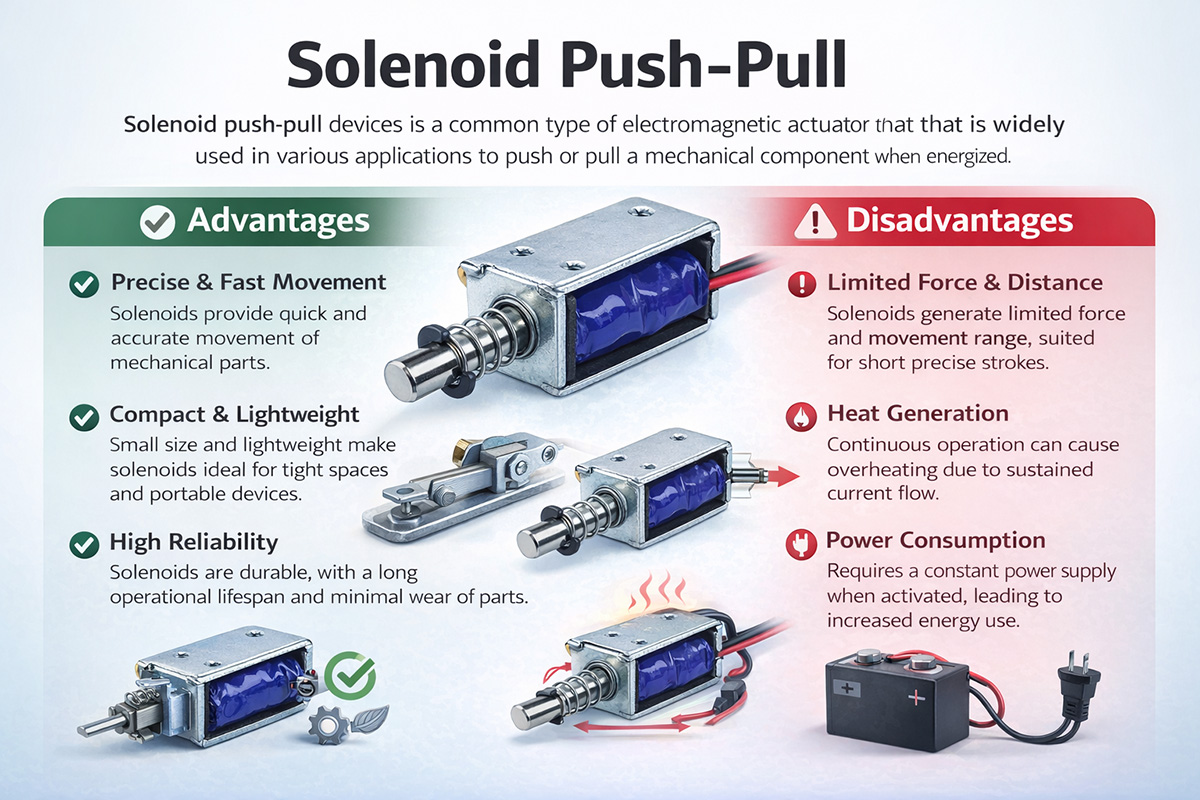
The Solenoid push pull actuators have simple structure and high response rate. They have reliable linear motion with high force output. They are simple to install and can be controlled electrically using DC voltage. They are cost-effective and can be used for mass production. They can be customized to suit different application requirements.

They are also compact in size and can be used in environments where space is limited.

Disadvantages

The Solenoid push pull actuators may produce heat during continuous operation. The force output decreases with an increase in stroke. The efficiency of the Solenoid push pull actuators depends on proper design and voltage stability. Noise may also be produced during operation. They have limited stroke compared to motor-driven actuators. The magnetic force may also weaken during high-temperature operation.

These shortcomings can be eliminated through proper selection and design.

WL0420 Solenoid Push Pull FAQ

1. What is a push-pull solenoid?

A solenoid push pull is an electromechanical device that turns electrical energy into linear motion. When it gets power, it creates a magnetic force that moves a plunger either inward (pull) or outward (push), depending on how it is set up. A lot of people utilize it in medical gadgets, vending machines, locks, and home appliances.

2. What is the function of a solenoid push pull?

Electromagnetic induction is how a push-pull solenoid works:

The copper coil lets current flow through it.

A field of magnetism is created.

The moveable iron plunger is pulled in by the magnetic field.

The plunger makes things move in a straight line (push or pull).

A spring brings the plunger back to its original position when the power goes out.

3. What sets push type solenoids apart from pull type solenoids?

In most cases, there is no difference in structure. The direction of motion depends on how it is set up:

Plunger moves inward when it is pulled.

Push type: When the plunger is powered, it moves outward.

Some designs have longer shafts so that they can work in both directions.

4. What choices do you have for voltage?

Some common voltage choices are:

5V DC

DC 12V

24V DC

110V or 220V AC

DC types are more widespread in equipment that runs on batteries or is automated.

5. How much force can a solenoid with a push-pull function make?

It depends on the force:

Turns of the coil

Voltage in

Length of stroke

Main material

Size of the frame

Common range of force:

Small size: 1–10N

Size: 10–50N

Big factories: 50–200N+

As the stroke distance gets longer, the force gets weaker.

6 Can a solenoid push pull function all the time?

It depends on the duty cycle:

Intermittent duty (10–50%) is the most typical type.

Continuous duty (100%) needs a particular coil design and heat control.

The primary problem with continuous operation is that it can get too hot.

7 Why does the solenoid push pull get hot?

The following things cause heating:

Resistance in the coil (I²R loss)

Long time to energize

A lot of voltage

Not enough air flow

In ordinary designs, the temperature can rise by 40 to 70 degrees Celsius.

8 How to choose the proper solenoid push pull?

Important things to think about before choosing:

Required force (at what stroke position?)

Length of the stroke

Voltage and current

Duty cycle

Space for mounting

Temperature of the environment

The force is strongest at the starting point and is weaker as the stroke moves.

9 What are the parts of push-pull solenoids made of?

Coil of copper

Frame made of low carbon steel

Plunger made of iron

Shaft made of stainless steel

Spring to return

Magnetic materials of high quality make things work better and stronger.

10 How long does a solenoid push pull last?

Average life span:

100,000 to 1,000,000 times

It depends on the load, the duty cycle, the environment, and how well the design is made.

How to Select the Solenoid Push Pull?

There are various parameters to be considered while selecting a push pull solenoid. Firstly, you must determine the force required at the working stroke position. The magnetic force is inversely proportional to the stroke position. So, you must determine the exact position where your solenoid is to be operated. Then, select a voltage source, either 12V DC or 24V DC, depending on your power source.

Also, consider whether it is for continuous duty operation. For continuous operation, a special coil design is required to avoid overheating. Additionally, determine the stroke position and dimensions to ensure proper mechanical design.

Other parameters to consider are response time and return spring strength. Also, consider environmental conditions including temperature, humidity, and vibration levels. For harsh environments, a protective housing is required.

Lastly, select a reliable manufacturer who can offer quality control and customization services to meet your requirements.

By considering these parameters while selecting a push pull solenoid, you can ensure a long service life for your device.


Get A Free Quote Now

Contact Form

Related Products

Related News

  Chapter 1: Introduction of Solenoid Lifespan? The solenoid lifespan represents one of the most widely considered points nowadays in […]

Scroll to Top

Get A Free Quote Now !

Contact Form
If you have any questions, please do not hesitate to contact us.
Weilong Solenoid Company Culture