Magnet Lock 12V-Secure Access Control Solution
Magnet Lock 12V for Smart Access Systems
High Strength 12V Magnetic Door Lock Guide
est Magnet Lock 12V for Access Control Systems
12V Electromagnetic Lock-Features & Benefits
Secure Your Door with Magnet Lock 12V System
Magnet Lock 12V-Secure Access Control Solution
Magnet Lock 12V for Smart Access Systems
High Strength 12V Magnetic Door Lock Guide
est Magnet Lock 12V for Access Control Systems
12V Electromagnetic Lock-Features & Benefits
Secure Your Door with Magnet Lock 12V System

WL5030 Innovative Magnetic Lock 12V Guide

A Magnetic Lock 12 V, also called a 12V electromagnetic lock, is a security device that uses electricity to make a magnetic field that keeps doors closed when the power is on. There is an electromagnet on the door frame and an armature plate on the door. When electricity flows, the magnet pulls the plate toward it, which keeps the door locked. These locks are often used in access control systems because they are dependable, respond quickly, and have a strong holding force. They are good for keeping people out of and in a safe way in offices, stores, and factories.

The Function of Magnet Lock 12V

A magnetic lock 12V works because of the principle of electromagnetism. When you plug in a 12V DC power supply, the coil inside the electromagnet gets current, which makes a strong magnetic field. This magnetic force pulls on the armature plate attached to the door, keeping it locked.
When the power goes out, the magnetic field disappears right away, and the door opens. This means magnet locks are always safe and will open on their own if the power goes out. This keeps you safe in an emergency. These locks are often connected to access control systems that let people in with cards, passwords, or fingerprints.

WL5030 Magnetic Lock 12V Product Overview

A  magnetic lock 12v is a new kind of lock that is made for access control systems to keep things safe. It uses electromagnetic force to keep doors closed, which makes it powerful and dependable. Many homes, businesses, and factories use these locks because they are strong and easy to use.

They can work with a number of access control systems, like RFID, keypads, and biometric systems. The fail-safe design makes sure that doors will still open even if the power goes out. This approach makes safety compliance better. 12V magnetic locks are the best option for smart and secure entry management systems because they are easy to set up, need little maintenance, and work very well.

WL5030 Magnetic Lock 12V Video

WL5030 Magnetic Lock 12V Detail Display

WL5030 Magnetic Lock 12V Datasheet

Brand Weilong Technology Model Number WL5030
Rated Voltage (V) DC12V  or 24V Rated Power (W) 8–10 W
Work Mode Power on to Hold, power off, Magnet Off Holding Force (N) 50–60 kg
Stroke (mm) 0 MM Customized Reset Time(s) 1 S ON, 3 S OFF
Service Life 200 Thousand Times Certification CE, RoHS, ISO9001,
Material Superior Magnet Iron Lead Wire Length (mm) 200 MM
Install Style Screw Tolerance of Dimension  +/-  0.1 MM
Water-proof  None Insulation Class B
Hi-Pot Test AC 600V 50/60Hz 2s Non-excitation Holding Force 0
Working Temperature -10°C-100°C Duty Cycle 1-100%
Thread Depth (mm) / Payment Term TT, or LC At Sight
Sample Order Yes Warranty 1 Year
MOQ 1000 pcs Supply Ability 5000 pcs per Week
Delivery Time 30 Days Port of Loading shenzhen

WL5030 Magnetic Lock 12V Application

WL5030 Magnet Lock 12V Application

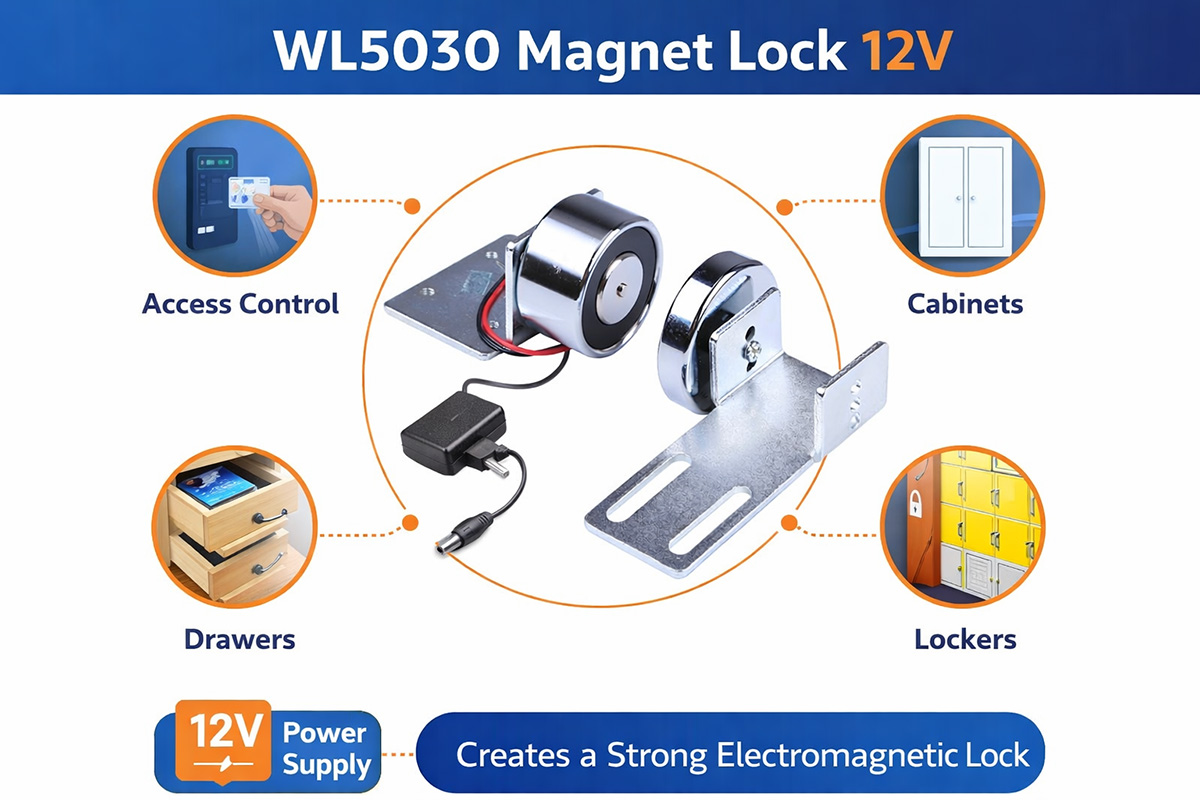
Many different fields use magnetic lock 12V because they are dependable and flexible. In business buildings, they are often put on office doors so that only people with cards or keypads can get in. Stores use them to keep places that only employees can go, like storage rooms and staff-only areas, safe.
Smart home systems come with these locks, which make homes safer by letting people access and monitor them from afar. Industrial buildings use 12V magnetic locks to keep sensitive areas safe. These places are warehouses, labs, and production areas where controlled entry is important.
They also look good and hold things in place well on glass doors in hotels, banks, and shopping malls. Schools use them to protect classrooms, labs, and offices. Magnetic locks are also used by hospitals and other healthcare facilities to keep people out of sensitive areas like pharmacies and rooms where patient records are kept.
The magnetic locks 12V is very important for making places safer, managing access better, and keeping people safe in a lot of different situations because they can work with modern access control systems.

Advantages and Disadvantages of WL5030 Magnetic Lock 12V

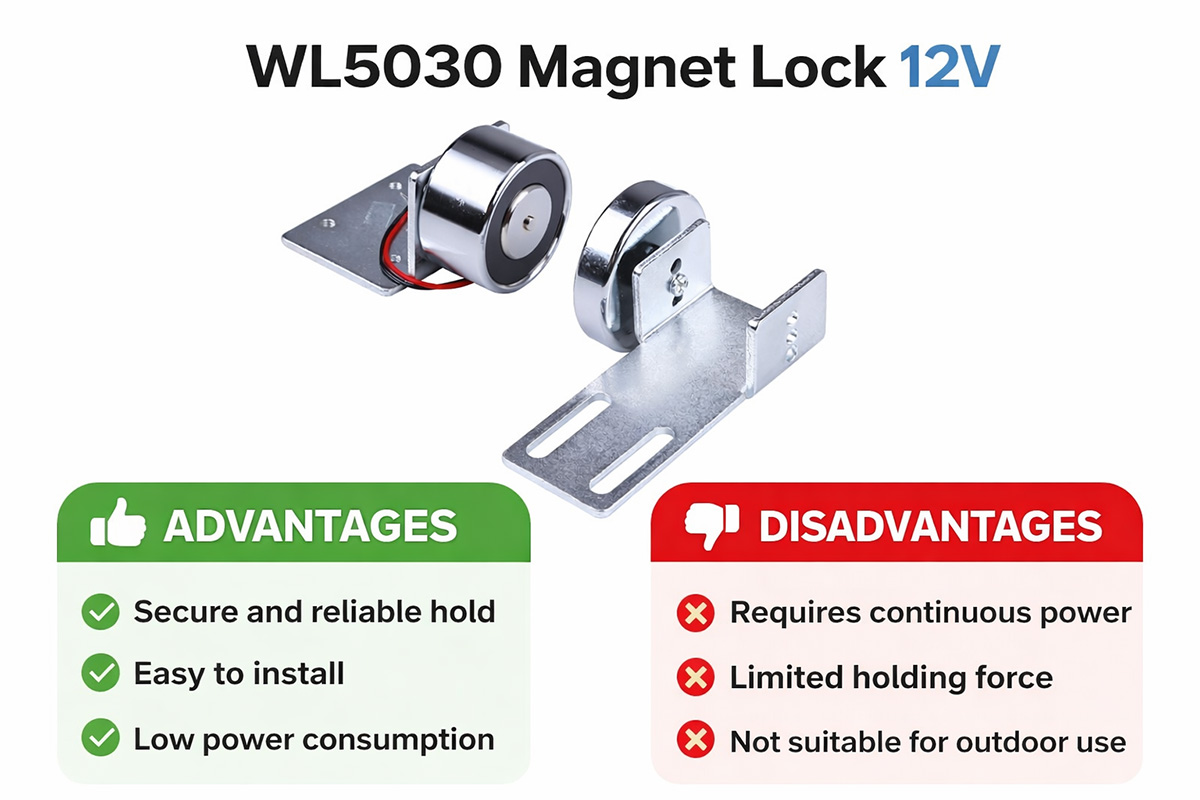
WL5030 Magnetic Lock 12V: Advantages and Disadvantages

Pros the Magnetic Lock 12V

A 12V magnet lock (otherwise known as an electromagnetic lock) is a widely used door locking mechanism in the access control system. It employs electromagnetic forces in the operation process and locks a metal armature plate upon receipt of 12V DC electricity.

  1. 🚀 Fast and Easy to Use

The quick unlocking happens automatically when the power is cut or the access control system regulates them.

  1. 🔧 Ease of Installation

It requires no mechanical latches, which means a quick installation process.

  1. 🛡️ High Durability

Since there are no moving parts, there will be almost no wearing out, thus resulting in longevity.

  1. 🔒 Strong Holding Capacity

Provides powerful magnets suitable for glass, metal, or wooden doors in secured premises.

  1. 🔌 Can Be Integrated with Remote Control Systems

It allows quick integration with RFID, keypad, biometric, or access control systems for a secure operation.

  1. 🔥 Built-In Safety Release Upon Power Failure

It has a built-in safety mechanism that ensures automatic opening upon a sudden loss of power

Problems With the Magnetic Lock 12V

  1. ⚡ Depends on Electric Power Supply

Requires constant electric power supply (12V DC) to remain locked. Any power supply interruption will unlock the door.

  1. 🔋 May Create Security Risks upon Power Outage

Loss of power supply will create security gaps temporarily. However, it can be mitigated by adding backup power.

  1. 💰 Costlier than Locking Mechanical Devices

It costs more compared to regular locking devices due to the presence of electronic components.

  1. 🧰 Requires Professional Installation

Installation is a complicated process, as the lock must be wired, aligned, and integrated with controllers and a power supply.

  1. 🔥 Generation of Heat

While heating is normal, excessive temperature occurs due to inappropriate voltage or malfunctioning of power supply units.

  1. 🌧️ Restricted Environment Application

Standard magnet locks require additional waterproof variants to be applicable outdoors.

📌 Bottom Line

A 12V magnet lock represents a modern, reliable lock suitable for keeping your apartment or house safe. It is quick, durable, and provides quick access via smart systems. However, it depends significantly on a reliable power supply and professional installation.

How to maintain a 12V magnetic lock?

Maintaining a 12V magnetic lock is pretty simple: you just need to clean the mating surface once per month, check the fasteners every three months, and monitor the power supply. Here is a basic maintenance plan based on manufacturer guidelines and best practices.

🧼 Step 1: Clean the Mating Surface (Monthly)

This is the most critical step because dust, dirt, or rust may create a gap between the magnet and armature plate, reducing its holding strength.

Cleaning: Use a soft, lint-free cloth moistened with a solution of water and a mild detergent or isopropyl alcohol.

Lubricate: Apply a thin layer of silicone-based lubricant (WD-40) to the mating surface after cleaning. This will prevent corrosion and reduce dirt accumulation.

Avoid using oil and harsh chemicals, which could damage the metal surfaces.

🔧 Step 2: Tighten Hardware Components (Quarterly)

As the locking mechanism operates, closing the door creates vibrations that may loosen the screws.

Examine the armature plate: Make sure that it is properly mounted to the door and that the central bolt allows slight rotation around its axis. This self-adjustment is necessary for full alignment with the magnet.

Verify magnet: The mounting bolts should be tight to prevent any movement.

Tip: To reduce vibration-induced loosening, apply a tiny amount of Loctite (thread locker) to all bolts.

⚡️ Step 3: Verify the Power Supply (if needed)

When a maglock receives too much current, it overheats. On the other hand, low voltage reduces its holding strength.

Voltage test: Using a multimeter, measure the voltage at the terminal points of the maglock and verify that it provides a stable 12V DC (+/-10%).

Current test: Make sure that the power supply is able to deliver sufficient current (usually 300mA-500mA).

Loose wiring causes inconsistent operation. Check connections and tighten all terminal screws.

Step 4: Identify Common Issues Early

Symptom Common Cause What to Check
Weak Holding Force Dirty surfaces or misalignment Clean the surfaces (Step 1). Ensure the armature plate has “wobble” room (Step 2)-5-9.
Lock Won’t Release Residual magnetism or stuck armature Check that the rubber washer is present. Loosen the armature bolt slightly if it is too tight (1-9).
The lock is overheating. Voltage too high or wrong jumper setting Verify voltage input (12V). If the lock has jumpers, ensure they are set to 12V, not 24V.
Humming Noise Loose armature plate Tighten the armature bolt slightly or check the mounting bracket -9.

5. Troubleshooting

Often, users notice signs of malfunctioning before a maglock fails completely. Here are some typical problems and solutions:

Outdoor Installation: The vast majority of standard maglocks (like the WL5030 series) are designed for indoor installations only. Unless you provide proper protection, you will frequently find rust and corrosion.

📝 Summary Maintenance Schedule

To ensure optimal performance and reliability of your WL5030, follow this schedule:

Weekly: Listen for humming sounds and monitor whether the door is heated up.

Monthly: Clean the magnet and armature plate, lubricate with silicone spray.

Quarterly: Check screw tightness for all mounting bolts and terminal screws.

By following these recommendations, you’ll ensure a trouble-free operation of your magnetic lock for many years to come.


FAQs of WL5030 Magnetic Lock 12V

1. Can I use magnetic lock 12v safely?

Yes, this type of magnetic lock 12v is generally used for access control system installations, so you can be sure that it is fail-safe. In case of a power outage, this lock automatically releases its grip to allow users emergency exits.

2. Does magnetic lock 12v consume a lot of energy?

No, since it is made to work with a 12V DC power source, such locking mechanisms are low voltage and consume very little electricity. The device consumes power only during the locking process.

3. Can I install magnetic lock 12v myself?

Yes, but it is not recommended because you need to align it properly to ensure safety and correct operation. The wiring process requires certain skills and experience.

4. Why does my magnetic lock 12v feel hot?

It operates continuously, so it is normal for this mechanism to warm slightly. However, overheating may appear due to the poor quality of power supply or high voltage.

5. What will happen if there is a power outage?

Since it is fail-safe, in case of a power outage, the electromagnet lock will release the door. Such a feature guarantees safety even in case of fire.

6. What are the holding force specifications for the WL5030?

The “5030” in the model usually means the dimensions (like 50mm x 30mm). Usually, this relates to a holding force of around 50kg (500 N) or 60kg (600 N). Check the product label to verify that it fits your access control requirements.


7. How should the armature plate be mounted properly?

The movable armature plate must be fixed onto the door (movable part). There must be some degree of “wobble” in the plate so that it can automatically align itself to the magnet body fixed to the frame.

8. What will happen when I use 24 volts instead of 12 volts?

The use of 24V instead of 12V will result in overheating, high current draw, and the burning out of the coil. It is crucial that you use a 12V DC supply on the lock.

In case your lock isn’t performing well, there may be two possibilities: either the input voltage is not right or the gap between the magnet and the steel plate is greater than 0.5mm.

How to pick the magnetic lock 12V?

Before you buy a magnetic lock 12V, you should think about a few things to make sure it works well and is safe.

First, find out how much force you need to hold something. Different uses need different amounts of strength, usually between 60 kg and 500 kg or more. A lower holding force is enough for light doors, like small glass doors or cabinets. Metal or industrial doors, which are very heavy, need very strong magnet locks.

Second, think about what kind of door it is and how it will be put up. For glass doors, you may need special brackets, but for wooden and metal doors, you can mount them in more ways. Verify that the lock you choose works with the right hardware for mounting.
Third, check that the voltage and power use are the same. A 12V system is common because it is safe and works well, but you need to make sure that your power supply can handle the lock’s needs.

Fourth, look for extra features like LED lights, status updates on the door, and time delay functions. These features make access control systems easier to use and work with.
Fifth, consider the weather. If you want to use the magnet lock outside, make sure it is waterproof and won’t rust. This will help it last longer.
Finally, choose a company that you can trust and that has a history of making good products. You can tell how good a product is by things like its certifications, testing reports, and how long it lasts.
You can find a 12V magnet lock that meets your security needs, lasts a long time, and works well with your access control system by carefully considering these factors.

How to avoid the common mistake when selecting a magnetic lock 12V?

You are looking for a common mistake. This article will help you find the best product by avoiding mistakes during purchase:

🚨 1. Choosing an inappropriate holding force

Error: You do not consider the lock holding force.

Typical force ratings: 180kg / 280kg / 350kg / 500kg+
Small doors require less force.
Large or secured doors require more.

👉 Small locks are easily opened.
👉 Large locks increase costs and power consumption.

⚡ 2. Ignoring the power supply stability

Error: The power supply may be unstable.

Regulated 12 VDC power supply is recommended
Consider the power supply current rating (especially if there are several locks)
Take into account the voltage drop along the cable

Low magnet force = low voltage

🔌 3. Lack of backup plan

Error: Failure to organize fail-safe action.

Generally, the magnetic locks are fail-safe.

You must choose: 👉

Is the emergency exit important?
Or is security priority (backup power source is needed)?

🚪 4. Incorrect door selection

Error: Install the standard lock for non-standard doors

Confirm your door type:

For glass door – U-bracket required
Frequent installation – wooden or metal door
For frameless door – additional mounting components required

👉 Bad mounting = bad alignment = bad grip

5. Improper installation alignment 📐

Error: Magnet and armature plate misalignment.

Two surfaces must be parallel.
Complete surface coverage is mandatory for maximum force.

👉 Significant impact on performance.

🌡️ 6. Ignoring the environment factors

Error: Indoor lock installation outdoors.

Outdoor use – requires anti-corrosive coatings.
Prevent rust in humid climates.

Corrosion reduces life span and magnet force.

🔁 7. Heat dissipation & duty cycle not taken into consideration

Error: Continuous powering of the magnet.

Magnetic lock needs constant power supply.
Consider the heat dissipation feature when selecting.

👉 Inexpensive devices tend to overheat.

🧲 8. Holding force measurement vs. Rated force

Error: You believe in the manufacturer claims.

Rated force – laboratory measurements under optimal conditions.
Actual magnet force is lower.

👉 Choose high-quality manufacturers providing test results.

🔐 9. Ignoring compatibility with access control system

Error. Lock does not interact with control systems.

It should work with:
Access control systems
Key/RFID reader
Emergency exits
Fire alarm integration

🛠️ 10. Lack of quality certificates

Error: You purchase uncertified products.

Look for:
RoHS
CE
Fire safety certificates.
Factory acceptance test reports

👉 Particularly important for commercial buildings.

💡 Professional selection checklist

While purchasing, you should verify:

Correct grip force
Stable 12V power source
Door type and mounting components
Indoor or outdoor installation
Backup power source (if required)
Quality certification


Get A Free Quote Now

Contact Form

Related Products

Related News

Scroll to Top

Get A Free Quote Now !

Contact Form
If you have any questions, please do not hesitate to contact us.
Weilong Solenoid Company Culture
