Solenoid Pinch Valve for Industrial Fluid Control Systems
How Solenoid Pinch Valve Improves Fluid Control Efficiency
Solenoid Pinch Valve Solutions for Automation Equipment
Custom Solenoid Pinch Valve Manufacturer for Industry
High Reliability Solenoid Pinch Valve for Liquid Control
Solenoid Pinch Valve Applications in Medical Equipment
Solenoid Pinch Valve for Industrial Fluid Control Systems
How Solenoid Pinch Valve Improves Fluid Control Efficiency
Solenoid Pinch Valve Solutions for Automation Equipment
Custom Solenoid Pinch Valve Manufacturer for Industry
High Reliability Solenoid Pinch Valve for Liquid Control
Solenoid Pinch Valve Applications in Medical Equipment

WL3682 Complete Guide to Industrial Solenoid Pinch Valve

Solenoid pinch valve is  a convenient and effective method of automating the liquid flow control system. These valves use electromagnetism to squeeze a flexible tube. This results in precise ON/OFF control without any direct contact between the liquid and the valve body. This innovative design minimizes the contamination risks, facilitates maintenance, and improves the reliability of the system.

A solenoid pinch valve is made for compact equipment and precision applications that require quick response, low power consumption, long lifespan, and flexible installation options. They are often used in medical analyzers, laboratory systems, water treatment equipment, beverage machines, and industrial automation devices. Solenoid Pinch Valve offers a wide variety of solutions for OEM applications, including adjustable voltage, tube diameter, mounting structure, and performance.

Industrial Solenoid Pinch Valve Product Overview

The solenoid pinch valve is a small electromagnetic valve for liquid control in automated liquid switching systems. This paper describes the innovative flow control device that combines solenoid actuator and flexible tube squeezing mechanism for precise liquid control. The standard configurations include DC 12V and DC 24V operation, customized tube diameter and various mounting options. The valve is highly reliable, requires little maintenance and has a long lifespan. It is especially suitable for medical, laboratory and hygiene-sensitive applications, because the liquid does not come in contact with anything but the tube. We can manufacture Custom Solenoid Pinch Valves as per customers’ requirements such as voltage, flow rate, size and mounting.

How Does a Solenoid Pinch Valve Operate?

A solenoid pinch valve is based on the principle of electromagnetically induced movement.
When you turn on the electrical current in the valve, the current flows through the coil and generates the magnetic field. This magnetic field attracts the internal plunger and causes the mechanical movement. The plunger squeezes the flexible tube. This reduces the opening of the tube and stops the flow of the liquid.
If you cut off the current supply, the magnetic field collapses. The return spring forces the plunger to return to its original position and opens up the tube.
The steps of the operation include:
coil activation by electrical signal
Magnetic attraction causes mechanical movement
The plunger squeezes the tube.
The flow of the liquid stops.
Power off, tube release.
The simple design allows for fast switching and precise flow control.

Key features of a solenoid pinch valve

Solenoid pinch valves feature a simple design, reliable operation, and good flow isolation performance. There is no contact between the liquid and the flexible tube, so there are no contamination risks, and they are ideal for sensitive applications. The electromagnetic design provides fast response and precise flow control. Its small size allows for easy integration in automated equipment. The coil is well-designed for reliable operation and long lifespan, usually above 100,000 cycles. Solenoid pinch valves support different voltages, tube diameters, and custom mounting structures. Their features make them ideal for medical, laboratory, industrial, and precision liquid control applications.

Industrial Solenoid Pinch Valve Presentation

Industrial Solenoid Pinch Valve Detailed Display

Industrial Solenoid Pinch Valve Datasheet

Brand Weilong Model Number WL 3682
Rated Voltage (V) DC12V  or 24V Rated Power (W) 15W
Work Mode Air or Liquid Control Valve Working Pressure (MPa) 0.5 MPa
Air-Flow Rate 0-0.5 L/minute Reset Time(s) 1 S On, 1 S Off
Service Life 200 Thousand Times Certification CE, ROHS, ISO9001,
Pipe Gate Outside Dia.: 5 mm, inside: 2.5 mm Lead Wire Length(mm) 200 MM
Install Style Screw Tolerance of Dimension ± 0.1 MM
Water-proof None Insulation Class B
Hi-Pot Test AC 600V 50/60 Hz 2s Non-excitation Holding Force 0
Working Temperature -10°C-100°C Duty Cycle 1-100%
Thread Depth (mm) / Payment Term TT, or LC At Sight
Sample Order Yes Warranty 1 Year
MOQ 1000 pcs Supply Ability 5000 pcs per week
Delivery Time 30 Days Port of Loading Shenzhen

Why Is the Solenoid Pinch Valve Gaining Popularity?

Solenoid pinch valve becomes more and more popular because the modern industry requires cleaner, smarter, and more reliable liquid control solutions.

The biggest advantage is the absence of contamination. These valves are perfect for medical, laboratory, and food applications, because the liquid comes into contact only with the flexible tube.

Another important reason is the development of automation technology. The component manufacturers are required to supply the components that are compact, energy efficient, and easy to integrate. Solenoid Pinch Valves are characterized with quick response, simplicity of control and reliable performance.

Less maintenance is required and cleaning is easier than for standard valves. They are customizable, allowing manufacturers to create solutions for different tube diameters, voltages, and application requirements.

As the demand for precise liquid handling in healthcare, industrial automation and smart equipment continues to grow, Solenoid Pinch Valves will become an important part of fluid control systems in the future.

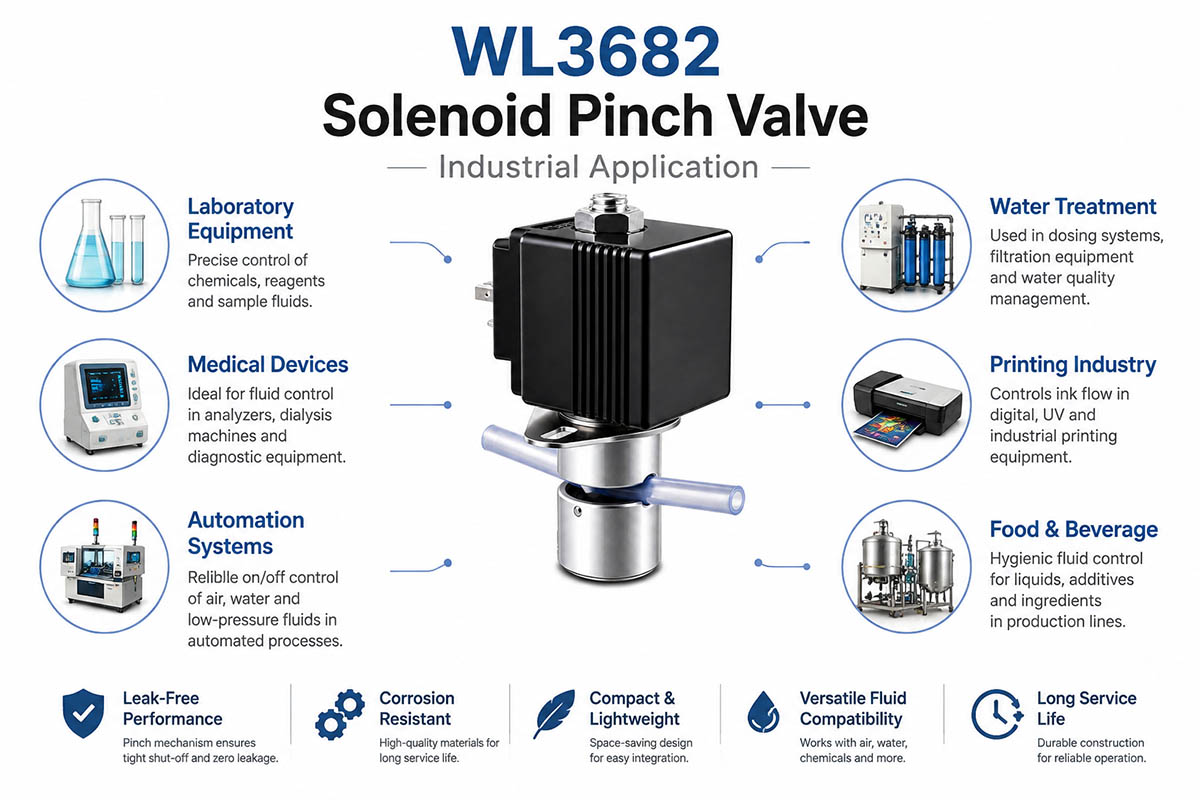
Solenoid Pinch Valve Industrial Application

Solenoid Pinch Valve Industrial Solution

Solenoid pinch valve is used in several industries where accurate, clean and reliable control of liquids is required.

Medical devices

Solenoid pinch valves are used in medical analyzers, diagnostic machines, dialysis equipment, and laboratory instruments. The liquid is isolated inside disposable tubing. This helps to decrease the contamination risks and increase the safety.

Lab Equipment

Scientific instruments require precise control of chemicals, water, and testing liquids. Solenoid pinch valves feature repeatable switching and easy maintenance.

Water Treatment Systems

These valves are used in water treatment equipment, filtration systems, and automatic dispensers for controlling the flow of liquids.

Food and Beverage Machinery

Solenoid Pinch Valves help to maintain hygiene standards in beverage dispensers and processing equipment because the liquid does not come in contact with any internal metal parts.

Factory Automation

Reliable ON/OFF flow control is a must-have in factory automation systems, liquid filling machines, and precision dosing equipment. Solenoid pinch valves with fast response and long lifespan.

Semiconductor & Electronics Manufacturing

The management of clean liquid is a critical factor in semiconductor processes. Pinch valve technology protects against contamination in chemicals and liquid handling.

Solenoid pinch valves are increasingly used in advanced automation systems due to their small size and reliability.

Pinch Valve vs Solenoid Valve: A Comprehensive Guide

In the process of choosing industrial equipment, engineers will often compare the Pinch Valve and the Solenoid Valve when choosing a fluid control valve. Both devices provide automatic flow control, but they have a different working principle, different ways of fluid contact, maintenance, and area of application. How a pinch valve works

The pinch valve controls the fluid flow by squeezing the flexible tube. Compression of the tube to stop the flow. Releasing the tube brings it back to its original state and allows the fluid to flow through.

1. Working Principle Comparison

Item Pinch Valve Solenoid Valve
Operating Method Mechanical pinching of a flexible tube Electromagnetic movement controls valve opening.
Main Driving Force Pneumatic, manual, or electric actuator Electromagnetic coil
Flow Control Method Opens/closes by compressing the tube Opens/closes internal valve seat
Fluid Contact Only contacts the tube Contacts internal valve components

1.1 Solenoid Valve Working Principle

A solenoid valve moves the plunger or diaphragm using an electromagnetic coil. When activated by electricity, magnetic force opens or closes the flow passage of the valve. One big advantage of pinch valves is in cases where there is a need for contamination-free operations because the fluid does not contact the valve body.

1. 2. Structural Comparison

Pinch Valve Structure

Components:

Electric pinch valve (solenoid coil)

Syringe plunger

Bounce back

Tube clamping system

Flexible tube

Housing

Structure:

Coil ↓ Plunger ↓ Pinching system

↓ Fluid flow ↓ Flexible tube

Solenoid Valve Structure

Parts:  Coil (electromagnetism)

Plunger/armature

Valve seat

Seal

Spring

Valve housing

Structure:

Coil ↓ Magnetic plunger ↓ Valve seat ↓ Flow channel ↓ Liquid Application Comparison

Pinch Valve Applications

Pinch valves are widely used for:

Equipment for medicine

Blood analysis

Diagnostic equipment

Kidney dialysis equipment

Medicine fluid management systems

Laboratory equipment

Chemical analysis equipment

Liquid sample systems

Test Machine

Food and drinks

Pumps for liquids

Filling systems

Process of liquids hygienically

Water treatment

Filtering systems

Dosage system

Liquid purification systems

Industrial automation

Precision dispensing of liquids

Working with chemicals

Systems testing

2. Fluid Contact Comparison

Feature Pinch Valve Solenoid Valve
Fluid Contact Flexible tube only Valve body, seals, diaphragm, plunger
Contamination Risk Very low Higher compared with a pinch valve
Cleaning Requirement Easy tube replacement Requires internal cleaning
Suitable for Sensitive Fluids Excellent Depends on valve material

Winner: Pinch Valve

For applications requiring hygienic and contamination-free operation, pinch valves provide a major advantage because the fluid never touches the mechanical valve structure.


3. Applications of Solenoid Valves

Solenoid valves are widely used in:

Industrial automation

Pneumatics

Hydraulics

Engineering mechanics

Water control systems

Irrigation systems

Cleaning machines

Water supply systems

Heating and cooling systems

Refrigeration control

Heating system

Air-conditioning systems

Gas control

Gas appliances

Combustion equipment

Industrial gas equipment

4. Performance Comparison

Performance Pinch Valve Solenoid Valve
Response Speed Fast Very fast
Flow Accuracy Excellent for clean liquids Excellent for general fluids
Leakage Risk Very low with proper tube Depends on seal condition
Noise Level Low Possible clicking noise
Maintenance Low Medium
Lifespan Depends on tube cycles Depends on seal and mechanism

5. Advantages and Disadvantages

Advantages of Pinch Valves

✔No fluid contamination

✔Simple structure

✔Easy maintenance

✔Suitable for sensitive liquids

✔Low risk of leakage

✔Suitable for disposable tube systems

Disadvantages of Pinch Valves ✘ Limited ability to withstand pressure

✘ Need to replace the tube after its operation

✘ Limited flow due to tube size

✘ Inapplicable in very high temperatures without a special tube

6. Advantages of Solenoid Valves

✔ High-pressure capability

✔ Wide size range

✔ Suitable for liquids and gases

✔ Quick switching reaction

✔ Variety of industrial applications

Disadvantages of Solenoid Valves ✘ Fluid contact with internal parts

✘ Higher risk of contamination

✘ Leakage due to seal wear

✘ More complex maintenance

7. Pinch Valve or Solenoid Valve: Which to Choose?

Choose a pinch valve in case:

✅ Fluid has to remain uncontaminated.

✅ No contamination in application

✅ Fluid is sensitive or expensive.

✅ It is acceptable to change the tube.

✅ Compact equipment is required.

Examples

Medical analyzers

Laboratory systems

Equipment in the catering business

Precision fluid control

7. How to choose a solenoid valve

✅ Need for high pressure

✅ Need for large flow rate

✅ Need for gas control

✅ Need for long-term industrial operation

✅ Acceptable internal valve contact

Examples

Industrial equipment

Pneumatics 1.

Water management

8. Quick Selection Table

Requirement Recommended Valve
Clean liquid handling Pinch Valve
Medical application Pinch Valve
Laboratory equipment Pinch Valve
High-pressure control Solenoid Valve
Gas control Solenoid Valve
Large flow system Solenoid Valve
Disposable tubing system Pinch Valve
General industrial automation Solenoid Valve

9. HVAC Systems Conclusions

Solenoid valves and pinch valves are both efficient automatic valves for liquid flow control but have different areas of application.

As the fluid does not contact the valve body, a Solenoid Pinch Valve is a good solution in case of a need for uncontaminated fluid control. Solenoid Valve is better suited for applications requiring higher pressures and large flow rates.

Solenoid Pinch Valves are extremely reliable, easy to maintain and provide long-term performance for medical equipment, laboratory tools and smart fluid control systems. For heavy industrial applications requiring high pressure.

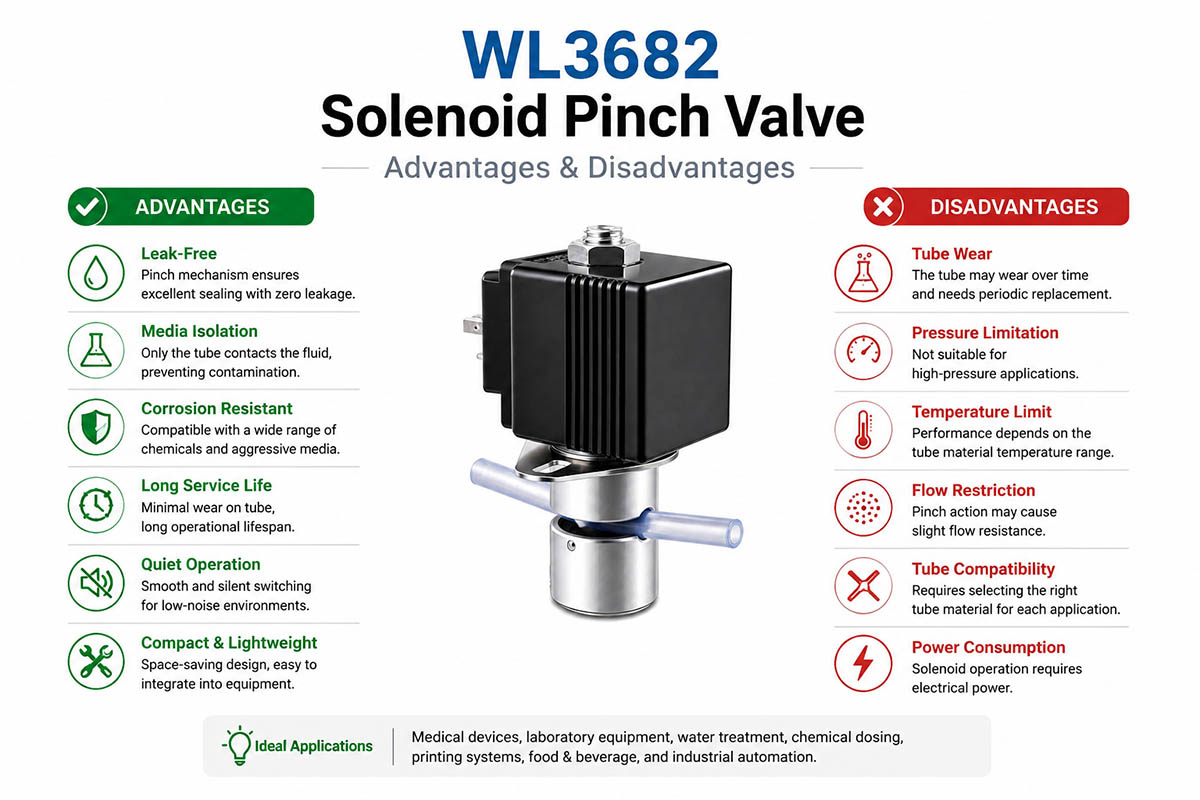
Solenoid Pinch Valve Advantage and Disadvantage

Solenoid Pinch Valve Advantage and Disadvanage

Solenoid pinch valves have a lot of advantages compared to standard valves.

1. Fluid control clean

The liquid is in contact with the tube only, reducing the contamination risk.

2. Easy maintenance

Tube replacement is simple, and maintenance costs are low.

3. Long life

High-quality designs allow tens of thousands of operating cycles.

4. Small size

Compact design for tight-space installations.

5. Reliable automation

Electromagnetic operation allows quick and repeatable switching.

Solenoid pinch valve: Cons:

1. Tube wear

The flexible tube may need to be replaced after prolonged operation.

2. Limited pressure range

Pinch valves are usually used for lower pressures than metal valves.

3. Flow limitation

The tube diameter determines the maximum flow capacity.

4. Temperature limitations

The tube material should be selected according to the required temperature range.

Solenoid Pinch Valve is perfect for applications where clean, accurate, and reliable liquid control is required.

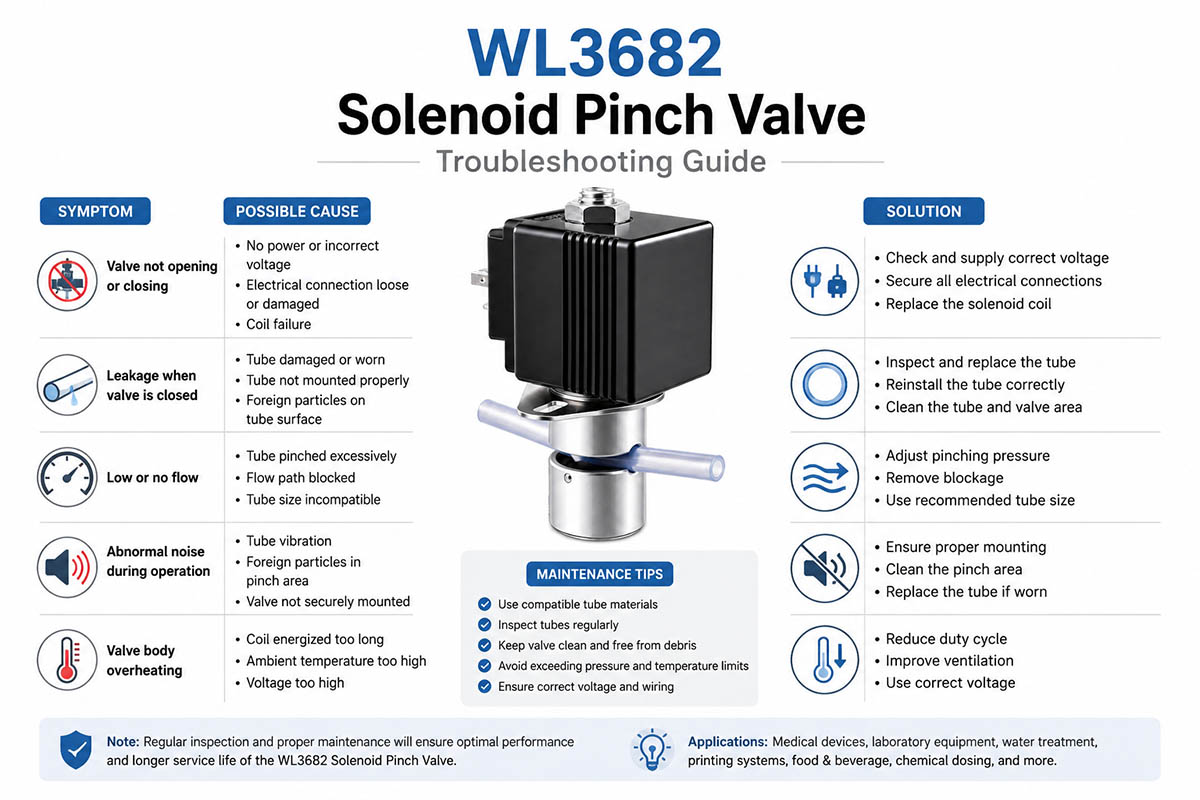
Solenoid Pinch Valve Troubleshooting Guide


Valve Will Not Open or Close

Possible reasons:

Wrong voltage supply

Damaged coil

Obstruction to the mechanical operation 2.

Incorrect wiring connection

Solutions:

Checking the power supply

Measurement of the coil resistance

Observation of the movement inside

Loss of liquid

Possible reasons:

Broken tube

Insufficient compression power

Incorrect tube diameter

Solutions:

Replacement of tube

Pressure check of the valve

Confirmation of tube specifications

Slow Response

Possible reasons:

Low voltages

Friction – Mechanical problem

Overheating of the coil solutions:Solenoid Pinch Valve Troubleshooting guide

Checking of the electrical parameters

Checking of the mechanical parts

Noise operation

Possible reasons:

Loose parts

Incorrect mounting

Magnetic Vibration Solutions:

Improving installation structure

Checking mechanical alignment

With the proper design and periodic inspection, the reliability of the solenoid pinch valve can be significantly increased.

8 Common FAQs for Solenoid Pinch Valves

1. What is the function of a Solenoid Pinch Valve?

A solenoid pinch valve is used for the automatic ON/OFF control of liquid flow of industrial and commercial equipment. It is widely used in medical analyzers, laboratory instruments, water treatment systems, beverage machines, chemical dosing equipment, and industrial automation systems. The liquid is in contact with the flexible tube and not with the internal metal parts. This prevents contamination and is ideal for applications where you need to control fluids cleanly.

2. How does a Solenoid Pinch Valve operate?

The solenoid pinch valve controls the flexible tube by means of electromagnetism. As electric current flows through the solenoid coil it produces a magnetic field that pulls the plunger inside. The plunger squeezes the tube, and the flow of the liquid is stopped. As soon as the power is cut off, the return spring releases the tube, and the liquid can flow again. The simple principle of operation allows for quick response, reliable switching, and automation control.

3. What liquids can a Solenoid Pinch Valve control?

Solenoid Pinch Valves can control various types of liquids such as water, chemicals, medical fluids, cleaning solutions and beverage liquids. The main point is to select the right tube material depending on the properties of the liquid. The tube should be resistant to chemicals and temperature and durable for long-term operation.

4. Reasons for using a solenoid pinch valve

The main advantages of Solenoid Pinch Valves are:

Fluid isolation because the liquid is in contact with the tube only

Reduced contamination risk

Fast response due to electromagnetism

Easy integration of the equipment due to compact design

Low maintenance requirement

  • Long life span

Ideal for the automatic control systems.

These features make them perfect for applications requiring precise liquid handling.

5. What is the service life of a Solenoid Pinch Valve?

The service life of a solenoid pinch valve depends on the conditions of operation, tube material, switching frequency, and the quality of the design. High-quality designs are usually able to achieve 100,000+ cycles under proper operating conditions. To increase service life, engineers should use the correct voltage, avoid overpressure, and select the right tube material.

6. How do I choose the proper Solenoid Pinch Valve for my application?

When selecting a solenoid pinch valve, consider the following:

Working voltage (DC 12V, DC 24V, etc.)

Required tube diameter and flow rate

Type of liquid and its compatibility with the tube

Service pressure

Duty cycle

Installation space

Required lifespan

Mounting and Connector Requirements

A professional valve manufacturer can provide customized solutions for the equipment.

7. How is a Solenoid Pinch Valve different from a standard solenoid valve?

The main difference is in the fluid contact method. In a standard solenoid valve, the liquid flows through the internal passages of the valve and comes in contact with its internal parts. In the Solenoid Pinch Valve there is a flexible tube which is squeezed by the solenoid mechanism and the liquid flows through it.

Advantages of a solenoid pinch valve compared to traditional valves:

Improved contamination control

Simplified tube replacement

Cleaner handling of fluids

Lower maintenance requirement

Standard solenoid valves are preferred for higher-pressure or large-flow applications.


8. Can Solenoid Pinch Valves be customized for OEM applications?

Yes. Solenoid pinch valves can be manufactured according to OEM equipment specifications. Customized features may include:

Working voltage

Power coil

Diameter of the tube

Valve dimensions

Mounting structure

Type of connector

Flow performance

Material selection

Engineers can cooperate with an experienced Solenoid Pinch Valve manufacturer to optimize the performance, installation, and production cost of the valve for a specific application.


How to Choose a Solenoid Pinch Valve

Choosing the right solenoid pinch valve requires the careful assessment of electrical, mechanical, and liquid control factors.

1. Determine the liquid medium.

The first thing to know is the medium that is controlled. Think about whether it is water, chemicals, medical liquids or any other liquids. The tube should be compatible with the medium for a long lifespan.

2. Confirm tube diameter and flow requirements

The diameter of the tube has a direct effect on the flow performance. Engineers should measure:

Outside diameter

Inside diameter

Required flow rate

Conditions of operation

Large tubes have better flow performance, while smaller tubes have better control.

3. Choose the correct voltage

The standard operating voltages are

DC 12V DC 24V

The voltage should be compatible with the power supply of your equipment.

4. Duty Cycle Assessment

Different applications require different working frequencies. The design of the coil should be different for continuous operation, frequent switching, and intermittent operation.

5. Consider the available installation space. Check:

Valve dimensions

Orientation of mounting

Location of connector

Available installation space for the equipment

Compact valves are required for portable and integrated systems.

6. Determine your expectations regarding the performance

Important specifications are:

Turn-around time

Noise operation

Life expectancy

Performance of leakproof

Temperature range

7. Choose a reputable manufacturer

Professional manufacturer should offer:

Engineering assistance

Prototype development

Quality test

Customization options of design

Mass manufacturing

Choosing the correct solenoid pinch valve improves the reliability of the system, decreases the maintenance cost, and guarantees a long lifespan of the equipment.

How to Avoid the Common Errors in Solenoid Pinch Valve Design

Incorrect choice of the tube material for the medium of liquid

Failure to comply with the required flow rate and pressure conditions

Choice of insufficient solenoid power for the tube squeezing

Disregard of the operational temperature conditions

Failure to consider the installation space during the equipment design

Use of incorrect voltage specification

Disregard of duty cycle and lifespan requirements

Prototype testing prior to mass production

No consideration of tube replacement availability

Choice of suppliers lacking customization capability


Get A Free Quote Now

Contact Form

Related Products

Related News

Scroll to Top

Get A Free Quote Now !

Contact Form
If you have any questions, please do not hesitate to contact us.
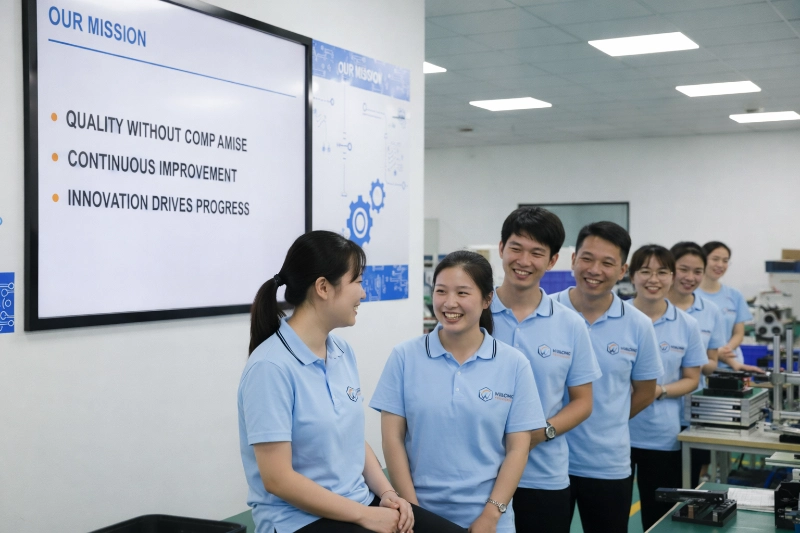
Weilong Solenoid Company Culture