How to choose a compact tubular solenoid for your project needs?
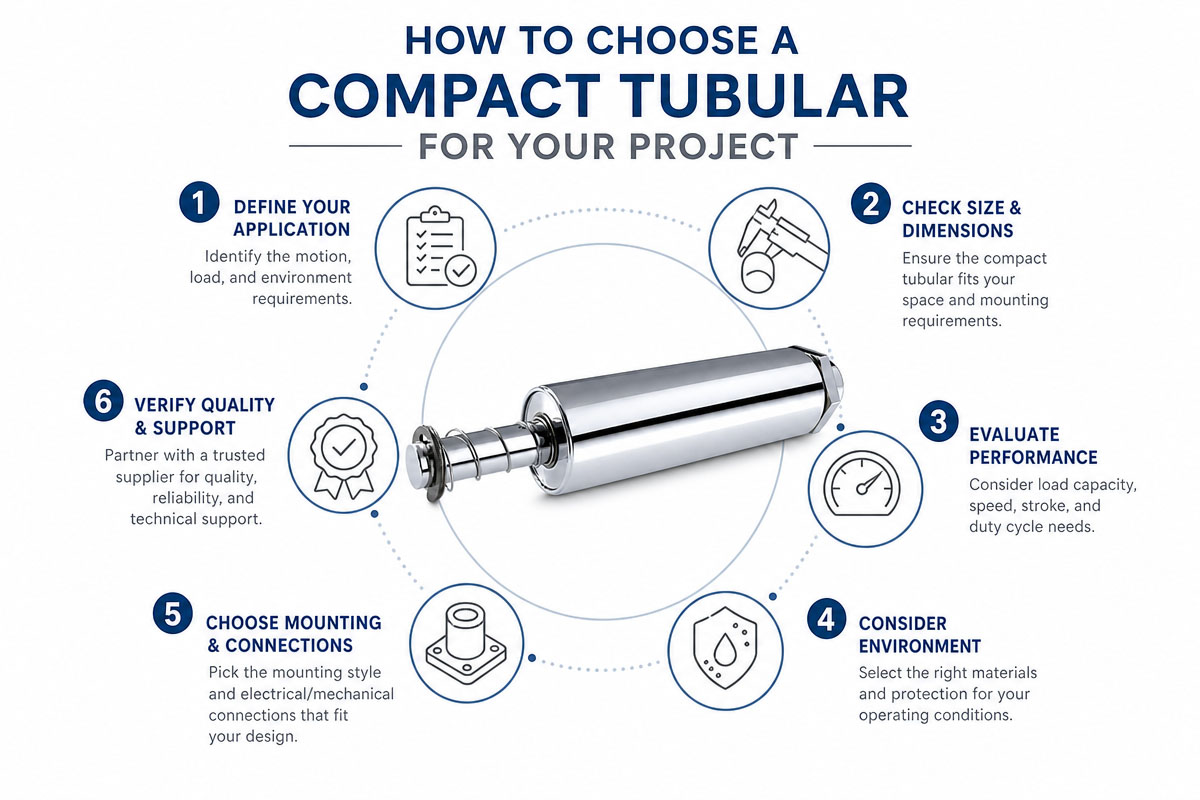
Selection of the right compact tubular solenoid is not just selection of voltage and physical dimensions. The right actuator must be chosen based on the total requirements of the application: mechanical, electrical, thermal, and environmental.
1. Find the force needed
Evaluate the minimum force required at the actual working stroke. Pull and push forces can be very different, so in case of necessity, specify both.
2. Stroke length definition
Identify the stroke length (the distance the plunger travels). The available force usually changes depending on the stroke length and may require a different magnetic circuit.
3. Check operating voltage.
Specify the actual power supply, e.g., 24 VDC or other voltage. Also identify voltage variations that are acceptable.
4. Check the duty cycle.
Define if the solenoid operates continuously or periodically. More power will generate a lot of heat while continuous operation.
5. Consider response time
If your application requires fast automation cycles, specify energizing and release response times.
6. Installation space evaluation
Identify the overall diameter, length, mounting position, shaft size, connector position and available clearances. Smaller actuator does not always mean that it can provide the necessary force.
7. Define the return mechanism
Specify if the design requires return spring, gravity return, external load or any other return mechanism.
8. Consider environmental factors
Operating temperature, humidity, dust, vibration, corrosive environment and possibility of fluid contact must be taken into account.
9. Determine the service life
Specify the required number of operational cycles. The lifetime testing of industrial equipment must be representative for the actual load, stroke, voltage and duty cycle.
10. Discuss personalization early in the design
For OEM applications, provide the manufacturer with a 2D drawing, 3D model, force/stroke requirements, voltage, duty cycle, installation constraints, and target lifetime. It allows the supplier to optimize the design of the electromagnetic and mechanical part of the device rather than just adapt existing standard products.
Tips to Avoid Common Design Mistakes
There are several design mistakes that can reduce the performance of a compact tubular solenoid or increase the development cost.
Pitfalls to avoid
1. Voltage selection only
Since the machine works on 24 VDC, it does not automatically mean that it is a good match for a 24 VDC solenoid. Also the stroke, duty cycle, power, and force must be matched.
2. The real blow: neglecting the force
Always consider the force at the required working position, not only the initial pull force.
3. Too much power
More is not always better in the matter of watts. Excess power can cause the rise of temperature and reduction of coil life.
4. Ignoring duty cycle
The solenoid designed for intermittent duty cycle can overheat during continuous operation.
5. Inadequate mechanical clearance
Check the full travel of the plunger, the shaft extension, the mounting tolerance and the surrounding parts.
6. Tolerance stack-up
Remember that the housing, shaft, mounting holes and machine components must be with the appropriate dimensional tolerances.
7. Heat dissipation is ignored
Compact medical or automation equipment can trap the heat near the actuator.
8. Only unloaded operation test
The performance must be tested under real mechanical load and working conditions.
9. Free-plunger magnetic analysis
The magnetic performance is directly related to plunger dimensions and materials.
10. Waiting too long to call the manufacturer
Early discussion with the manufacturer will help to avoid costly tooling and redesigning problems.