Machine Holding Magnet for Industrial Equipment Tools
Machine Holding Magnet for Factory Equipment and Use
Machine Holding Magnet for Fixtures and Machine Tools
Machine Holding Magnet Features for Industrial Applications
Machine Holding Magnet for Workshop Machine Fixtures
Machine Holding Magnet for Automated Equipment Systems
Machine Holding Magnet for Industrial Equipment Tools
Machine Holding Magnet for Factory Equipment and Use
Machine Holding Magnet for Fixtures and Machine Tools
Machine Holding Magnet Features for Industrial Applications
Machine Holding Magnet for Workshop Machine Fixtures
Machine Holding Magnet for Automated Equipment Systems

WL18063 Machine Holding Magnet for Heavy Duty Equipment Systems

A machine holding magnet is a convenient magnet solution used to firmly and precisely hold ferromagnetic parts and workpieces on machines. Its use helps producers to increase the accuracy of workpieces’ positioning and improve the efficiency of production process. Machine holding magnets can be used in CNC machines, automated machines, manufacturing fixtures, production lines and other machines. There are two types of magnets: electromagnets and permanent magnets, depending on the magnetic technology used. There are several factors to take into account while selecting a machine holding magnet: holding force voltage dimensions duty cycle operating temperature mounting method workpiece material Correctly selected machine holding magnet makes it possible to reduce demands for mechanical clamping and make the fixture simpler.

Machine Holding Magnet Description

Machine holding magnet is a magnet used for holding ferromagnetic materials on a machine. Machine holding magnets can be found on industrial machines, fixtures, workholding equipment, automated machines and production lines. Depending on the type of machine holding magnet there can be either magnetic holding force or magnetic holding force generated by electromagnetic coil. Electromagnetic machine holding magnets can be switched on and off by electricity; permanent types have constant magnetic holding force. Machine holding magnets have compact construction, can provide repeatable positioning and fast operation. They can be found in different sizes and configurations.

How Does A Holding Magnet Machine Operate?

An attraction between magnet and ferromagnetic material takes place in magnetic field between pole surface of a magnet on the machine and a ferromagnetic workpiece or machine part.

In electromagnetic machine there is a current passing through a coil of the magnet. As a result, the magnetic field is created, concentrated by the pole structure and creates an attracting force for a steel or iron member. Removing power causes reduction or elimination of magnetic field that releases the workpiece.

Main steps of operation:

Proper mounting of the magnet to the machine or fixture.

Suitable ferromagnetic member is put against the magnetic surface.

Power supply to the electromagnetic coil (if it is an electromagnetic machine).

Production of a magnetic field.

Pole face and magnetic core permeation by magnetic flux.

Firm pressing of the workpiece against the magnet.

De-energizing of the magnet in case of workpiece release.

The actual force depends on air gap, material thickness, contact area, surface condition, magnetic circuit design, voltage and temperature.

Machine Holding Magnet Video

Machine Holding Magnet Detail Display

Machine Holding Magnet Technica

Brand Weilong Technology Model Number WL18063
Rated Voltage (V) DC 12V or 24V Rated Power(W) 10-50W
Work Mode: Power on, Magnet on Holding Force (N) 1500 Kgs
 working duty 100% Resistance 100  Ω
Service Life 100 Thousand Times Certification CE,ROHS,ISO9001,
Material Superior Magnet Carbon Steel Housing Lead Wire Length(mm) 50 MM
Install Style Screw Hole Tolerance of Dimension  +/-  0.1 MM
Water-proof  None Insulation Class B
Hi-Pot Test AC 1200V 100/120Hz 2s Non-excitation Holding Force 0
Working Temperature -10°C-100°C Duty Cycle 1-100%
Thread Depth(mm) / Payment Term TT, or LC At Sight
Sample Order Yes Warranty 2 Year
MOQ 3000 pcs Supply Ability 5000 pcs per Week
Delivery Time 30 Days Port of Loading shenzhen

The Rise in Popularity of the Magnet Holding Machine

Nowadays manufacturers seek for faster, cleaner and more flexible workholding and machine holding magnets gain popularity. Modern production equipment is highly automated and machine holding magnets can be easily integrated with PLCs, sensors, robotic systems and machine-control circuits.

Another factor is efficiency of production. Magnetic clamping reduces manual clamping and unclamping operations decreasing time of machine setup and workpiece loading. Compact magnetic design makes it possible to simplify fixture and free workspace.

CNC machining and automated manufacturing lead to increased demand for reliable machine holding solutions. For many industrial applications magnetic workholding is an attractive option as manufacturers require repeatable positioning and secure retention during repetitive production cycles.

In some fixture designs, machine holding magnets can reduce number of mechanical moving parts making it easier to operate and reduce maintenance requirements.

Customization is another factor in rising popularity of machine holding magnets. Manufacturers can design magnetic holding solutions according to customer’s requirements for dimensions, voltage, holding force, mounting and automation interface.

Overall, machine holding magnets provide compactness, controllability, repeatability and compatibility with automation. Proper designing and implementation of machine holding magnets improves manufacturing productivity, fixture flexibility and equipment performance.

Machine Holding Magnet Applications

Machine Holding Magnet Applications for Modern Industry

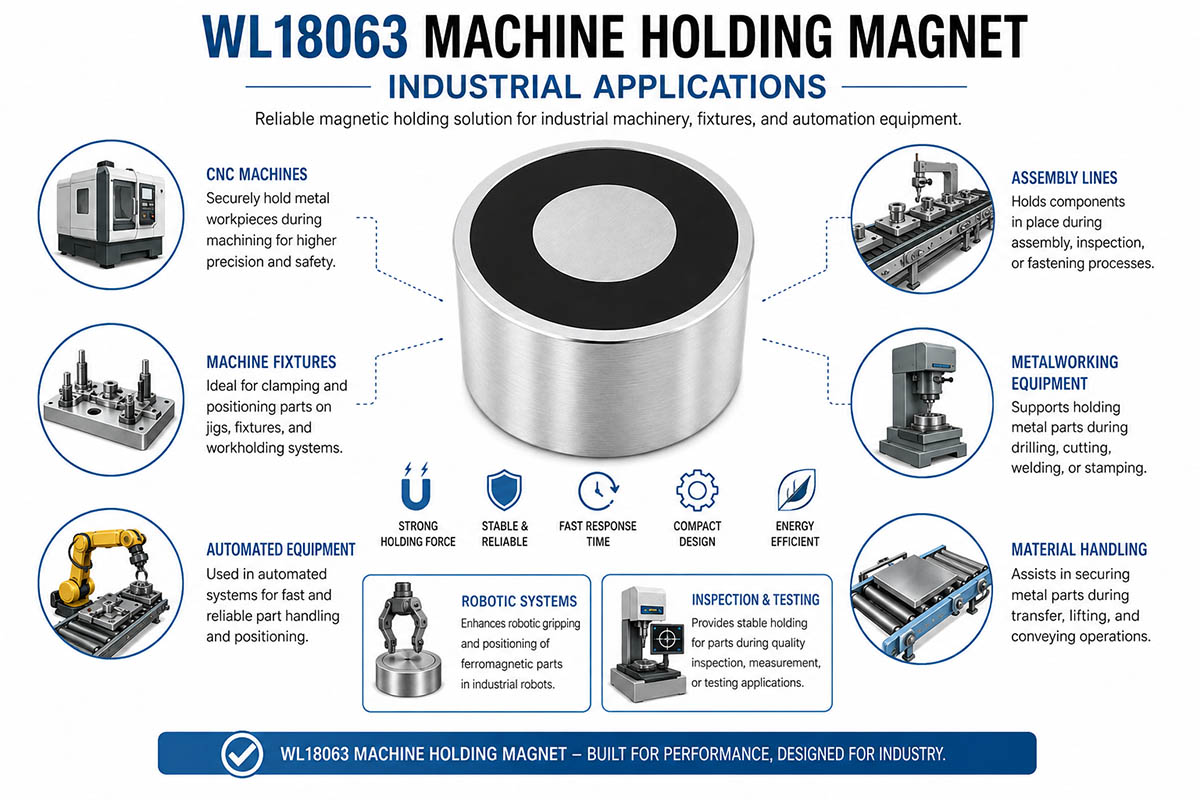
Machine holding magnets can be used in industrial environment for firm holding and positioning of metal parts. Machine holding magnets can help with positioning of machine fixtures, workpiece holding and positioning of a machine setup in CNC machining. Electromagnetic machine holding magnets can be included in control circuits of automated manufacturing systems for gripping and releasing parts in programmed sequence.

Machine holding magnets are helpful for machine operation where metal parts are held steady during assembly equipment operations such as drilling, fastening, welding, inspection or alignment. Machine holding magnets can be used in production-line fixtures where rapid workpiece loading and unloading increases efficiency of manufacturing.

Machine holding magnets can be used in metal fabrication for holding steel components during processing and positioning. Machine holding magnets can be included by manufacturers of industrial machinery in machine fixtures, robotic tooling, handling equipment and clamping systems of different tasks.

Machine holding magnets are also very suitable for material handling equipment, automated transfer systems, inspection machines, packaging machinery and industrial positioning mechanisms using ferromagnetic components.

Machine holding magnets for heavy duty application should be selected according to required holding force, weight of workpiece, conditions of contact, operating cycle, temperature, vibration and safety requirements. Machine holding magnets are designed in such way that they will work reliably and not overloaded and thermally stressed.

Machine Holding Magnet Adv. & Disadv

Machine Holding Magnet Advantages and Design Limits Use

Advantages and Disadvantages of Magnet Holding Machines

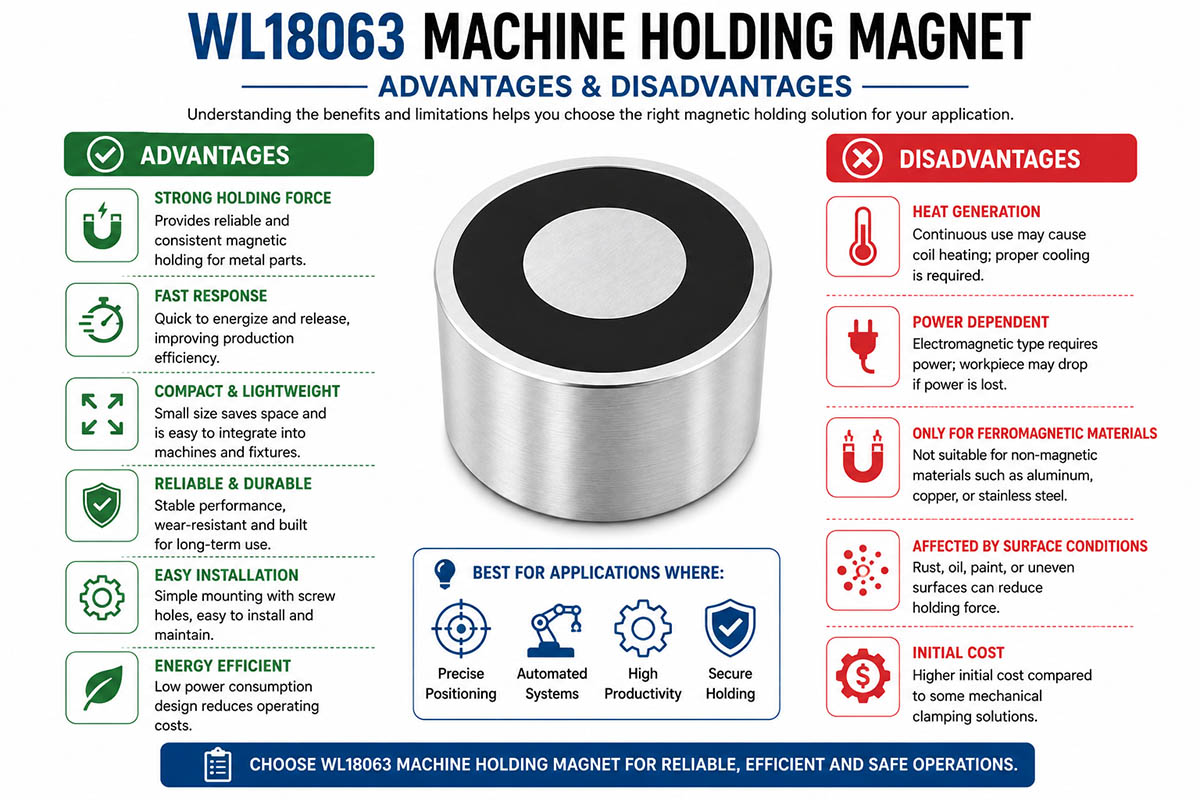
There are many advantages of magnetic holding device for industrial machines and automated workholding applications. Speed of operation is also one of the big advantages. Electromagnetic machine holding magnets can be engaged and released quickly reducing time of manual clamping. The magnetic holding provides compact solution that reduces time of building fixture and increases available workspace. The magnetic holding provides repeatable positioning and reduces number of mechanical clamps required. Integration with PLCs, sensors, switches and automation systems increases production efficiency.

One more advantage is less mechanical wear caused by fewer moving clamping components. Well-designed machine holding magnets have durability through repeated production runs and reliability in workpiece holding.

However, machine holding magnets also have some disadvantages. Magnetic holding force is highly dependent on workpiece material, contact area, surface condition and air gap. Traditional machine holding magnets are not very good in holding non-ferromagnetic materials. Electromagnetic machine holding magnets require electrical power and produce heat during operation. The release can happen due to power failure unless a suitable fail-safe or backup system is provided.

Machine holding magnets can attract unwanted metal chips and should be cleaned regularly. High temperatures, corrosion, vibration, improper installation can reduce performance of the magnet. Thus, the advantages are realized in case of correct selection, installation, control and maintenance of the magnet for particular application.

Machine Holding Magnet Design and Industrial Use Guide

Troubleshooting Machine Holding Magnets

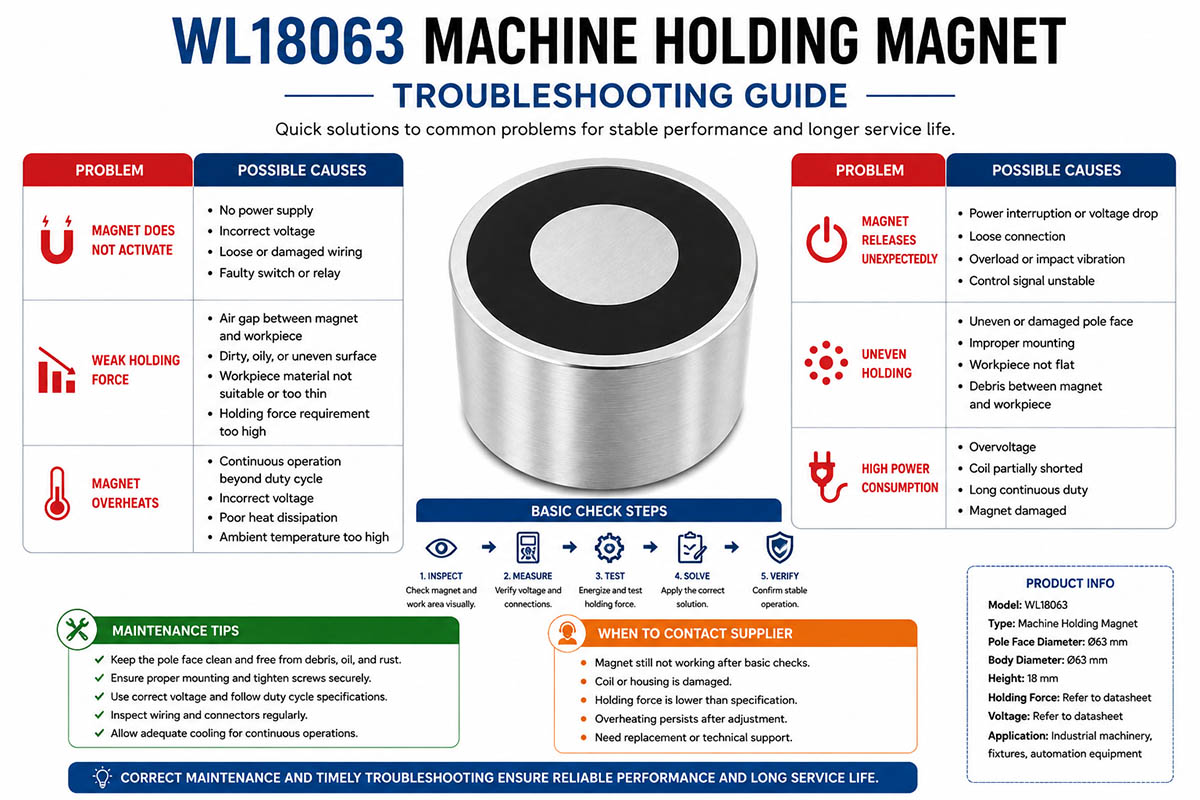
If a machine with magnets is not working properly, start with electrical system checking, and then check mechanical and magnetic conditions.

Weak holding force Check that the workpiece is made of ferromagnetic material. Check contact surface for rust, paint, oil, chips or other foreign matter. Small air gap can greatly reduce the magnetic force. Check that the workpiece is of sufficient thickness and contact area.

If the magnet is not activating, check the power supply, wiring, connectors, switches, relays and control signals. Supply voltage should match the rated voltage of the magnet. Check the coil for burns or electrical damage.

Machine magnet gets too hot Check duty cycle and operating voltage. Operation above rated value continuously leads to overheating of the coil. Ensure that the magnet has enough cooling and that surrounding equipment does not add extra heat.

Magnet turns off unexpectedly Check power supply for voltage dips or outage. Check control-system signals and connections. For safety-critical applications, ensure that the system has appropriate secondary retention or fail-safe design.

Uneven holding Check mounting surface and pole face for mechanical damage or contamination. Ensure that the magnet is flat on the work piece.

If the problem persists, compare the actual operating conditions to the manufacturer’s specifications and have electrical and mechanical testing done by a professional.

FAQ

What is a machine holding magnet?

Machine holding magnet is a magnetic device that holds, positions and stabilizes ferromagnetic materials, machine parts and fixtures during industrial processes.

How does machine with magnet function?

The magnet generates a magnetic field when the electric current passes through the coil of an electromagnetic machine. This magnetic field attracts proper metallic parts to and clamps it against the pole surface of the magnet.

Application of Machine Holding Magnets

Machine holding magnets find applications in various sectors like:
Machine holding magnets are used in various sectors including CNC machines, industrial fixtures, automatic machines, assembly machines, production lines, machining machines, robots and material handling.A magnetized machine can attract any ferrous or magnetic material.

Most machine holding magnets are suitable for ferromagnetic materials such as iron and many steels. The performance of holding power will depend on magnetic characteristics of the material, thickness, surface condition and contact area.

What should be considered when selecting machine holding magnet?

The following factors are important when choosing a machine holding magnet: required holding force, type of workpiece material, dimensions, air gap, operating voltage, duty cycle, temperature, mounting process, environment and control requirements of the machine.

My machine holding magnet loses its holding power, why?

Air gap, dirty or uneven contact surfaces, unsuitable workpiece material, insufficient power supply, overheating, improper installation and operating beyond rated specifications of the magnet are possible causes.

Can machine with magnet run continuously?

Some electromagnetic machines are continuous duty types, whereas others are intermittent duty types. Ensure that your machine meets all the voltage and temperature ratings of the magnet prior to continuous operation.

How to service a machine with magnet?

Ensure that the magnetic contact surface is clean, inspect the wiring and mounting hardware regularly, prevent overheating, get rid of attracted metal, do not overheat, do not exceed voltage rating, etc.

How to Choose a Machine Holding Magnet

The choice of a machine holding magnet should be based on operating environment and not only holding force as claimed by a magnet.

1.Determine the holding force needed.

Determine the weight and acting forces of the workpiece. Take into account acceleration, cutting forces, impact, movement, vibration. Instead of operating always at the maximum capacity of the magnet, select an appropriate safety margin.

2.Check material of workpiece.

Machine holding magnets work best with ferromagnetic materials like steel or iron. Stainless steel and other alloys have different magnetic properties. Check the actual material of the workpiece.

3. Determine contact surface.

Magnetic holding performance is highly dependent on surface flatness and cleanliness. Paint, rust, oil, chips, uneven surface and air gap can affect the magnetic force. What seems to be strong magnet in laboratory may not pull with such force in the machine.

4. Choose the right voltage.

For electromagnetic machine holding magnets select magnet rated voltage which matches voltage of the available control-system. There are various voltages in many industrial systems and you should check electrical compatibility.

5. Consider the duty cycle.

Will the magnet be permanent or pulsed? If you run it continuously you can heat the electromagnetic coil. You should select a magnet which is appropriate for duty cycle and temperature conditions.

6. Verify physical dimensions.

Check for available mounting space, bolt pattern, magnet height, pole-face dimensions, cable location and clearance to moving machine parts.

7. Consider the environment.

Temperature, humidity, dust, oil, vibration, coolant and corrosive substances affect performance and service life. You should select the proper housing and protection for the application.

8. Consider release requirements.

In case of quick electrical release it is better to choose electromagnetic machine holding magnet. If you want to hold the workpiece without power, then you should select a permanent magnetic magnet.

 9.Consider control integration.

Make sure that the magnet works correctly with relays, PLCs, sensors, switches and safety circuits used by the machine.

10. See manufacturer specifications.

Before purchasing make sure that the magnet has the rated force, voltage, dimensions, temperature, mounting arrangement and expected life according to the actual machine requirements.

Tips for Avoiding Common Mistakes in Machine Holding Magnet Design

Don’t choose a magnet based on the max holding force.

Don’t forget about the actual workpiece material and magnetic properties.

Don’t consider the rated holding force as constant in the presence of an air gap.

Keep magnetic contact surfaces clean and properly aligned.

Ensure adequate safety margin for vibration and dynamic loading.

Please make sure the magnet has the correct operating voltage if you are connecting an electromagnetic model.

Don’t forget about the continuous operation coil heating.

Don’t install the magnet where surrounding machine parts can interfere with the magnetic circuit.

Mounting bolts and structural supports should be checked for full loading.

Don’t forget about the corrosion, coolant, dust, oil, temperature in the design.

Consider the requirements for emergency release.

Make sure magnet is compatible with PLC and machine-control systems.

Route the cable to avoid mechanical damage.

Don’t run a magnet beyond its duty cycle.

Test the assembly in a real operating environment before going into full production.

Follow manufacturer’s dimensional and electrical specifications.

Use suitable secondary retention where necessary for safety-critical applications.

Get A Free Quote Now

Contact Form

Related Products

Related News

Scroll to Top

Get A Free Quote Now !

Contact Form
If you have any questions, please do not hesitate to contact us.
Weilong Solenoid Company Culture
