Ferrite Coil Antenna for AM Radio Applications
Ferrite Coil Antenna Performance Testing Methods
Ferrite Coil Antenna for Navigation Systems
Ferrite Coil Antenna Improves Signal Reception
Ferrite Coil Antenna Core Material Selection Guide
Ferrite Coil Antenna Troubleshooting Guide
Ferrite Coil Antenna for AM Radio Applications
Ferrite Coil Antenna Performance Testing Methods
Ferrite Coil Antenna for Navigation Systems
Ferrite Coil Antenna Improves Signal Reception
Ferrite Coil Antenna Core Material Selection Guide
Ferrite Coil Antenna Troubleshooting Guide

WL1225 Custom Winding Ferrite Coil Antenna for Industry

Ferrite coil antennas are compact magnetic antennas that are effective for the reception of signals in low and medium frequency applications. The antennas use precise copper winding and high-permeability ferrite core to focus the magnetic field and to increase the sensitivity in reception.

Compared to conventional wire antennas, ferrite coil antennas feature smaller size, improved electromagnetic performance and easier integration into electronic devices. They are widely used in AM receivers, wireless communication devices, RFID readers, navigation systems, industrial sensors and IoT products.

Ferrite coil antennas can be made according to the specific frequency range, inductance value, core size, number of winding turns and installation method. They are compact in structure and feature stable performance, so that they are suitable for applications where compactness, reliability and signal quality matter.

Ferrite Coil Antenna Description

A ferrite coil antenna is a highly sensitive magnetic antenna for the efficient reception of electromagnetic signals. It is made of a ferrite core and copper winding with the specific frequency and electrical performance. The ferrite material increases the magnetic sensitivity while keeping compact size. Ferrite coil antennas are produced in different sizes, frequencies and winding configurations for wireless communications, RFID, AM receivers and industrial sensors applications. They offer excellent signal performance, low power requirements and reliable operation and are the best choice for compact electronic devices and industrial communication systems.

How a Ferrite Coil Antenna Works?

A ferrite coil antenna works on the principle of electromagnetic induction. With the occurrence of radio-frequency magnetic field, the magnetic flux is concentrated in the ferrite core material. The changing magnetic field is transformed into the electrical signal by the copper winding on the ferrite core.

The ferrite core increases the magnetic permeability and allows the antenna to receive weaker signals in comparison with an air-core coil of the same size. The winding and the ferrite core together form an inductive circuit and can be tuned by capacitors in order to resonate at a specific frequency.

The ferrite coil antenna in the receiver application acts as a filter, increasing the desirable signals and reducing the interfering signals. Directional magnetic field response is also helpful for positioning and noise reduction.

Main Features of Ferrite Coil Antenna

The main features of ferrite coil antennas are high magnetic sensitivity, compact size, low power consumption and good frequency selectivity. The ferrite core allows to concentrate the magnetic flux and to increase the sensitivity despite the small size of the antenna. They are reliable in low frequency and medium frequency communication systems. Other features include light weight,customizable winding design, stable electrical performance and interference resistance. Ferrite coil antennas are produced from different core materials, wire specifications, inductance values and frequency ranges for meeting the specific application requirements. These features help ferrite coil antennas to become implemented in wireless receivers, IoT devices, industrial sensors and communication equipment.

WL1225 Ferrite Coil Antenna Video

Ferrite Coil Antenna Detail Display

Ferrite Coil Antenna Data Sheet

Item Description
Ferrite Coil Inductor Enameled copper wire
Wire Diameter 0.2 (AWG options available)
Winding Type Single-layer round or sectional  winding
Core Material  Magnetic Rod
Footprint length 25 mm
Encapsulation Optional varnish, epoxy, or coating
Mounting Through-foot / Custom

Electrical Specifications (Typical)

Parameter Description
Inductance Range 0.1 µH – 100 µH (customizable)
Inductance Tolerance ±2%, ±5%, ±10%
DC Resistance (DCR) Custom
Q Factor High Q, optimized for frequency range
Self-Resonant Frequency High, application-dependent
Operating Frequency kHz to MHz range
Rated Current Custom per design
Insulation Resistance ≥100 MΩ

Why Is The Ferrite Coil Antenna Getting So Popular?

The ferrite coil antennas become increasingly popular due to the growing requirements of electronic devices to smaller, more efficient and reliable wireless communications solutions.

The rapid development of IoT devices, smart sensors, automotive electronics, RFID technology and industrial automation drives the demand for miniaturized antenna elements.

Ferrite coil antennas provide high magnetic sensitivity and very low space requirements. They are perfect for battery-powered devices due to the low power consumption. The possibility of customization of frequency range, size, winding design and electrical performance allows to incorporate them in a variety of products.

With the further development of wireless technologies, ferrite coil antennas remain an important solution for low-frequency communication, identification systems and industrial electronic applications. The combination of compact size, stable performance and cost-efficiency will drive the market development.


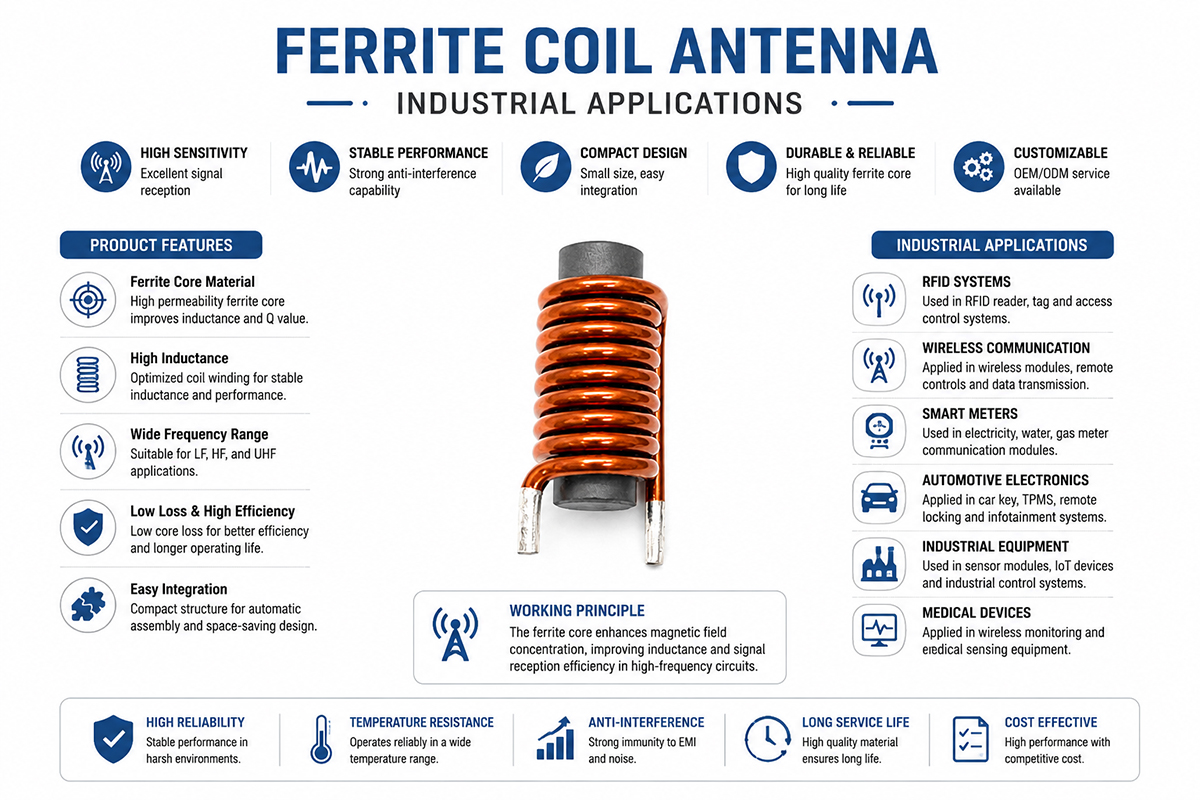
Ferrite Coil Antenna Applications

Ferrite Coil Antenna for RFID Applications


Uses of ferrite coil antenna

There are numerous commercial applications for ferrite coil antennas for the reliable wireless signal reception in industrial and consumer electronic market.

1. AM Radio Systems

AM radios use ferrite coil antennas. They have great sensitivity and directional reception in small form factors.

2. RFID & Access Control

They are used in RFID readers, smart cards, electronic locks and identification systems for short distance wireless communication.

3. Internet of Things devices

Compact and energy-efficient, ferrite coil antennas are used in smart meters, environmental sensors and low-power wireless devices.

4.Automotive Electricals

Ferrite coil antennas are used in vehicle keyless entry systems, tire pressure monitoring systems and navigation systems.

5. Automation Industry

In factories, ferrite antennas are used in wireless sensors, monitoring systems and machine communication systems requiring stable signal reception.

6.Electronic Consumer

Ferrite coil antennas are used in portable receivers, smart appliances and electronic devices for their compact design and reliable performance.

Ferrite coil antennas remain an important solution for modern wireless electronic systems due to their excellent magnetic field reception and customizable nature.

Ferrite Coil Antenna Advantage and Disadvantage

Ferrite Coil Antenna Applications in Communication

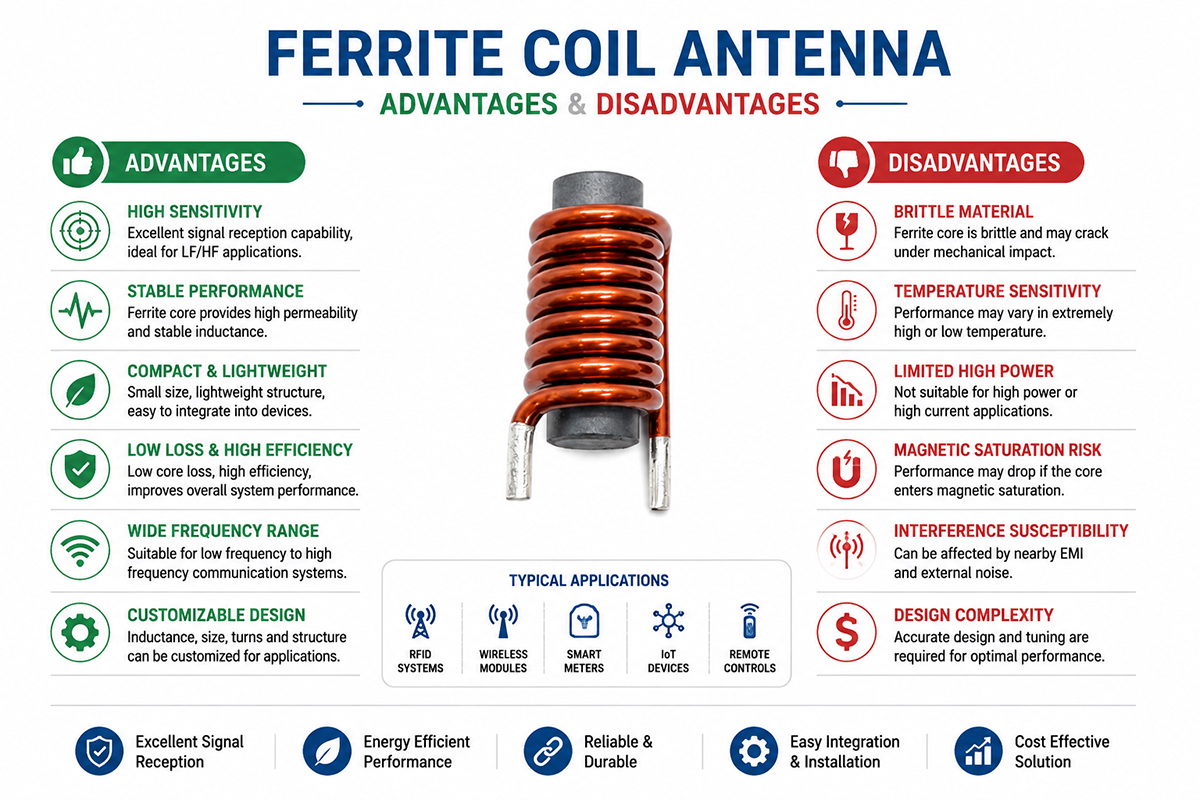
Advantages of Ferrite Coil Antenna

Ferrite coil antennas are extremely compact and provide excellent magnetic signal reception. The ferrite core helps to increase the concentration of the magnetic flux and provides higher sensitivity compared to air-core antennas of the similar size. They feature low power consumption, good directional properties and are easy to integrate into electronic products.

Other advantages include:

  • Small installation size

High frequency selectivity

  • Stable electrical performance
  • Low electromagnetic shielding •
  • Customizable and flexible options
  • Long service life

Disadvantages of Ferrite Coil Antenna

There are a lot of advantages of ferrite coil antennas, however, there are some disadvantages as well. The performance greatly depends on the quality of ferrite material and proper frequency matching. They tend to have a narrower bandwidth than some broadband antennas. The ferrite core is fragile and can be damaged by the mechanical impact.

Other limitations include:

Directional reception properties

  • Poor performance at incorrect frequencies
  • Sensitivity to the presence of metal objects nearby
  • Complex tuning requirements

These limitations can be overcome by the proper design and testing and provide reliable antenna performance.

Ferrite Coil Antenna Supplier Selection Checklist

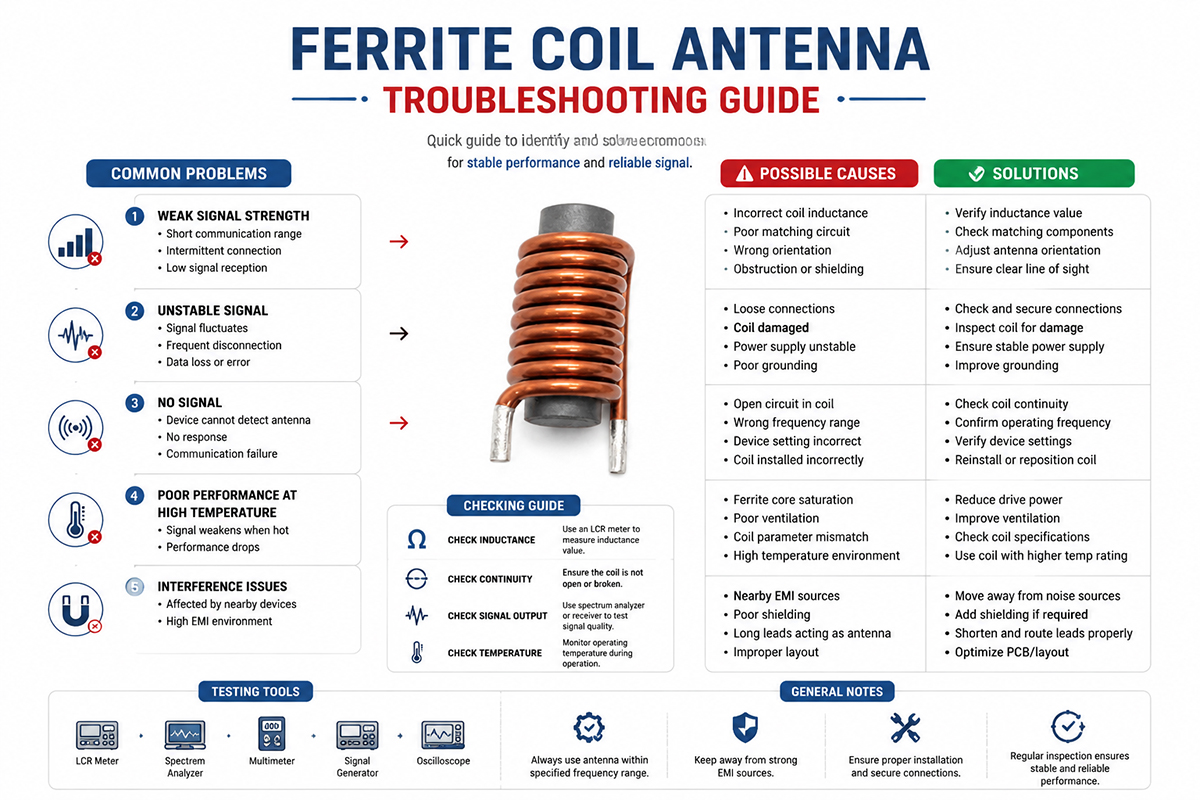
Troubleshooting of Ferrite Coil Antenna

The typical problems with ferrite coil antennas include poor signal reception, unstable performance, frequency mismatch and interference.

1.Poor Signal Reception

The possible causes: improper antenna orientation, damaged ferrite core, insufficient number of winding turns, poor antenna design.

2. Mismatch in frequency

If the antenna resonance is not tuned to the operating frequency, then the performance of the signal will be poor. Verify the values of inductance and tuning elements.

3.Big Noise

The noise can be caused by the electronic interference nearby. Improvements in shielding and antenna placement.

4.Diminished Sensitivity

The poor quality of winding or improper selection of ferrite material reduces the magnetic performance.

5.Mechanical injury

The ferrite cores are brittle and have to be handled carefully during assembly and transportation.

The regular testing of frequency response, inductance and receiving sensitivity will help to detect the problems in time and maintain the reliable operation of the unit.


FAQs

1. What do you use a coil antenna for?

A  coil antenna is mainly used for the reception of electromagnetic signals in low frequency (LF) and medium frequency (MF) applications. They are widely used in AM radio, RFID systems, wireless sensors, smart meters, automotive keyless entry systems, industrial communication equipment and IoT devices. The ferrite core concentrates the magnetic field, so that the antenna can receive signals efficiently while being small in size.

2. Why is ferrite used in an antenna?

The ferrite is used due to the high magnetic permeability and good electromagnetic properties. The magnetic flux is concentrated around the winding by the ferrite core resulting in the increased sensitivity of the signal compared to the air-core coil of the similar size. The ferrite materials also have good frequency stability, low power losses and better interference resistance and are suitable for small electronic devices.

3. What are the benefits of a coil antenna?

The benefits of  coil antennas include:

  • Lightweight and Small
  • High sensitivity reception
  • Good directionality
  • Low power consumption
  • Very good frequency selectivity
  • Reduced electromagnetic interference
  • Easy to incorporate into electronic products
  • Electrical parameters and size are customizable

These features make ferrite coil antennas attractive for industrial and consumer electronics applications where the space is limited.

4. How does a ferrite coil improve reception?

The ferrite coil antenna improves the signal reception using the high permeability of the ferrite material to concentrate magnetic energy around the coil winding. The antenna is hit by the electromagnetic wave creating an electrical signal due to the electromagnetic induction from the changing magnetic field. The ferrite core enhances the magnetic field in the coil, allowing the antenna to receive weaker signals.

5. How do I choose the right coil antenna?

You should choose the right coil antenna taking into account the following aspects:

  • operating frequency range
  • Required receiving sensitivity

Ferrite core material

  • Core size and shape
  • Value of inductance

Number of winding turns

  • Wire Diameter
  • Installation space
  • Environmental conditions

For industrial applications the engineers have to consider temperature stability, mechanical strength and long-term reliability.

6. Yes, ferrite coil antennas can be customized.

Are ferrite coil antennas customizable for OEM and industrial use? The manufacturers can customize:

  • Ferrite rods length and diameter
  • Ferrite material type
  • Construction of the coil winding
  • Wire gauge
  • Value of Inductance

Frequency spectrum

Mounting method

  • Connector design

The performance of the antenna can be optimized for different communication systems and electronic products by the custom design.

7. What makes a ferrite coil antenna perform poorly?

The common reasons for the poor performance of ferrite coil antennas include:

  • incorrect frequency match of operation
  • Incorrect winding turns
  • Wrong choice of ferrite material
  • Bad antenna location
  • Near metal interference
  • Electrical noise from adjacent circuits
  • Ferrite core broken
  • Wrong choice of tuning capacitor

The proper design, testing and installation will greatly improve the sensitivity and reliability of the antenna.

8. What companies use ferrite coil antennas?

Ferrite coil antennas are used in a variety of industries, including:

Automotive electronics : Keyless entry, vehicle sensors and communication modules

  • IoT systems: smart meters, wireless sensors, monitoring devices
  • Industrial automation: machine communication and control systems
  • RFID technology – identification, access control and tracking systems

Consumer electronics: radios, portable receivers, smart devices

  • Medical equipment Electronic equipment and wireless monitoring
  • Telecommunication systems: Receiving of signals for data and communication equipment

Ferrite coil antennas are an important component in modern wireless technology due to the small size, high sensitivity and reliable performance.

How to Choose a Ferrite Coil Antenna

The selection of an appropriate ferrite coil antenna plays a crucial role in ensuring reliable performance, high sensitivity and stability of the signal reception for your electronic device. Ferrite coil antennas are used in AM radios, RFID, wireless sensors, smart meters, IoT, navigation devices, and other industrial communication systems. There are several key factors that should be considered when choosing a ferrite coil antenna:

1.Determine the Frequency Range

Firstly, you should identify the necessary frequency range for the application. Ferrite coil antennas are mainly used for LF, MF, and HF communication systems. By changing inductance, number of coil turns and ferrite material it is possible to adjust the antenna for optimal operation on a particular frequency.

2.Select the Suitable Ferrite Material

Different ferrites have different magnetic permeability, frequency responses and losses. Ferrite cores with high permeability are recommended for low-frequency applications since they increase the magnetic field concentration and sensitivity. Low-loss ferrites should be used at high frequencies to maintain high efficiency of the antenna.

3.Antenna size and installation place

The size of the ferrite antenna should be compatible with the available space for installation. Longer ferrite rods have high sensitivity and good reception. On the contrary, shorter antennas are recommended for portable electronic devices.

4.Check the specifications

Electrical specifications include inductance value, Q factor, impedance, operating voltage, temperature stability, and sensitivity. High Q factor usually leads to better selectivity and reception of the signal. It is important to match the antenna with the circuit to minimize signal losses.

5.Consider the customization of ferrite antenna

If the standard ferrite coil antennas do not meet the requirements of your application, customization is a good option. The following parameters could be changed: coil winding, ferrite size, frequency range, connector design and environmental protection. Customization services are offered by OEM manufacturers.

6.Pay attention to quality and reliability

High quality ferrite coil antennas should demonstrate reliable and durable performance. You should check the manufacturing and testing capabilities of your potential supplier.

Thus, taking into consideration such factors as frequency range, ferrite material, antenna size, electrical performance, customization, and quality you will be able to choose the most suitable ferrite coil antenna for your application.


How to Avoid Common Mistakes in Ferrite Rod and Coil Antenna Design

Don’t choose ferrite material only considering its physical size.

Don’t make wrong turns causing the frequency mismatch.

Don’t forget the adjustment of the resonance between the antenna and the circuit.

Don’t place the antenna near the sources of strong noise.

Insulate properly the winding wire.

Consider the effect of the temperature on the ferrite performance.

Test the antenna performance in real operational conditions.

Make sure that mechanical mounting doesn’t influence the magnetic performance.

Get A Free Quote Now

Contact Form

Related Products

Related News

Scroll to Top

Get A Free Quote Now !

Contact Form
If you have any questions, please do not hesitate to contact us.
Weilong Solenoid Company Culture