Custom Metering Valve Solenoid for Industrial Equipment
High Precision Metering Valve Solenoid Manufacturer
How to Choose the Right Metering Valve Solenoid for your project need
Metering Valve Solenoid vs Standard Solenoid Valve
Metering Valve Solenoid for Fluid Control Applications
Advanced Metering Valve Solenoid Technology Explained

Industrial Metering Valve Solenoid Complete Guide 2026

The metering valve solenoid is the precision electromagnetic actuator which is used for controlling of the fluid flow, dosing and positioning of the valve in industrial processes. Solenoid creates a controlled magnetic field that accurately moves the valve mechanism for achieving the precise fluid flow regulation.

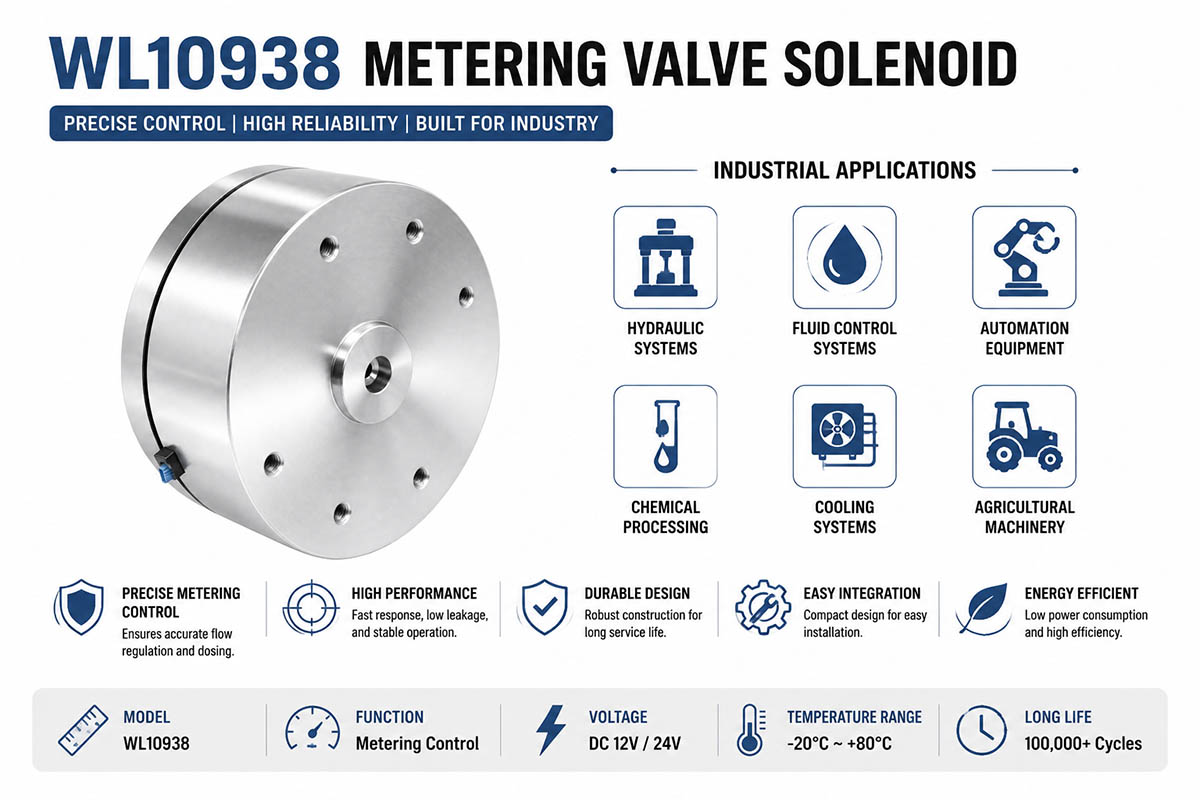
The metering valve solenoids are designed for harsh conditions and have fast response, compact design, low energy consumption and high reliability. They are widely used in automated equipment, chemical processing systems, cooling systems, agricultural machines, hydraulic control devices.

The modern solenoids for metering valves can be customized according to the voltage, force required, stroke, duty cycle, operating temperature and installation space. Because of the precise control the solenoids are perfect for industries which need accurate fluid control and efficient operation.

Industrial Metering Valve Solenoid Product Overview

Metering valve solenoid is an accurate actuator for industrial valve control applications. Electromagnetic and sophisticated mechanical technologies are incorporated into this product to provide accurate and reliable flow regulation. The product is offered in customized voltage, force, stroke and mounting versions to meet the different applications.

The metering valve solenoid is designed to be robust, magnetically optimized and durable for reliable operation under challenging conditions. The metering valve solenoid is an optimal choice for automation equipment, fluid control systems, dosing machines, chemical process control equipment and industrial machinery requiring accurate and repeatable valve control.

How a Metering Valve Solenoid Works?

The operation of the solenoid metering valve is based on electromagnetic conversion.

When the electric current passes through the coil it generates the magnetic field around it. This magnetic force attracts or repels the plunger and makes linear mechanical movement.

The movement of the plunger controls the metering valve mechanism connected to it. Depending on the design of the solenoid the valve opening can be regulated to control the flow rate of the fluid, liquid dose or pressure.

The control system can vary the voltage, current or pulse signal to get the accurate position of the control. It guarantees the accurate dosing of the metering valve solenoid.

Key working process:

Electric signal is supplied to the coil.

The coil is the source of the electromagnetic force.

Plunger moves, magnetic attraction.

Valve changes opening.

Fluid flow is precisely controlled.

Main Features of Solenoid Metering Valve

The metrology valve solenoids are used for high precision control, fast response, compact design and reliable operation. Electromagnetic design allows precise metering valve movement and consistent fluid control. Main features of solenoid metering valves are custom voltage, optimized magnetic circuits, low power consumption, durable materials and long service life.

The advanced designs provide the excellent repeatability, stable force generation and compatibility with industrial automation systems. Solenoids for metering valves can be designed with various stroke, force, sealing design and environmental protection level.

Industrial Metering Valve Solenoid Video

Industrial Metering Valve Solenoid Detailed Display

Industrial Metering Valve Solenoid Datasheet

Brand Weilong Technology Model Number WL 10938
Rated Voltage (V) DC 12 or 38 V Rated Power(W) 10–100 W
Work Model  100 000 Lifespan Cycles Push PUll Force (N)  1-60N  at stroke distance of  0–2 mm
Stroke(mm) 3–10 MM Reset Time(s) 1 S 3S Off


Service Life 300 Thousand Times Certification CE,ROHS,ISO9001,
Material Carbon Steel Housing with Zinc Plated Coating Lead Wire Length(mm) 200
Install Style both side with three mounted Screw Holes for easy setting up Tolerance of Dimension  +/-  0.1 MM
Water-proof  None Insulation Class F  Cel.  150 Degree
Hi-Pot Test AC 600V 50/60Hz 1 s Non-excitation Holding Force 0
Working Temperature -10°C-100°C Duty Cycle 1-100%
Thread Depth(mm) / Payment Term TT, or LC At Sight
Sample Order Yes Warranty 1 Year
MOQ 500 pcs Supply Ability 5000 pcs per Week
Delivery Time 30 Days Port of Loading shenzhend

Why metering valve solenoids become popular?

The reason for the increased popularity of metering valve solenoids is the necessity of higher automation and energy efficiency in modern industries.

CANNOT BE accomplished with traditional manual valves, remote control capability, precision and repeatability. The metering valve solenoids allow integrating electronic systems, such as PLC controllers, sensors and intelligent machines for controlling the fluid flow.

As industries such as automation, medical devices, chemical processing, agricultural industry and smart manufacturing develop, there is an increased demand for precision control solutions.

The metering valve solenoids are also very popular with engineers all over the world due to other benefits, including compact design, fast response, low maintenance and possibility of customized design.

With the increasing connectivity and intelligence of industrial equipment, the metering valve solenoids will play more and more important role in precision fluid control systems.

Metering Valve Solenoid for Precision Flow Control Application

Metering Valve Solenoid For Industrial Control Solution Application

Metering valve solenoid is widely used in various industries where precise flow control and regulation is needed.

Chemical process control is assured through the regulation of precise amounts of chemicals, additives and liquids during manufacturing processes.

Metering valve solenoids are efficient control devices in industrial automation applications, including robots, production line and automatic dispensers.

Fluids’ flow and pressure are controlled in hydraulic systems with the use of metering valve solenoids, thus increasing efficiency of the system.

Precision metering solenoids are necessary in medical and laboratory instruments for liquid dispensing and analysis.

Flow of the refrigerant or coolant is regulated by the metering valve solenoid to maintain constant temperature in cooling systems.

Fertilizer, pesticides and irrigation fluids are distributed through the agricultural machines by the metering valve solenoid.

Metering valve solenoids are used in automotive applications for fuel control, emission control and special fluids management.

Modern industrial equipment is replacing the conventional mechanical valve controls with the metering valve solenoids because of the advantages such as small size, fast response and accuracy of the operation.

Industrial Metering Valve Solenoid advantage and disadvantage

Metering Valve Solenoid Advantage and Disadvantage

Industrial Metering Valve Solenoid Advantages

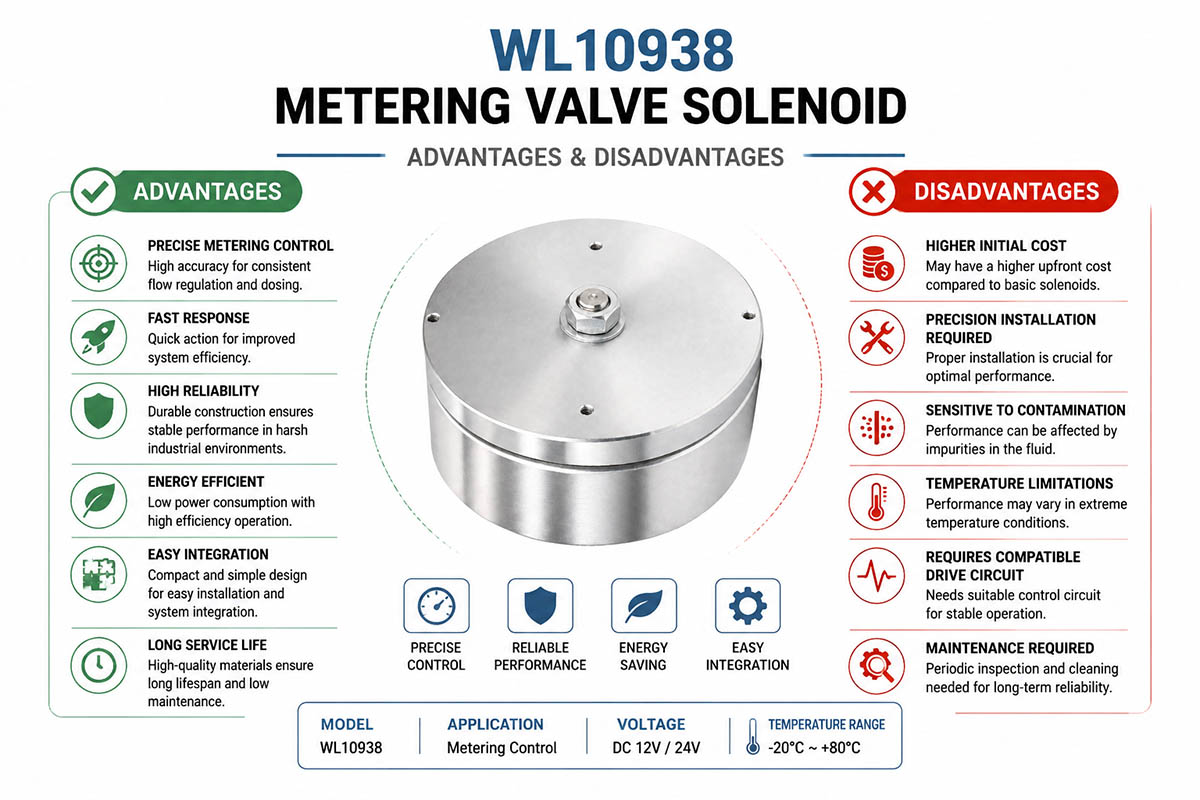
Metering valve solenoids provide much more precision than conventional mechanical valves. Their reaction speed is high, the operation based on electromagnetism is reliable and they can easily be integrated into an automated system of control.

The compact design saves space during installation and flexible design gives engineers the opportunity to adjust to the force, stroke and voltage requirements.

Other advantages include:

Precise dosing of liquids

Low energy consumption

High service life

Fast Switching Response

Manual adjustments reduced

Easy integration of PLC and electronics control

Industrial Metering Valve Solenoid Advantages Disadvantages

Metering valve solenoids have numerous advantages but have some disadvantages also.

First, the price of these solenoids is higher in comparison with the price of conventional solenoids due to high precision and complicated manufacturing.

They require electrical installation and appropriate control. The overheating may happen due to inappropriate voltage or high duty cycle.

The contamination of the fluid influences the work of the valve.

For some high force applications, larger solenoids are needed.

Therefore, the proper selection, installation and maintenance provide maximum performance.

Troubleshooting Metering Valve Solenoid

Metering Valve Solenoid Troubleshooting Guide for Users

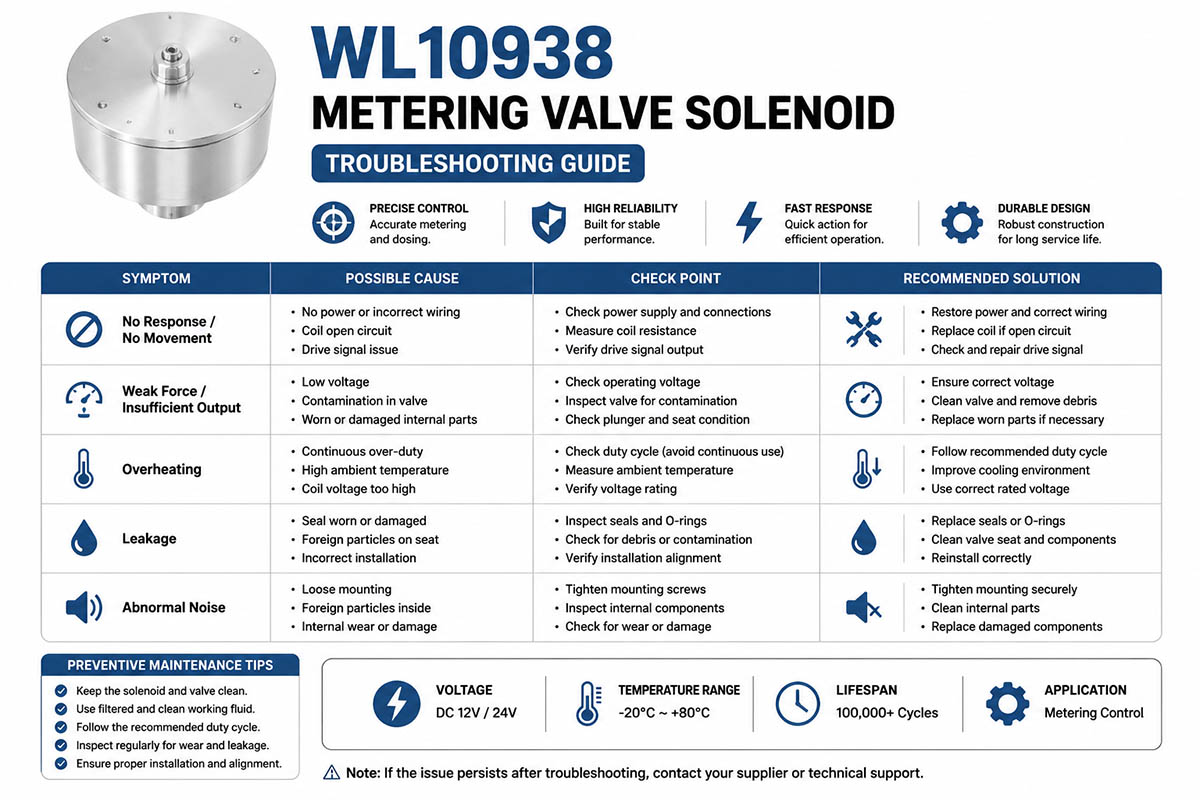
1. Trouble Shooting Solenoid

Reasons can be:

No power supply

Wiring problems

Coil damage

CONTROL SIGNAL ERROR

Solutions

Check voltage input, wiring connections and coil resistance.

2. Reduced valve motion

Reasons may be:

Low voltages,

Excessive load.

Contamination of the valve inside components

Solutions:

Check the operating voltage Clean the internal components of the valve.

3. Problema de sobrecalentamiento

Possible reasons: 1.

Constant operation beyond the rating

Wrong voltage

Bad heat transfer

Solutions:

Check the duty cycle and improve cooling conditions.

4. Dripping

Possible reasons:

Damaged seals

Foreign substances

Installation problems

Solutions:

Replace the seals and clean the valve components.

5. Unusual sounds

Possible reasons:

Loose mounting

Wear of mechanical components

Internal contamination.

Solutions:

Tighten the mounting screws and check the internal components.

With regular maintenance and correct operating conditions the lifespan of metering valve solenoids can be prolonged considerably.


FAQS on Industrial Metering Valve Solenoid

1. What is the purpose of a metering valve solenoid?

An industrial system uses a metering valve solenoid for precise control of fluid flow to dose volume or valve position. The electromagnetic force created by the solenoid moves the valve mechanism with high precision.

The metering valve solenoids are usually used in:

Equipment of injection of chemicals

Hydraulic control system

Cooling system

Medical devices

Industries of automation

Agricultural irrigation systems

Systems for fluid handling

In applications when the precise control of fluid is necessary, metering valve solenoids provide better accuracy and repeatability in comparison with conventional ON/OFF solenoids.

2. How does metering valve solenoid work?

A metering valve solenoid operates on the basis of the electromagnetic force of a coil.

When the electric current passes through the coil, a magnetic field arises that moves the internal plunger. Controlling the motion of the plunger, it controls the opening of the valve and thus the fluid flow, pressure or dosing volume.

The control system varies the voltage, current or electronic signals to obtain the precise valve position.

The basic principles of work include:

Electrical signal energizes the coil.

Magnetic fields create a pushing or pulling force.

Plunger moves in the magnetic circuit.

Variation of the valve opening.

Precise control of the fluid flow.

This principle of work provides the fast reaction and reliable operation.

3. What are the main advantages of a metering valve solenoid?

The main advantages of metering valve solenoids are:

Precision control – Precise dosing and flow adjustment.

Fast response – provides fast operation of the valve and increases the efficiency of the system.

Compact design – saves the space of installation in comparison with conventional actuators.

Low power consumption – The power consumption is decreased by the optimized coil design.

High service life – Durable construction that can endure thousands or millions of cycles.

Automation integration – Compatibility with PLC, sensors and industrial control systems.

These advantages make metering valve solenoids perfect for the modern automated industrial equipment.

4. What is the difference between metering valve solenoid and ordinary solenoid valve?

The main difference consists in precision of control.

While the standard solenoid valve is designed mostly for the ON / OFF operation, i.e. opening or closing the fluid channel.

The metering valve solenoid is designed for precise control. The movement, flow and dosing volume of the valve can be regulated.

Standard Solenoid Valve Metering Valve Solenoid

ON/OFF Variable control

Moderate High

Applications Easy fluid switching Flow and dosing control

Quick Fast and Controlled

Cost Lower Higher

The metering valve solenoids provide the best performance in applications requiring precise fluid contro

5. How do I choose the right metering valve solenoid for my application?

To choose the right metering valve solenoid, you should take into consideration the following parameters:

1. Supply Voltage

There are several options: DC 12V, DC 24V and custom voltage designs.

2. Required Power

You should calculate the force necessary to overcome the valve resistance, spring load and system pressure.

3. Stroke Length

Stroke should correspond to the necessary valve travel.

4. Duty cycle

Select the solenoid that is rated for 100% duty cycle for constant operation.

5. Environment

You should consider:

The temperature range

The humidity

Vibrations

Corrosion testing

Fluid contaminates

6. Lifetime Requirement

Industrial applications usually require long cycle life, e.g. 100,000 cycles or more.

The professional solenoid manufacturer will help to optimize the design according to the real requirements of the application.

6. Why does the metering valve solenoid become hot while the unit is running?

The frequent problem of the electromagnetic device is overheating caused by the conversion of electrical energy into magnetic force and heat.

The possible causes include:

Voltage is too high

The duty cycle is greater than the rated specification

Poor heat dissipation

Poorly designed coil

Operation of the device beyond the product rating (constant operation)

Solutions:

Check the input voltage.

Check the requirements for duty cycle.

Improve the ventilation or air conditioning

Select the solenoid with higher duty cycle

Select the correct coil spec.

The properly designed metering valve solenoid will operate without overheating in the range of rated temperature.

7. How can I extend the life of the service of metering valve solenoid

To prolong the service of the solenoid follow the recommendations:

Use the correct operating voltage.

Do not exceed the duty cycle as it was recommended.

Keep valve and fluid system clean.

Prevent the entry of foreign particles to the valve.

Install the solenoid according to the specifications.

Have the heating system checked and serviced regularly.

Select the right materials for harsh environment.

High quality metering valve solenoids with optimized magnetic circuits, durable materials and proper thermal management can work up to hundreds of thousands of cycles.

8. Can I customize the metering valve solenoid for special industrial purposes?

Yes, the metering valve solenoids can be customized for special industrial purposes.

The possibilities of customization include:

Voltage (DC 5V, 12V, 24V, 48V etc.)

Holding and pulling forces

Stroke Length

Mounting arrangement

Connector Type

Coils Design

Level of Protection

Temperature Operating Range

Special Materials or Coatings.

The custom design is widely used in the:

Industrial Automation Devices

Chemical Process Systems

Medical Devices

Hydraulic Engineering

Smart Manufacturing Systems

Cooperation with the experienced solenoid manufacturer will allow engineers to get the best balance of performance, reliability and cost.


How to Choose the Metering Valve Solenoid?

Choosing the right metering valve solenoid means paying attention to some technical aspects for assuring reliable operation.

1. Calculate Required Force

It is necessary to calculate the required electromagnetic force first. The solenoid should be capable to exert the force which overcomes valve resistance, spring force and operating pressure.

2. Check Stroke Length

Valve movement depends on the stroke. Longer stroke requires designing a larger solenoid, while shorter stroke applications can be satisfied by compact solenoids.

3. Choose Voltage

DC 12V, DC 24V and customized voltages are available. It is important to select voltage which corresponds to the control system.

4. Look at Duty Cycle

The solenoid should be designed for 100% duty cycle operation. Some applications might require intermittent operations allowing to design the solenoid with high force output and low duty rating.

5. Consider Operating Environment

Factors such as temperature, humidity, vibration and contamination are the factors which should be taken into account. Protection against corrosion should be considered in industrial environments.

6. Check Response Speed

Fast response applications require optimized magnetic circuitry and lightweight moving parts.

7. Compatibility of Check Valves

The valve assembly should be compatible with the solenoid mechanical interface, mounting, plunger and connections.

8. Consider Lifetime Requirements

Industrial equipment experiences thousands or millions of cycles of operation. It is necessary to select the product with high durability and reliable materials.

Experienced solenoid manufacturer will help to optimize performance, decrease development cost and find the best solution for your application.

Common Mistakes in Metering Valve Solenoid Designing

Faulty Force Calculation

The mistake made by many designers consists in choosing a solenoid only by size without taking into consideration the resistance, force of pressure and spring loading of the valve.

Overlook of Heat Generation

In case the power rating of the coil and duty cycle are not calculated correctly, there is a risk of overheating of the coil during the constant operation.

Incorrect Choice of Stroke

In case the stroke is chosen incorrectly, the valve won’t be able to fully open or fully close.

Inadequate Magnetic Circuit Design

A poor magnetic efficiency results in low force and large energy consumption.

Improper Material Choosing

Industrial conditions require appropriate materials to resist corrosion, high temperatures and wear.

No Prototype Testing

It is important to test prototypes before producing solenoids in mass production.

Overlook of the Maintenance

The solenoid should be easy to clean, change and maintain.

Get A Free Quote Now

Contact Form

Related Products

Related News

Scroll to Top

Get A Free Quote Now !

Contact Form
If you have any questions, please do not hesitate to contact us.
Weilong Solenoid Company Culture
