Bistable Latching Solenoid Automation Systems
Bistable Latching Solenoid Smart Valve Control
Bistable Latching Solenoid Process Automation
Bistable Latching Solenoid Energy Saving Systems
Bistable Latching Solenoid Automotive Systems
Bistable Latching Solenoid Industrial Machinery 0
Bistable Latching Solenoid Automation Systems
Bistable Latching Solenoid Smart Valve Control
Bistable Latching Solenoid Process Automation
Bistable Latching Solenoid Energy Saving Systems
Bistable Latching Solenoid Automotive Systems
Bistable Latching Solenoid Industrial Machinery 0

WL0837 Compact Bistable Latching Solenoid Guide

The Bistable Latching Solenoid is an advanced electromechanical actuator offering high performance and reliability for various challenging industrial applications. The main innovation in the product is the use of the permanent magnet in order to lock the armature in either of two possible stable states without any electrical power being consumed. The use of this “latching” technology reduces power consumption and heat generation of the latching solenoid significantly compared to traditional “on/off” solenoids that need to be constantly powered in order to retain their state. A single pulse of electricity changes the state of the bistable latching solenoid depending on the polarity of this pulse. The bistable latching technology makes this product an ultra-efficient and cool running part for battery-operated or remote control applications. The robust design ensures high reliability and long working lifetime. The product is perfect to be used in locking mechanisms, fluid control valves and automation systems where a stable state is necessary without a constant power draw.

Compact Bistable Latching Solenoid Product Overview

Our industrial-grade Bistable Latching Solenoids are designed for high performance and maximum energy efficiency. They come in two types (push/pull and rotary) and have a solid steel or stainless steel body and high conductivity copper coil. They are durable and work effectively on low voltage DC sources (usually between 3.6V and 24V). The built-in latching technology allows retaining the state of the plunger without power consumption, being suitable for remote or battery-operated systems. We provide our solenoids in a wide variety of sizes, strokes and mounting options making them perfect for automation, security, fluid control and automotive applications.


Compact Bistable Latching Solenoid Video

Compact Bistable Latching Solenoid Detailed Display

Compact Bistable Latching Solenoid Data Sheet

Brand Weilong Technology Model Number WL0837
Rated Voltage (V) DC 12V Rated Power (W) 10–20W
Push Pull Force 300 Gf Holding Force (N) 500 Gf
Stroke (mm) 3-5 MM Customized Working Duty 20%
Service Life 100 Thousand Times Certification CE, RoHS, ISO9001,
Material Superior Magnet Iron Lead Wire Length (mm) 200 MM
Install Style Screw Tolerance of Dimension  +/-  0.1 MM
Water-proof  None Insulation Class B
Hi-Pot Test AC 600V 50/60Hz 2s Non-excitation Holding Force 0
Working Temperature -10°C-100°C Duty Cycle 1-100%
Thread Depth (mm) / Payment Term TT, or LC At Sight
Sample Order Yes Warranty 1 Year
MOQ 1000 pcs Supply Ability 5000 pcs per Week
Delivery Time 30 Days Port of Loading shenzhen

How Bistable Latching Solenoid Works

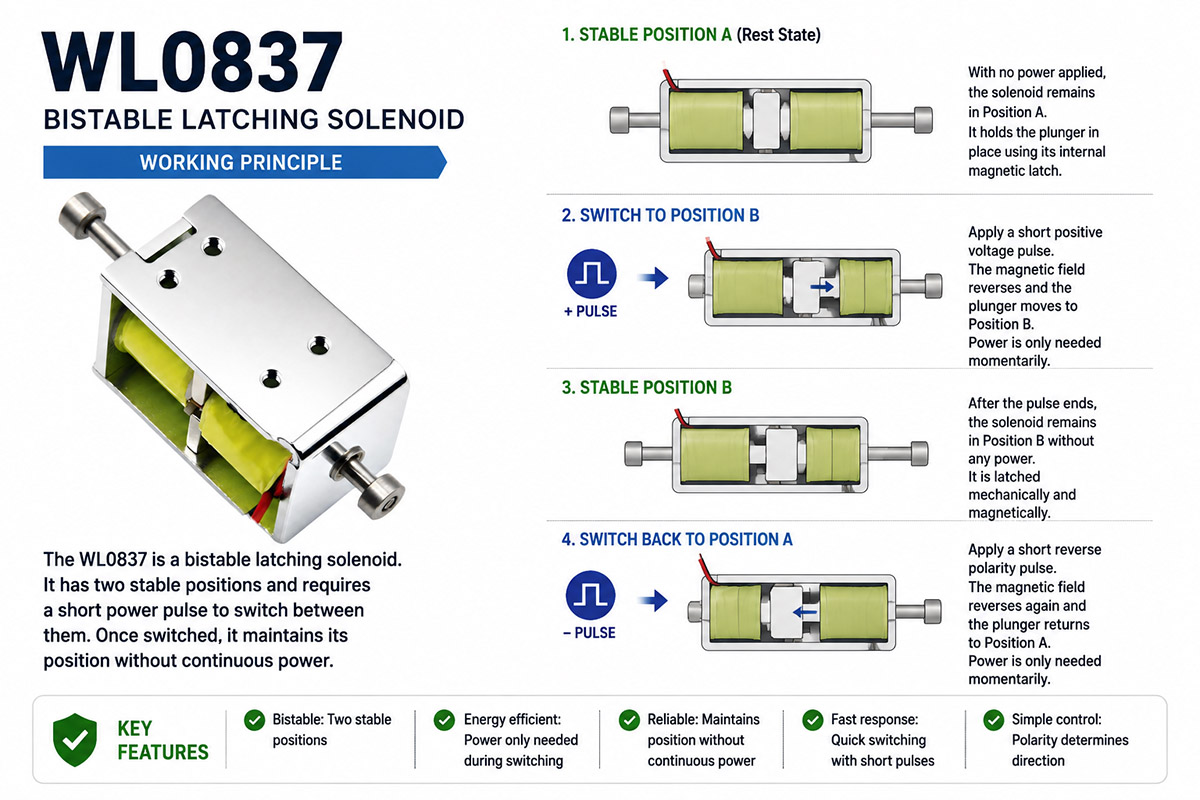
Bistable Latching Solenoid Working Principle

The bistable latching solenoid uses the combination of electromagnetism and permanent magnetism technologies. The bistable latching solenoid consists of the same parts as the conventional solenoid (the coil and the moveable plunger or armature) but includes a permanent magnet as well. The coil is supplied with a short electrical pulse to operate the plunger. This pulse creates a magnetic field which strengthens or weakens the field of the permanent magnet. In case the polarity of the pulse is right then the electromagnetic field will overcome the force created by the permanent magnet and draw the plunger to its second stable state. As soon as the pulse stops, the magnetic field disappears but the permanent magnet keeps the plunger firmly in the new position without power consumption. In order to return the plunger to the previous position the pulse of opposite polarity should be generated which will release the plunger and allow it to return. Thanks to this technology the bistable latching solenoid operates by changing its states with the use of short pulses (millisecond-long), being highly efficient in power consumption.

Features of Bistable Latching Solenoid

High energy efficiency: consumes power only during the pulse; zero power consumption to retain the state;

Two stable states (e.g. open/closed) retained by a permanent magnet without power;

Very low heat generation: when powered on the coil is active for a short period of time and has no chances to overheat;

Fail-safe latching: retains its state in case of power failure;

Compact size: based on a smaller coil than a comparable constant-duty solenoid, providing compactness of the assembly.

what is the difference between single-latching vs. double-latching solenoids?

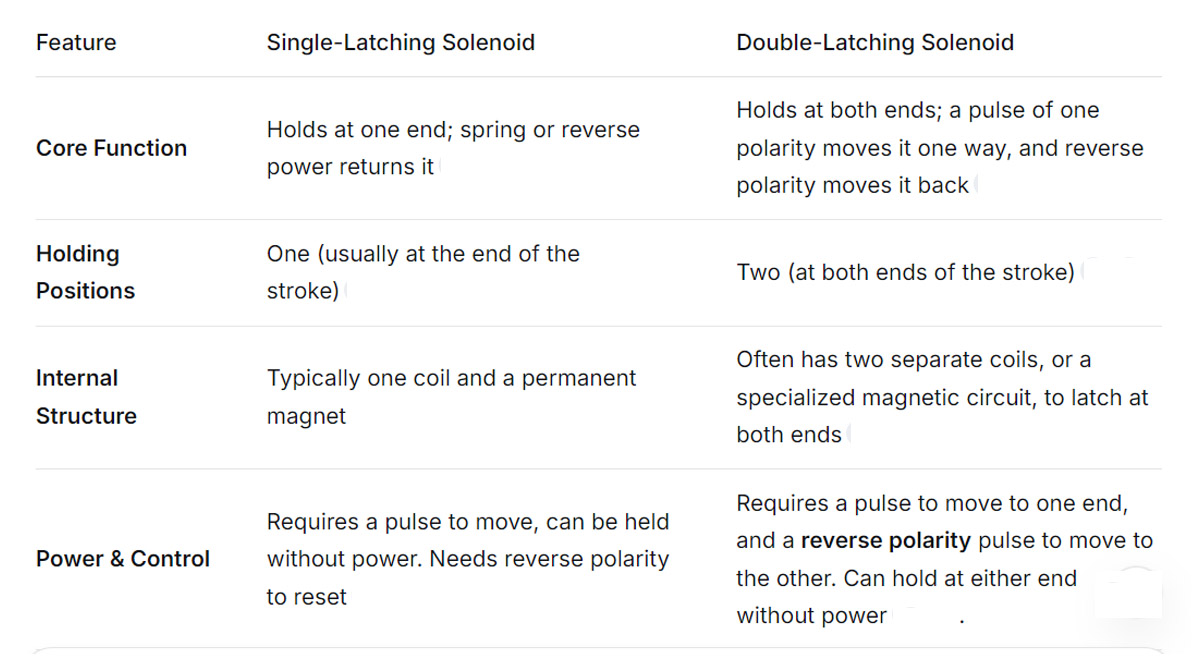
The main difference is how many places the solenoid can be when the power is removed .

Single latching solenoid: Maintains position only at one end of travel (usually the “energized” or pushed-out position). To return, you must apply power in reverse polarity.

Double-latching solenoid – Can lock itself at both ends of the stroke (fully pushed out and fully pulled back) It is truly ‘bistable’.

Both rely on a permanent magnet to hold the position without the need for continuous power, so they are very energy efficient.

Here’s a quick rundown of their main differences:

Single-Latching VS Double Latching Solenoid

Applications in Practice
Which one you choose usually depends on what you want the solenoid to do in the “off” position.

Single-latching solenoids are good for when a mechanism only needs to be held firmly in one particular position after energizing, and the “default” or reset position doesn’t matter. A common example is a lock mechanism that must remain locked when power is lost.

Double-latching solenoids are the perfect solution when a mechanism needs to hold strongly in two different states (something like “open” and “closed”) without using any power. That’s good news for battery-powered devices. Sprinkler valves are a perfect example . A pulse opens the valve , a reverse pulse closes it and it remains in either state without using battery power .

So the key question if you are choosing between the two is: does your application need holding in one position or is reliable holding in both positions essential?


Compact Bistable Latching Solenoid Application

Compact Bistable Latcing Solenoid Application

Applications of Bistable Latching Solenoids

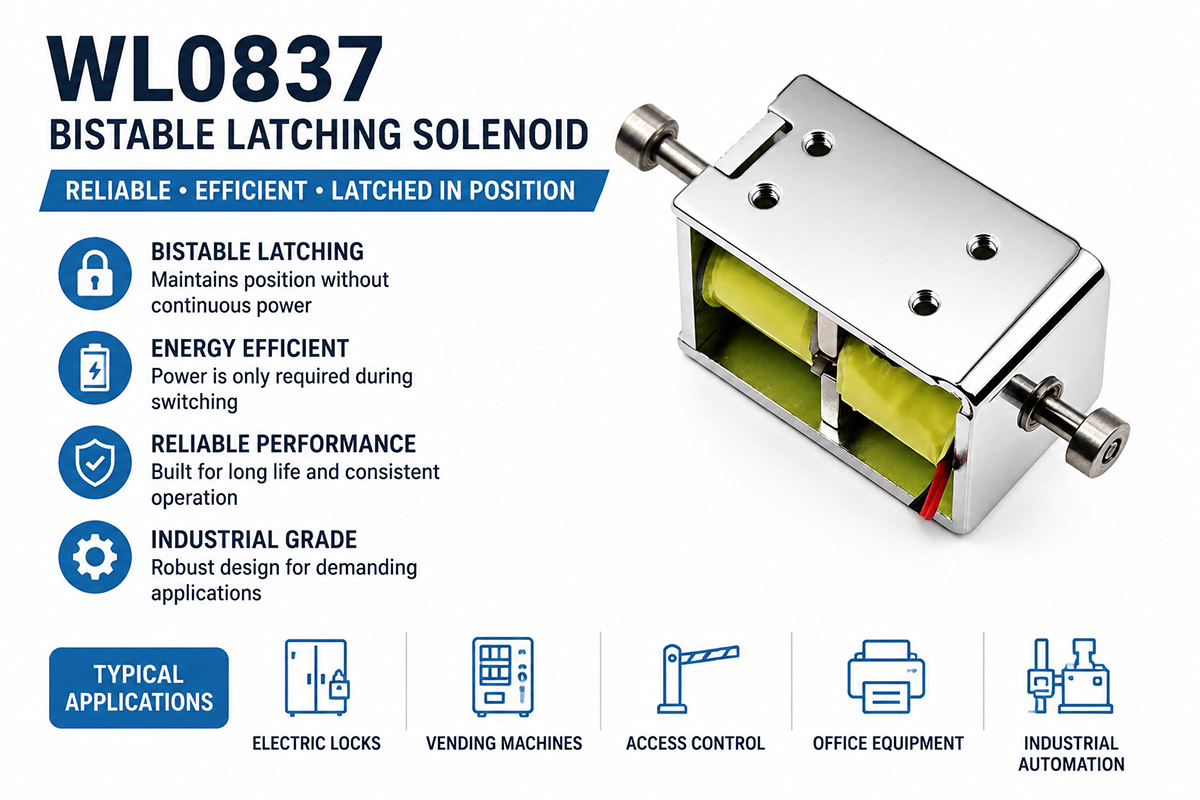
The bistable latching solenoids are widely used in many different industries due to its special energy-saving and position-retaining capabilities. They are used in fluid control applications for irrigation, HVAC, sanitation valves for water and gas control. With one pulse they can effectively open or close a valve, saving the battery charge. They are used in security and access control applications in smart door locks, electronic cabinet locks or server rack locks that will retain their locked state even in case of power failure. They are used in aerospace and automotive industries as actuators for flaps, landing gear and door systems. Their low power consumption makes them perfect for battery management and isolation systems in electric cars. They are used in industrial automation applications for sorting gates, safety interlocks and latching relays. They are used in battery operated IoT sensors and remote devices as they can retain a certain position without power

Why the Bistable Latching Solenoid is so Popular

Growing concern for energy efficiency and development of the Internet of Things connected battery-powered devices became a direct cause for growing popularity of bistable latching solenoids. They can hold a mechanical position without power consumption. This makes them ideal for applications where power is scarce or expensive, such as remote sensors or smart meters. Another driving factor is rapid growth of the electric vehicles industry where engineers try to optimize every watt hour of the battery capacity and bistable solenoids become a crucial component of the energy management systems. Growth of industrial automation and smart building technology also creates demand for small, reliable, low-heat actuators. To better cater to such needs, manufacturers constantly innovate and customize these solenoids, securing their place in the future of industrial control and energy efficiency.

Bistable Latching Solenoid Advantage and Disadvantage

Bistable Latcing Solneoid Advantage and Disadvantage

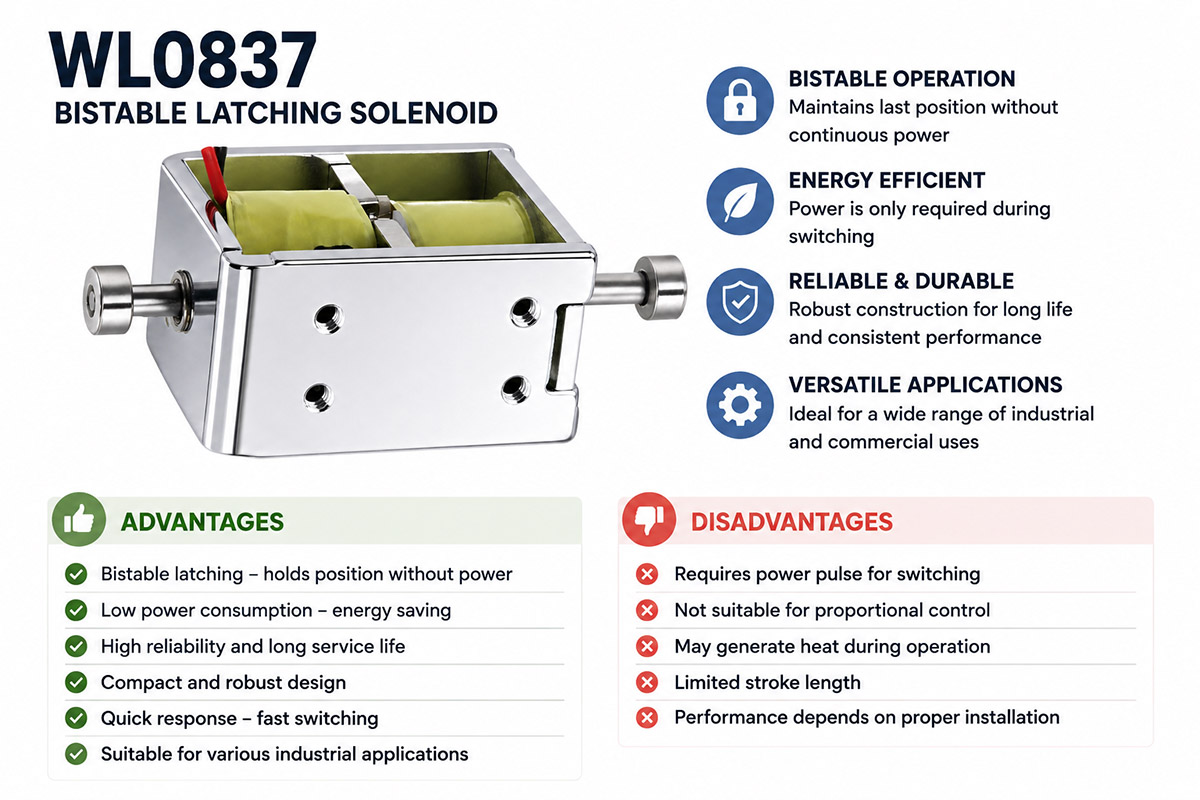
Bistable Latching Solenoid  Advantages

Energy Efficient The main advantage is that it uses no power at all to maintain a state thus allowing for substantial energy savings which is very good for battery powered devices

No heat generation: As it is activated for only milliseconds it has no coil heating problems leading to increased reliability and longevity

Reliability: Magnetic latching without moving parts inside the latching mechanism provides for a very long operational life and great stability

State retention ability: Holds the position in case of power loss which is important for many locking and safety applications

Bistable Latching Solenoid  Disadvantages

Expensive: Much more expensive than an ordinary push pull solenoid (1-2 times the price) because of the use of permanent magnets and a more complex construction

Complicated control: It needs a more complicated control circuit (Must be able to provide pulses of both polarities) It’s not just ON/OFF switch as it is with the ordinary solenoid

Bistable solenoids having short stroke are likely to have short stroke compared to a regular solenoid due to necessity to release the holding force of the permanent magnet in order to switch the state.

Sensitive: Magnetic latching types can be demagnetized by high temperatures or external magnetic fields

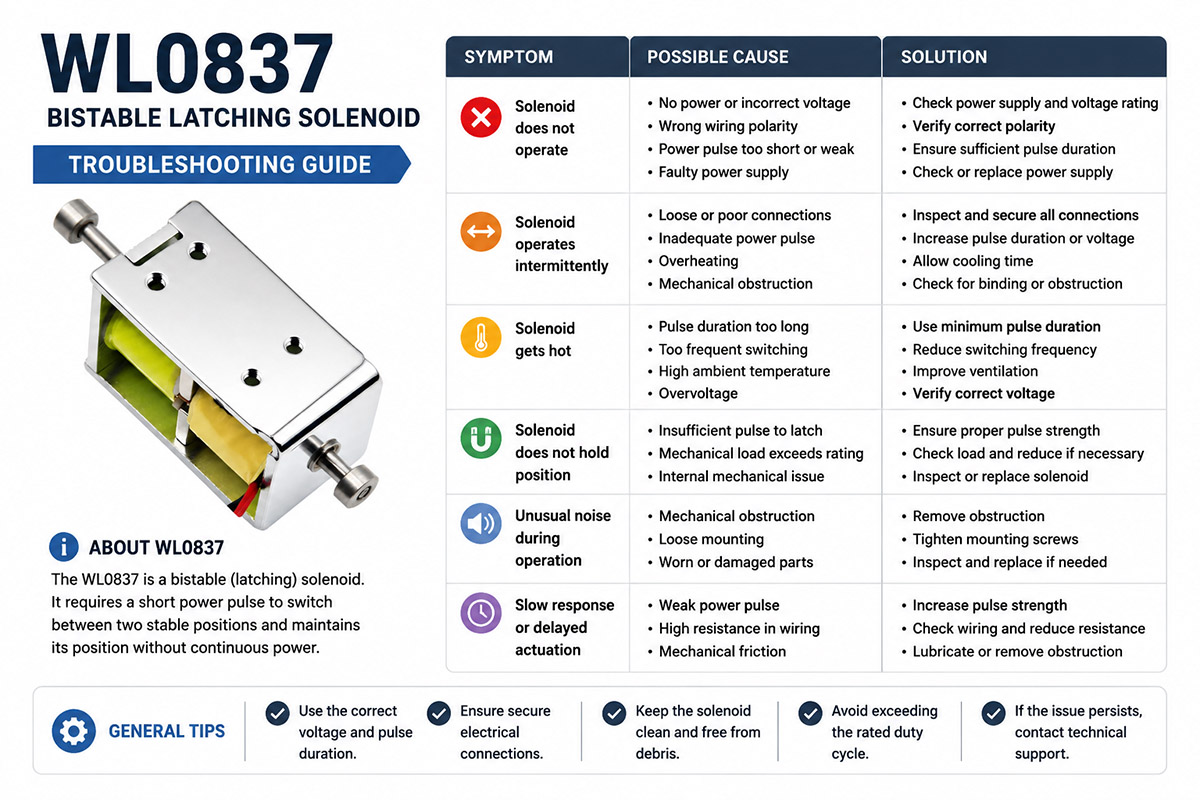
Bistable Latching Solenoids Troubleshooting Guide

Bistable Latchng Solneoid Troubleshooting Guide

Problem: Solenoid Does Not Switch States

Cause: Insufficient pulse power. the pulse duration is too short or the pulse voltage or current is too low to overcome the holding force of the permanent magnet.

Solution: Make sure that the control circuit provides the correct pulse (voltage, current, duration) as indicated in the solenoid specifications. Search for voltage drops in the wires

Problem: Solenoid turns on but does not stay on

Cause: Permanent magnet is demagnetized (weakened) due to high temperature or high external magnetic field exposure.

Solution: Make sure that the working environment is within the specifications of the solenoid. In many cases this malfunction is irreversible and requires replacement.

Problem: Operation Intermittent

Potential cause: Loose connections or a malfunctioning control circuit can lead to an inconsistent pulsing. Also the power supply may have malfunctioned.

Solution: Check the continuity of all wires and connections. Check the power supply and the control circuit for stable performance.

Problem: Random Behavior on Power-Up

Potential cause: Unknown previous state of the solenoid. Microcontroller may not have the program code to move the solenoid into a safe state on the startup.

Solution: Add a subroutine to the controller code to provide the command for a known state of the solenoid on startup

FAQs of Compact Bistable Latching Solenoid

1. How does a bistable latching solenoid hold its position without power?

It uses a permanent magnet incorporated into its magnetic circuit. Once a pulse of current moves the plunger to one of its stable positions, the holding force of the permanent magnet will hold the plunger in this position despite the loads. The position will be maintained without power.

2. What is the difference between a solenoid and a latching solenoid?

Ordinary solenoid needs a continuous power supply to keep its plunger actuated. Latching solenoid needs only a short pulse to switch to a different state after which it will stay in this state without any power. Therefore it is much more energy efficient and produces less heat.

3. Bistable latching solenoids are ideal for fail-safe applications.

Yes, but with some reservations. Without power it will retain its previous position. If you need to have a certain safe position, you need to create a fail-safe circuit. It is usually done using a built-in capacitive discharge circuit providing the pulse to switch the solenoid to the safe position in case of power loss.

4. What drive circuit is required for the latching solenoid?

It is not simply a switch that you can turn on and off. To switch the state, you need a circuit that can reverse the polarity of the pulse. Standard solution is H-bridge circuit that allows to change the direction of current through the coil to latch/unlatch.

5. These solenoids are not suitable for battery powered devices.

On the contrary. The key advantage of these solenoids is their very low power consumption. They use no power at all in a holding state, which makes them ideal for remote sensors, IoT devices, automatic valves and other devices where battery life is crucial.

6. What are the common uses for this type of solenoid?

They are commonly used in applications where it is necessary to maintain the state without continuous power supply. This includes electronic door and cabinet locks, fluid control valves in irrigation and water systems and other switching and actuation mechanisms in industrial automation and automotive applications.

7. What are the disadvantages or difficulties in using this device?

The key disadvantages are the higher cost compared to an ordinary solenoid and a need for a more complicated control circuit. Also, the permanent magnet is very sensitive to high temperatures or strong external magnetic fields that affect its holding force


8. Why doesn't a latching solenoid switch states?

The most common reasons include an insufficient electrical pulse. This may happen because the pulse duration is too short or the voltage/current is too low. Other common causes include: malfunction of the control circuit, weak power supply or bad connections. Mechanical malfunctions, such as a stuck plunger, may also prevent the switching.

Tips to avoid mistakes while designing

Inadequate Pulse Power: A mistake is a lack of understanding of the required power and length of the pulse needed to change the state of the solenoid. You should be sure that your driver circuit can supply sufficient voltage and current for the required pulse time.

Fail-Safe logic is not considered: Bistable solenoid retains its last position if power fails. If this is a possibility in your application, you should implement the fail-safe logic that would take your solenoid to the safe state (e.g. using a super capacitor to close a valve).

Demagnetization: The permanent magnet may weaken over time because of high temperature or the influence of external magnetic field. You should select a solenoid with appropriate temperature rating for your environment and shield it from the external magnetic field.

Polarity Error: The error in the polarity of the pulse needed to switch the state in the opposite direction. It should be implemented in your control logic.

Overload: The mechanical load greater than the force holding the solenoid after latching can cause motion of the plunger. The load should always be less than the maximum holding force of the solenoid.

Bistable Latching Solenoid Selection Guide

Selecting the right bistable latching solenoid is essential for the optimal performance, reliability and lifespan of your application. At first, the core requirements of your app should be clearly stated. It means defining the required force (thrust or pull) and stroke (distance of movement). It is a typical recommendation for engineers to select a solenoid with a minimum holding force twice as high as the load to ensure reliable performance . Then, the electrical parameters should be considered. You need to define the available supply voltage (most common are 12V or 24V DC in industrial applications). You should check the resistance of the solenoid’s coil and the current it consumes. The latching solenoid needs a pulse in order to switch its state and your control system should provide such pulse of correct polarity.

Also, you should consider the working conditions. Temperature range, humidity, vibration, and corrosive agents are the environmental factors that affect the performance of the permanent magnet in the solenoid causing demagnetization over time. So it is essential to select a solenoid that is suitable for your environment. In case of the fluid control application, the material of construction (stainless steel for corrosion resistance) and pressure rating are crucial. The physical dimensions are also very important. You should estimate the available space and choose the solenoid that can be incorporated into your design, potentially having a compact form-factor in case the space is limited.

Finally, you need to choose between magnetic and mechanical latching. The most popular latching technology is magnetic latching. It uses the permanent magnets to lock the armature in its position. This technology provides fast response times and compact form-factor. But it can be affected by the external magnetic field. The mechanical latching technology is more robust and is immune to magnetic interference but has moving parts that wear out over time and is larger and slower. By carefully analyzing the force, stroke, electrical supply, environment and latching mechanism requirements of your application, you can make an informed decision. High recommendation to check the reliability history of the manufacturer and their technical support.

Get A Free Quote Now

Contact Form

Related Products

Related News

Scroll to Top

Get A Free Quote Now !

Contact Form
If you have any questions, please do not hesitate to contact us.
Weilong Solenoid Company Culture
