Compact 12V Tubular Solenoid for Machinery
High Force 12V Tubular Solenoid automation guide
Custom 12V Tubular Solenoid for OEM Project Solution
Reliable 12V Tubular Solenoid for medical Equipment
DC 12V Tubular Solenoid for Industrial Use
Precision 12V Tubular Solenoid for Industrial Device
Compact 12V Tubular Solenoid for Machinery
High Force 12V Tubular Solenoid automation guide
Custom 12V Tubular Solenoid for OEM Project Solution
Reliable 12V Tubular Solenoid for medical Equipment
DC 12V Tubular Solenoid for Industrial Use
Precision 12V Tubular Solenoid for Industrial Device

WL1330 12V Tubular Solenoid for Industrial Solutions

A 12v tubular solenoid is a device that generates mechanical linear motion using electrical energy supplied in the form of DC voltage. The electrical voltage excites a coil to generate magnetic fields that either pull or push a plunger. The construction of tubular solenoids offers several advantages over the conventional solenoid frame design.

Compact 12V Tubular Solenoid Product Overview

The 12V tubular solenoid is a relatively small electromagnetic actuator capable of performing push or pull movements at a voltage of 12VDC. Due to compactness and efficiency, tubular 12V solenoids have found applications in industrial automation, intelligent locks, vending machines, medical devices, fluid control systems, packaging equipment, and various OEM products.

Compact 12V Tubular Solenoid Video

Compact 12V Tubular Solenoid Detailed Display

Compact 12 V Tubular Solenoid Technical Data Sheet

Brand Weilong Technology Model Number WL1330
Rated Voltage (V) DC 5 V or 12 V or 24 V Rated Power (W) 3-5 W
Work Model Tubular Push-Pull Type Holding Force (N) 0.1 to 0.3 N
Stroke (mm) 3-5 MM Reset Time(s) 30 ms
Service Life 100,000 shots Certification CE, RoHS, ISO9001,
Material Carbon Steel Housing with Zinc Plated Coating Lead Wire Length (mm) 200
Holding Force:  1.8 Kgs Tolerance of Dimension  +/-  0.1 MM
Water-proof  None Insulation Class F
Hi-Pot Test AC 600V 50/60Hz 2s Non-excitation Holding Force 0
Working Temperature -10°C-100°C Duty Cycle 1-100%
Working Duty 10%–30% Payment Term TT, or LC At Sight
Sample Order Yes Warranty 1 Year
MOQ 1000 pcs Supply Ability 5000 pcs per Week
Delivery Time 30 Days Port of Loading shenzhen

How the 12V Tubular Solenoid Works

The electromagnetic tubular 12V solenoid works on the principle of electromagnetism. The following are basic steps involved in the functioning of a tubular 12V solenoid.

Step 1: Power on

A voltage of 12V DC flows in the coil.

Step 2: Creation of a Magnetic Field

Due to the electric current, the magnetic field is created in the solenoid.

Step 3: Movement of the Plunger

The magnetic field pulls the iron plunger to the center.

Step 4: Mechanical action

Movement of the plunger causes pushing or pulling of the attached object.

Step 5: Moving Again

Once the voltage is off, a return spring reverts the plunger to its initial state.

DC 12V Tubular Solenoid Features

Below are some of the key features offered by tubular 12V solenoids:

Compact and space-saving design.

Can perform both push and pull actions.

Powerful, yet consumes minimal energy.

Fast response rate.

Reliable for more than millions of cycles.

Low noise.

Different stroke length and mounting possibilities.

Available as continuous or intermittent solenoids.

Custom adjustable voltage and stroke length.

Suitable for demanding industrial and OEM applications.

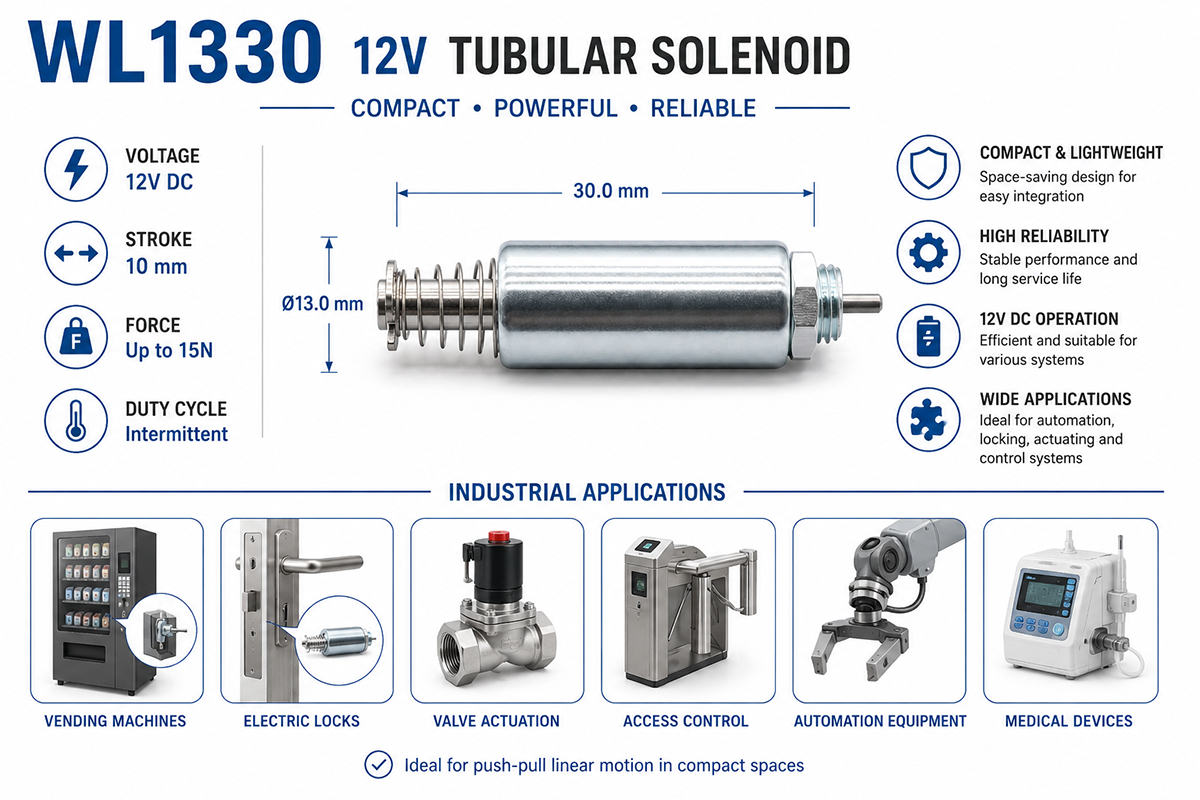
Compact 12 V Tubular Solenoid Industrial Application

WL1330 12V Tubular Solenoid Industrial application

2V tubular solenoids find wide application in many areas. This is attributed to their compact and reliable performance.

Industrial Automation

They find widespread application in assembly lines and robotic equipment.

Intelligent Locking Systems

Locking or unlocking cabinets, safes, and vending machines.

Medical Instruments

They are used in diagnostic devices, infusion pumps, and laboratory devices.

Valves Control Devices

Fluid valves control pneumatic and hydraulic systems.

Automotive Applications

Door locking mechanisms, fuel systems, transmission control, and actuators.

Packaging Machine Application

Accurate positioning and high speed in filling and labeling machines.

Textile Machinery Application

Mechanical actuators in yarn feeders and textile machinery.

Automation Office Application

They are used in printers, copiers, ticket dispensers, and paper-handling devices.

Security Devices

They are used in electronic locks and security devices.

OEM Equipments

Wide variety of special industrial OEM machines and consumer products.

Why 12V Tubular Solenoids are getting Popular

Popularly known as tubular electromagnetic actuators, 12V solenoids are becoming increasingly popular because of several factors.

Development of industrial automation.

Increase in the demand of smart locks.

Growth of demand for various smart devices.

Demand for OEM equipment in industry.

12V tubular solenoids provide the following in comparison with conventional designs.

Greater compactness

Improved magnetic materials

Faster response

Less maintenance

Better life-time

Easy integration into electronic systems.

Increased customization abilities

Therefore, 12V tubular solenoids are becoming increasingly popular owing to the increased demand for smart locks, vending machines, medical devices, robotics, packaging equipment, and automation industry.

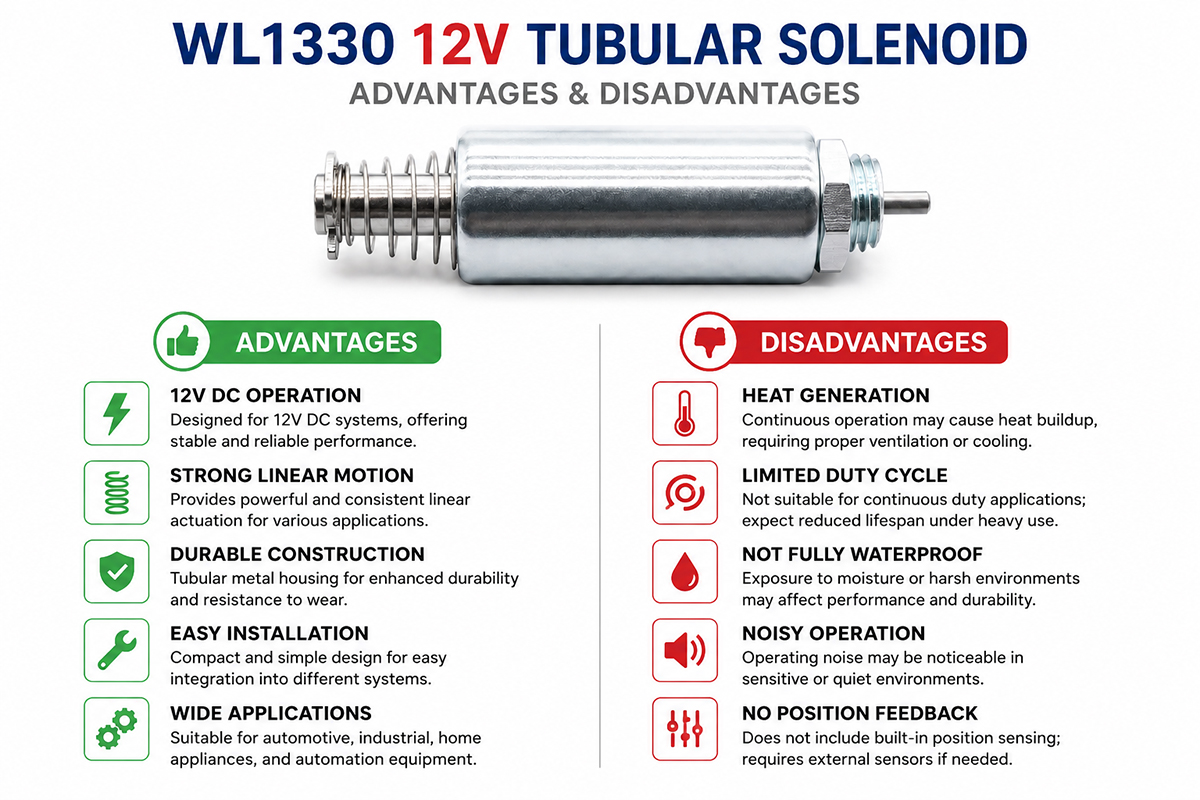
Advantages and Disadvantages of 12V Tubular Solenoid

WL1330 12V Tubular Solenoid advantage and Disadvantage

Compact 12V Tubular Solenoid Advantages

Smaller size

Greater force to size ratio

Faster response

More reliable lifetime

Minimal maintenance requirement

Higher efficiency

Noiseless operation

Easy integration into electronic devices

Flexible push and pull arrangement

Perfect for customized OEM solutions.

Compact 12V Tubular Solenoid Limitations

Decreasing output force with increasing stroke

Generating heat in long-time usage

Limited movement in comparison with the motors

Proper power management needed

Voltage above the recommended can reduce service life

Continuous duty solenoids can be costlier.

12V Tubular Solenoid Troubleshooting Guide
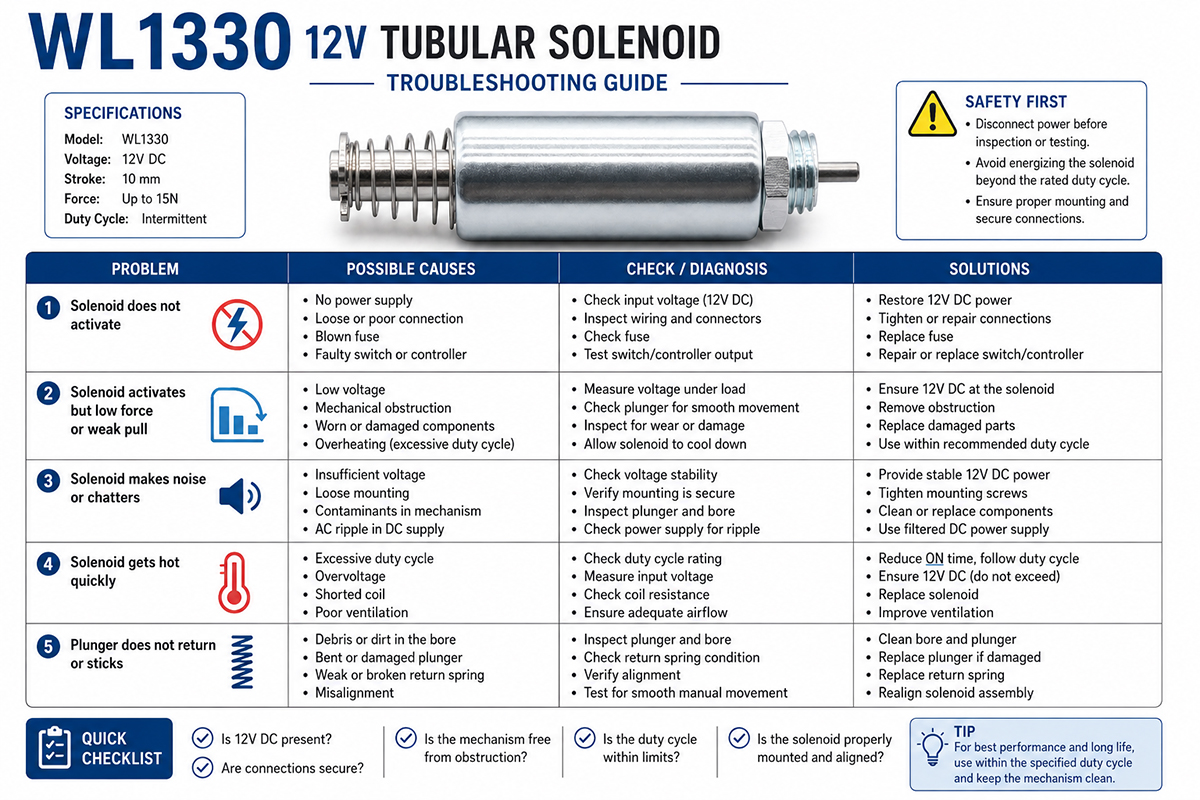
12V Tubular Solenoid Troubleshooting Guide

This guide offers a logical sequence that can help to troubleshoot a 12V tubular solenoid in the most efficient manner.

First one :

The first step to diagnose a problem with the device is to try listening and observing. If there is a distinct audible “click,” electrical and mechanical parts of the device work properly. In case if there is no sound or some buzzing noise, then most likely there is an electrical problem with the device, and you have to use a multimeter to find a solution.

Here is a list of steps that can be used to troubleshoot the solenoid:

Preliminary Visual & Mechanical Inspection

First of all, it is important to conduct a preliminary inspection before conducting any measurements.

Second step:

Inspect Plunger: Manually move the plunger of the device (metal stick that is supposed to move when the solenoid operates). If the plunger is stuck inside, it may be jammed, and this means that the device heats up as the coil does not shift.

Third Step:

Check the Wiring & Connection: Pay attention to possible defects and corrosion on the wiring, as well as on the connections and the grounding.

Check for Signs of Damage: Inspect for possible cracks on the casing since it might mean that moisture entered into the solenoid and caused an electrical fault.

Four Step:

Electrical Test Using Multimeter

This step is the most important one because this test allows diagnosing the problem of a solenoid in its true nature. Please note that it is recommended to disconnect a solenoid from its source of electricity before starting the tests.

Five Step:

Measure the Coil Resistance

How to: Place the test probe tips of a multimeter onto the terminals of the solenoid coil.

What to Expect?

An open circuit (infinite resistance): This suggests that a coil is damaged internally and that the device needs to be replaced.

A short circuit (very low resistance): A short circuit will cause a very high current through the coil, and this is why this condition leads to overheating and damage.

Proper Resistance: You need to compare this value with the specifications of the device, and usually, the resistance for a 12V miniature solenoid is approximately 48 Ohm with the operating current equal to 250 mA. If you do not have technical documentation, you need to remember that resistance of a solenoid of such power is usually several dozens of Ohm.

6 Measure Supply Voltage While Operating

How to: Connect a solenoid and measure the voltage across the terminals of the device with a multimeter probe tips.

What to Expect:

There Is No Voltage: This suggests that you have a problem either with a power source or with switch wiring;

Low Voltage: A solenoid requires at least 9.0V DC, and if the voltage is lower, it suggests that the battery capacity is insufficient or that the voltage was dropped due to low cross-section cables (resistance increases with the temperature rise).

Troubleshooting Guide table chart for 12V Tubular Solenoid

Problem Possible Cause Solution
No movement No power supply Check voltage and wiring
Weak force Low voltage Verify power source
Overheating Excessive duty cycle Reduce energizing time
Slow response Mechanical friction Clean moving parts
Excessive noise Loose installation Tighten mounting
Coil burnout Overvoltage Use rated voltage
Plunger sticking Dirt contamination Clean and lubricate
Intermittent operation Poor electrical connection Inspect terminals
Short service life High impact load Add damping mechanism
Inconsistent stroke Incorrect alignment Reinstall properly

Regular inspection and preventive maintenance greatly improve reliability and service life.


12V Tubular Solenoids FAQs

1. What is a 12V tubular solenoid?

12V Tubular Solenoids are primarily used in the production of linear push and pull actions in industrial automation, smart locking systems, vending machines, medical devices, fluid control systems, packaging machines, and various OEM products. Due to small sizes, tubular 12V solenoids are used even in the most constrained spaces.

2. What is the working of 12V tubular solenoid?

The coil of 12V DC is energized creating an electromagnetic field inside a tubular housing. As a result, the plunger moves linearly. Once the voltage ceases, a return spring reverts it to its starting position.

The coil of 12V DC is energized creating an electromagnetic field inside a tubular housing. As a result, the plunger moves linearly. Once the voltage ceases, a return spring reverts it to its starting position.

A12 V Tubular solenoid has encased cylindrical shapes while open frame solenoids do not have an encasement. Hence, compared to open frame solenoids, tubular solenoids provide more efficiency, better magnetic performance, and reduced noise levels.

4. Can a 12V tubular solenoid work continuously?

Yes.  Continuous duty tubular 12V solenoids operate continuously without overheating. Intermitting-duty solenoids must be energized based on the specified duty cycles.

5. What is a suitable way of choosing a 12V tubular solenoid?

When selecting a 12V tubular solenoid remember:

Required force output

Required stroke length

Push or pull operation.

Duty cycle

Speed of action

Working temperatures

Overall dimensions

Lifetime requirements

Operating environment

Cooperation with an experienced manufacturer can facilitate proper selection.

6. Why does the 12V tubular solenoid become hot?

Electric energy is converted into magnetic energy in the form of heat during the operation of solenoids. The excessive temperature can occur due to:

Surges in Voltage

Continuous usage of the solenoid

Insufficient ventilation

Unsuitable coil design

Intermittent duty in continuous-duty solenoids

The regulated voltage and duty cycle provide higher efficiency.

7. How long will a 12V tubular solenoid serve?

The service life depends on working conditions and quality of solenoids. In particular, the high-quality industrial tubular solenoid provides several million cycles. Meanwhile, quality custom tubular 12V solenoids provide up to five million cycles.

8. Is it possible to customize the 12V tubular solenoid?

Yes. Below are the possible modifications that can be done for the tubular solenoid.

Required force output

Stroke length

Design of the shafts

Voltage

Cycle duty

Increase in dimensions

Protection of the housing from water

Different connector & wires options

How to choose the Right 12V Tubular Solenoid

Selection of the appropriate 12V tubular solenoid is very important.

1. Calculate Required Force

Consider the maximum load required. Include a margin of 20-30% as safety factor.

2. Choose Appropriate Stroke Length

Specify how far the plunger needs to move.

3. Select Push Or Pull Model

Choose based on the mechanical design.

4. Verify Duty Cycle

Continuous or intermittent duty cycle?

Duty cycle affects heat generated and solenoid service life.

5. Think About Operating Conditions

Evaluate:

Temperature, Humidity

Dust, Vibration, Corrosion Protection

Some environments may require specially designed units.

6. Response Time

Calculate the required speed of action.

7. Installation Space Available

Space for mounting and movement of the solenoid.

8. Power Consumption

Energy-efficient design with proper balance.

9. Solenoid Lifetime

For high-cycle operations consider millions of test cycle products.

10. Customization Needs

Look for customization options provided by the supplier including.

Custom Forces Output

Shaft design

Installation dimensions

Voltage variations

Connector and lead wires

Tips for Avoiding Design Problems

Here are common errors to be avoided when designing tubular 12V solenoid:

Under-Sized Force Output

Always include a safety factor.

Wrong Choice of Duty Cycle

Intermittent-duty coils get over-heated in continuous operation.

Ignoring Heat Effect

Heat reduces efficiency and insulation life.

Poor Selection of Stroke Length

The longer strokes reduce force output.

Ignoring Return Spring Requirement

Actuation depends on the spring force.

Changing Power Voltage

Power change alters speed and force of action.

Not Considering Environmental Effects

Special care required to protect from humidity and dust.

No life Cycle Test

Evaluating life cycle in high cycles application.

No Mounting Dimensions

Make sure there are sufficient dimensions for mounting.

No Cooperation with the supplier

Supplier support in the design phase avoids re-design costs.


Get A Free Quote Now

Contact Form

Related Products

Related News

Scroll to Top

Get A Free Quote Now !

Contact Form
If you have any questions, please do not hesitate to contact us.
Weilong Solenoid Company Culture