AC Bobbin Coil for Reliable Valve Control Use
AC Bobbin Coil with Stable Magnetic Force
AC Bobbin Coil for Solenoid Valve Systems
AC Bobbin Coil for Long Service Life Tasks
AC Bobbin Coil for Fast Response Applications
AC Bobbin Coil for Reliable Valve Control Use
AC Bobbin Coil with Stable Magnetic Force
AC Bobbin Coil for Solenoid Valve Systems
AC Bobbin Coil for Long Service Life Tasks
AC Bobbin Coil for Fast Response Applications

WL8580 AC Bobbin Coil Custom Industrial Solutions

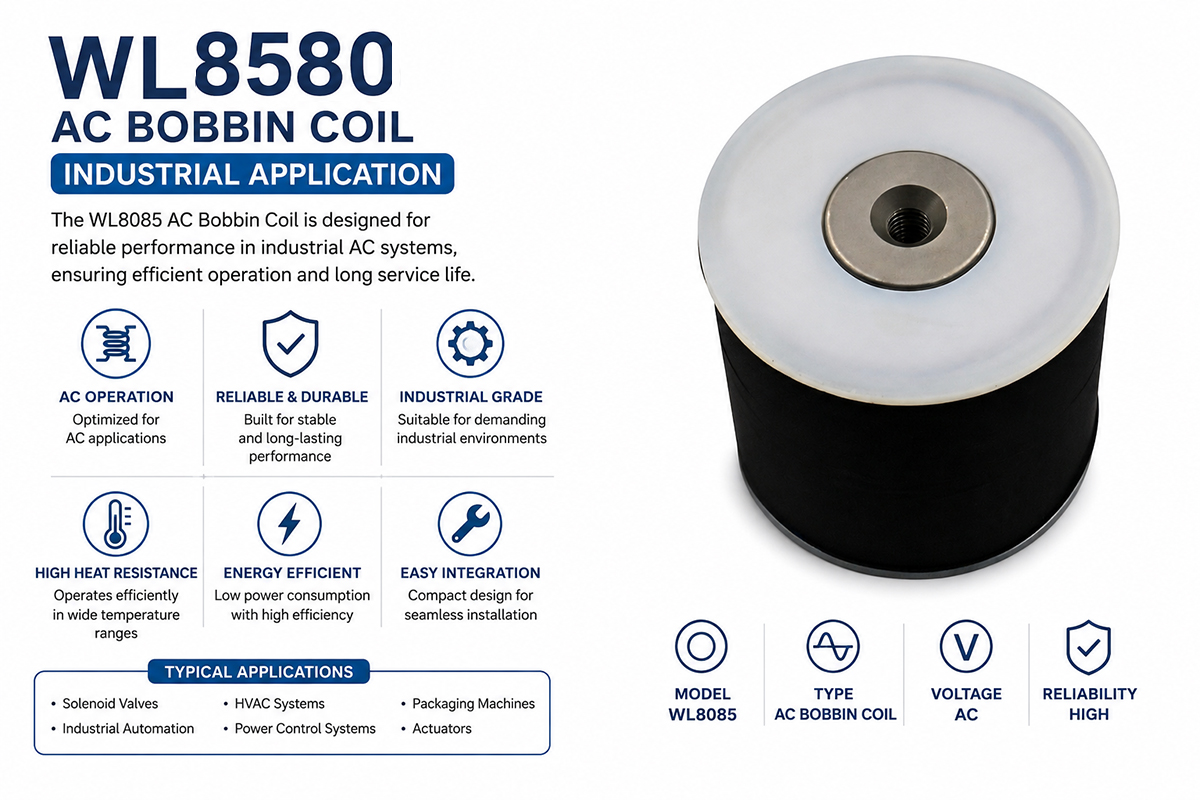
The WL085 AC Bobbin Coil is a reliable and high-performance AC coil. Made of copper wire and insulators, it provides high efficiency and stability.

High-quality copper winding, excellent insulation, stable magnetic force generation, and reliable switching performance.

The WL085 AC Bobbin Coil is offered in different voltage ratings and customized designs. With a durable build, robust structure, high efficiency, and reliable performance, the WL085 AC Bobbin Coil is an ideal product for OEM applications and industrial environments.

With high-quality copper winding, excellent insulation, high efficiency, and reliability of operation, the WL085 AC Bobbin Coil provides efficient actuation under demanding industrial conditions.


AC Bobbin Coil Product Feature Overview

The AC bobbin coil is a heavy-duty electromagnet providing uniform magnetic force. Designed from high-quality materials and with precision-wound copper wire, it operates reliably in industrial conditions.

Excellent electrical insulation, uniform magnetic force, and efficient electromagnetic actuation characterize the WL085 AC Bobbin Coil, which is an excellent solution for solenoid valves, pneumatic equipment, actuators, and relays. Available in multiple voltage ratings and customized, the WL085 AC Bobbin Coil provides excellent performance, reliability, and long operational life.


AC Bobbin Coil Product Display Video

AC Bobbin Coil Product Detailed Display

AC Bobbin Coil Product Datasheet

Brand Weilong Technology Model Number WL8580
Rated Voltage AC 110V, 230V Rated Power (W) 1000–1500 W
Service Life 100 Thousand Times Certification CE, RoHS, ISO9001,
Material Copper Coil Lead Wire Length (mm) 200
Install Style  TBD Tolerance of Dimension  +/-  0.1 MM
Water-proof  None Insulation Class F  155 Degree
Hi-Pot Test AC 600V 50/60Hz 1 s  DC Resistance 134  Ω
Working Temperature -10°C-100°C Duty Cycle 1-100%
Materials  RoHS Compliance Payment Term TT, or LC At Sight
Sample Order Yes Warranty 1 Year
MOQ MOQ: 1000 pcs Supply Ability 500000 pcs per Week
Delivery Time 30 Days Port of Loading shenzhen

How Does A Bobbin Coil Work (AC)?

The AC bobbin coil acts by converting electrical energy to magnetic energy.

  1. AC is applied to the winding of a coil.
  2. The current flows through copper wire resulting in generation of a magnetic field.
  3. The magnetic field draws the ferromagnetic plunger.
  4. Actuation is generated by a mechanical movement of the plunger.
  5. The power is turned off and the plunger returns to its initial position thanks to a spring.
  6. Cycles repeat when current is switched on.

The shading rings are often used in AC solenoid systems to maintain the magnetic attraction throughout zero crossings.

AC Bobbin Coil Main Features

The main characteristics of AC bobbin coil are its high quality of copper winding, insulation, and magnetic energy generation.

AC bobbin coils offer a high efficiency of electromagnetic conversion, fast response time, excellent insulation, and reliable operation for decades. Multiple voltage ratings and customization options give freedom to choose a product to meet your needs. The small size of the coil allows mounting it inside other equipment.

With high quality copper windings, excellent insulation and reliability, good efficiency, and durability, the AC bobbin coils are a high-performance industrial product for electromagnetic actuation.

AC Bobbin Coil Industrial Application

AC Bobbin Coil Industrial Application Guide

Highly reliable and efficient in actuation, the AC bobbin coil finds application in multiple industrial fields.

They allow generating the required magnetic force in solenoid valves for regulating the flow of liquids and gases in pneumatic and hydraulic systems. The coils provide fast and precise actuation in automation machinery, which is important in the automation of industrial processes.

AC bobbin coils are widely used for actuation and switching in relays and contactors of industrial control systems. AC bobbin coils are applied in the automation equipment of assembly, packaging and material handling.

AC bobbin coils are employed in HVAC industry valves and dampers to control airflow. The coils are applied in water treatment systems in automated operation of valves and regulation of liquid flows.

AC bobbin coils for agricultural equipment, irrigation systems and automation devices.

AC bobbin coils are utilized in the manufacturing of medical devices, vending machines and textiles machinery.

Why AC Bobbin Coil is becoming So Popular

AC bobbin coils are gaining popularity because of the growing industrial demands for automation, smart manufacturing, fluid control systems, and affordable solutions for electromagnetic actuation and switching.

The coils are the perfect solution for solenoid valves, relays, actuators and automation systems due to their reliability, long operational life, simple design and ease of integration. They are inexpensive to manufacture; besides, they have high efficiency and durability and long service life. In addition, the rising demands in automation, HVAC, water treatment, agricultural machinery and industrial controls stimulate demand for high-quality AC bobbin coils worldwide.


Advantages and Disadvantages of AC Bobbin Coil

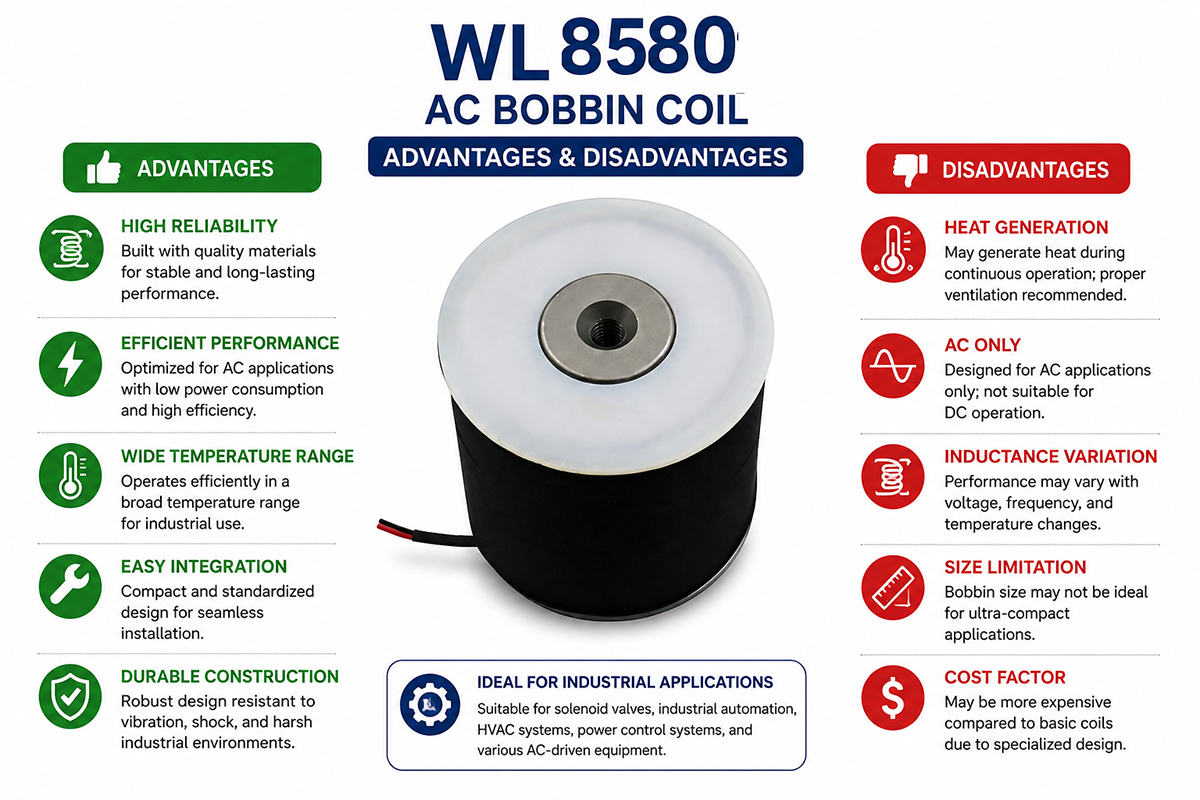
WL8580 AC Bobbin Coil Advantage and Disadvantage

AC Bobbin Coil Advantages

Simple and reliable structure.

Low cost production.

Efficient generation of high magnetic force.

Reliability under industrial conditions.

Wide range of voltages.

Long operational life.

Ease of integration to valves and actuators.

Little maintenance required.

Fast switching response.

OEM projects customizability.

AC Bobbin Coil Disadvantages

Heat generation when working continuously.

Generation of humming noise.

Voltage fluctuations can affect magnetic force.

Requires good thermal management.

Tends to consume more power than some DC coils.

Fluctuating magnetic force affected by frequency.

Reduction of efficiency at extreme temperatures.

Possible coil damage from wrong voltage application.

 AC Bobbin Coil Troubleshooting Guide

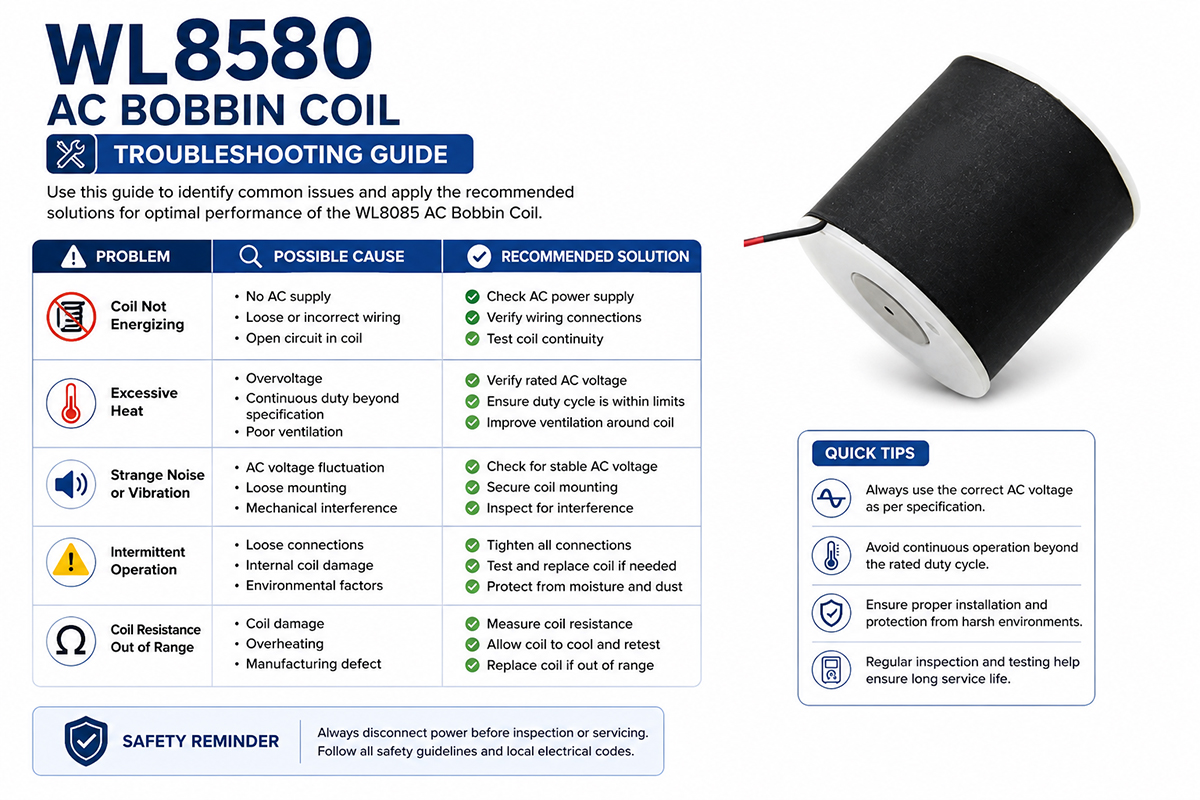
AC Bobbin Coil trouble shooting guide

Not powered

  1. Power source problem.
  2. Check connection between power supply and solenoid.
  3. Measure the coil resistance.
  4. Check connection in connectors and terminals.

Overheating

  1. Incorrect operating voltage.
  2. Not meeting specifications of duty cycle.
  3. Insufficient cooling of a coil.
  4. Short circuits in coil windings.

Weak magnetism

  1. Incorrect voltage supply.
  2. Wrong armature placement.
  3. Wear of magnetic part.
  4. Improper air gap between parts.

Humming and noise generation

  1. Shading ring condition checked.
  2. Plunger fit verified.
  3. Mounting stability checked.
  4. Magnetic circuit checked.

Coil Burn Out

  1. Voltage overload detected.
  2. Thermal management rechecked.
  3. Insulation condition checked.
  4. Coil consumption of current measured.

Intermittent coil operation

  1. Connection problems.
  2. Power supply fluctuation.
  3. Coil terminals.
  4. Environment conditions.

Regular servicing and checking increase life span of AC bobbin coils.


FAQs of AC Bobbin Coils

1. Why are AC solenoid coils wound with multiple parallel wires (e.g. trifilar)?

Coils wound with two or three wires in parallel (bifilar/trifilar) are often done for practical manufacturing reasons. The flexibility of a bundle of fine wires over a single thick wire means that it can be wound more neatly around complex-shaped bobbins (e.g., square or rectangular cores) without leaving large gaps. It can also be a money saver, as using multiple strands of a commonly stocked wire gauge can be less expensive than a single, less common gauge.

2. What if I use aluminum or metal bobbin for AC coil?

An AC coil with a conductive metal bobbin, like aluminum, is a problem. The changing magnetic field induces a current in the conductor.
active bobbin, which effectively makes a “shorted turn.” This will cause the bobbin to act as a shield (reducing the magnetic field), become very hot, and possibly melt the coil or its insulation. For AC applications bobbins should be made of nonconductive material such as plastic or resin-impregnated paper.

3. What's the difference between a common mode choke bobbin and a regular AC coil?

It has a special dual chamber bobbin common mode choke. It is intended to have two separate windings on the same core: Each winding is in its own segmented chamber on the bobbin. This physical separation allows the windings to withstand high voltage differences between them, and also to be wound in the same direction so as to properly filter common mode noise on AC power lines.

4. Why do AC contactor coils burn out at a time or gradually?

The pattern of damage points to the cause:

Immediate Burnout (minutes) This is usually caused by applying a voltage far in excess of the coil’s rating (ie. plugging a 120V coil into a 240V power source). The coil will swell in the center and show heavy melting.

Long Term Burnout (hours/days) Usually due to low voltage (<85% rated) or mechanical obstruction. This means the contactor doesn’t completely shut off and the coil continues to draw a high “inrush” current instead of dropping to a low “holding” current, overheating it.

5. Do AC coils require a “break-in” period?

No. From the point of view of electrical engineering a correctly manufactured coil does not require a break-in period. The inductance and resistance are determined by the physical geometry (number of turns, core material) and should not change from the first use. Claims of a performance improvement over time are usually considered unfounded, even if some slight changes (drying of varnish, for example) may in principle occur in very sensitive instruments .

6. If the DC resistance looks normal, how can I check for a shorted turn in a coil?

If the short is minor, a normal multimeter measuring DC resistance (DCR) may not detect a shorted turn. Must have an LCR Meter. Use it to measure the AC resistance of the coil at 1KHz. If a turn is shorted, eddy currents will flow and the AC resistance will be much higher than normal even though the DC resistance appears normal. The inductance also will typically read lower than expected.

7. Why is it difficult to wind a square bobbin with fine wire (e.g. .05mm)?

A square bobbin with sharp corners will cause sudden jerks in tension as the wire pulls around the corners. The fine wire is not strong and breaks easily when these jerks occur. To get around this, professionals use a low-inertia tensioner or put the wire spool on the floor so the wire pulls off vertically, rather than spinning a heavy spool on an axle.

8. Why is temperature so important in the coil making process?

Plastic bobbins melt when heated. Manufacturing failures can be categorized in two ways:

Terminal Ejection: Heat can travel down the pin if wires are soldered to the bobbin terminals. If the plastic softens it can slip out of grip and push the terminal out of the bobbin.

How To Choose An AC Bobbin Coil

Selection of a proper AC bobbin coil is crucial to guarantee its efficient actuation performance.

Nominal voltage: Make sure your coil has a proper nominal voltage rating (24VAC, 110VAC, or 220VAC).

Power usage: Decide on the power consumption of your application and pick a coil that best suits your power requirements (high power – high magnetic force, but more heat generation).

Duty cycle: Specify whether a coil should operate in continuous or intermittent mode to provide the appropriate thermal management.

Required forces: Specify the necessary amount of force to actuate the plunger or armature. The magnetic force should be higher than the load.

Environmental conditions: Estimate temperature, humidity, and vibrations in the operation environment and choose an appropriate class of insulation.

Dimensions of a coil: Specify installation conditions in terms of mounting dimensions and space availability.

Class of insulation: Specify insulation rating depending on estimated operational temperature. Available classes include Class B, F, H, and others.

Speed of response: Specify whether fast-switching AC bobbin coils are required to meet the speed requirement of your application.

Special requirements: OEM projects may require customized connectors, lead wires, encapsulation, voltage ratings, or mounting conditions.

Manufacturer abilities: Make sure your chosen manufacturer can provide technical support, customization, and engineering services to meet the requirements of your project.

Common AC bobbin coil design mistakes and how to avoid them

Wrong operating voltage selected.

Underestimating thermal losses.

Incorrect selection of wire gauge.

Wrong insulation materials.

Improper allowance of magnetic force.

Conditions of continuous duty operation not specified.

Wrong winding density.

Inadequate dimensional tolerance of bobbins.

Inadequate thermal rise tests.

Vibration and environmental effects overlooked.

Poor quality materials for wire.

Compatibility with armature design was ignored.

Losses in magnetic circuits not minimized.

Electrical safety regulations violated.

Life cycle test not performed.

Get A Free Quote Now

Contact Form

Related Products

Related News

Scroll to Top

Get A Free Quote Now !

Contact Form
If you have any questions, please do not hesitate to contact us.
Weilong Solenoid Company Culture
