

Chapter 1 : Introduction of Residual Magnetism
One of the most significant aspects affecting the functioning and efficiency of the solenoid and electromagnet is the residual magnetism effect. The solenoid must respond properly and quickly when electricity stops being applied in most industrial environments. Nevertheless, there is some magnetism that remains in the armature or solenoid core because of the physical characteristics of the ferromagnetic materials after de-energizing the device.
An excess of Solenoid remanence in solenoids causes numerous technical problems, such as sluggish plunger, slower response time, malfunctioning of the valve, wearing out, and inefficient switching operation. The above-mentioned effects are particularly significant for the operation of precision tools such as metering pumps, medical equipment, solenoid valves, and automation systems.
For those developing high-efficiency solenoid products, it is crucial to know about the causes of residual magnetism and ways of its limitation.
Chapter 2 : What is Residual Magnetism?
Residual magnetism refers to the residual magnetism which remains inside the material after removal of external magnetic field or electrical current.
When the solenoid coil receives electrical power, current flows through the wire wound in the coil and generates magnetic field. This magnetic field magnetizes the iron core and armature in the solenoid. In theory, when the power is turned off, the magnetic field would totally disappear. But in actual process, some domains remain to be magnetized and generate magnetic field.
This kind of residual magnetic force is referred to as residual magnetism.
BrB_rBr
where BrB_rBr is residual magnetic flux density.
Solenoid remanence is a natural property of ferromagnetic materials such as iron and steel.
Chapter 3 : How Residual Magnetism Occurs?
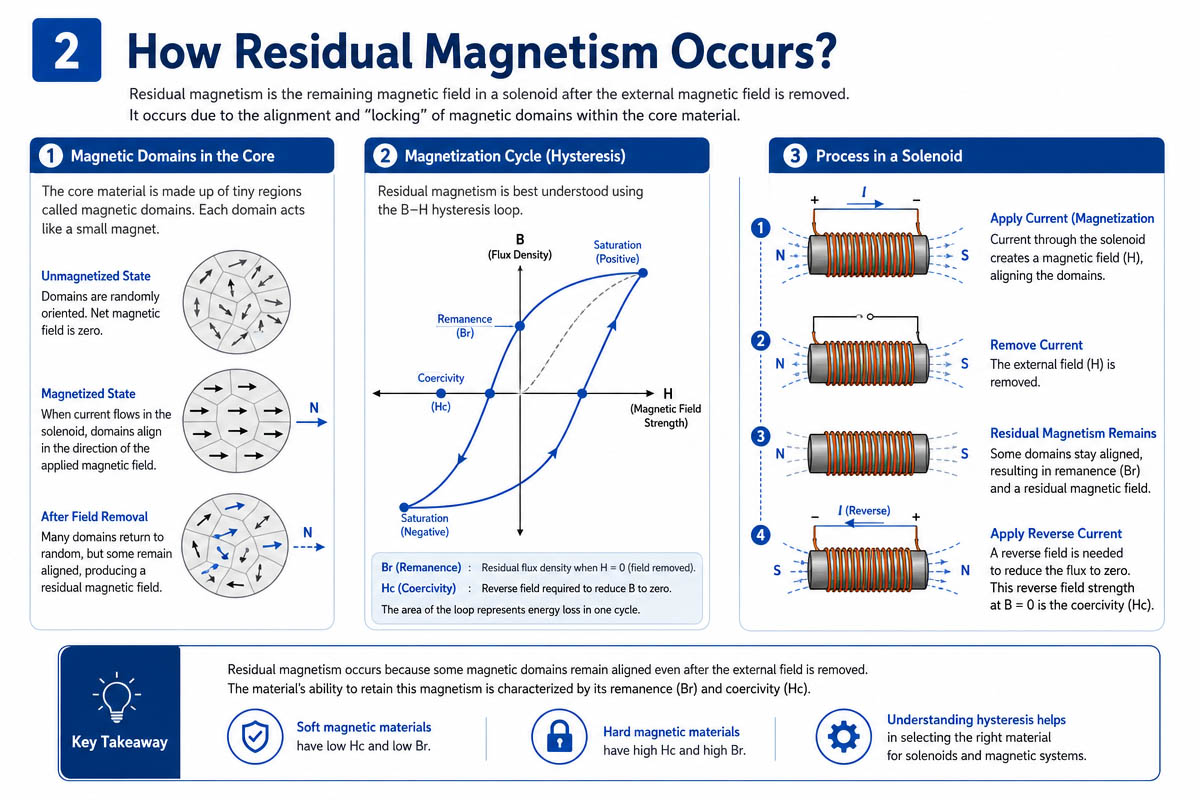
Why the Magnetic Domains Remain After Magnetization?
Inside a magnetic material, there are plenty of microscopic magnetic regions referred to as magnetic domains. Under normal situation, the magnetic domains inside a material are randomly arranged.
After passing the electric current:
the magnetic field makes domains get aligned
The magnetic material becomes strongly magnetized
Magnetic force draws the armature or plunger
However, after disconnecting power:
most magnetic domains will return to their original state;
some magnetic domains still get aligned;
residual magnetic field exists inside the material;
That’s how residual magnetism happens.
Chapter 4 :Main Reasons of Residual Magnetism
4.1 Magnetic Saturation
High magnetic saturation results in more aligned domains remaining after disconnecting power.
4.2 Hard Magnetic Materials
Magnetically hard material retains magnetism for a long time.
4.3 Absence of Air Gap
No space gap between core and armature leads to high residual magnetism.
4.4 Continuous DC Power Supply
Continuous powering increases residual magnetic force significantly.
4.5 Poor Magnetic Circuit Design
Flawed magnetic circuit design increases the possibility of trapping residual magnetism.
Chapter 5 :Consequences of Solenoid Has High remanence
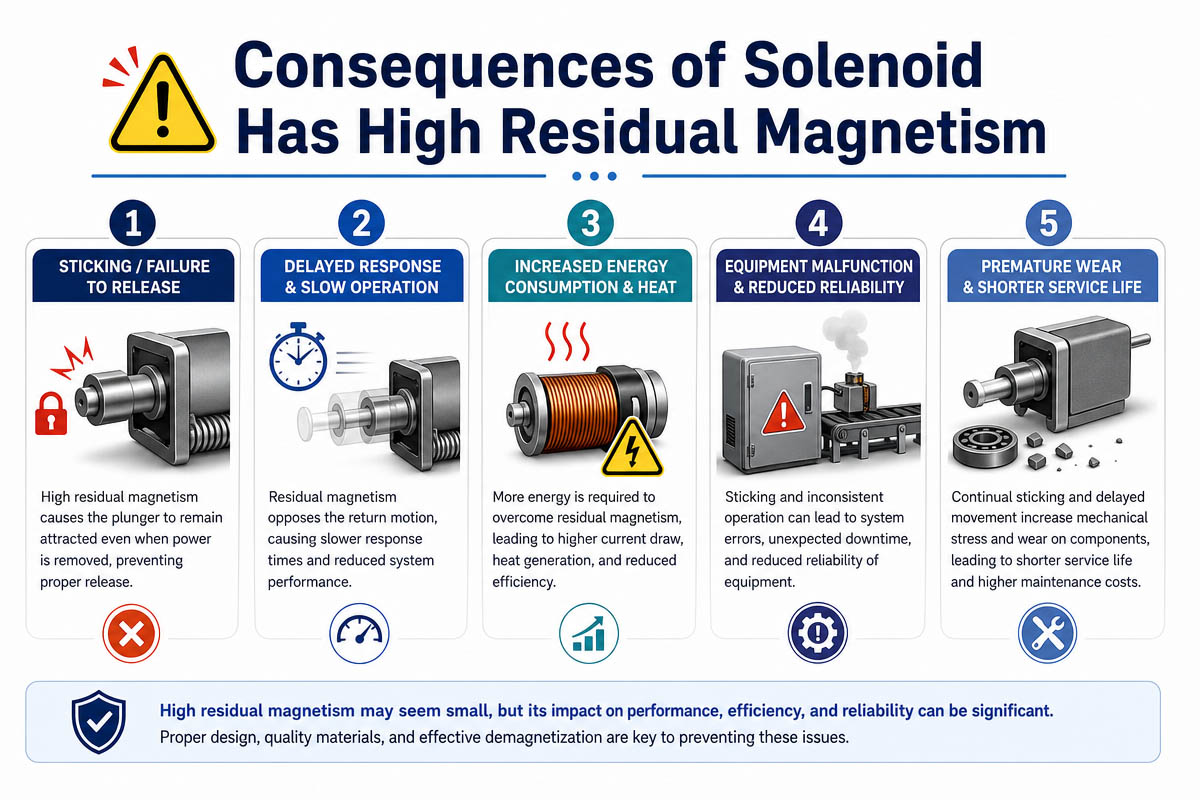
Excessive residual magnetism could cause many issues in solenoid operation.
5.1 Sticking Plunger
The main issue is the plunger sticking after power disconnection. In this case, plunger fails to return to its original position.
Result:
Delayed release;
Unsteady movement;
Incomplete switching action.
5.2 Low Switching Speed
Residual magnetic force opposes the return spring force. Therefore,
The switching speed gets lower.
5.3 Valve Malfunction
Especially in solenoid valve or metering pump application,
Fluid leaks;
Flow rate control gets incorrect.
5.4 More Wearing and Tear
With residual magnetism,
More friction is generated;
Core surface wears easily;
More noise;
Wear out of parts.
5.5 Higher Energy Consumption
Systems using strong spring or high drive current are required for overcoming the residual magnetism.
Chapter 6 :Difference Between Spring Return and Non-Spring Solenoid on Solenoid remanence
6.1 :The type of solenoid structure affects the impact of Solenoid remanence.
Spring return solenoid
The spring return mechanism is used to push plunger back after removing power.
Advantage:
The mechanical spring counteracts the residual magnetic force.
Disadvantage:
Long release time;
High power consumption.
Compared with spring-return solenoid, non-spring structure solenoid is prone to getting stuck because of residual magnetism in most cases.
6.2 Non-spring return solenoid
Without using mechanical spring, it uses other forces such as gravity or loading force to achieve release purpose.
Advantage:
Low energy consumption;
Simple structure;
Quiet working.
Disadvantage:
Residual magnetism effect is much larger;
Easy to get stuck after power-off.
Therefore, in most industrial applications, spring-return solenoid is preferred because of less residual magnetism problem.
Chapter 7 :Factors That Effect on Solenoid remanence
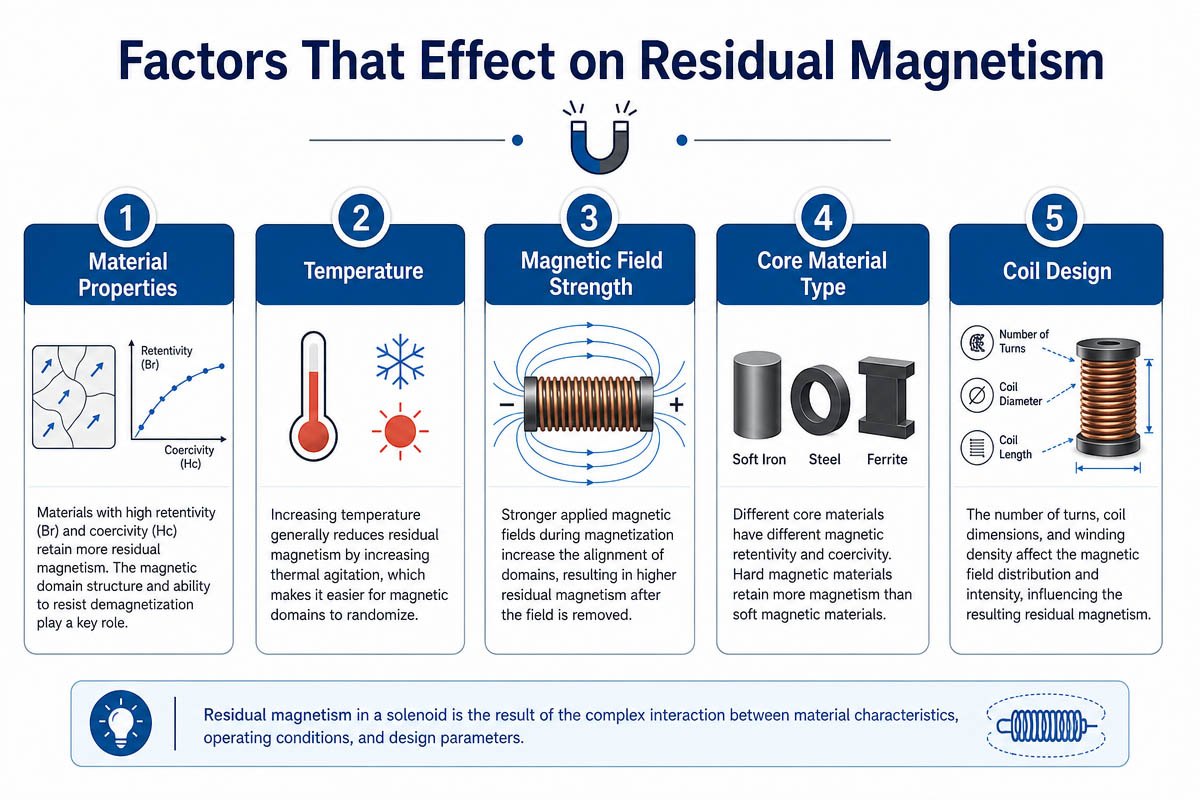 f Material
Choosing suitable material plays a key role when designing solenoid.
Soft magnetic materials
It has following properties:
Low magnetic coercive force;
Fast demagnetization;
Popular materials include:
7.2 : iron
silicon steel;
soft stainless steel;
The soft magnetic materials are highly applicable in applications requiring fast and precision switching and control.
Hard magnetic materials
Hard magnetic materials maintain magnetism persistently.
Properties of hard magnetic materials:
high magnetic coercive force;
strong residual magnetism;
Typical hard magnetic materials:
high carbon steel;
permanent magnetic alloy;
Generally, hard magnetic material isn’t suggested in fast-release applications.
7.3 Influence of Structure
Solenoid structure has great influence on magnetic retention.
7.3.1. Air Gap Design
Smaller air gap between core and armature decreases magnetic retention;
Benefit:
Reducing magnetism effect;
Shortening release time;
To achieve smaller air gap:
using nonmagnetic washer;
using pin stoppers;
core surface engraving;
7.3.2. Contact Surface Design
Lesser contact surface reduces the magnetic force;
Advantage:
Reduce residual magnetism;
Increase release speed;
7.3.3. Magnetic Circuit Design
Good magnetic circuit avoids concentrating magnetic flux;
Avoids magnetic saturation;
Increases magnetic efficiency;
Poor magnetic circuit design results in higher residual magnetic flux.
7.3.4. Spring Return Design
The spring force needs to match residual magnetism accurately.
If the spring is too weak:
residual magnetism dominates and makes plunger get stuck;
If the spring force is too strong:
it reduces the pull force and increases energy consumption;
Chapter 8 : Solutions Against Solenoid remanence
How to Minimize Residual Magnetism During Design
There are a few ways to reduce the residual magnetism in solenoids.
8.1. Choosing Suitable Magnetic Materials
Soft magnetic materials with
high magnetic permeability,
low magnetic coercivity
are recommended. Soft magnetic iron material is commonly used.
8.2. Avoiding Magnetic Saturation
Avoid operating solenoids at magnetic saturation region.
B=μHB=\mu HB=μH
Appropriate flux design to avoid domain retention.
8.3. Adding Nonmagnetic Spacers
Brass or stainless steel spacers create tiny air gap in solenoid structure.
Benefit:
significantly decrease residual magnetic force;
8.4. Optimizing Electrical Current
Too large current leads to saturation and residual magnetic flux.
Appropriate current:
proper voltage supply;
pulse current control;
accurate electrical current timing;
8.5. Precision Surface Finish
rough surface enhances magnetic attraction.
Use precision grinding technique;
8.6. Demagnetization Process
In certain precision applications, AC demagnetization process may be performed after production.
This effectively eliminates residual magnetic alignment.
Chapter 9: Types of Different Solenoids and Their Solenoid remanence
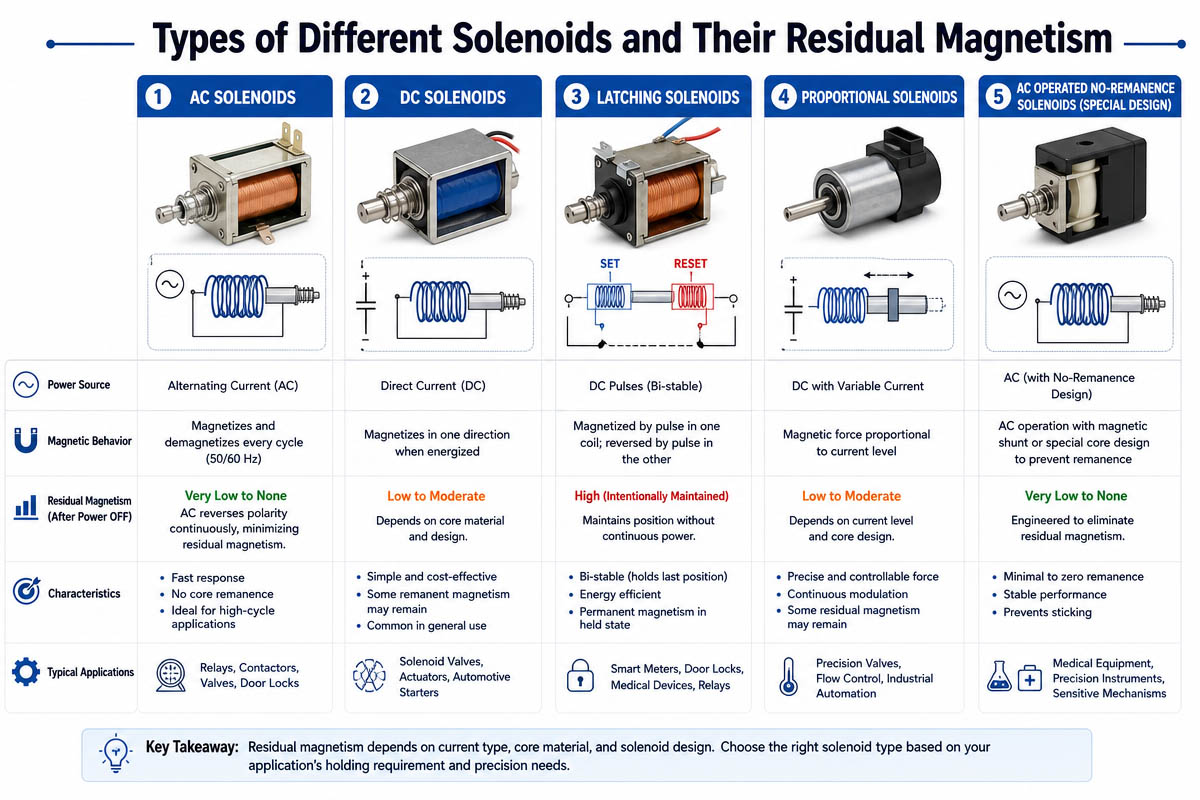
Types of solenoids experience different residual magnetism.
9.1 DC solenoid
The DC type is more influenced by residual magnetism than the AC counterpart.
Main reasons:
The DC magnetic field always remains in one direction;
Domains continually keep aligned;
High risk:
sticking;
slow release speed;
higher magnetic retention.
9.2 AC solenoid
Because the magnetic direction keeps changing in AC cycle,
lower residual magnetism;
faster releasing;
However, AC solenoid tends to make noise.
9.3 Rotary solenoid
The structure usually requires complicated magnetic circuit.
Effects:
incomplete rotation;
positioning error;
long release time;
9.4 Latching solenoid
It is intentionally designed to keep magnetic retention;
benefit:
low power consumption during maintenance;
powering only during switching;
9.5 Tubular solenoid
Tubular design ensures good magnetic performance and
uniform flux distribution;
Proper design avoids residual magnetism problem.
Chapter 10: Important Factors to Avoid Residual Magnetism Problem During Design
During design process, following aspects are key considerations.
material selection:
soft magnetic material;
air gap:
avoid full surface contact without considering air gap;
magnetic saturation:
keep the magnetic flux density under appropriate range;
spring force matching:
avoid magnetic saturation caused by improper spring force;
surface treatment:
good surface finish;
thermal management:
temperature affects the magnetic property;
tolerance control:
small change in size has big impact on magnetic retention;
Chapter 11 : Conclusion
Solenoid remanence is natural physical phenomena existing inside any electromagnets or solenoids. But the effects can be controlled through reasonable design.
Solenoid remanence if left untreated will cause following problems in solenoids:
sticking;
long release time;
valve malfunction;
increased wearing and tear;
reduced performance and stability;
The secret to minimize residual magnetism is:
material choice;
magnetic circuit design;
air gap design;
spring design;
avoid magnetic saturation;
Chapter 12 : FAQs About Solenoid remanence
12.1 What is Solenoid remanence?
Solenoid remanence refers to the weak magnetic force left inside solenoid after removing the power supply. This phenomenon occurs due to some magnetic domains which do not become unaligned completely when magnetic field turns off.
12.2 What causes plunger getting stuck after power off?
If residual magnetic force in the solenoid is excessively large, plunger gets stuck and cannot go back to original position because the residual force is larger than gravity force or return spring.
Causes of plunger sticking:
no air gap;
poor material selection;
weak return spring force;
high magnetic saturation;
12.3 What types of solenoids get more impacted by residual magnetism?
The DC solenoid is more impacted because of constant magnetization of magnetic domains throughout the operation.
The applications commonly suffering from residual magnetism issues are:
solenoid valves;
metering pumps;
door lock;
rotary solenoids;
precision devices.
12.4 How can engineers reduce residual magnetism during design?
Following techniques can be employed to reduce residual magnetism in solenoids:
soft magnetic material selection;
adding air gap;
installing non-magnetic spacer;
keeping no saturation of magnetic force;
adjusting spring force;
12.5 What materials are low retentivity?
Soft magnetic materials including
pure iron;
silicon steel;
soft stainless steel.
Hard magnetic material is suggested to avoid in application.
12.6 Can return spring mitigate residual magnetism problem?
A mechanical spring helps plunger separate from the core after power-off.
Therefore, solenoid using spring return mechanism has better performance in quick switching.
12.7 Why does air gap play important role in solenoid design?
Air gap in solenoid design ensures the space between core and armature and thus avoids complete magnetic surface contact, reducing residual magnetism.
Advantages of air gap design:
increase release speed;
reduce residual magnetic force;
ensure release consistency;
12.8 Can residual magnetism damage solenoids?
Residual magnetism alone cannot harm the device, but operational problems created by residual magnetism lead to wear and tear eventually.
12.9 What is the difference between residual magnetism and permanent magnetism?
Difference between permanent and residual magnetism:
the permanent one refers to intentionally made magnetism which maintains magnetic force persistently;
while residual one means unintentional magnetization of magnetically susceptible material.
12.10 How to test residual magnetism in solenoids?
Testing criteria includes:
time to release plunger after power-off;
holding force;
discharge distance;
magnetic flux density;
cycle life performances.

