

Chapter 1. Small Inductor in Electronics
1.1 What Is a Small Inductor?
An inductor is a passive element of an electric circuit that stores energy in the form of a magnetic field generated by electric current. Due to its miniaturization and lightweight nature, small inductors are widely applied in modern electronics where space optimization and electrical performance are vital .
Typically, a small inductor consists of a coil made out of conductive wire with a core made of materials like ferrite, iron or air. The type of core influences such features as inductance, frequency and current characteristics.
1.2 Small inductors are typically used in:
Portable electronics
IoT devices.
Power supplies
Radio-frequency communication systems
Circuits for filtering the signal
Feature Description
Size Miniaturized and lightweight
| Feature | Description |
| Size | Compact and lightweight for miniaturized designs |
| Inductance Range | Nanohenries (nH) to microhenries (µH) |
| Core Material | Ferrite, iron, or air |
| Applications | RF circuits, filters, SMPS, signal processing |
1.3 Function of Small Inductors in Circuits
A small inductor works according to the law of electromagnetic induction. By energizing the coil with electric current a magnetic field is formed, and energy is stored inside the inductor. When the current changes, the energy is returned to the circuit .
Thanks to the aforementioned property inductors are capable of performing the following tasks:
High frequency noise removal
Energy storage in switching power supplies
Current stabilization
1.4 Impedance matching in RF circuits.
Formation of resonant circuits in combination with capacitors
| Function | Description |
| Energy Storage | Stores energy in a magnetic field |
| Filtering | Blocks AC noise while passing DC |
| Impedance Matching | Optimizes power transfer |
| Resonance | Creates tuned frequency circuits |
Because of these characteristics, small inductors are essential components in high-performance electronic systems.
Chapter 2: 7 Ways to Pick Your Small Inductor
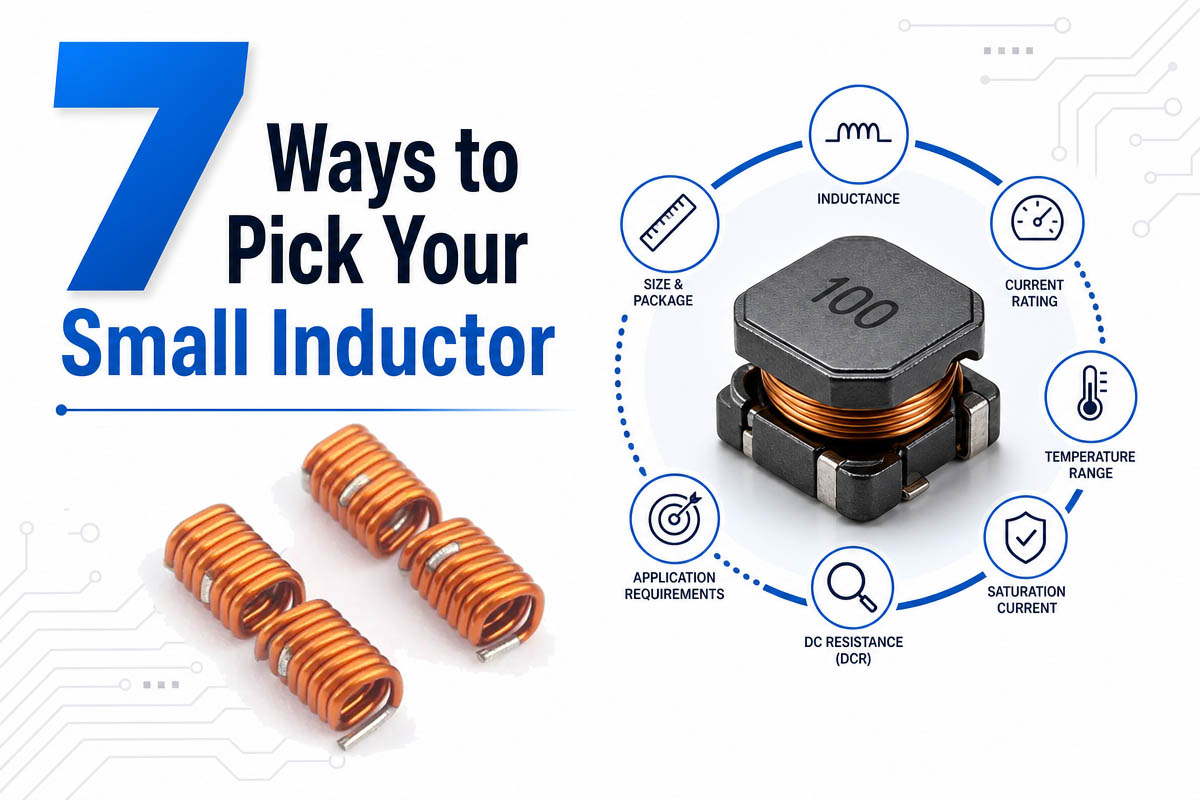
2.1. Pick the correct inductance value
The value of inductance determines how much energy a component will be able to store and how efficient it will be in signal filtering. Using the wrong inductance can adversely influence circuit’s operation.
Common ranges are:
Range of Inductance Application
| Inductor Type | Typical Current Range |
| Wirewound | 100 mA – 10 A |
| Multilayer Chip | 10 mA – 2 A |
| Ferrite Core | 500 mA – 5 A |
2.2. Check Inductor Current Rating and Saturation Current
Your chosen small inductor should be able to handle the operating current of your circuit without overheating.
Main parameters are:
| Inductor Type | Typical Current Range |
| Wirewound | 100 mA – 10 A |
| Multilayer Chip | 10 mA – 2 A |
| Ferrite Core | 500 mA – 5 A |
For your switching power supply, use a component with a current rating exceeding the operating level.
2.3. Consider the Physical Size
Smaller electronics require smaller components. However, decreasing the size may limit the amount of current and inductance the component can provide.
Factors to consider are:
Available space on the PCB
Efficient heat dissipation
Electrical properties: reliability and mechanical strength
SMT and Through Hole Inductors Mounting Type | Characteristics | Typical Applications | |—|—|—| | SMT |Compact size, automated production |Smart phones, IoT devices | | Through Hole | Robust, easy soldering |Industrial and power circuits |
Inductors based on surface mount technology are today the most popular choice among electronics manufacturers.
2.4 Choosing a Correct Core Material
The type of core will determine the overall performance of your small inductor.
Common Core Types and Their Benefits:
| Core Material | Main Advantages |
| Ferrite | Excellent EMI suppression |
| Iron Powder | Better energy storage |
| Air Core | Ideal for high-frequency RF applications |
Due to high magnetic permeability, ferrite core inductors have found wide application in EMI filtering and switching power supplies.
2.5 Measuring the DC Resistance (DCR)
The DCR of a small inductor affects energy efficiency and heat generation levels.
Benefits of lower DCR include:
Low losses
Low temperatures
Increased energy efficiency
Improvement of battery powered device performance
In case of high currents, it is important to select a small inductor with low DCR.
2.6 Determining the Self-Resonant Frequency (SRF)
Each inductor has a self-resonant frequency, after which a component behaves like a capacitor, not an inductor.
To achieve stable operation:
Make sure SRF is much higher than the circuit operation frequency
Choose inductors with high self-resonant frequency for RF and fast operations
Important for wireless communication devices and RF circuits.
2.7 Test Real World Performance
Datasheets give you all technical details, but testing is the only way to be confident.
Common Tests Include:
Thermal Tests Stability of inductance at high temperatures
Mechanical Tests Reliability of structure
| Test Type | Purpose |
| Thermal Testing | Measure inductance drift |
| Mechanical Testing | Verify structural reliability |
| EMI Testing | Ensure signal stability |
It is important to perform testing in order to avoid issues that may arise during long-term operation.
Chapter 3: Common Types of Small Inductors
3.1 Inductors on a Winding Wire
Advantages of wirewound inductors:
High inductance
Large current capacity
Low impedance
Typical applications:
Power supply circuits
Motor drives RF systems
3.2Multilayer Ceramic Inductor
Multilayer ceramic inductors are the best choice for miniature electronics because of:
Small dimensions
High frequency response
Cost-effective mass-production
Common applications:
Smart phones
RF modules
Wireless communication equipment
3.3Ferrite-core Inductors
Ferrite core inductors are extensively used in:
Suppression of EMI
Energy storage
Power conversion systems
Their versatile performance makes these components suitable for both industrial and consumer electronic devices.
Chapter 4: Small Inductor Applications
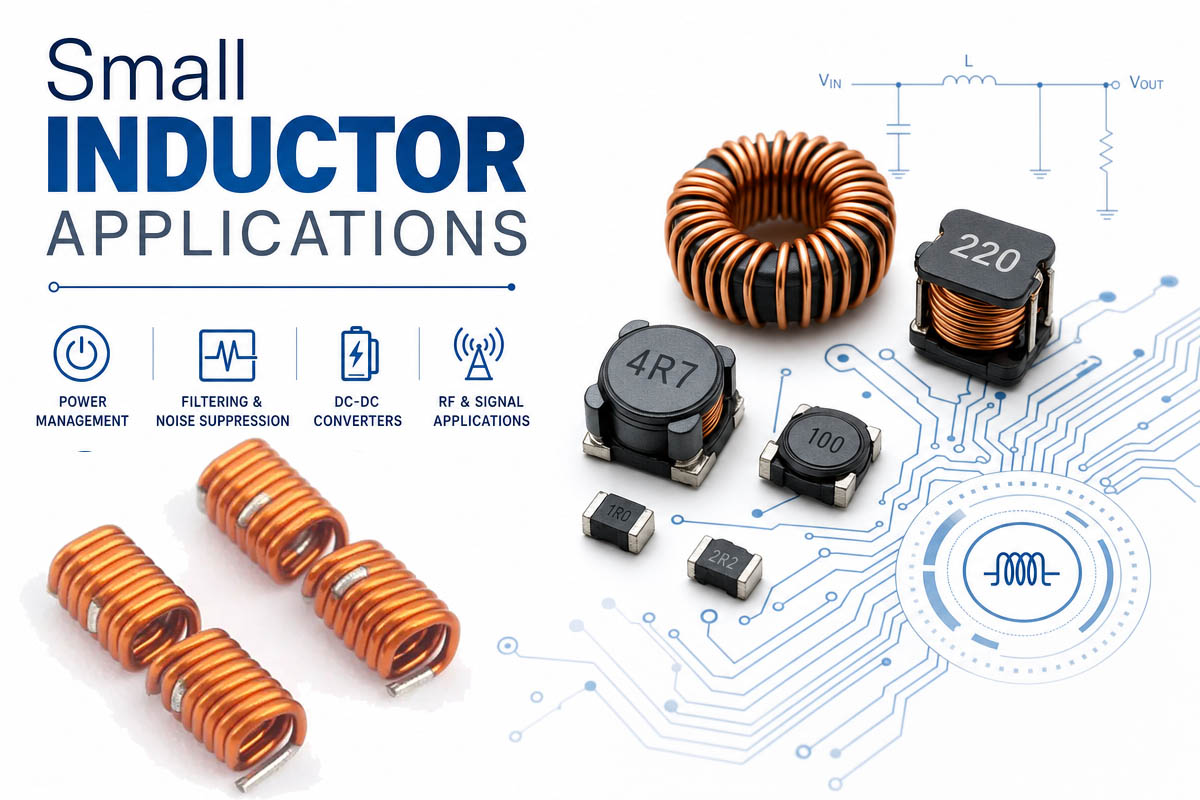
Applications in various industries and electronic devices are numerous:
Ssmall inductors are used in a wide range of industries and electronic products:
| Application | Function |
| Switching Power Supplies | Voltage regulation and ripple reduction |
| RF Circuits | Signal filtering and impedance matching |
| DC-DC Converters | Energy storage and power stabilization |
| Audio Systems | Noise filtering |
| IoT Devices | Compact power management |
Need for more powerful and compact electronics creates a huge demand for reliable small inductors.
Chapter 5: Tips for Avoiding Small Inductor Common Mistakes
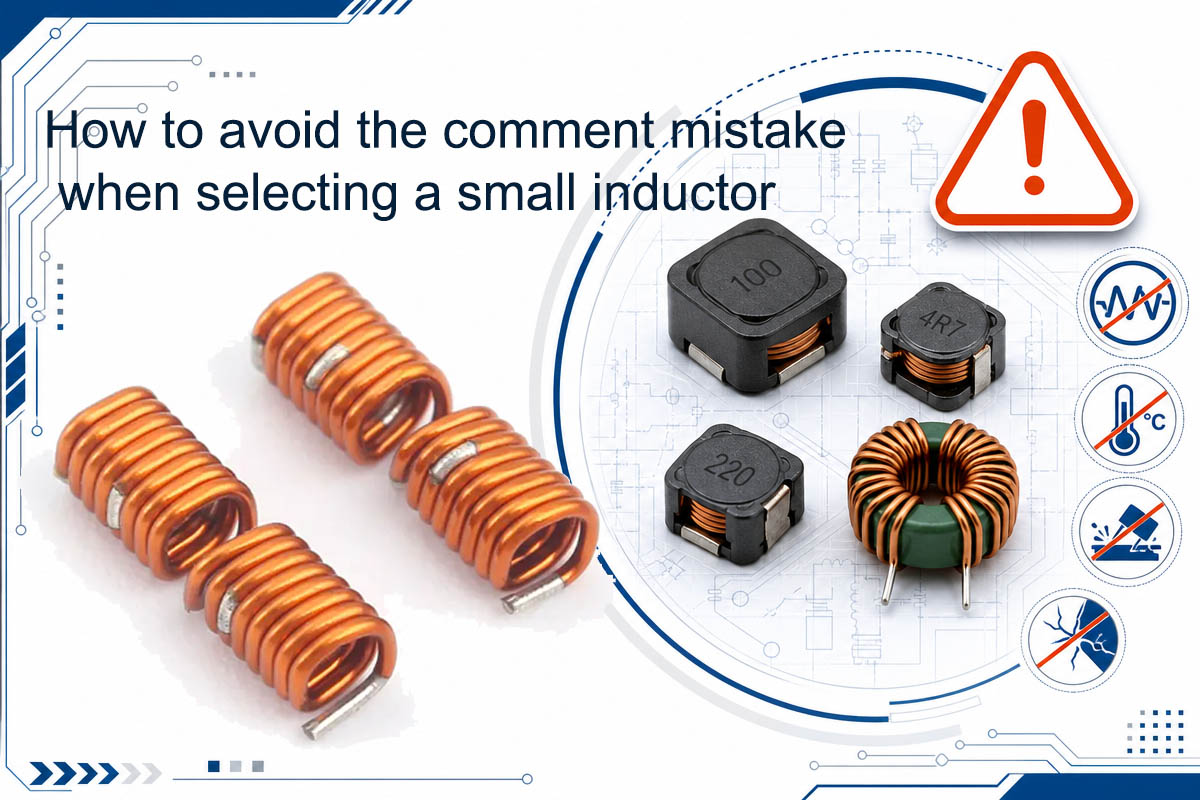
An incorrect selection of a small inductor can result in overheating, electromagnetic interference, inefficient filtering, or even circuit failure. In this section, we discuss some common mistakes in the selection process.
5.1. Choosing an inappropriate inductance value
Selecting a wrong inductance value leads to inefficient performance and other negative outcomes.
Too low can lead to:
Inefficient filtering
High ripple current
Unstable power output
Too high can cause:
Slow transient response
Less efficient
Large size
How to Avoid It
Ensure you choose the required inductance by taking into account the switching frequency and current ripple.
Always follow the recommendation of the integrated circuit.
Measure the inductance at the actual operating frequency.
Typical Inductance Application
| Application | Typical Inductance Range |
| RF Circuits | 1 nH – 100 nH |
| DC-DC Converters | 100 nH – 10 µH |
| Power Supplies | 10 µH – 100 µH |
5.2. Not paying attention to saturation current
Engineers often tend to focus on the DC current rating while neglecting the saturation current (ISAT).
Once the current exceeds saturation:
Inductance drops
Temperatures rise
Circuit instability increases
Efficiency drops
How to Avoid It
Select an inductor whose:
Saturation current is 20-30% above peak circuit current
Thermal safety margin is sufficient in high loads
It is especially relevant in:
Car electronics
Power supply switching
Motor control systems
5.3. Failing to Consider the DCR (Direct Current Resistance)
Higher DCR results in unnecessary:
Power failures
Heat generation
Shorter battery life
This is quite common in portable electronics and high-current applications.
How to Avoid It
Select an inductor with:
Low DCR for improved efficiency
Accurate wire diameter and core construction
Improved thermal performance
This is especially important for low DCR:
IoT devices
Battery-operated devices
High-efficiency converters
5.4. Incorrect core material selection
Different core materials have unique behaviors under certain operating frequencies and current levels.
Common Mistakes
Use of ferrite cores for energy storage applications
Iron powder cores for very high frequencies
Neglecting the EMI performance requirement
How to Prevent it?
Core Material Recommended Applications
Ferrite Core High-frequency circuits, EMI suppression
Iron Powder Core Energy storage, Power conversion
Air Core Used in RF and ultra-high frequency applications
Combine core material according to:
| Core Type | Best Applications |
| Ferrite Core | EMI suppression, high-frequency circuits |
| Iron Powder Core | Energy storage, power conversion |
| Air Core | RF and ultra-high-frequency applications |
5.5. Ignoring Self-Resonant Frequency (SRF)
Every inductor has its self-resonant frequency where it begins to behave like a capacitor rather than an inductor.
If the operating frequency approaches SRF:
Filtering becomes inefficient
Noise generation
Can result in circuit instability
How to Prevent It
Ensure the SRF is much greater than the operating frequency.
Take note of the manufacturer datasheets carefully.
Test RF performance on actual PCB layouts;
Important for:
RF modules
Wireless communication equipment
High-frequency digital systems
5.6. Selecting an small inductor solely based on PCB Space
While miniaturization is important, selecting the smallest possible inductor can create some performance challenges.
Small inductors can:
Have a low current rating
Higher DCR
Poor heat dissipation
How to Avoid It
Balance:
| Selection Factor | Why It Matters |
| Size | Fits compact PCB layouts |
| Current Rating | Prevents overheating |
| Thermal Performance | Ensures long-term reliability |
Reliability Long-term reliability guarantee
Do not compromise electrical performance for PCB space.
5.7. Not conducting tests under real-world conditions
Some designers only use datasheet values without considering real-life situations.
Real-world issues include:
Temperature drift
Failure in vibration and breakdown
EMI interference
Mechanical cracking
How to Workaround It
Do:
Thermal test
EMI test
Vibration test
Load test under long-term conditions
This is especially important in:
Automotive electronics
Industrial systems
Outdoor gear
5.8. Using Low-Quality or Unverified Suppliers
Low-quality inductors can cause:
Inconsistent inductance
Early failure
Difficult soldering
Unreliable performance
How to Prevent It
Select suppliers that offer:
Full data sheets
Testing for reliability
RoHS and REACH compliant
Consistent product quality
Reputable manufacturers also provide:
Tailored solutions
Quick delivery
Technical support
Chapter 6 : Conclusion
A small inductor is critical in ensuring the reliability of your circuit, energy efficiency, and longevity. When selecting a component, one should take into consideration inductance value, current rating, DCR, SRF, core material, and mounting type.
By knowing the seven practical tips discussed in this article, designers will be able to enhance circuit efficiency and minimize noise generation, heat generation, and performance issues.
Naheng Electronics offers high-quality small inductors for RF circuits, power supplies, IoT devices, automotive electronics, industrial, and many other applications.
Chapter 7 : FAQs of small inductor
1. What is a small inductor and where is it used?
A small inductor is a small passive element which stores energy in magnetic fields whenever there is current passing through it. The small inductor comprises a wire wound into a coil around a core material of ferrite, iron or air. Small inductors are extensively applied in power supplies, RF circuits, filters, and other signal processing circuits such as those of IoTs.
2.How does an inductor work in a circuit?
An inductor works through electromagnetism. Whenever current passes through the coil, the electromagnetic field is produced which contains energy. This energy is then released whenever there are changes in current. In general, small inductors can be described as electrical components that block high frequency alternating currents while allowing direct current to pass through. Therefore, they are used for noise reduction purposes among other uses.
3. What should you look out for when choosing a small inductor?
The key points that one needs to consider when purchasing a small inductor include the inductance value and its tolerance; the rating of current and the risk of saturation in order to ensure that the maximum peak current exceeds the limit.
4. What are the different kinds of small inductors and how do they apply?
There are several kinds of small inductors including the wirewound, which is suitable for applications requiring inductance with high values. On the other hand, multilayer ceramic inductors are used in mobile phone applications since they are cheaper. Lastly, the ferrite core is recommended where there is the need for EMI suppression applications.
5. How would you evaluate the performance of a small inductor?
To test for inductor stability, one should conduct thermal analysis by determining the amount of inductance drift at maximum rated temperatures, mechanical stress tests to check whether it is durable enough to withstand shocks, and EMI tests to ascertain if there is interference within the circuit.

