


How to Select a High Torque Rotary Solenoid
The selection of a rotary solenoid involves the careful matching of various electrical, mechanical, and environmental requirements with the requirements of your application. Follow these tips to find the right solenoid for your application.
1) Torque requirement of high torque rotary solenoid
First of all, measure the torque necessary to overcome the load, friction, and inertia, at precisely the stroke angle you intend to use. Please note that torque capacity decreases as you extend the stroke to reach its end and is maximum near the beginning of the stroke. Thus, the torque rating should exceed your load by a safety factor of about 50% or even more (minimum torque greater than maximum torque * 1.5). In case you require 10 lb-in at 45°, then select a solenoid having a rating of at least 15 lb-in at 45°.
2) Stroke angle of high torque rotary solenoid
Choose among the available stroke angles of 25°, 35°, 45°, 65°, or 90°. Don’t exceed the rated stroke angle since that would damage the internal mechanical stops limiting the stroke. Non-standard stroke angles such as 30° are also available in many cases.
3) Supply voltage and power
Commonly, available DC voltages are 6V, 12V, 24V, and 48V. Some AC solenoids can also be found but are usually larger in size compared to similarly rated DC versions. During evaluation, consider separately the inrush power requirements and holding torque power requirement. Transient overdrive can be achieved during pulsed operation to momentarily apply twice as much power (apply 24V to a 12V solenoid, for instance). The duty cycle could be typically 5% to 25% for intermittent and 100% for continuous operation. For intermittent use, try to use PWM technique to reduce holding power.
4) Direction of high rorque rotary solenoid
Specify if CW, CCW, or both directions are required. In order to provide bi-directional rotation, a model that allows polarity change is required and should be provided with appropriate reversing flyback protection in your drive circuitry.
5) Return mechanism of high torque rotary solenoid
A spring-return mechanism provides a fail-safe function in that it returns back automatically to its original position when power is released. Latching (or permanent magnet) type holds the rotated position indefinitely but requires an opposite pulse to return.
6) Form factor and size
Take a look at available solenoid types such as box-type, cylindrical type, and enclosed types. Determine how much room is available in your mechanical assembly. Decide on mounting features such as mounting flanges, studs, brackets, and types of shaft such as round, D-shaped, or slotted shaft.
7) Environmental conditions
If dust or moisture is a problem, choose an environmentally-sealed unit of class IP54 or better. Typical working temperatures of standard units are from −20°C to +70°C whereas high-temperature versions go as far as +120°C. Preferably, avoid environments where corrosive gases are present.
8) Expected life cycles
The typical life span of a standard rotary solenoid is about 5-10 million cycles. High life expectancy versions with ball bearing construction can reach over 25 million cycles. Extremely fast actuation rate exceeding 100 cycles/min will necessitate a continuous-duty version.
9) Electrical connections
Various electrical interfaces are flying leads, fasten terminals, or connectors. In case of DC solenoids, a suppression diode should be used in addition to providing protection for driving transistors against the inductive spike at the instant of power release.
10) Certifications
UL, CE, and RoHS certifications are necessary for commercial applications whereas MIL specs are required for defense applications.
Always make sure of the performance with your actual load and duty cycle. A datasheet featuring torque vs stroke curve will help.
what is the different between a high torque rotary solenoid and a comment rotary solenoid
There are several differences between the high torque rotary solenoid and the regular (common) rotary solenoid, and they depend on the torque output, design structure, and applications. The following is a comparative list of important differences:
1. Torque Output (the major difference):
A hight torque rotary solenoid designed for generating higher torque output
Capable of handling heavy loads or resistive mechanisms, Suitable for harsh working conditions in the industry
A common rotary solenoid Provides low or medium torque
Applied to the switching or positioning of light loads
Inappropriate for mechanical loads
2 Design Structure
Hiigh torque rotary solenoid has additional coils and magnetic field strength
Optimized magnetic circuit
Fitted with ball bearings, powerful shafts, or multi-pole design
Durable and massive
A common type
Has a simpler design
Includes smaller magnetic and coil parts
Compact and lightweight
Cheaper
3. Work Performance
High torque rotary solenoid
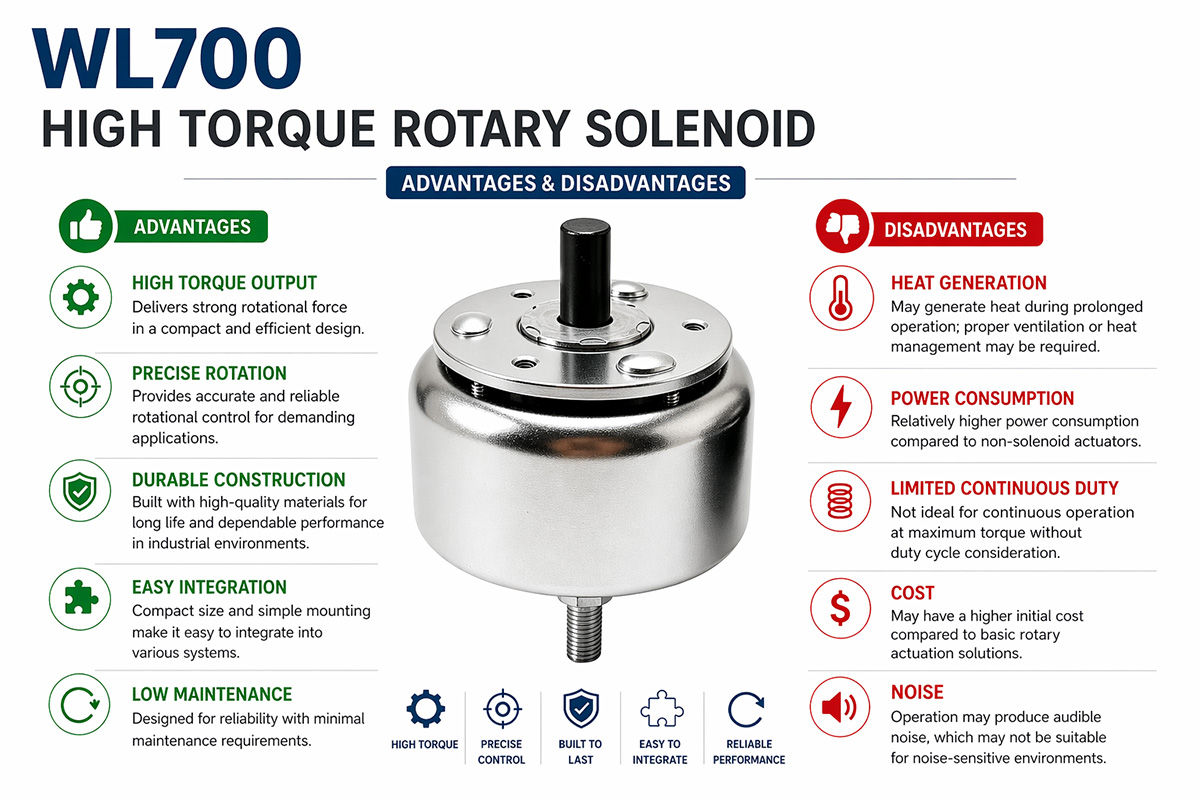
Higher energy consumption
Stability when loaded
Durability when working in heavy-duty cycles
Maintains torque at wide rotation angles
Common rotary solenoid
Lower energy consumption
Rapid response when dealing with light loads
Fast decrease of torque when encountering resistance
4 Typical Rotation Angle and Control
High torque rotary solenoid Works with larger angles (25° – 90° or above)
Higher precision when loaded
Common rotary solenoid Only certain angles are available (e.g., 25°, 35°, or 45°)
Instability when the load is changing
Situations in which It Should Be Used
High torque rotary solenoid
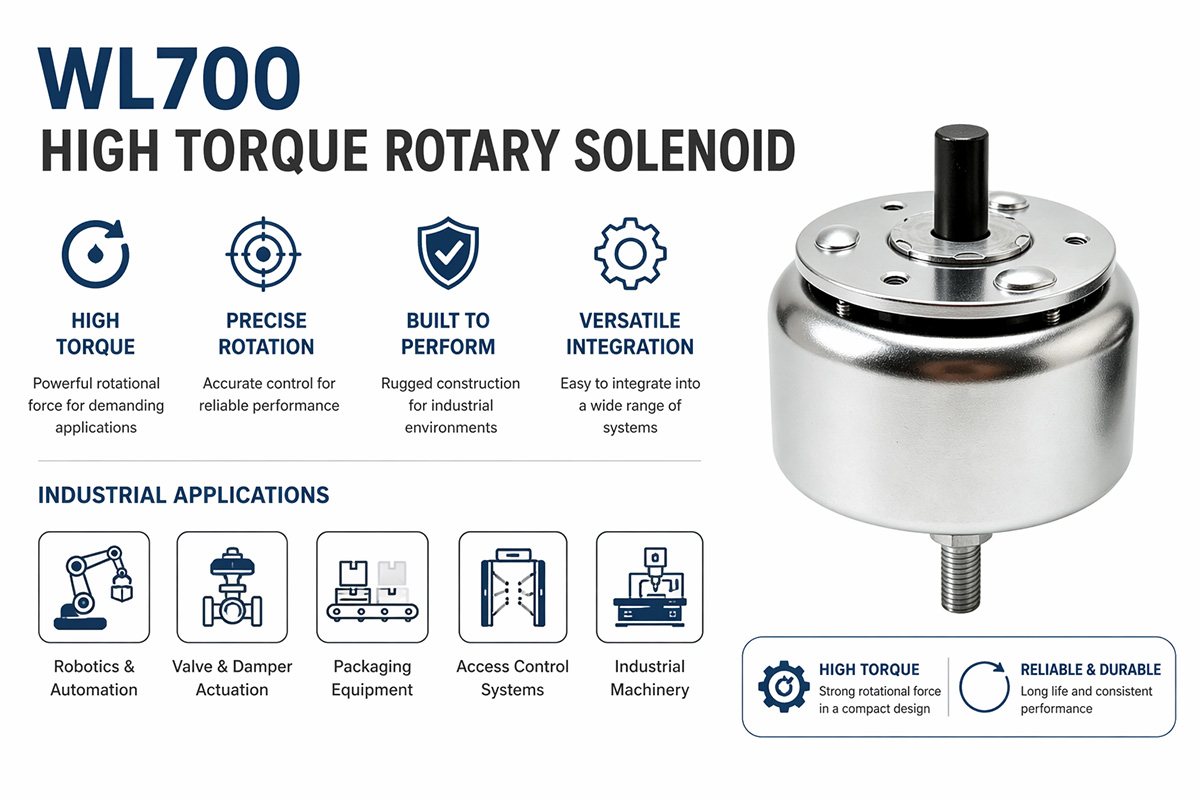
Automation tools for the industry
Robots and engines
Locking devices requiring higher clamping force
Valves or mechanical indexing control systems
Common rotary solenoid
Office equipment
Miniature locks
Camera parts
Light switching devices
5 Size and Cost
High torque
Larger dimensions
Expensive
Complex manufacturing process
Small and cheap
Simple analogues for integration
An analogy can be given in the following way:
The high torque rotary solenoid is an industrial actuator functioning like a motor.
A common rotary solenoid is a compact switching actuator.


