


How to Select the Solenoid Rotary Actuator?
Choosing the rotary solenoid depends on six criteria: angle, torque, voltage, duty cycle, mounting type, and environmental protection.
1. Solenoid rotary Angle
Available rotation angles vary from 30° to 90°. Select the option that corresponds to the desired angular displacement produced by the solenoid-operated mechanism. For unusual angles (e.g., 45°, 75°), consult the manufacturer.
2. Required torque of solenoid rotary
A solenoid specification typically states a value of torque generated at a given angle. Determine load torque, including friction, inertia, and spring forces. Add a safety margin of 30-50%. Typical torque amounts to 0.1-5+ Nm. Torque diminishes as the solenoid approaches the final rotation point.
3. Voltage and Power
Common DC voltage values include 6, 12, 24, 48, 110 volts. Pick the one matching the application requirements. Higher voltage leads to faster response, increased losses, and heating. Battery-powered devices require 12V or 24V and pulsed operation to preserve energy. Analyze the inrush and hold current of solenoids because some decrease power usage after rotation.
4. Duty cycle of Solenoid Rotary
Intermittent duty cycle up to 25% permits generating maximum torque without overheating. A continuous duty cycle means a torque derating. The formula looks as follows: (on-time/time) * 100%. For high cycles per minute above 100, choose solenoids featuring intermittent duty below 25%.
5. Solenoid rotary direction
There are two options here: unidirectional (fixed clockwise or counterclockwise) or bidirectional (dependent on polarity or coil).
6 Environmental conditions and life
Normal operating temperatures include 0-40°C, while high-temperature units have operating temperatures of up to 120°C. IP rating varies from IP40 (clean indoor conditions) to IP65 (dust tight and water jets) and IP67 (complete submergence). A mechanical lifetime exceeds 10, 25 or even 50 million cycles.
7. Mounting & dimensions
Examine the required mounting options (e.g., bracket-mount), shaft diameter, and footprint. Request datasheets with torque vs. rotation angle and response times, and try sample units under actual loads and cycles per minute. In case of high-cycle applications, consider overvoltage, but be ready to monitor temperature increases.
How to Choose the Solenoid Rotary vs. Step Motor
There is one main question that will help you decide between a solenoid rotary and a stepper motor: Do you need to hold a position firmly without power, or do you need to stop exactly at many different points along a full rotation?
The short answer is
If you need to position something very precisely at multiple points while it is rotating continuously, like a robotic arm, a 3D printer axis, or a camera pan-tilt mechanism, choose a stepper motor.
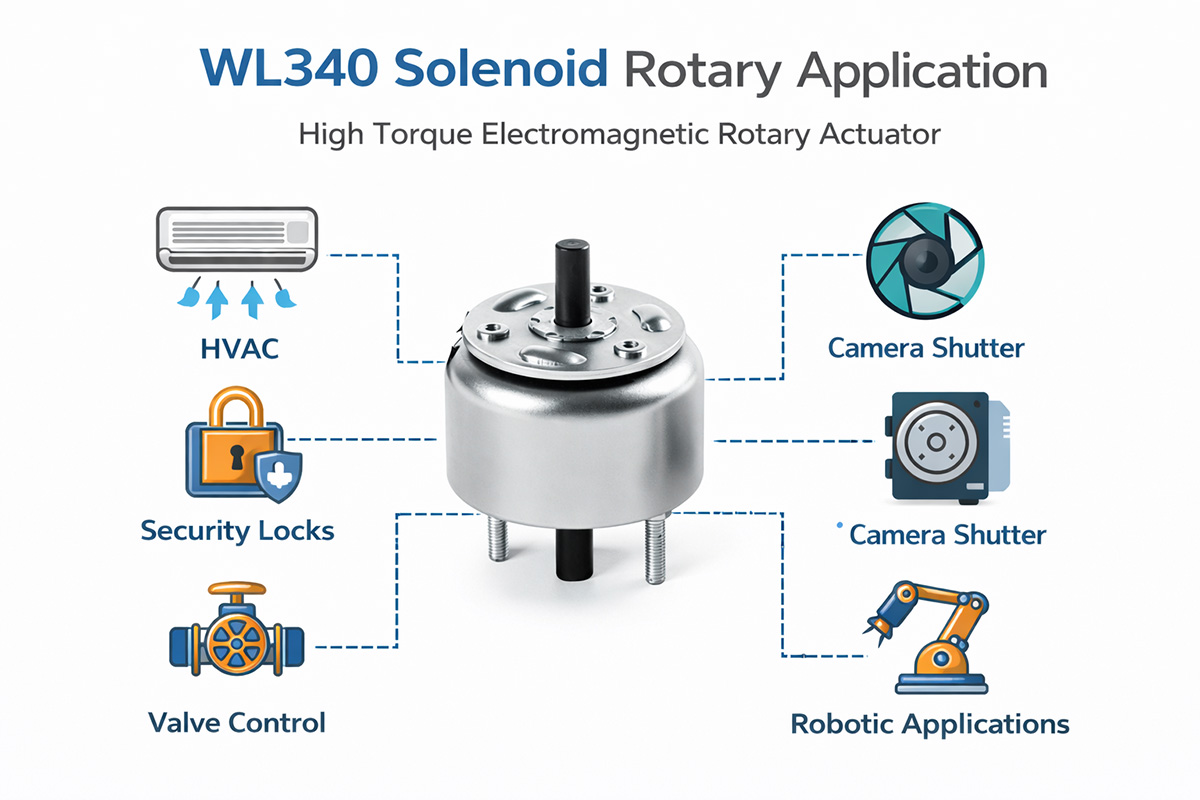
If you need a simple, super-fast “flip-flop” motion between two fixed angles, like a sorting gate, a lock mechanism, or a shutter, choose a rotary solenoid.
The table below breaks down their core differences side-by-side.
| Feature | Stepper Motor | Solenoid Rotary |
|---|---|---|
| Motion Type | Continuous rotation (360°+) or precise steps | Limited oscillation (typically 30°–90°) between two positions |
| Positioning | Extremely precise, open-loop control; can stop at hundreds of positions per revolution | Only two fixed end positions (e.g., “open” and “closed”) |
| Power & Holding | Needs continuous power to hold a position (holding torque) | Bistable: Holds position firmly with zero power (magnetic latch) |
| Speed | Moderate; speeds vary with load and driver | Extremely fast (< 10 ms switching time) |
| Control | Requires a driver and sequential pulses (2-4 wires) | Simple: just reverse DC polarity to change state (2 wires). |
| Lifespan | High, limited by bearings | Very high (100+ million cycles); no brushes |
How to Pick: A Useful Guide
To choose, compare the strengths of the actuator to the needs of your project.
If you want to use a stepper motor,
You have to hold your ground while fighting against a force. When power is applied, a stepper motor’s “holding torque” keeps it in place.
You need more than one place to stop. Steppers are excellent for doing things in steps that are separate and repeatable, like moving a CNC gantry or positioning an antenna. You need to keep rotating. A stepper is the best choice for any job that needs a full 360° spin or more.
If you want a Bistable Rotary Solenoid,
Your app runs on batteries or is sensitive to heat. It only uses power when it changes states, so it uses almost no energy while holding a position. You need “blazing fast” switching. A stepper motor can’t keep up if you need to move a gate or diverter in less than 10 milliseconds. You need a simple ON/OFF rotary action. Solenoids are a much simpler and stronger way to control electronic locks, shutter controls, or sorting flaps than a full motor controller.
💡 A Quick Note About “Holding Torque”
You might think that a stepper motor’s “holding torque” spec works like a solenoid’s latch. But to keep that hold, a stepper motor needs a steady supply of electricity, which makes heat and drains batteries. A bistable solenoid uses magnets to physically latch into place, so it doesn’t need large amounts of electricity to stay put.


