Chapter 1 : Introduction of Electromagnet and Solenoid
Few people know that the electromagnet and solenoid is a different thing. Here, we would like to discuss this issue in our blog post as below .
Electricity and magnetism are the main forces that power the latest technologies in today’s world. The laws of these phenomena govern the performance of all sorts of devices starting from ordinary household gadgets to industrial machinery. The electromagnet and the solenoid derive from this interrelation and are of major importance.
Though people often use the notions electromagnet and solenoid synonymously, these two words denote different things. A solenoid is a device made out of a certain element. The students, engineers, physicists, and everyone interested in these issues should be familiar with the difference between electromagnet and solenoid. Our complete guide on electromagnets and solenoids is going to clarify this topic and give answers to all of your questions about these concepts.
Chapter 2 : What is a solenoid?
A solenoid is a cylindrical coil of wire, wound spirally. The solenoid creates a magnetic field when electric current flows through the wire.
2.1 Shape of a Solenoid
The typical elements of a solenoid are:
– A long cylindrical copper wire wrapped tightly
– Insulation coating
– Many windings
– An empty internal core or, sometimes, the core of a soft ferromagnetic metal
The most distinctive characteristic of a solenoid is the fact that it is much longer than wide. It provides the creation of the magnetic field that is evenly distributed along the whole length of the wire.
How Does a Solenoid Work?
Each turn of the wire coil creates a magnetic field when there is an electric current in the wire. All these separate fields form a rather strong and even magnetic field in the whole solenoid.
Right-Hand Rule shows the direction of the magnetic field lines – when you put your right hand’s finger along the current line, the thumb will show you the field direction.
2.2 Magnetic Field of a Solenoid
The magnetic field inside a solenoid is even and runs parallel to the axis of the coil. It is one of the key properties of this object that make it highly practical in scientific and industrial spheres.
Main Properties of a Solenoid
– Creates an even magnetic field
– Can work both with and without a core
– The magnet’s strength depends on such factors as:
– Current
– Number of turns
– Length of the coil
It is an important electromagnetic component.
Chapter 3 : What is an Electromagnet?
An electromagnet is a kind of magnet that generates a magnetic field under certain conditions, namely under influence of an electric current. It can be controlled in contrast to other permanent magnets.
3.1 Elements of the electromagnet
Typically, the electromagnet includes such components as:
– Coil similar to a solenoid
– Ferromagnetic core (mainly made of iron)
The core increases significantly the field power.
3.2 How Does an Electromagnet Work?
When the coil is electrified, the following happens:
- A magnetic field occurs.
- The core becomes magnetized.
- Magnetic field becomes strong.
The magnetic field disappears if the power goes down, therefore, electromagnets are relatively easy to control.
Main Things about Electromagnets That Everyone Should Know:
– Requires a ferromagnetic core
– Creates a very strong field
– Can be switched on and off
Adjusting the strength of a magnet: you can regulate the field of the electromagnet using the following methods:
– Changing the electric current
– Adding more turns to the wire
– Using better core materials
Chapter 4 : Relation Between Electromagnet and Solenoid
4.1 First of all, electromagnet and solenoid should be mentioned that:
All electromagnets have solenoids, but not all solenoids are electromagnets.
As soon as you connect the electromanget and solenoid to the ferromagnetic core and use it as a functional part of a machine, it turns into the electromagnet.
4.2 Differences Between Electromagnet and Solenoid
| Feature | Solenoid | Electromagnet |
| Definition | Coil of wire | Functional magnetic device |
| Core | Optional | Required (iron core) |
| Field Strength | Moderate | Strong |
| Function | Component | Performs work |
| Usage | Part of system | Complete device |
Chapter 5 : Common Feature of Electromagnet and Solenoid
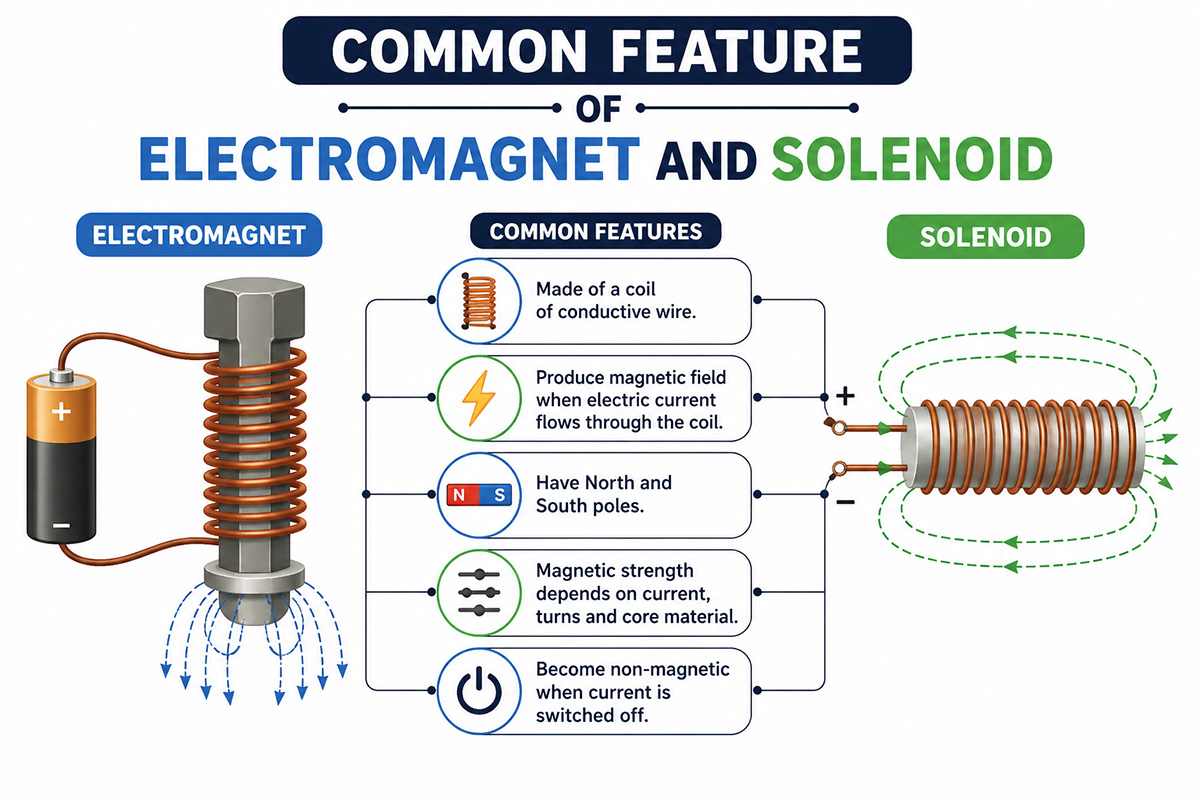
Even though these devices are different, electromagnet and solenoid is still share a lot of common characteristics between electromagnet and solneoid:
– Powered by electricity
– Produce a magnetic field
– Contain coiled wire
– Governed by laws of electromagnetism
– Used in electronics and electrics
5.1 Applications of Solenoid
There are various kinds of devices using solenoids to perform certain tasks in a controlled manner:
- Electric Valves
A solenoid opens and closes the valve to stop or move fluid.
- Relays
It operates automatically, switching electrical contacts.
- Automotives
Applied in starter motors, fuel injectors, and transmission systems.
- Door Locks
Locks and unlocks a door.
- Industrial Automation Machinery
Used to perform mechanical tasks precisely.
5.2 Applications of Electromagnet
Electromagnets are used when there is a need for strong controlled magnetic fields:
- Magnetic Cranes
They are applied in junkyards to lift heavy metal parts; easy-to-control.
- Electrically operated bells
Used in doorbells that create a magnetic field that pulls the striker.
- Electric motors
Useful for creating the motions under action of magnetic fields.
- Generators
Convert mechanical energy to electric power.
- Medical equipment (MRI)
Produces strong magnetic fields.
- Electronic components (hard drives)
5.3 Benefits of Electromagnet
– Can be switched on/off
– Adjustable magnetic field strength
– Usually stronger than permanent magnets
– Wide application in industries and businesses
5.4 Benefits of Solenoid
– Easy and cheap to produce
– Possess fast energy conversion
– Reliable and powerful
– Important in automation
5.5 Disadvantages of Electromagnet
– Require constant power source
– Can heat up during prolonged usage
– More complicated construction due to the core
5.6 Disadvantage of Solenoid
– Weaker field without core
– Less heavy-duty applications
– Sometimes require additional parts
5.7 A Practical Example to See the Difference between electromagnet and solenoid
For example, let us consider the mechanism of functioning of the doorbell.
Pressing the button activates the following:
– The coil lets the current pass through it; its structure of a solenoid creates the magnetic field.
– Iron core makes it into the electromagnet.
– Electromagnet pulls the striker that strikes the bell.
Here, the solenoid is the structure, the electromagnet is the functional part.
A Short Comparison Table
Solenoid vs. Electromagnet:
– Solenoid: Linear coil creating the magnetic field
– Electromagnet: Coil and ferromagnetic core creating magnet
Core presence:
– Solenoid: an option
– Electromagnet: necessary
Properties and usage
– Solenoid: medium to strong magnetic field with limited control
– Electromagnet: fully controllable
Usage and role
– Solenoid: part used to build a system
– Electromagnet: functional device
Chapter 6 : Common Application Between The Electromagnet & Solenoid
Electromagnet and solenoid is the generic names for devices whose principal function is electrical-mechanical energy conversion.
Examples of Applications Include:
Industrial & Automation
– Fluid valves
– Pneumatics and hydraulics
– Sorting, pick-and-place machines
– Locking mechanism
Consumer Electronics
– Smart locks
– Printers, scanners
– Vending machines
– Camera autofocus
Automotive
– Fuel injectors
– Starter relays
– Automatic transmissions control
– Electric car charging lock mechanism
Medical & Security
– Magnetic Resonance Imaging (MRI) Systems
– Automated Hospital Devices
– Access Control System
– Safe locking systems
Chapter 7: The reasons behind the popularity of Electromagnet and Solenoid
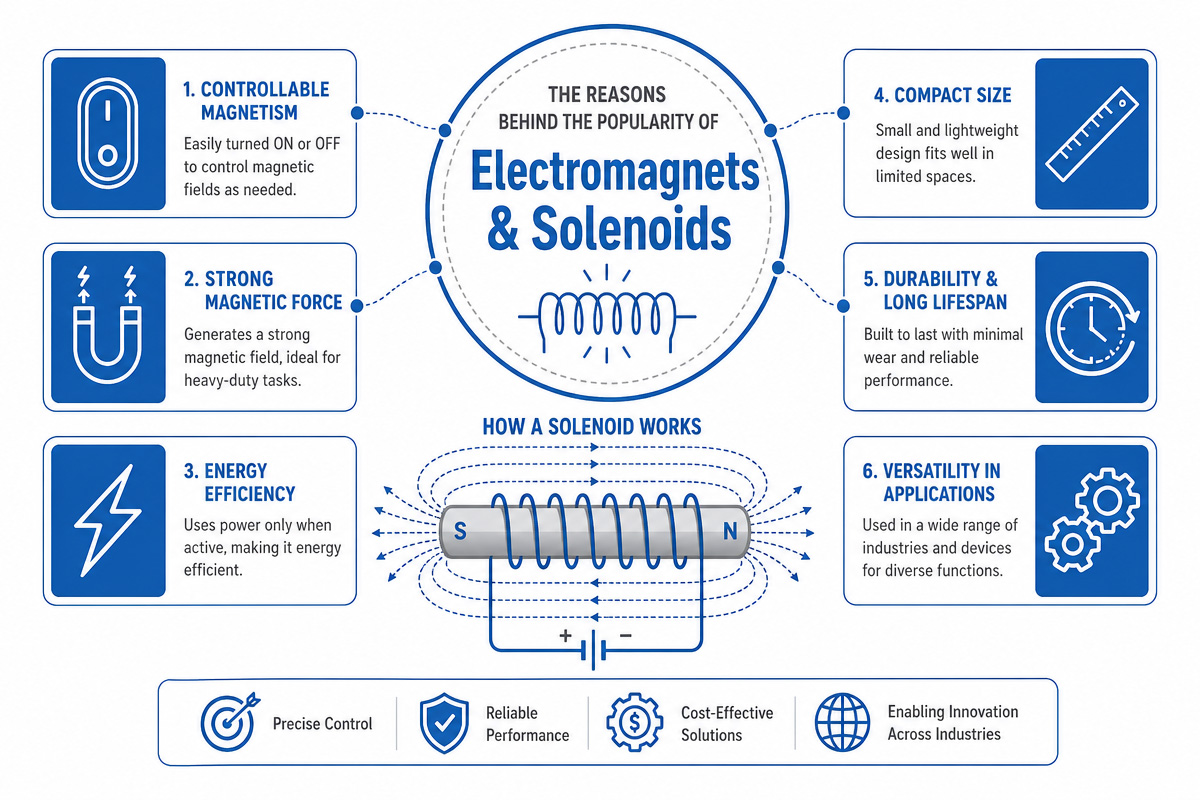
7.1)Electromagnet and Solenoid has Simple Construction & Reliable Operation
– No gears and linkages required
– Less moving parts equals less potential for failures
7.2)Electromagnet and Solenoid features with Fast Action
– Instant actuation in milliseconds
– Ideal for automation & precise control
7.3)Electromagnet and Solenoid also has Easy Electrical Control
– May be controlled directly by:
– DC power sources
– Microcontrollers
– PLCs+
7.4) Low-Cost and Small Size Solution
– Comparatively, compared to motors and pneumatics, they provide:
– More compact size
– Lower total costs
– Better convenience in mounting
7.5) Adjustable Magnitude of Produced Force
– With varying parameters:
– number of coil turns
– applied voltage/current
– core material
– It’s possible to build both:
– micro-actuators
– massive lifting magnets
7.6) Energy Saving (Latching Types)
– Only consumes energy during switching
– Very important when operating in:
– battery-powered systems
– IoT gadgets
Chapter 8 : How to Select electromagnet and solenoid Properly?

A lot of people make mistakes during the choice step since selection criteria between electromanget and solenoid usually include nothing but the physical dimensions of an actuator and voltage. However, that’s not enough.
Step 1: Determine the Desired Type of Motion between electromanget and solenoid
– Linear push or pull motion – Linear solenoid
– Object hold – Holding electromagnet
– Rotation – Rotary solenoid
– Locking of position – Latching solenoid
Step 2: Compute Required Force of electromanget and solenoid
Need to know:
– load’s mass
– friction
– safety margin (+30% or +50%)
Estimation of the magnetic holding force of electromagnets:
F = 2μ0 B2 A
where F is the force, B is the flux density, A is contact area, μ0 is the permeability of vacuum.
Note: Always consult supplier’s graphs to estimate force values in practical conditions.
Step 3: Stroke Length (for solenoids)
– Short stroke length produces higher force
– Longer stroke generates weaker force
Typical stroke lengths:
– 2-10 mm: high force;
– 10-30 mm: moderate force;
– 30 mm and larger: need a custom product
Step 4: Duty Cycle
– Continuous operation (100%): need a heat-resistant construction
– Intermediate operation (25%-50%): higher forces are attainable
– Pulse mode: maximal peak force
Hint: Heating is the most frequent reason of breakdown.
Step 5: Voltage and Power
Possible voltages are:
– 12V DC (most common);
– 24V DC (industry standard);
– Other voltages (5V, 6V, 48V).
Consider:
– Power source available
– Current restrictions if any
– Whether it needs to be battery-driven
Step 6: Ambient Conditions of Electromagnet and Solenoid
Determine:
– Operating temperature range
– Moisture/humidity proofing requirements
– Resistance to dust/corrosive environments
– Vibration resistance (especially for cars and industrial equipment)
Step 7: Physical Size and Fixation
– Space for the actuator available
– Orientation of fixation
– Weight constraints
In some cases, physical fit may matter more than electrical ones.
Step 8. Tips from Practical Engineering Experience
– Do not choose based on max force only. Always estimate the force at the stroke point.
– Ask for the graph of dependence of the force from the stroke length.
– Always add a safety margin between 20% and 50%.
– Remember about noise problems in consumer products.
– In energy-efficient applications, consider using latching solenoids.
Step 9. Example of Choosing the Appropriate Actuator Quickly
Application: Smart cabinet lock
– Needed movement: pull – linear solenoid
– Stroke: 8 mm
– Force required: 15 N – choose the device with 20-25N force
– Voltage: 12V DC
– Duty cycle: intermittent
– Environmental conditions: indoors
Solution: Miniature 12V push/pull linear solenoid with spring return mechanism
Step 10. Final though of electromagnet and solenoid
Electromagnet and solenoid is still popular because they combine the simplicity, speed, low-cost, and convenience in operation.
As long as you base your choices upon the following criteria:
– force
– stroke length
– duty cycle
– environment
then you’ll minimize the chance of making a design mistake.
Chapter 9 : How to Avoid Common Mistakes When Selecting the Electromagnet and Solenoid
Selecting a suitable electromagnet and solenoid usually means recognizing some common mistakes that can be easily avoided with the right approach.
First of all, stop confusing these two terms. While electromagnets and solenoids are somewhat similar, they have different purposes. The former are mainly focused on the generation of magnetic force (for holding, etc.), while the latter are designed for movement along a certain direction (pushing, pulling). Mixing them in your mind leads to unsatisfactory results.
A typical mistake is insufficient estimation of the necessary force. Many people use theoretical figures without considering various losses caused by, e.g., air gaps, friction, misalignment or temperature variations. Add about 20-50% of margin, for example, from 10 N to 15 N, if a data sheet claims 10 N.
Mistakes with voltage and duty cycle lead to a lot of problems. For instance, using a continuous-duty solenoid instead of the one designed for intermittent operation results in overheating. The incorrect voltage causes either low strength or burnout. Make sure that the supply voltage matches the required parameters (e.g., 100% ED versus 25% ED).
Overlooking heat production can ruin your performance quickly. Both electromagnets and solenoids produce heat due to resistance. This requires proper management, especially when used in applications requiring continuous operation or high temperatures, i.e.:
– correct insulation class,
– sufficient ventilation/cooling system.
Otherwise, the strength of your device will degrade, and the coil will break much earlier than expected.
Another important factor many users neglect is the ratio of stroke length to the force curve. The force produced by solenoids changes throughout the stroke. It starts with its maximum value and then decreases. Thus, if the required force appears when reaching the maximal stroke, pay attention to the curve, not to the peak only.
Proper mechanical alignment is also crucial here. For example, even the best solenoid can perform poorly because of:
– misalignment,
– side load,
– poor mounting.
This will cause wearing, excessive noise or sticking.
Often, environmental factors remain unknown until a problem occurs. Think about such aspects as:
– presence of dust, moisture or oil,
– necessity for waterproofing (IP rating),
– possibilities of corrosion.
If you make the wrong choice regarding housing/material, you may shorten the service life considerably.
Finally, many users forget to check the performance during a life cycle. Even if a cheap unit shows good results according to data sheets, it may break after several thousand strokes. So make sure that:
– the rated life cycle corresponds to the required (e.g., 100K vs. 1 M cycles);
– the manufacturer meets the appropriate standards;
– the consistency of units within each batch is good enough.
As far as you would probably like to avoid most of these mistakes, consider using the following checklist:
– define the purpose correctly: for holding vs. pushing/pulling;
– check that the necessary force is provided at the exact position;
– match the voltage/duty cycle;
– estimate thermal parameters;
– check stroke and force curve;
– ensure alignment;
– take into account the environment;
– compare the life cycle/supplier quality.
However, if you tell me about the specifics of your case (load, stroke, voltage, environmental conditions, etc.), I will try to find a suitable model for you.
Chapter 10 : Conclusion of electromagnet and solenoid
Understanding the difference between the electromagnet and solenoid is essential to know the basics of electromagnetism. An electromagnet is the next step in evolution and uses a solenoid with a ferromagnetic core to create the controllable magnetic field. Solenoid is a plain wire coil that generates the magnetic field in the coil. A solenoid is the basis of electromagnet construction while the electromagnet is a finished device. Both of them are important elements in today’s technology. Knowing how these concepts operate and differ from each other can help you understand the basics of the electrical world better.
Chapter 11 : FAQ of electromagnet and solenoid
- What makes the electromagnet and solenoid different ?
The solenoid is a coil of wire while the electromagnet is a solenoid that creates a magnetic field with the core.
- Can I use a solenoid without turning it into an electromagnet?
Yes. You can use the solenoid as a separate device.
- Why is an electromagnet stronger?
It possesses an iron core that makes it stronger.
- Do people use electromagnets in everyday life?
Sure. Electromagnets work as doorbells, motors, and cranes.
- How to make a solenoid strong?
Increase the number of turns or make the solenoid longer.
- Is the electromagnet better than the regular magnet?
It depends on your needs but, usually, yes, because of its controllability.
- In what spheres are solenoids used?
Relays, valves, automotives, industrial automation.
- Is every solenoid an electromagnet?
No. The solenoid is the base of the electromagnet.