The correct selection of DC industrial solenoid is necessary to provide optimal work for automation, locking, medical and industrial equipment. It is important to remember that there is no “universal” model and to understand the characteristics and parameters of the product.
The Guide Will Help You Understand Everything!

Chapter 1: What is a DC Industrial Solenoid?
It is an electromechanical device that transforms electrical energy into linear or rotary movements thanks to electromagnetic action.
Basic composition:
Coil (copper winding)
Plunger (magnet)
Sleeve (frame)
Spring (return mechanism)
At the time of connection, due to the magnetic field created by the coil, the plunger is attracted into the coil causing either pushing, pulling or rotation.
Chapter 2: The Type of DC Industrial Solenoid
Choosing the correct type of solenoid should be your priority.
2.1. Linear Solenoid
Push or pull action
Standard type
Typical applications include door locks, valves, automation systems
2.2. Rotary Solenoid
Angular action
For switchable and indexing systems
2.3. Tubular Solenoid
Small size and cylindrical shape
Excellent performance and long lifespan
2.4. Latching Solenoid
Does not require constant voltage to hold its position
Ideal for saving energy
Chapter 3: Working Principle of DC Industrial Solenoid
The basic principle of the DC solenoid is electromagnetism.
At the moment of applying voltage:
Magnetic field arises
Plunger is attracted into the coil
There appears mechanical action
When power ceases:
There is return of plunger in the initial position
due to the effect of a spring
Chapter 4: Application of DC Industrial Solenoid
There are a lot of areas of use for this solenoid.
Access Control Systems (Locking Mechanisms)
Automobile (Gear Shifting System, Fuel System)
Medical Devices (Precision Actuators)
Automation Machinery (Sorting Machinery, Robotics)
Vending Machines/Kiosks
Banks Equipment (Safe Locks)
Chapter 5: How to avoid making mistakes when selecting a DC Industrial Solenoid?
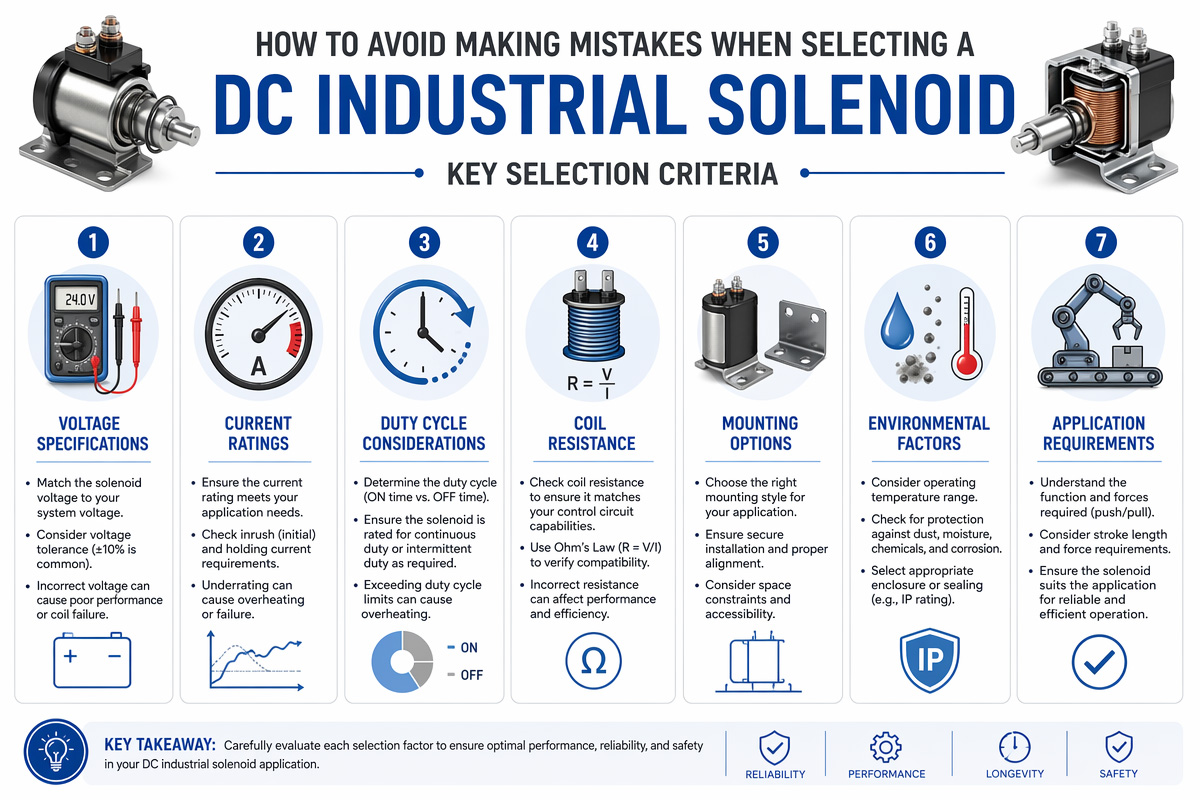
5.1 Do not underestimate the requirements of force
Mistake: selection of solenoid depending on the nominal force value
Problem: In real applications, additional forces must be overcome, such as friction force, misalignment of installation, etc.
✅ Right Way
Add 20-30% safety margin
Take into account the force at the point of maximum stroke
5.2 Neglect of force dependence on stroke
Mistake: to select solenoid without taking into account the reduction of force on stroke
Reality: Force rapidly declines while the stroke increases
✅ Avoid this mistake by:
Estimating force/stroke dependency chart
Taking into account force at maximum stroke
5.3 Ignoring the requirement of duty cycle
Mistake: using intermittent solenoid where continuous is needed
Consequence: overheating of solenoid, burnout of coil
✅ The right approach
Define clear ON/OFF times
Match them with:
100% duty (continuous)
25% duty (intermittent)
Pulse duty (<10%)
5.4 Do not pay attention to temperature
Mistake: ignoring environmental conditions (ambient temperature and temperature rise)
Problem: Reduced operating force, burnout due to exceeding insulation limit
✅ To prevent mistakes do the following:
Take into account ambient temperature
Check temperature rise limitations
If needed increase insulation class of coil
5.5 Ignoring operating environmental conditions
Mistake: installing non-protection solenoid in difficult conditions
Problem: solenoid corrosion, dust blocking the hole in the solenoid
✅ Right approach
Indicate protection level (IP) of a solenoid
Apply corrosion-resistant coating
Protect with sealed case
5.6 Installing in limited space without verification of performance parameters
Mistake: installing solenoid before knowing whether it satisfies force/ stroke parameters
Fact: Solenoid with smaller dimensions provides lower force/output stroke ratio
✅ Avoid by:
Checking performance first and then installation space
Preparing yourself to change mounting place
5.7 Ignoring time response requirement
Mistake: failing to set clear requirements of time response of actuator
Problem: slow response leads to inefficient work, fast response – to overheating
✅ To avoid mistake define:
Time of actuation in ms
If necessary, apply voltage booster circuit
Incorrect matching power source
Mistake: selection of inappropriate voltage/current
Consequence: weak force output (under-voltage), overheat (over-voltage)
✅ Right way:
To match solenoid specifications with the voltage source of DC (12V, 24V, etc.)
5.8 Not considering the requirements of service lifetime and reliability
Mistake: focusing only on initial parameters and performance
Consequence: frequent breakdown of the equipment
✅ Correct way:
Specify rated number of cycles (operational lifetime)
Evaluate mechanical wear of moving elements (plunger, spring)
5.9 Attempting to finalize the specifications on own
Mistake: trying to find out parameters on own
Reality: solenoid performance depends greatly on particular application conditions
✅ The right way
Provide information about:
Force requirement
Stroke
Duty cycle
Operating environmental conditions
Pro-Tip (Oftentimes Forgotten)
In case your requirements almost coincide with the standard DC industrial solenoid
➡️ you might consider customized or adapted one.
Benefits:
Improved efficiency
Reduced size restrictions
Extended operational lifetime
Chapter 6: Reason for Popularity of DC Industrial Solenoid
6.1 Perfect Suit for Automation and Smart Equipment
Modern equipment requires the actuator to have the following properties:
Fast actuation
Precision
Compact size
And this is what a DC solenoid gives
Applications:
Automation machinery
IoT devices
Smart Access Control Systems
With the development of automation, more and more DC solenoids become necessary.
6.2 Simple Structure = High Reliability
Comparing solenoid with other actuators (motors, pneumatic cylinders) it can be stated that they have:
Fewer moving elements
Do not require gearing
Minimum maintenance
As a result of which solenoids are characterized by:
Low failure rate
Longer operating period
Minimal downtime
6.3 Fast Response Time
The response time of DC solenoid does not exceed millisecond
Benefit:
High-speed sorting systems
Accurate dosing mechanism
Safety mechanism
6.4 Integration into DC Electric Power Systems
Almost all modern technical systems operate under DC voltage
Voltage levels: 12V, 24V, etc.
Battery-operated devices
Solenoid perfectly fits into electric system due to the possibility of direct integration
Benefit:
Higher efficiency
Low complexity
6.5 Energy Saving Properties
Thanks to advances in production new designs of solenoid appeared, such as latching solenoid. They consume electrical energy during switching only.
Comparing with other designs they require:
Lower electrical consumption
Less heating
Perfect for green energy applications
6.6 Small Size and High Output Force
Due to advances in technologies modern DC industrial solenoids provide
Higher efficiency
Better power density (smaller dimensions, more output force)
👉 Suitable for:
Medical equipment
Portable equipment
6.7 Low Cost (in Some Cases)
Comparing with expensive actuators such as AC motors, DC Industrial solenoids:
Has a Low price Compared to alternatives:
| Technology | Cost | Complexity | Maintenance |
| Solenoid | Low | Low | Low |
| Pneumatic system | Medium | High | High |
| Servo motor | High | High | Medium |
👉 Solenoids offer the best cost-to-performance ratio.
6.8 Variety of Applications
These DC solenoids have a wide range of uses in different sectors:
Door locking
Automobile (fuel systems, transmissions)
Medical devices
Consumer devices (vending, kiosk systems)
Automation machinery
6.9 Possibility of Customization
The possibility of modification allows to use DC solenoid in many different application areas by varying the following features of construction:
Stroke
Output force
Voltage type
Mounting structure
6.10 Advances in Technologies of Production
Recent progress in manufacturing process and material usage allowed to improve performance of DC solenoids:
Improving of insulation class
Increasing of magnetic properties of materials
Using CNC precision machines
…etc.
6.11 Conclusion
DC industrial solenoids are becoming popular due to the following reasons:
✔ Simple construction
✔ Fast response
✔ Long-life and minimal maintenance
✔ Cost-effectiveness
👉 They do not replace other actuators but for on/off linear motion they are the best solution.
6.12 Quick Insight
If your application requires:
Short stroke
Fast actuation
Repetitive motion
DC solenoid will be better solution than motors or pneumatic systems.
Chapter 7: Steps to Selecting a DC Industrial Solenoid
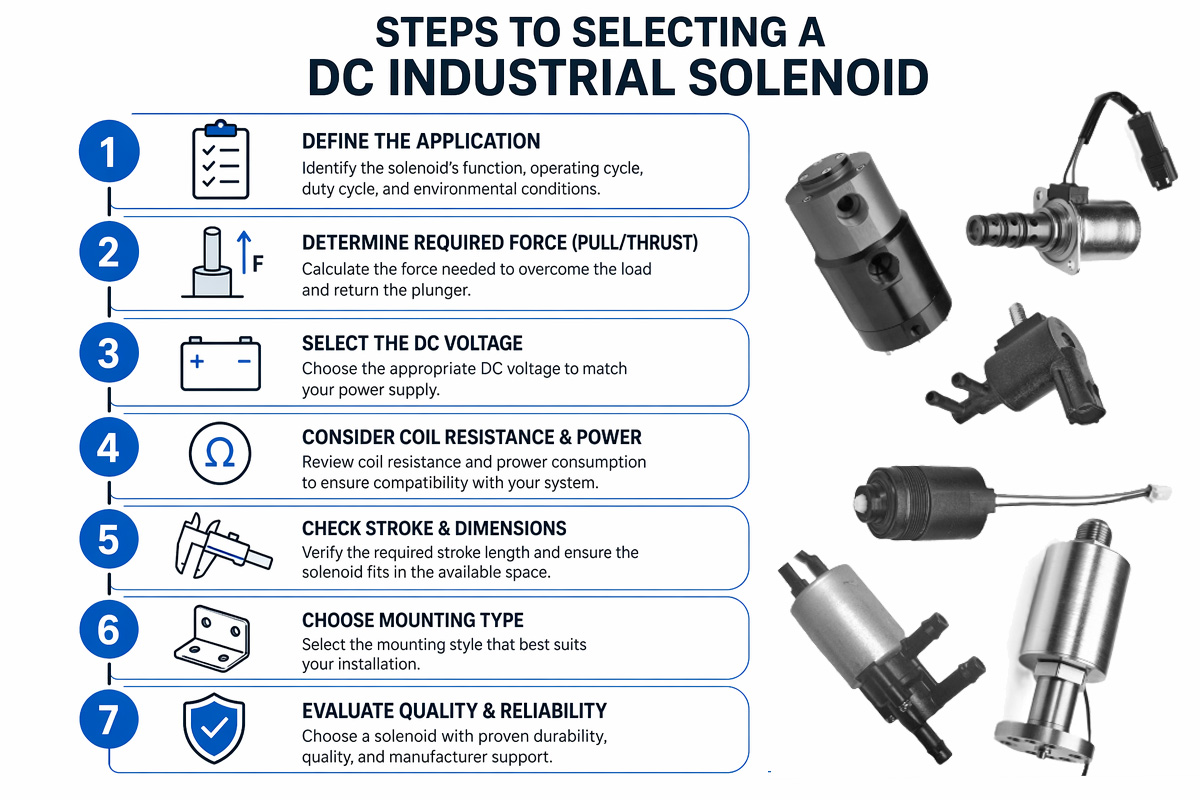
For selection of DC industrial solenoid please take the following six steps.
7.1 Solenoid Size Restrictions
Defining space available for installing the solenoid
Parameters: length, width, height
⚠️ Limited space may reduce force and output stroke capabilities.
7.2 Direction of Actuation
Selection of direction of actuation is necessary. The options include:
Pushing
Pulling
Rotating
7.3 Operating Stroke
Definition of operating stroke is a next step
Stroke is the distance that the plunger will travel
Short Stroke (<6 mm) – compact solenoid
Long Stroke (<50 mm) – larger size solenoid
⚠️Important:
Lower output force with increasing of stroke.
7.4 Actuation Force
Selection of minimum force that is required to move an object at maximum stroke.
Value indicated in Newtons (N)
Required to overcome load resistance
Always take into account safety margin.
7.5 Duty Cycle
Definition of ratio between ON time and OFF time of the actuator. Possible solutions:
Continuous duty (100%) – actuating continuously
Intermittent duty (25%) – periodic actuation
Pulse duty (<10%) – quick burst actuation
❗ Shorter duty cycle – possibility of higher force generation.
7.6 Environmental Considerations
-
a) Ambient temperature
Higher temperature – lesser force generated by solenoid
Maximum temperature depends on coil insulation
-
b) Humidity and moisture, Dust
Need for sealing and/or protective housing
Need for anti-corrosive coating
Chapter 8: Custom DC Industrial Solenoid or Standard Solenoid?
If none of standard designs meets your needs:
Modification of standard solenoid – cheaper and faster
Customization of DC industrial solenoid – more advanced solution
Working with experienced manufacturers helps to get optimal product.
Chapter 9: Additional Frequently Asked Questions about DC Industrial Solenoid Selection and Application
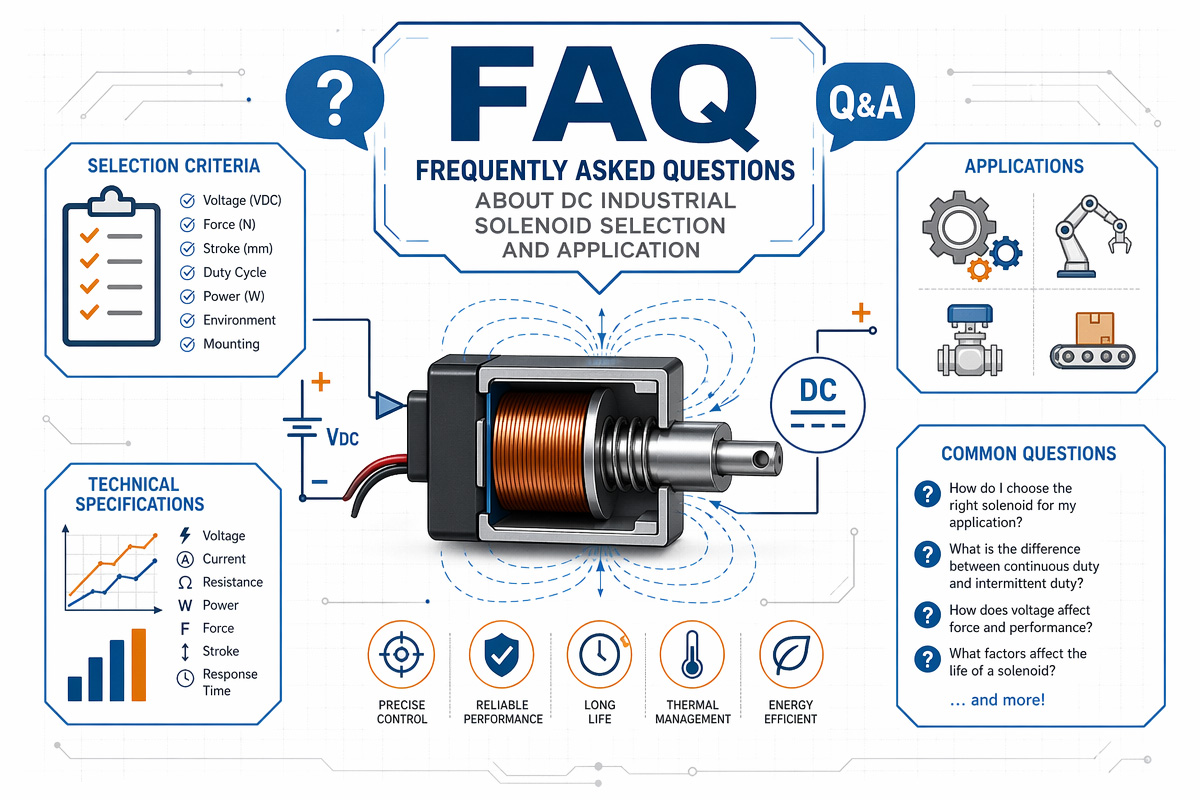
9.1 How can I calculate the appropriate force of the solenoid?
The solenoid must be able to generate a force that exceeds the requirements of your system by approximately 20-30%
– This is because of the possible presence of friction, wear, and misalignment.
– Make sure that the necessary force is reached during full stroke rather than initial stroke.
9.2 Why does the solenoid force depend on stroke?
It depends on the properties of an electromagnetic field.
The farther the plunger is from the winding, the lesser becomes its magnetic attraction.
– As a result, the maximal force is exerted at 0 stroke while the minimal – at full stroke.
9.3 What duty cycle fits me best?
The choice is determined by the time of operation for the solenoid.
– 100% Duty Cycle (Continuous) – always ON
– Intermittent Duty (25-50%) – periodic operating mode
– Pulse Duty (<10%) – short-term strokes
9.4 Difference between push and pull solenoids?
– In the push solenoid, the plunger moves outwards.
– In pull solenoid, plunger moves inwards.
– Pull solenoids usually produce greater forces due to the superior performance of the electromagnetic field.
9.5 Is it possible to have a continuous operation with DC industrial solenoid?
Yes, however, only if the solenoid was designed for that particular type of work (continuous-duty solenoid).
– Continuous solenoids are designed to dissipate heat faster and have higher-class insulation.
– Non-continuous solenoids used for continuous operations will suffer from coil burnout after some time.
9.6 Do environmental factors influence the operation of DC solenoid?
Indeed, there are plenty of environmental factors that may affect solenoid performance:
– Heat reduces force;
– humidity causes corrosion and other damage;
– dust obstructs the movement of the plunger.
– For protection against the environment use waterproof and dust-resistant seals, varnishes, and coatings.
9.7 What voltage would be better to choose (12V, 24V, …)?
Select such voltage as corresponds to the voltage in your system.
– The most popular are:
– 12V DC – for portable systems
– 24V DC – used mostly for industrial automation.
– The greater the system voltage, the smaller becomes its current consumption.
9.8 When do I need a custom-designed DC solenoid?
You should opt for a customized solution in cases:
– Standard solenoids cannot provide the desired force or stroke
– Space limitations are critical
– Your environment requires additional care
– In such cases, a custom solenoid ensures you get the optimal solution.
Chapter 10: Conclusion
Proper selection of the DC industrial solenoid requires deep understanding of the parameters such as force, stroke, duty cycle, and environmental factors. If you follow these guidelines, you will be able to select the best DC industrial solenoid for your purpose.