

Introduction :
Stainless steel stamping products are found everywhere: from household appliances in kitchens to monumental architectural elements such as urban sculptures, building facades, and interior objects. The wide variety of applications of the material is explained by the attractiveness of stainless steel due to its aesthetics, high resistance to corrosion, and long-term operational reliability. Unfortunately, there are still many prejudices and misconceptions about this type of product. One of the most common is the so-called “magnet test”.
Not long ago, I witnessed how a customer was conducting tests of cookware on the presence of magnetism in a building materials market. The gentleman insisted that “if a magnet attaches, then it is bad stainless iron; if not – then it’s stainless steel, which means good steel and stainless steel cannot contain any magnetism.” Such misunderstandings arise mainly due to lack of information, so let’s shed light on some aspects of stainless steel production.
Chapter 1. Clarifying Terms: The Difference between Iron, Steel, and Stainless Steel
The difference between iron and steel lies in the amount of carbon they contain:
Steel contains no more than 2% of carbon in its composition.
In iron, the concentration of carbon exceeds 2%.
Chapter 2. Classification of Stainless Steel Stamping: Why Are Some Types Magnetic?
Stainless steel is mainly classified into three types based on microstructure. Their magnetic properties differ due to alloy composition:
| Type | Main Alloy Elements | Magnetic | Key Characteristics |
| Austenitic | Chromium + Nickel | ❌ Non-magnetic | Attractive appearance, good overall performance |
| Ferritic | Chromium + little/no nickel | ✅ Magnetic | Cost-effective, good thermal conductivity |
| Martensitic | Chromium + Iron + Carbon | ✅ Magnetic | High hardness, can be heat-treated |
There are over 100 types of stainless steel stamping today. Apart from austenitic stainless steel, both ferritic and martensitic types are magnetic. Therefore, the claim that “non-magnetic equals good stainless steel” is completely false.
Chapter 3. Buyer Beware: Don’t Be Misled by “Non-Magnetic”
this metal is strong, flexible, and highly resistant, so steel is the material most commonly used in everyday products. Stainless steel is one type of steel characterized by high resistance to corrosion due to chromium added to its composition. Steel is called “stainless” when chromium content is 10.5% and higher.
Magnetism does not play any role in terms of assessing quality. It all comes down to alloy composition and the structure of metal on a microscopic scale. In metallurgy, the term “stainless iron” is not relevant. Don’t Be Fooled by “Non-Magnetic”
Why is there a preference for non-magnetic stainless steel? Another common misconception is “stainless steel without magnetism contains more nickel and, therefore, is better”. This is due to the fact that nickel is a relatively rare and expensive element, and high-nickel austenitic stainless steel is quite expensive. However, the absence of magnetism does not necessarily imply the presence of good properties.
Some kinds of non-magnetic stainless steel stamping involve the application of the formula based on manganese content and reduced content of nickel (or even its absence at all). Such grades cost thousands of RMB cheaper than high-nickel grades. Dishonest suppliers capitalize on the idea that non-magnetic stainless steel stamping is high-quality and sell cheap non-magnetic steel as more expensive high-nickel stainless steel. Therefore, always stay vigilant when shopping.
Chapter 4. Choosing the Right Grade of Stainless Steel for Your Application
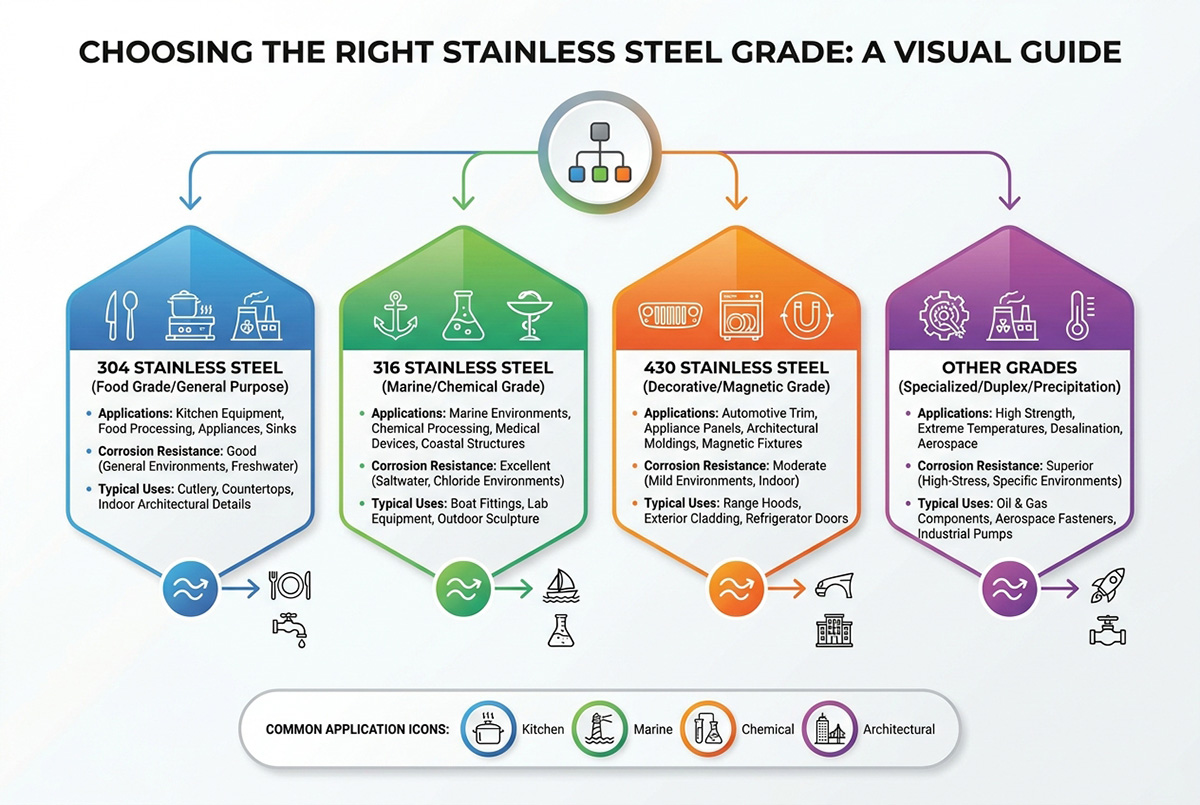
There are several types of stainless steel stamping with specific properties that determine their areas of use. Proper selection of materials according to application requirements is the key to achieving the highest quality and performance:
Aesthetically appealing, shiny, and non-magnetic, austenitic stainless steel is ideal for decorative purposes such as sculptures and landscaping objects. The disadvantage of this grade is that it does not conduct heat well, thus it is not suitable for cooking utensils since its heating requires additional effort.
Very resistant to corrosion and featuring thermal conductivity exceeding the indicators of austenitic grades by nearly 50%, ferritic stainless steel is perfect for the manufacture of fry pans, rice cookers, washing machine drums, water heaters, and kitchen sinks.
Extremely durable martensitic stainless steel allows changing hardness through heat treatment. It is the best choice for knives and blades. Most often people say that “stainless steel knives are not sharp” because heat treatment cannot increase the hardness of austenitic stainless steel. The stamping properties of stainless steel
Is stainless steel stampinig fragile and subject to bending?
The stamping properties of stainless steel depend greatly on the grade and previous treatment. Highly malleable austenitic steel (e.g., 304 grade) bends even during the cold working process. On the contrary, brittle martensitic steel grades such as 420 tend to break under pressure. Hardness of steel can vary depending on previous heat treatment or cold deformation and affects stamping significantly.
Chapter 5. Material Selection Tips for Stainless Steel Stamping
Several practical factors determine whether the material will perform well during stamping and meet end-use requirements:
| Factor | Considerations |
| Thickness | Stainless steel sheets generally range from 0.1 mm to 6 mm. Thin gauges suit lightweight or detailed components; medium and thick sheets provide strength for structural or load-bearing parts. |
| Tolerance | Cold-rolled sheets typically offer tighter tolerances of ±0.02–0.05 mm. Applications with strict dimensional requirements may call for even higher precision. |
| Surface Finish | Options such as 2B, BA, or No. 3 finishes influence appearance and the need for further surface treatments. |
| Mechanical Properties | Yield strength, tensile strength, and elongation levels affect die design, press force, and overall process settings. |
By weighing these factors together, manufacturers can select materials that balance formability, strength, and final product performance.
Chapter 6. Common Types of Stainless Steel Stamping
| Grade | Characteristics |
| 301 Stainless Steel | Moderately high tensile strength and corrosion resistance. Available in hard, half-hard, and full-hard. |
| 304 Stainless Steel | The workhorse of the 300 SS series. Moderate tensile properties, corrosion resistance, most common in food-grade quality stainless steel and disc stamping. |
| 316 & 316L Stainless Steel | Modification of the basic 300 SS series. Added molybdenum improves strength and corrosion resistance. Used for pharmaceutical, food processing, and marine environments. |
| 321 & 347 Stainless Steel | Variations of the basic 18-8 composition. Stabilized by alloy addition to improve weldability and high-temperature service. |
| 17-7PH Stainless Steel | Heat-treatable stainless steel with forming characteristics of 304. May be hardened up to 200,000 psi tensile strength after cold forming. |
Chapter 7. Stampability of Stainless Steel Stamping
Will Stainless Steel Stamping Snap or Bend?
The properties of stainless steel depend on the type of grade and heat treatment/cold-working of the material. The austenitic grades (304) bend and do not break easily under cold working conditions. Meanwhile, martensitic grades (420) are less ductile and tend to snap.
Differences Between Various Grades for Stamping
An austenitic grade with low carbon content makes the metal stretchable, therefore it can be used in deep drawing to create sinks and fryers. Meanwhile, martensitic types of stainless steel are harder and less ductile. Therefore, they are preferred when it comes to making cutting tools and other sharp items.
Features and Benefits of Stainless Steel Stamping
Fire and heat resistance: the high amount of chrome and nickel provides heat resistance to stainless steel.
Aesthetic look: consumers prefer the look of the stainless steel sink and can polish them with electropolishing.
Long life: stainless steel parts do not degrade in quality or aesthetics after years of service despite a relatively higher initial price.
Sanitary properties: stainless steel is trusted by the pharmaceutical and food & beverage industry, since parts made of it can be quickly washed without any problem. Some stainless steel alloys can be considered to be safe for contact with food.
Sustainability: according to many experts, stainless steel can be called one of the most sustainable alloys to use.
Key Properties When Working with Stainless Steel Stamping
When do the stainless steel stamping, remember about its properties:
High yield point, hardness and cold work hardening → the material is very prone to breaking apart
Low thermal conductivity compared to carbon steel → more forces required to deform the material, cutting and blanking
High plastic deformation force when drawing → wrinkles and tearing of thin material during drawing
Tendency to die galling and surface scratching during drawing → require adequate lubrication
High hardness and great corrosion resistance → good materials for structural, cosmetic and outdoor parts
Chapter 8. Why Stainless Steel Is Great for Stamping
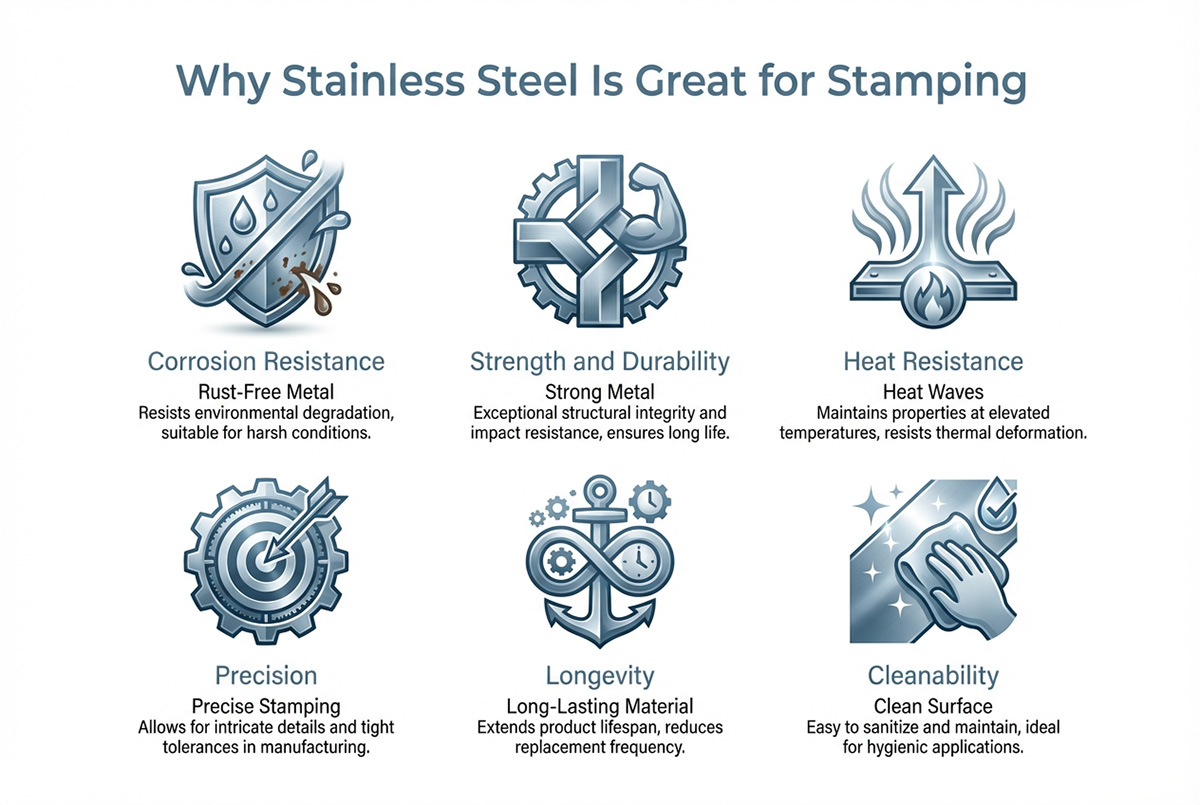
There are some reasons why people prefer to stamp stainless steel parts:
Corrosion Resistance: thanks to the high amounts of chrome and nickel, stainless steel stamping can endure exposure to humidity, chemicals, and moisture and will not deteriorate from the outside.
Strength and toughness: stainless steel stamping offers great strength and toughness properties, which allow creating strong and resilient parts that can be bent and drawn into different shapes.
Surface finishing options: the material allows using different finishes for stamped parts.
However, stainless steel stamping is more complicated to work with than carbon steel because of its increased hardness, ability to work-harden and lower thermal conductivity. To tackle those problems, the stamping industry evolved dramatically. Tolerances became more precise, the efficiency was increased through the progressive dies with up to 200 strokes per minute, and the smart manufacturing systems were implemented.
Chapter 9. Stainless Steel Stamping Process
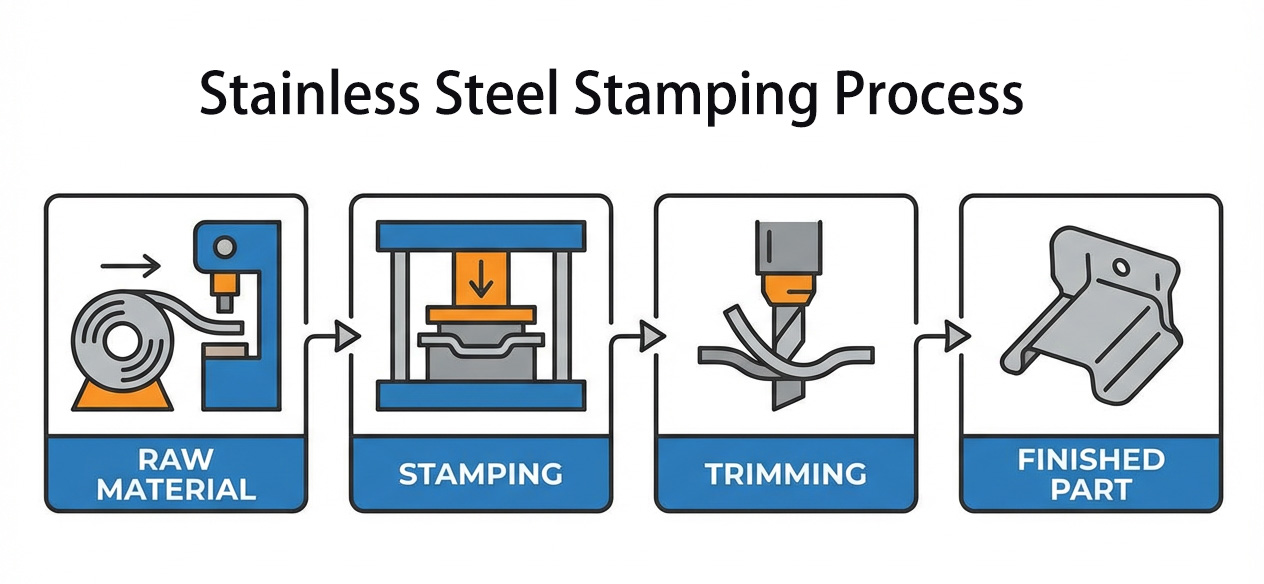
9.1 Equipment Selection
Successful stainless steel stamping begins with selecting the right equipment:
| Equipment Type | Suitable Process | Recommended Tonnage |
| Mechanical Press | High-speed blanking, shallow drawing | 25–200T |
| Hydraulic Press | Deep drawing, precision forming | 100–1000T |
| Servo Press | High precision, energy-saving | 30–300T |
9.2 General Steps
Stainless steel stamping process requires several processes to create the desired shape and quality:
Blanking: Cutting the stainless steel sheets in required sizes using mechanical shears and lasers.
Punching: Making holes or separating pieces. It is important to align the dies accurately and apply the necessary pressure to get clean edges without burrs.
Bending: Bending pieces of metal in required angles using press brakes and forming dies. It is important to set up the machinery to prevent spring back.
Drawing: Forming of deep drawing pieces such as sinks and containers through the process of metal forming in die cavities. Material and process parameters need to be selected correctly.
Finishing: Correcting pieces after bending to compensate for the spring back.
Surface Finishing: Various polishing and coating options can be used.
Chapter 10. Quality Assessment and Surface Treatments
Surface treatments types
Surface finishing methods
Mechanical: vibration polishing, sandblasting, brushing, polishing with mirror
Chemical: passivation, electropolishing, coloring, PVD coating
Special antibacterial, fingerprint-resistant, self-cleaning, and laser textures
Quality Check
Dimensional measuring instruments: caliper, CMM scanner, optical scanner
Methods of visual inspection: visual inspection, roughness measurement, SEM, and 3D white-light interferometry
Performance tests include: salt spray test, hardness test, metallography, tensile/bending test
Chapter 11. Possible Problems in Stainless Steel Stamping and Ways to Solve Them
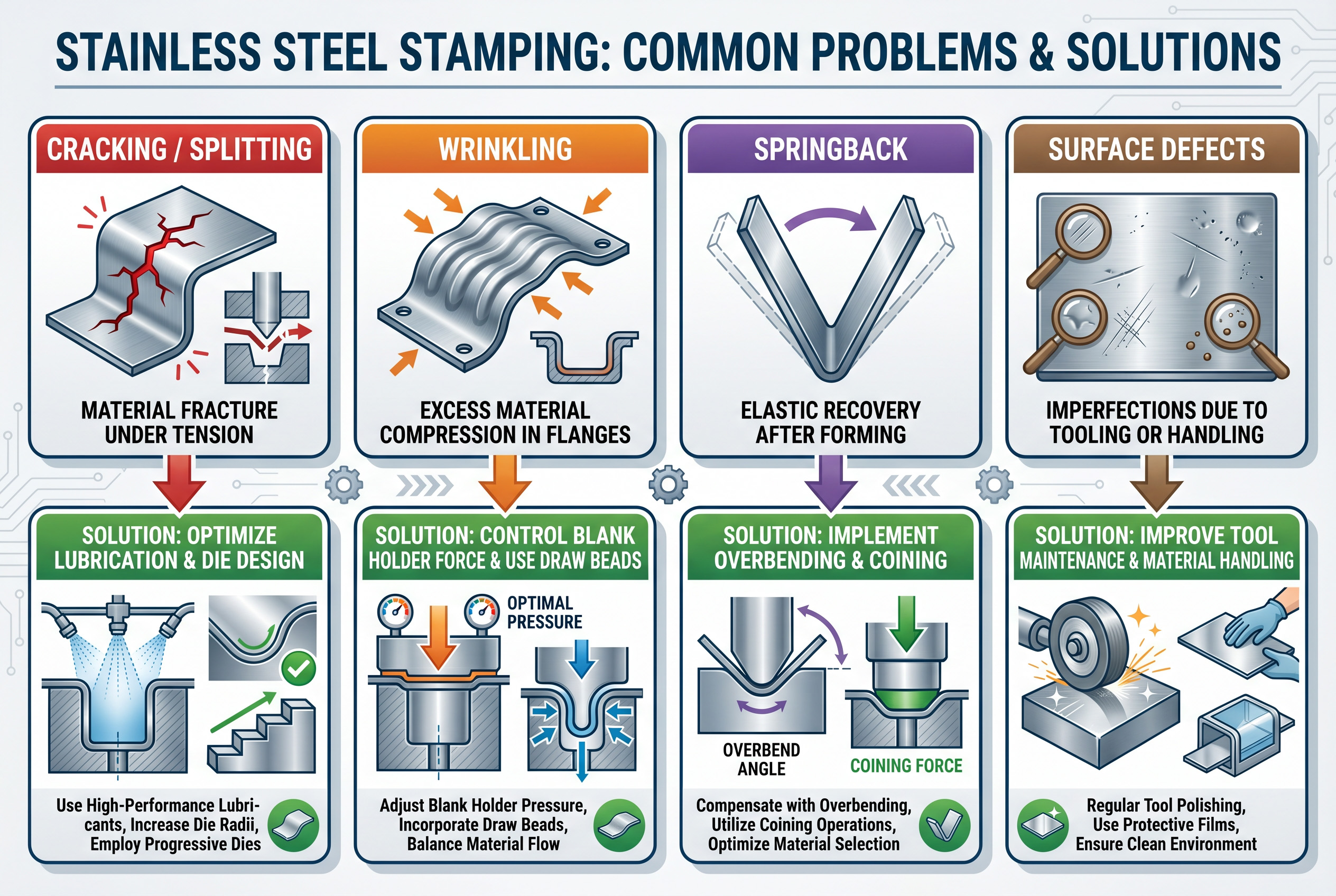
11.1 Surface Scratches
Cause of the defect: Movement of the workpiece surface and molding surface relative to each other under pressure and formation of overheated layer due to plastic deformation.
Solution: Applying adequate amounts of lubricant, keeping the mold surface in optimal condition, and controlling pressing speed.
11.2 Breaking and cracking
Cause:
High cold hardening index of austenitic stainless steel causing martensitic transformation.
Inhomogeneity of sheet structure
Insufficient die space allowance or incorrect centering.
Increased punching temperature due to long-term stamping.
Non-uniform loads caused by nibbling, punching corners, or cutting
Solution:
Optimizing the sheet annealing process
Achieving more homogeneous plane strain orientations within grains.
Changing the pressure distribution during die debugging.
Adjusting die clearance and alignment.
11.3 Problem with Stripping (metal transfer)
Cause:
Worn cutting edge
Too much mold allowance
Inadequate clearance
Use of inappropriate stamping oil causing metal thickening
Solution: Maintain the cutting edge in a proper condition, optimize clearance and use special stamping oils.
11.4 Deformation resulting from springback
Cause: All materials experience springback deformations after stretching, however, the high hardness of stainless steel causes significant rebounding.
Solution: Predicting springback in the design process and including measures against it.
11.5 Issues during heat treatment
Cause: Numerous parts created using stamping and drawing require further heat treatment. Heating the parts may cause bending.
Solution: Taking into account the expected distortion of parts.
11.6 Selecting punches and dies material
Cause: High hardness of stainless steel leads to severe wear of punches and dies.
Solution: Using stamps of the appropriate hardness to match stainless steel grade.
11.7 Stamping oil issues
Cause: Incorrectly chosen stamping oil may lead to hardening of steel, deformations, burr formation, or cracks.
Solution: Use drawing and stamping oils containing sulfur and chlorinated components. Opt for low viscosity oils to facilitate cleaning.
Chapter 12. Conclusion
Thanks to advancements in technology, stainless steel stamping has evolved from simple forming into sophisticated operations performed using automated systems with sensors. These processes will continue to evolve and become more efficient in response to growing demands for higher performance and reliability of parts produced.
However, the task is not limited to the ability to stamp the desired part, but it also means being able to create high-quality and precisely manufactured parts. When it comes to implementing your product design, partnering with an experienced manufacturer is always a winning solution.
Chapter 13. Frequently Asked Questions (FAQs)
1 Does stainless steel rust?
Yes, under specific circumstances only. Unlike regular steel, stainless steel resists rusting due to the presence of chromium that provides an inactive oxide coating. In case of excessive exposure to aggressive surroundings, damaged protective oxide layer, or inappropriate application of inferior grades, stainless steel may corrode.
2 Which grade is better for stamping: 304 or 316 stainless steel?
In general, 304 is preferred for conventional stamping purposes. The alloy is highly malleable and affordable, making it ideal for manufacturing a wide variety of consumer goods and equipment. Grade 316, enriched with molybdenum, provides greater corrosion resistance but proves challenging for stamping. Therefore, this grade is recommended for marine, pharmaceutical, or food-processing applications where corrosion resistance takes precedence over manufacturing efficiency.
3 Why are stainless steel stamping dies prone to rapid wear?
Insufficient lubrication, inadequate clearances, high-speed stamping, improper selection of die materials with insufficient hardness, and negligence regarding die maintenance (e.g., dull cutting edges) may cause rapid wear of stamping dies.
4 How can I prevent galling (scratching) during stamping stainless steel parts?
To minimize heat build-up, choose premium-grade stamping oils with extreme-pressure additives, provide adequate clearances, maintain proper smoothness of the dies’ surfaces, apply coatings and polish the dies’ surfaces, and manage the speed of stamping.
5 Why does my stainless steel part have burrs?
Burr formation is caused by excessive clearances, dull cutting edges, poor alignment, or lack of proper support during material shearing operations. Ensure that the dies’ alignment is correct, provide optimal clearances, and maintain sharpness of punches and dies regularly.
6 What is the difference between 301 and 304 stainless steel stamping?
Grade 301 has increased work-hardening rates and exists in several tempers (hard, half-hard, full-hard). As a result, it is preferable for manufacturing springs and parts with high tensile strength requirements. In turn, 304 is recognized as the best choice for general stamping and food-grade applications. Due to its ductility, this alloy offers greater malleability and durability against corrosion.
7 Is welding possible for stamped stainless steel parts?
Welding stamped stainless steel parts is possible but requires extra care. Ensure the compatibility of filler metal, optimize the amount of heat input to avoid part deformation, and consider post-weld heat treatment (annealing) for releasing residual stresses. It is recommended to weld austenitic grades (304, 316) rather than martensitic grades.
8 How can I eliminate springback in bent stainless steel stamping parts?
To compensate for rebound, perform pre-bend with a higher bending angle, apply bottoming or coining operations, extend the holding time, and redesign dies with springback compensation features based on material test data.
9 Is stamping capable of magnetizing stainless steel parts?
Yes, some grades of stainless steel become slightly magnetic during cold working operations (bending, stamping, drawing). Such effects are typical for austenitic grades (304) that normally aren’t magnetic. In such cases, magnetism doesn’t indicate poor quality.
10 What is the optimal thickness for deep drawing of stainless steel stamping?
Thinner gauges (0.5-1.5 mm) are used for manufacturing products with intricate shapes, such as sinks and cookware meant for daily usage. Nevertheless, the elongation percentage of material plays a key role in deep drawing. Thus, austenitic grades (304) are preferable for deep drawing due to their high elongation rate.
11 How should I select the proper lubricant for stainless steel stamping?
Consider material grade (austenitic vs. martensitic), operation (drawing vs. blanking), complexity of the parts, and requirements for the cleaning process. Chlorinated and sulfurized EP oils are preferable for hard drawing processes, while light oils are preferable for blanking operations. If post-stamping cleaning is necessary, use low viscosity or water-soluble lubricants.
12. What causes wrinkling of deep-drawn in stainless steel stamping parts?
Insufficient pressure applied to the blank holder, inefficient design of draw beads, excessively large clearances, or inadequate lubrication may cause wrinkling during deep-drawing operations. Increase pressure on the blank holder, optimize the shape of draw beads, and ensure uniform distribution of material flow.
13 What is the difference between passivation and electropolishing?
Passivation is aimed at eliminating contaminants from the surface of stainless steel parts and enhancing the oxide coating to provide superior corrosion resistance. Electropolishing removes a thin layer of material to provide a perfectly smooth, polished, reflective surface with improved corrosion resistance.
Is it possible to perform heat treatment to harden stainless steel parts after stamping?
Only martensitic and precipitation-hardening grades (17-7PH) may be hardened via heat treatment. Austenitic grades (304, 316) cannot be hardened by heating but are hardened through cold-working.
14 How can I prevent cracks in stainless steel stamped parts?
Use annealed material whenever possible, lubricate parts properly, optimize clearances of the dies, control stamping speed to decrease heat generation, apply larger bend radii, and consider multistage stamping operations to manufacture complex parts.
Stainless Steel stamping Properties and Benefits
Stainless steel with high amounts of chromium and nickel is highly resistant to heat.
Appearance: Stainless steel is aesthetically pleasing to many consumers, and electropolishing improves its appearance further.
Cost-efficiency: While being more expensive initially, stainless steel provides long-lasting quality and aesthetic performance.
Sanitation: The pharmaceutical and food and beverage industries rely on stainless steel because of its sanitary properties. Several alloys are approved as food-grade materials.
Sustainability: This alloy is among the most eco-friendly options available on the market, suitable for green manufacturing processes.
Key Characteristics of stainless steel stamping Operations
While making the stainless steel stamping parts, remember the following characteristics:
High yield point and hardness along with cold-working hardening make parts susceptible to cracking.
Poor thermal conductivity compared to carbon steel makes stainless steel parts require greater deformations, blanking, and drawing forces.
Heavy plastic deformation force during drawing makes thin-gauge parts wrinkle and tear.
During drawing operations, they are vulnerable to die gall and scratches. Therefore, ensure adequate lubrication.
Due to hardness and rust-resistance, it is frequently used for manufacturing parts with structural, cosmetic, and outdoor purposes.
15 Why Stainless Steel is the Best Material for Stamping
There are several reasons why people prefer to stamp stainless steel parts:
Corrosion-resistance: Stainless steel stamping products won’t oxidize in contact with moisture, corrosive substances, and humid environments. They are expected to have long service life, including kitchen appliances and outdoor machinery.
Strength and toughness: Provides good balance between tensile strength and ductility allowing stamped parts to retain their shapes during bending, curving, and deformation.
Options for Surface Finishes: Allows applying various surface finishing techniques, such as polishing, brushing, and coating, useful for aesthetic and functional applications.
Nevertheless, stainless steel stamping is more difficult to process than carbon steel. Being more resistant, work-hardening faster, and having poor thermal conductivity, stainless steel requires particular caution concerning material selection, die design, and process parameters.
The stamping industry has developed numerous approaches to addressing these challenges. Tolerances for precise stamping have been significantly reduced, and efficiency was raised due to progressive dies with speeds exceeding 200 strokes per minute. In addition, advanced smart manufacturing technologies, including sensors and AI-driven monitoring, have been widely adopted.

