MnZn Ferrite Core Coil for EMI Noise Suppression guide
MnZn Ferrite Core Coil for High Frequency Application
MnZn Ferrite Core Coil for Industrial Power Solutions
MnZn Ferrite Core Coil for Switching Power Solutions
MnZn Ferrite Core Coil for Industrial Control Systems
MnZn Ferrite Core Coil Specifications for Engineers guide
MnZn Ferrite Core Coil for EMI Noise Suppression guide
MnZn Ferrite Core Coil for High Frequency Application
MnZn Ferrite Core Coil for Industrial Power Solutions
MnZn Ferrite Core Coil for Switching Power Solutions
MnZn Ferrite Core Coil for Industrial Control Systems
MnZn Ferrite Core Coil Specifications for Engineers guide

WL1050 MnZn Ferrite Core Coil for Industrial Electronics Solutions

MnZn Ferrite Core Coil. Electromagnetic device composed of a manganese-zinc ferrite magnetic core, around which the wire is wound. MnZn ferrite is a soft magnetic ceramic material of high magnetic permeability, relatively low electrical conductivity, and useful properties in various power and electromagnetism applications. The core concentrates the magnetic flux created by the winding and allows for achieving the high inductance and effective magnetic coupling in a compact structure. MnZn ferrite core coils are widely used in power supplies, transformers, EMI filters, common mode elements, converters, industrial controls, and other electronic systems where magnetic performance, frequency characteristics, efficiency, and compact size are essential.

MnZn Ferrite Core Coil Product Overview

A typical MnZn ferrite core coil product includes a ferrite magnetic core, an insulated copper winding, terminals, insulation material, and optional mechanical housing or mounting components. Configurations of products include drum, E-core, EE-core, EI-core, RM-core, toroidal, ring, or other custom geometries. Typical electrical specifications are inductance, rated current, saturation current, DC resistance, operating frequency, impedance, insulation rating, and temperature range. Mechanical specifications include overall size, core dimensions, terminal location, winding height, and mounting. The manufacturer can customize the core material, number of turns, wire diameter, air gap, insulation, terminals, and assembling method for a particular application.

How does the MnZn ferrite core coil work?

Passing the current through the coil winding creates the magnetic field around the conductor. Most of this magnetic flux is concentrated and directed by the MnZn ferrite core that provides the high permeability magnetic path.

The inductance and magnetic properties of the component depend on the relationship between the winding and magnetic core.

In other words:

Current –> Magnetic Field –> Ferrite Core Concentrates Flux –> Inductive Effect

Change of the current results in change of the magnetic field. Hence, the voltage appears in the coil that opposes rapid changes of the current. This is the basic principle of inductance.

Such behavior can be used in the power circuit to:

  • Store energy magnetically
  • Constant current
  • Less wobble
  • Filtering of the unwanted high-frequency signals
  • Reduction of EMI (electromagnetic interference)
  • Transfer of energy between coils
  • Change of current
  • Increase of electromagnetic compatibility

The exact behavior depends on the grade of the material used, core geometry, number of turns, wire characteristics, operating frequency, current level, air gap, and temperature.

Main Features of MnZn Ferrite Core Coil

MnZn ferrite core coils have some features that make them suitable for industrial electronics. The high magnetic permeability makes it possible to concentrate magnetic flux and achieve the relatively high inductance in a compact structure. MnZn ferrite has high electrical resistivity in comparison with metallic magnetic materials, and it can be used to reduce the eddy-current losses at a suitable operating frequency.

This material provides good magnetic performance for power conversion, filtering, transformer application, and EMI suppression. Other important features include the possibility of customization of inductance, winding, core geometry, wire diameter, terminal arrangement, and mounting structure. Well-engineered MnZn coils provide stable electrical properties, small size, reliable performance, and are suitable for automated electronic assembly.

MnZn Ferrite Core Coil Product Video Presentation

MnZn Ferrite Core Coil Product Detailed Display

Compact MnZn Ferrite Core Coil Datasheet

Item Description
Ferrite Coil Transformer Enameled copper wire
Wire Diameter 1.5 (AWG options available)
Winding Type Single-layer round or sectional winding
Core Material MnZn Magnetic Rod
Footprint length 15 mm
Encapsulation Optional varnish, epoxy, or coating
Mounting Through-foot / Custom

Electrical Specifications (Typical)

Parameter Description
Inductance Range 0.1 µH – 60 µH (customizable)
Inductance Tolerance ±2%, ±5%, ±10%
DC Resistance (DCR) Custom
Q Factor High Q, optimized for frequency range
Self-Resonant Frequency High, application-dependent
Operating Frequency kHz to MHz range
Rated Current Custom per design
Insulation Resistance ≥50 MΩ

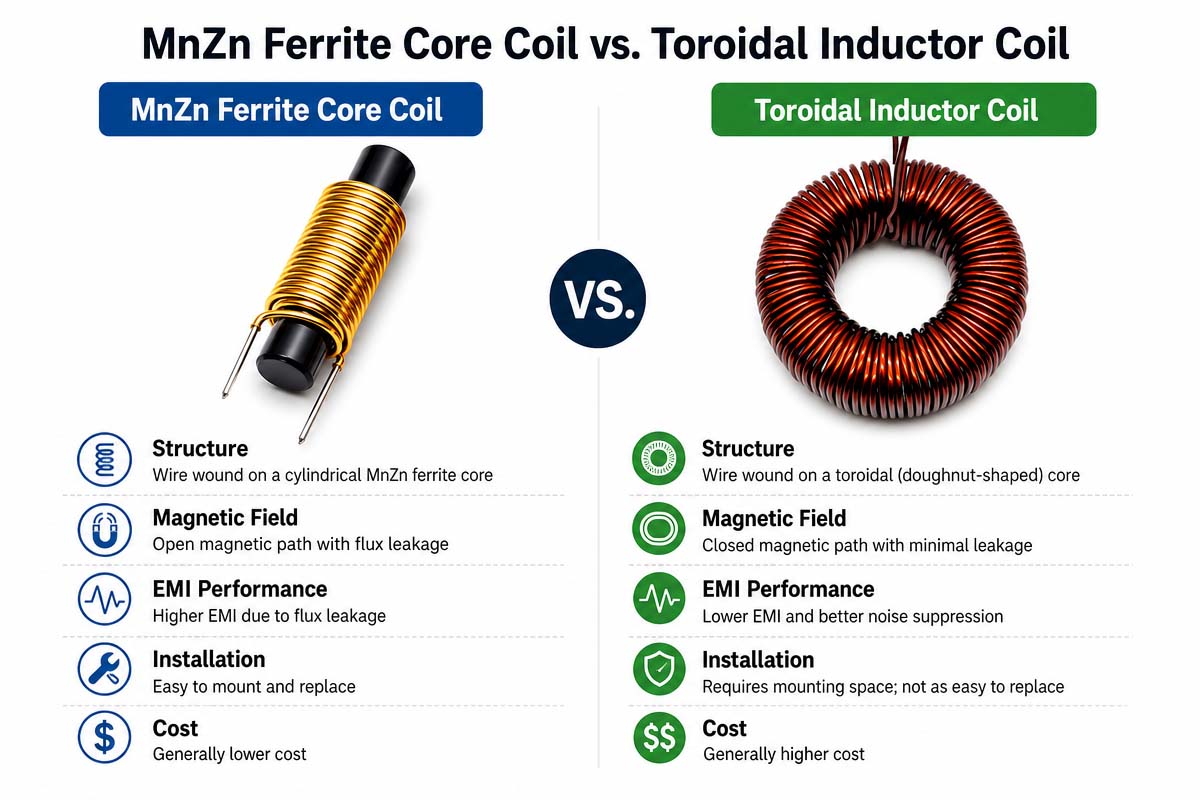
MnZn Ferrite Core Coil vs. Toroidal Inductor Coil

MnZn Ferrite Core vs Toroidal Inductor

Testing should include inductance, DC resistance, temperature rise, current loading, frequency response, insulation, and long-term reliability.

Feature MnZn Ferrite Core Coil Toroidal Inductor Coil
Definition Material/core-coil category Core geometry and winding structure
Core Material MnZn ferrite is commonly used. Can use MnZn ferrite, NiZn ferrite, powder, etc.
Shape E, EE, EI, RM, drum, ring, custom Circular/ring-shaped
Magnetic Path Depends on geometry Generally closed magnetic path
Leakage Flux Depends on construction Often relatively low
EMI Performance Depends on design Often beneficial for low external magnetic leakage
Winding Flexible Usually wound around the ring
PCB Mounting Can be very convenient May require additional mounting space
Air Gap Easy to implement in many E-core designs More difficult depending on construction
Customization High Moderate to high
Typical Uses Power supplies, transformers, filters, converters Power inductors, filters, energy storage, EMI applications

Important note: MnZn ferrite and toroidal are not directly comparable categories.

The physical core geometry is toroidal, and the magnetic material is MnZn ferrite.

In fact, a toroidal inductor can be manufactured using MnZn ferrite as core material. The proper comparison is usually therefore made between an MnZn ferrite coil with a specific geometry and a toroidal inductor coil.

Choose an MnZn Ferrite Core Coil When

When you need to select a suitable MnZn ferrite core coil:

High permeability

Compact magnetic core

Power conversion

Transformer operation

EMI filter

Custom PCB Enclosure

Regulated airspace

Flexible winding configuration

Use a Toroidal Inductor When

When toroidal geometry is preferable:

Low external magnetic leakage is important.

A closed magnetic path is preferable.

A round, compact package is acceptable.

High inductance for a given volume is required.

The application is able to provide toroidal winding and mounting.

Key Design Takeaway

The best answer is not just ‘MnZn or toroidal.’ But the more correct engineering decision is

Core material. Core geometry. Winding design. Operating frequency. Current. Thermal requirements.

For example, an inductor made of MnZn ferrite with a toroidal shape includes both of these features: MnZn is the magnetic material, and toroidal is the core geometry.

For industrial applications, therefore, engineers should compare complete magnetic design rather than materials and geometry as two different concepts.


8 FAQs of MnZn Ferrite Core Coil

Custom MnZn Ferrite Core Coil Application Guide

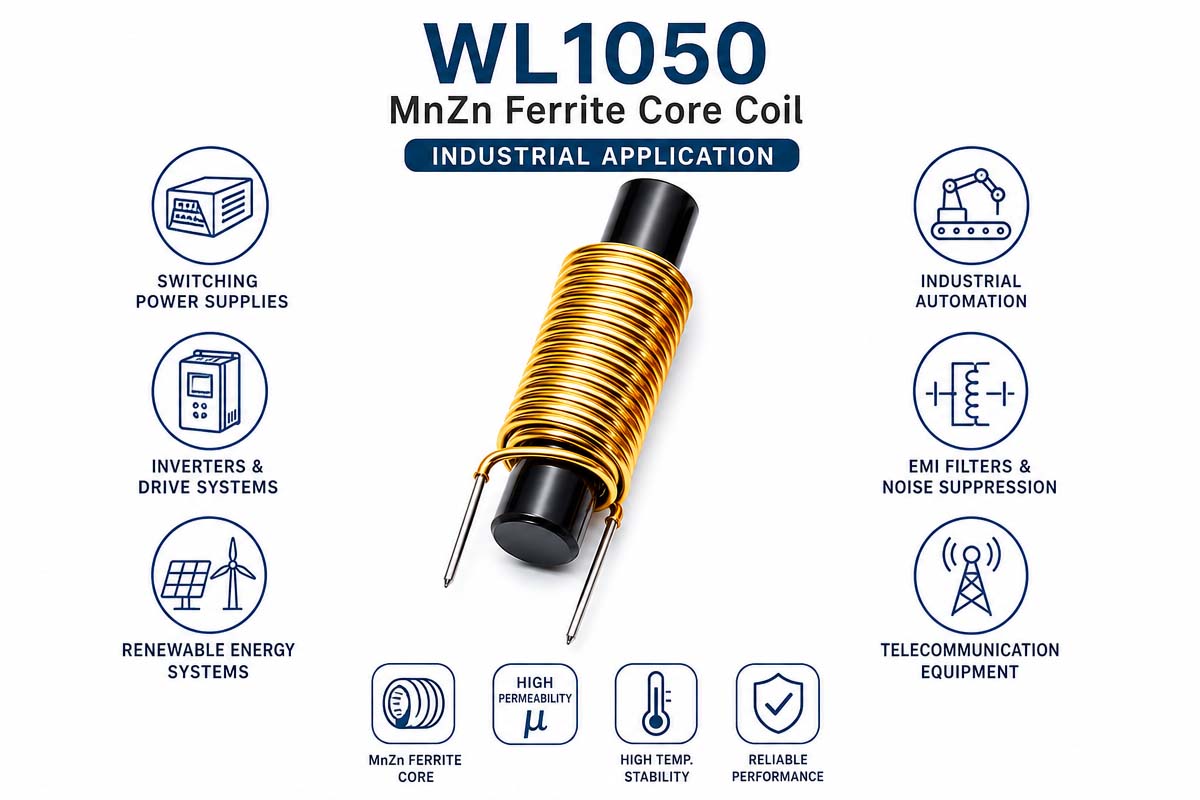
MnZn Ferrite Core Coil Industrial Application

Application of MnZn Ferrite Core Coils: MnZn Ferrite Core Coils are widely used in industrial and commercial electronic systems where the controlled inductance, magnetic coupling, power conversion, and reduction of electromagnetic noise are required.

Power Supplies

They are used in switching power supplies, DC-DC converters, AC-DC converters, adapters, and industrial power modules for filtering and energy transfer functions.

Components for EMI and EMC filtering based on MnZn ferrite can help to attenuate unwanted high-frequency noise and improve electromagnetic compatibility if properly designed in input, output, or signal circuits.

Industrial Automation

Ferrite-based magnetic components can be used in PLC systems, control cabinets, sensors, actuators, motor controllers, and industrial communication equipment for filtering and power conversion.

Energy from renewables

Components of MnZn ferrite are used in power conversion circuits of solar inverters, energy storage systems, wind power electronics, and battery management equipment.

Car Electronics & Accessories

By proper selection of the material and temperature ratings, ferrite magnetic components can be used in electric vehicle power electronics, charging systems, DC-DC converters, electronic control units, and other automotive systems.

Telecoms

Ferrite components can be used in communication power supplies, network equipment, and signal conditioning circuits to filter and reduce noise.

Medical and Consumer Electronics

Compact MnZn coils are used for power conversion and electromagnetic control of computing equipment, appliances, instruments, and some medical electronic systems.

Why is the MnZn Ferrite Core Coil popular in electronic product solutions?

The requirements for higher power density, better EMI performance, smaller size, and higher energy efficiency in modern electronic products are never-ending, and therefore the MnZn ferrite core coils become increasingly popular.

Moreover, industrial power electronics are getting smaller. With the growth of switching frequencies and power densities, magnetic components should not only exhibit predictable electrical performance but also fit into limited installation space.

MnZn ferrite offers an attractive combination of magnetic permeability, electrical resistivity, frequency-dependent losses, and design flexibility. These properties are helpful in a number of power conversion and electromagnetic filtering applications.

The next important factor grows.

ELECTRIC CARS

Charging apparatus

Renewable Energy Systems

Energy storage – batteries

Automation in industry

Intelligent manufacturing

Data center power systems

Communications Equipment

IoT devices

Power supplies, high efficiency

More and more complex magnetic components are required in these products.

MnZn ferrite is also available in various core geometries and winding configurations, giving engineers the possibility to customize the component according to their requirements regarding PCB, enclosure, current, frequency, or temperature.

But popularity does not mean that MnZn ferrite is always the best choice for any application. The engineers should compare core material, frequency, losses, saturation behavior, temperature, size, cost, and manufacturing requirements before making their decision.

Custom MnZn Ferrite Core Coil Advantage and Disadvantage

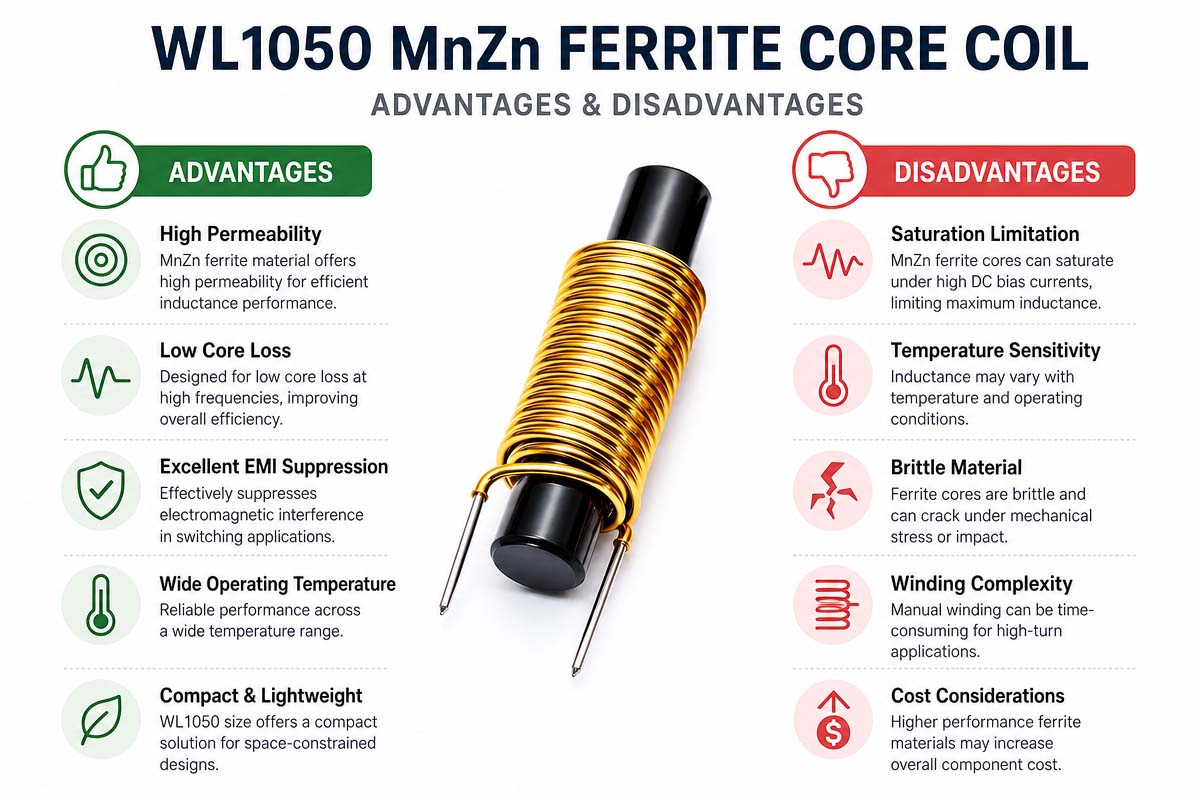
MnZn Ferrite Core Coil Advantages and Disadvantages

MnZn Ferrite Core Coil Advantage

High permeability High magnetic permeability of the MnZn ferrite allows achieving high inductance in the magnetic core structure of small size.

High frequency performance MnZn ferrite may exhibit lower losses than most magnetic materials within their appropriate operating range.

High electrical resistivity Compared with conductive magnetic materials, ferrite materials limit eddy current losses.

Compactness Proper magnetic core geometry will help to obtain high inductance or magnetic coupling in the magnetic core of relatively small size.

Wide Application Range MnZn ferrite core coils are applicable for power supplies, transformers, filters, converters, industrial controls and EMI related applications.

Flexibility of design: Magnetic core size, material, number of turns, wire diameter, air gap, terminals and enclosure are customizable.

MnZn Ferrite Core Coil Cons

The material is critical; MnZn ferrite does not behave in the same way at all frequencies and temperatures.

Saturation MnZn ferrite core coil shows the limitation of saturation when DC bias and peak current are high.

Temperature dependence: MnZn ferrite properties The properties of MnZn ferrite and ther conductor change with temperature.

Brittleness: Being a ceramic material, the ferrite core may crack if the handling of the component is incorrect.

Manufacturing tolerances : variations of the core characteristics , air gap, winding and assembly affect inductance and performance .

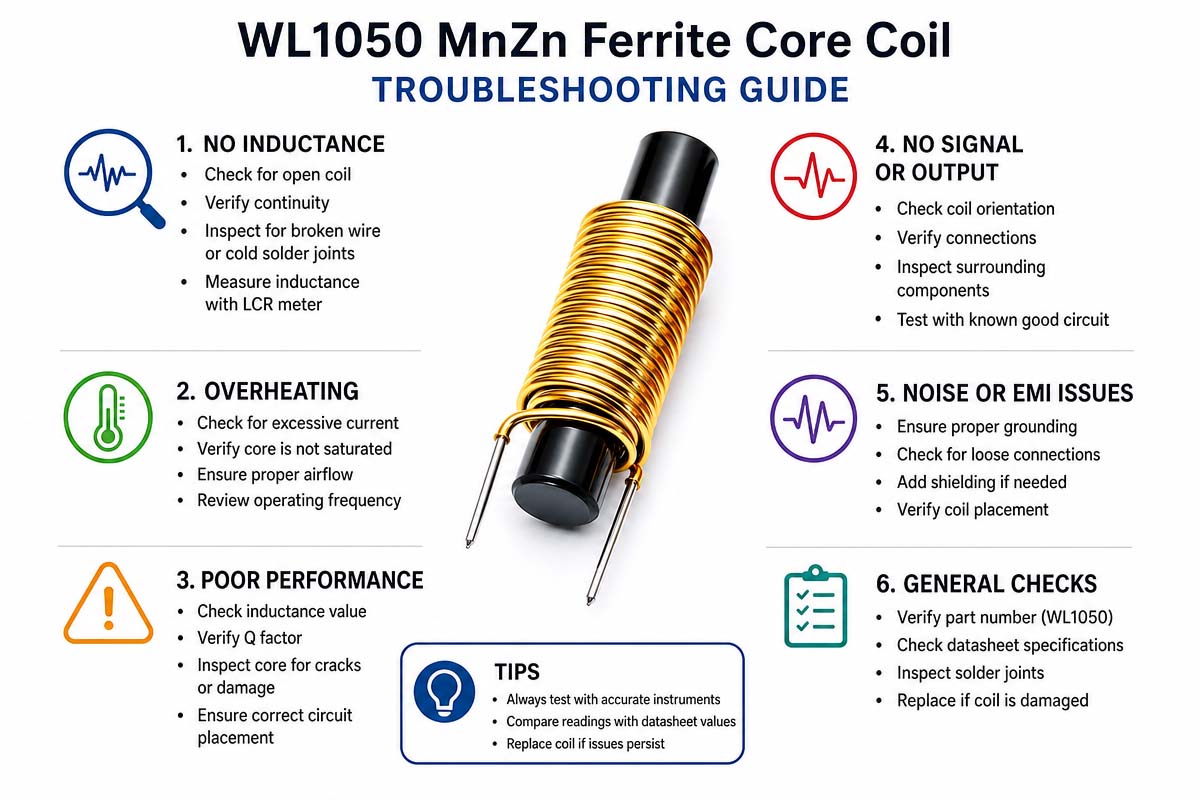
MnZn Ferrite Core Coil Troubleshooting Guide

MnZn_Ferrite_Core_Coil_Troubleshooting guide

Problem 1: Inductance Too Low

Possible reasons for this problem are insufficient number of turns, improper core material, large air gap, improper core size, or wrong test frequency.

Solution: To verify the number of turns, core specification, air gap, test frequency, and measurement technique.

Problem 2: Over Temperature

Possible reasons include high copper resistance, high RMS current, high core losses, bad thermal management, or improper operating frequency.

Solution: Use a larger conductor. Choose appropriate core material. Reduce magnetic flux density. Improve thermal management. Use a larger core.

Problem 3 – Inductance drops

when loaded. This is mostly caused by magnetic saturation or high DC bias.

Solution: Check the peak current and magnetic flux density. Use a larger core, appropriate air gap, or proper core material for the application.

Problem 4: Too Much EMI or Noise

The coil may have insufficient impedance or may be incorrectly mounted.

Solution: Consider impedance versus frequency characteristic, PCB mounting, grounding, parasitic coupling, and necessary attenuation range.

Problem 5: Mechanical Cracking

If the assembly or impact forces are high, the brittle ferrite core may crack.

Solution: Control assembly force, improve packaging, and prevent mechanical damage.

Problem 6: Inconsistency of inductance values in production

The reasons for inductance inconsistency include core tolerance, winding variation, air gap variation, or inconsistent assembly.

Solution: Incoming inspection of material, winding process, and final test


8 FAQs of MnZn Ferrite Core Coil

1. What is MnZn Ferrite Core Coil ?

An MnZn ferrite core coil is an electromagnetic component that is manufactured by winding insulated conductive wire around a manganese-zinc ferrite core. The MnZn ferrite concentrates the magnetic flux and helps the coil to have inductance in a small size. These coils are widely used in power supplies, transformers, EMI filters, DC-DC converters, industrial controls, and other electronic applications.

2. What is the use of MnZn Ferrite Core Coil?

The MnZn ferrite core coils are used in the power conversion, energy storage, filtering, EMI suppression, and electromagnetic coupling. Typical applications include switching power supplies, AC-DC converters, DC-DC converters, industrial automation equipment, motor drives, renewable energy equipment, communication systems, and automotive electronics.

3. What are the primary advantages of MnZn ferrite?

MnZn ferrite has high magnetic permeability, high electrical resistivity, good magnetic performance, and relatively low core losses in appropriate frequency ranges. It enables engineers to obtain compact magnetic components with useful inductance and good electromagnetic performance.

4. Which is the best MnZn Ferrite Core Coil?

The main selection parameters are inductance, operating frequency, rated current, peak current, core size, magnetic material, wire diameter, DC resistance, temperature range, and mounting dimensions. Engineers should also consider saturation behavior, core loss, temperature rise, and air-gap requirements for power applications.

5. Can MnZn Ferrite Core Coils be customizible?

Yes. Industrial MnZn Ferrite Core Coils are available with customizable core geometry, ferrite material, number of turns, wire diameter, inductance, resistance, terminals, dimensions, insulation, air gap and mounting configuration. This option is especially useful when a customer’s electrical or mechanical requirements cannot be satisfied by standard components.

6. Why does the MnZn Ferrite Core Coil overheat?

Reasons for overheating are high current, high copper loss, high core loss, improper operating frequency, lack of cooling, or high magnetic flux density. Engineers should consider both copper loss and ferrite core loss at actual operating conditions and select proper core and winding design.

7. What is the difference between MnZn Ferrite and Toroid coil?

MnZn ferrite refers to magnetic material, and “toroidal” refers to core geometry. MnZn ferrite can be actually used as a core for a toroidal coil. Therefore, they are not direct alternatives. The final design depends on material characteristics, core geometry, frequency, current, inductance, thermal and installation requirements.

8. How to increase the reliability of a MnZn Ferrite Core Coil?

To improve reliability, select the proper ferrite material, avoid magnetic saturation, control temperature rise, use proper wire size, maintain winding tension, protect the fragile ferrite core from mechanical stress, and control manufacturing tolerances. Prototype


Tips to Choose a MnZn Ferrite Core Coil

Choosing the proper MnZn ferrite core coil is not only the choice of core size. Electrical, magnetic, thermal, mechanical, and manufacturing requirements should be taken into consideration.

  1. Choose Operating Frequency

Start at the minimum, nominal, and maximum operating frequencies. There are several grades of MnZn ferrite materials, and also losses depend on the frequency. The selected material should correspond to the desired frequency range.

  1. Determine the Required Inductance

Indicate the target inductance under the real operating conditions. Inductance varies with current, temperature, frequency, and magnetic bias.

  1. Verify Current Requirements

Define continuous current, peak current, RMS current, and transient current. The core should have enough magnetic capacity to prevent excessive saturation, and the winding should be able to carry the required current without excessive temperature increase.

  1. Choose the Core Geometry

The core geometry affects magnetic path length, effective area, thermal performance, winding space, mechanical dimensions, and manufacturability. E, EE, EI, RM, drum, ring, and toroidal cores have different advantages.

  1. Air Gap Consideration

However, in energy storage inductors, an intentional gap is necessary to control inductance and increase usable magnetic energy before saturation. The proper gap depends on magnetic design.

  1. Decide on Wire Gauge

Choose the conductor according to current density, space for winding, resistance, temperature rise, skin effect, and manufacturing requirements.

  1. Estimate Thermal Performance

Ambient temperature. Operating temperature. Maximum temperature. Core loss. Copper loss. Enclosure conditions. Cooling availability.

  1. Check Mechanical Requirements

Review the mounting method, terminals, PCB clearance, creepage and clearance, overall dimensions, and assembly method.

  1. Validate EMI Specifications

For the filtering application, consider impedance, insertion loss, common mode or differential mode behavior, and frequency range to be attenuated.

  1. Prototype and Test 12.

Finally, a design should be tested for inductance, resistance, temperature rise, saturation, frequency response, insulation, and reliability tests.

Tips for Designing an MnZn Ferrite Core Coil to Avoid Common Mistakes

1. Don’t Choose the Core Only on Size

Also, the physically larger core doesn’t mean better performance. The material grade, effective magnetic area, magnetic path length, and operating frequency are equally important.

2. Don’t Forget About Saturation

The designs for the nominal current can lead to unexpected decreasing of the inductance with the higher peak current.

3. Proper Material for the Desired Frequency

Loss characteristics of MnZn formulations are different. Always choose the material according to the actual operating frequency and magnetic flux conditions.

4. Consider Temperature

Copper resistance increases with the temperature, and the magnetic properties of ferrite can also vary. The design should take the whole temperature range into account, not only room temperature.

5. Don’t Use Wire That Is Too Small

Too small wire leads to high copper losses and excessive temperature rise.

6. Don’t Forget About the Winding Space

The chosen number of turns and wire diameter should physically fit in the core window.

7. Verify Insulation Requirements

For high-voltage applications, proper insulation systems, creepage and clearance, and dielectric strength tests may be required.

8. Consider Manufacturing Tolerances

The end inductance can be affected by core dimensions, AL value, wire diameter, winding tension, air gap, and assembly tolerances.

9. Testing under the Actual Operating Conditions

Laboratory measurements at the low current and room temperature can not be indicative of the performance in the actual application.

10. Specify All the Specifications

When ordering the samples or quotations, please indicate voltage, current, frequency, inductance, dimensions, temperature, duty cycle, insulation, terminals, and quantities wherever possible.
 

Get A Free Quote Now

Contact Form

Related Products

Related News

Scroll to Top

Get A Free Quote Now !

Contact Form
If you have any questions, please do not hesitate to contact us.
Weilong Solenoid Company Culture
