Robotic Holding Magnet for Metal Component Handling
Robotic Holding Magnet for Automated Loading Systems
Robotic Holding Magnet for Factory Automation Systems
Robotic Holding Magnet for Automated Press Feeding
Robotic Holding Magnet for CNC Machine Loading Systems
Robotic Holding Magnet for Automated Material Handling
Robotic Holding Magnet for Metal Component Handling
Robotic Holding Magnet for Automated Loading Systems
Robotic Holding Magnet for Factory Automation Systems
Robotic Holding Magnet for Automated Press Feeding
Robotic Holding Magnet for CNC Machine Loading Systems
Robotic Holding Magnet for Automated Material Handling

WL3530 Robotic Holding Magnet for Robotic Press Operations

A robotic holding magnet is a specialized industrial magnetic gripper used for enabling robots to pick up, move, position and release ferromagnetic objects. It can be applied in robotic arms, automated handling machines, CNC machine tending equipment, assembly systems and material transfer machines. Depending on the design of the magnet, it may be either a permanent, electro-permanent or electrically controlled magnet. Robotic holding magnets are particularly useful for handling steel sheets, plates, components, blanks, castings, fabricated parts and other magnetic materials. Being compact and controlled in its action, the magnet may help to improve automation efficiencies and reduce manual handling. A properly selected robotic holding magnet provides reliable holding force, fast action, accurate positioning and compatibility with the robot payload and end effector system.

Robotic Holding Magnet Description

A robotic holding magnet is a magnetic gripper attached to a robotic arm or machine to hold and transport ferromagnetic workpieces. It is a robot’s end-effector that enables the robot to pick up steel sheets, plates, components, blanks, tools or fabricated parts without the need of using conventional mechanical jaws. Depending on the design, the holding magnet uses permanent magnets, electromagnets or electro-permanent magnets. The magnetic force that exists between its pole surface and the workpiece is controlled by the magnet. Robotic holding magnets are used for material handling, CNC machine tending, welding, assembly and fabrication.


How Does a Robotic Holding Magnet Work ?


The operation of a robotic holding magnet is based on the magnetic attraction between the magnetic pole surface of the holding magnet and the workpiece.


The standard operating cycle includes the following steps:


Approach: The robot moves the magnet towards the workpiece.

Contact: The magnetic pole face contacts the steel surface.

Activation The magnet produces sufficient magnetic holding force.

Lifting: The robot lifts the workpiece with the necessary safety margin.

Transfer The robot moves the workpiece to the designated position.

Release: The magnetic force is reduced or switched off for releasing the work piece.

Return The robot moves back to the programmed position.


Holding performance depends on the type of material, workpiece thickness, work piece surface condition, air gaps, contact area, magnet temperature, robot acceleration and load geometry. For automated systems, the magnet must be selected considering both static and dynamic robotic loads.

Robotic Holding Magnet Video

Robotic Holding Magnet Detail Display

Robotic Holding Magnet Data Shee

Brand Weilong Technology Model Number WL3530
Rated Voltage (V) DC 12V or 24V Rated Power(W) 2-4.8 W
Work Mode: Power on, Magnet on Holding Force (N) 30 Kgs
 working duty 100% Resistance 32  Ω
Service Life 300 Thousand Times Certification CE,ROHS,ISO9001,
Material Superior Magnet Carbon Steel Housing Lead Wire Length(mm) 200 MM
Install Style Screw Hole Tolerance of Dimension  +/-  0.1 MM
Water-proof  None Insulation Class B
Hi-Pot Test AC 600V 50/60Hz 2s Non-excitation Holding Force 0
Working Temperature -10°C-100°C Duty Cycle 1-100%
Thread Depth(mm) / Payment Term TT, or LC At Sight
Sample Order Yes Warranty 1 Year
MOQ 1000 pcs Supply Ability 5000 pcs per Week
Delivery Time 30 Days Port of Loading shenzhen

Why Are Robotic Holding Magnets Becoming So Popular?

Robotic holding magnets become increasingly popular because of manufacturers looking for faster, safer and more flexible ways of automating material handling. Manual handling of steel sheets, plates and components in the traditional way is a laborious and requires repeated lifting and positioning.

By using a robotic holding magnet, the same tasks can be done by robots with repeatability of gripping and positioning. It can be especially valuable in the case of handling of ferromagnetic workpieces, which cannot be gripped efficiently by using conventional mechanical tooling.

Another important feature is the flexibility. Robotic magnetic end effectors can be used in CNC machine tending, fabrication, stamping, welding, assembly and transfer operations. If the workpiece geometry changes, the magnetic gripping becomes more valuable than mechanical jaws.

The modern manufacturing industry focuses on short cycle times, consistency of quality, labor efficiency and production flexibility. Robotic holding magnets contribute to meeting these requirements, providing automated pick-and-place operations and positioning of materials.

The compact design, fastness and compatibility with industrial robots are attractive qualities of the magnets for automated production. The increasing implementation of smart manufacturing and robotic automation in the factories makes the magnetic gripping technology to be one of the key solutions for handling ferromagnetic workpieces.

Robotic Holding Magnet Applications

Robotic Holding Magnet for Pick and Place Automation

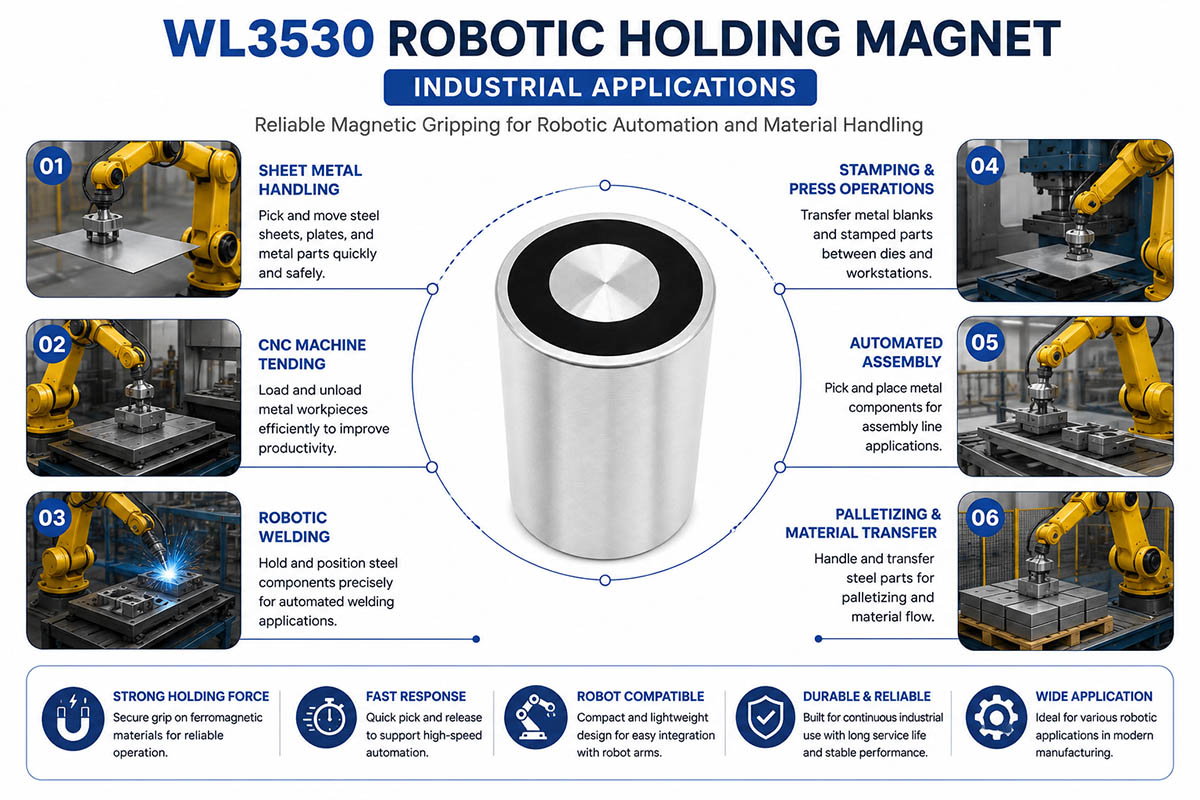
Robotic holding magnets are widely used in applications, where industrial robots have to manipulate ferromagnetic workpieces. One of the typical applications of robotic holding magnets is the handling of steel sheets, where robots pick up steel sheets and transfer them from one processing station to another. The robotic magnets are also used in machine tending applications, where robots load and unload steel components from machining centers.

In stamping and pressing processes, robotic holding magnets are used for transferring of blanks, stamped parts and metal plates between dies or production stations. Magnets used in welding automation transfer steel parts to fixtures or welding cells prior to processing.

Robotic magnets can lift pieces of metal and place them in designated locations for further assembling. In fabrication facilities, robots with magnets lift cut plates, brackets, structural components and other steel parts.

Other applications include palletizing, automated storage and retrieval, material transfer systems, metal sorting, machine loading and robotic pick and place operations.

Robotic holding magnets can be particularly valuable for handling of large volumes of metal parts with high production rates. They can be used to reduce manual handling, improve repeatability of positioning and continuous production. However, the applicability is limited by material properties, workpiece geometry, workpiece surface condition, holding force, robot payload and dynamic operating conditions. Therefore, the specific engineering evaluation has to be performed before the magnet deployment in the production environment.

Robotic Holding Magnet Adv. & Disadv

Advantages and Disadvantages of Robotic Holding Magnets

Benefits

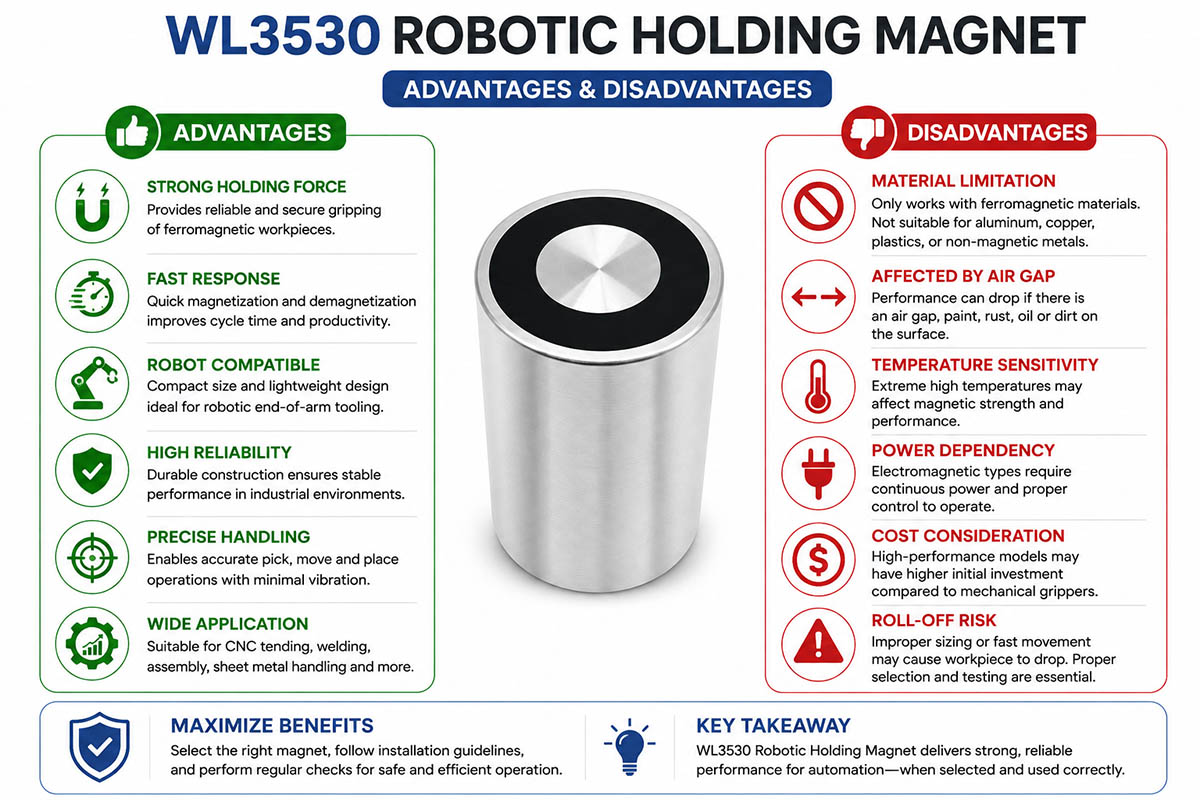
Robotic holding magnets have several advantages in the automated industrial handling. First of all, they are able to quickly collect ferromagnetic components without the need to use complex mechanical jaws. This makes end-of-arm tooling easier and reduces the number of moving gripping elements.

Robotic holding magnets enable repeatability of pick and place operations and increase productivity of material handling. Magnetic gripping is also beneficial for steel sheets, plates, blanks, fabricated components and irregularly shaped metal parts. Using the proper magnet, you can perform numerous production cycles with relatively small maintenance.

Another advantage is the flexibility. The same robotic system can handle different ferromagnetic workpieces, provided that the magnetic contact area and the requirements to holding force are met. Magnetic tooling reduces manual lifting and handling.

Disadvantages

There is one significant limitation of the robotic holding magnets. They can be used only for handling ferromagnetic materials, such as steel and iron, but aluminum, copper, plastics and other materials cannot be handled directly.

Other limitations of robotic holding magnets include such issues as air gaps, coating, rust, dirt, thin materials, curvy surfaces, insufficient contact. Also, in some types of magnetic technology, temperature can have negative effect on the performance. Electromagnets require electrical power and suitable control systems.

Dynamic loading is another issue. The magnet which holds a stationary workpiece well may not have sufficient margin during the robot acceleration. This means that the specific engineering evaluation has to be performed and appropriate safety factor used.

Robotic Holding Magnet for Robotic Handling Equipment

Troubleshooting of Robotic Holding Magnets – 200 Words

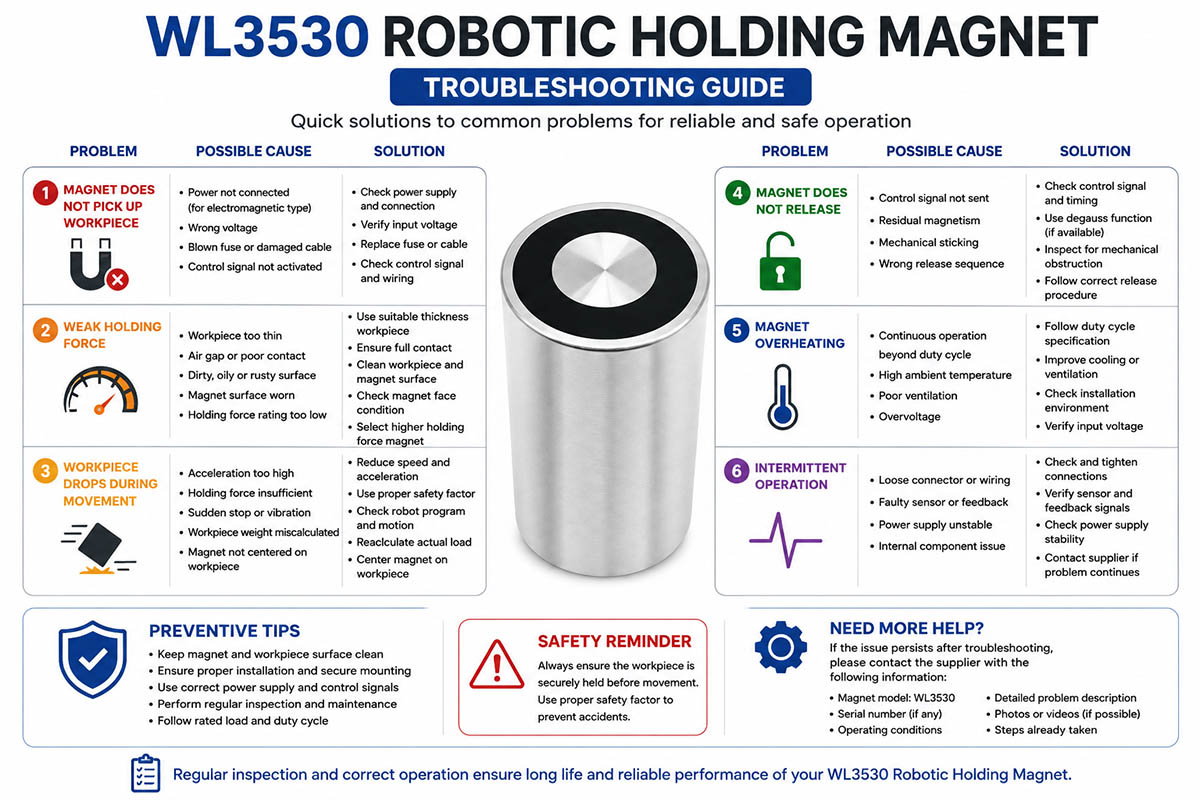
1. The magnet does not hold the workpiece

First, check the material of the workpiece. Make sure that it is ferromagnetic. Then check the magnetic pole face and workpiece for paint, rust, scale, oil, dirt or excessive air gaps.

2. Insufficient holding force

Check the thickness of the material and workpiece surface condition. Thin sheets have less magnetic attraction than thick steel. Make sure that the magnet has sufficient contact area and the selected holding force is sufficient for the workpiece.

3. Robot movement leads to dropping of the workpiece

Check robot acceleration, deceleration, robot orientation and vibration. While the static load is OK, dynamic forces are greater than the margin of holding force. You can reduce the speed and check the safety factor.

4. The magnet does not power on

If your magnet is electrically controlled, then you should check power supply, wiring, connection, controller, fuse and activation signal. Make sure that the magnet operates within the specified voltage.

5. The magnet does not detach

Check the release mechanism and the control signal. Make sure that there is no mechanical obstruction, contamination or residual magnetism. Perform the workpiece release according to manufacturer recommendations.

6. The magnet gets hot

Check the duty cycle, ambient temperature, electrical conditions and cooling. Do not operate the magnet outside the specified duty cycle, since it can lead to overheating and degrade performance.

7.Inconsistent selection

Verify the position of the workpiece, workpiece surface condition, magnet orientation and contact area. If the system uses work piece detection, you also have to check sensors and automation signals.

For repeat problems, stop the production as required and perform complete check of the robot, magnet, tooling, control system and workpiece.

FAQ

What is a robotic holding magnet?

It is a magnetic gripper attached to a robotic arm to lift, hold, move and position ferromagnetic objects such as steel sheets, plates and other metal parts. Robotic Holding Magnet

Where are robotic holding magnets most commonly used?

They are utilized in CNC machine tending, sheet-metal handling, welding, stamping, assembly, fabrication, material handling and automated pick-and-place operations.


Robotic holding magnets can handle any kind of metals as well as any other kind of material?

No. They are primarily used for ferromagnetic materials such as iron and many kinds of steel. Aluminum, copper, plastic materials and many non-magnetic stainless steels cannot be directly handled.

What weight can a holding magnet carry?

The lifting capacity is dependent upon the design of the magnet, material of the part, its thickness, surface condition, contact area, air gap and the movement of the robot. The capacity given by the manufacturer should always be considered with an appropriate safety factor.

Can robotic holding magnets carry thin steel sheets?

Yes, but thin sheets will have lower holding force. While selecting a magnet, check the sheet thickness, surface condition, magnet pole design and contact area, among others.

Do robotic holding magnets require electricity?

It depends upon the technology being used. Electromagnetic design requires power to operate. Permanent magnets can hold without needing continuous power. Electropermanent magnets provide controlled switching with lower continuous power required.

How can I stop a workpiece from dropping while the robot moves?

While selecting a magnet, consider the gripping force, maintaining the proper magnetic contact, robot acceleration and deceleration, and an appropriate safety factor. It is advisable to conduct tests with the actual workpiece and robot movements.


Maintenance of Robotic Holding Magnets

Keep the surface of the magnetic contact clean, monitor the mounting hardware and cables, look for any damage or overheating, and check the holding capacity and sensors, etc.

How to Pick a Robotic Holding Magnet

Choosing a proper robotic holding magnet requires more than just comparison of the advertised holding force. The magnet must match the workpiece, robot, end effector, operating environment and automation cycle.

1. Find out the material of the workpiece.

Make sure that the workpiece is highly ferromagnetic. Mild steels usually have better magnetic attraction than stainless steels and other types of materials with poor magnetic response.

2. Measure the thickness of the workpiece.

Small workpiece thickness may reduce drastically the holding force of the magnet. Instead of selecting the magnet for the heaviest workpiece, it is necessary to identify the minimum and maximum thickness of the material that the robot processes.

3. Analyze the surface condition.

Paint, rust, scale, oil, dirt, rough surface, air gaps reduce significantly the effective holding force. A magnet that works well with clean steel may perform badly with coated or rough material.

4. Determine the dynamic load.

Consider not only the weight of the workpiece, but also robot acceleration, deceleration, vibrations, robot orientation and centrifugal effects. The dynamic forces are higher than the static load.

5. Select the factor of safety.

Never use the magnet in the proximity of its maximum theoretical holding capacity. Use a safety margin based on engineering assessment of the application and consequences of the dropped load.

6. Robot payload compatibility.

Robot should not only handle the workpiece, but also the magnet, mounting hardware and sensors, the cables and other equipment. A very powerful but heavy magnet may reduce the robot payload capacity.

7. Choose a magnetic technology.

Permanent magnets do not need any electrical power to keep the workpiece held. Electromagnets allow controlling activation, but consume electricity. Electro-permanent magnets are an intermediate solution.

8. Consider the speed of operation.

For high speed applications, activation and release times are very important. Select a magnet able to perform the pick and release cycle.

9. Analyze the mounting and control.

Select the mounting and flange dimensions, consider mounting orientation, voltage, control interface, sensor compatibility and cable routing.

10. Test the magnet on the real workpiece.

Perform tests with the actual material, workpiece thickness, workpiece surface condition, robot speed and robot orientation. Testing in practice is one of the best methods of verifying reliable operation.

Tips for Avoiding Common Mistakes in Robotic Holding Magnet Design

Don’t select the magnet by the weight of the workpiece.

When calculating loads, take into consideration the robot acceleration and deceleration.

Don’t confuse the maximum advertised holding force with the actual holding force.

Check the exact steel grade before choosing magnetic technology.

Includes paint, oil, rust, scale and surface voids.

Check the minimum workpiece thickness.

Don’t oversized magnets and increase the robot payload unnecessarily.

Don’t forget to provide appropriate safety factor for dynamic operation.

Don’t forget to check if the magnet still performs at the desired temperature.

Position magnetic poles for the maximum useful contact area.

Consider the center of gravity when lifting the workpiece.

Route cables away from robot movements.

Don’t forget to check the switching voltage and control requirements of the magnet.

Install workpiece detection or magnetic status feedback if required.

Perform complete test of the robot-magnet-workpiece system prior to production.

Check the behavior of emergency stop and loss of power.

Don’t release a load until the robot is in a safe position and destination.

Consider workpiece wear, contamination and maintenance requirements.

Ensure that mounting hardware can withstand repeated dynamic loads.

Document the inspection procedure. Document the final operational limits.

Get A Free Quote Now

Contact Form

Related Products

Related News

Scroll to Top

Get A Free Quote Now !

Contact Form
If you have any questions, please do not hesitate to contact us.
Weilong Solenoid Company Culture
