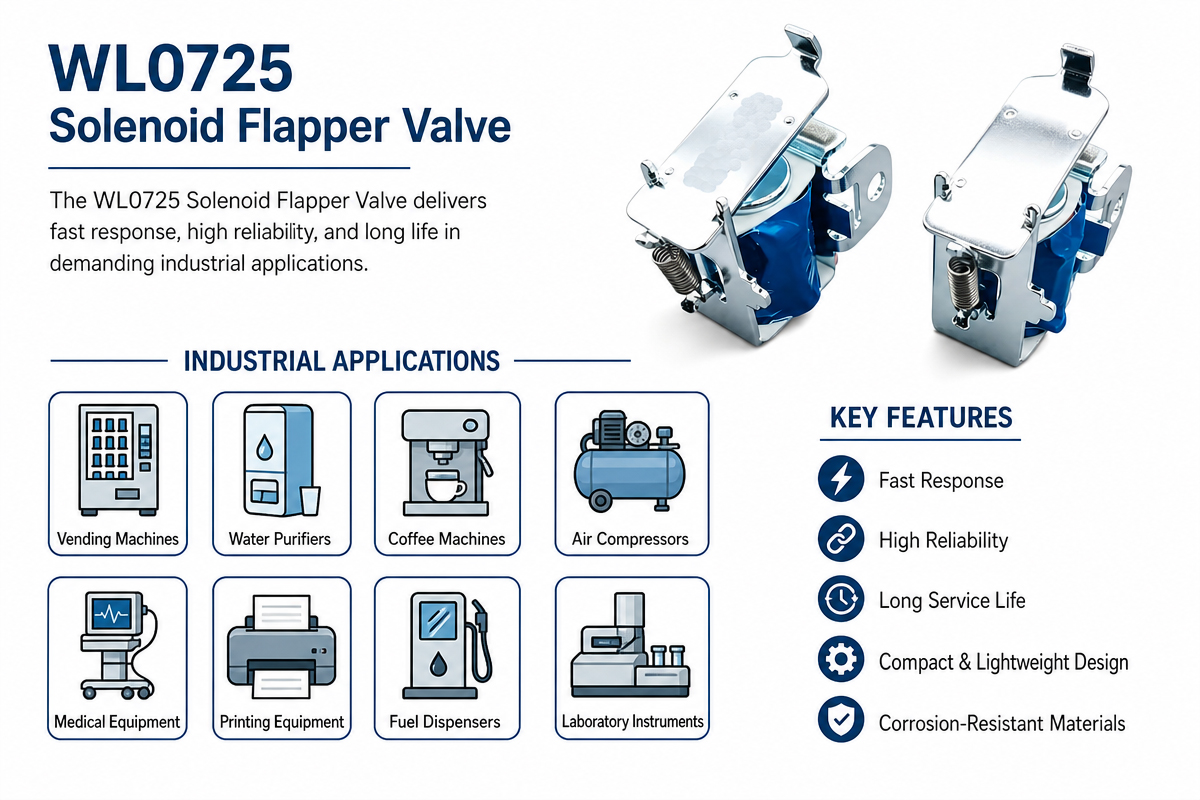
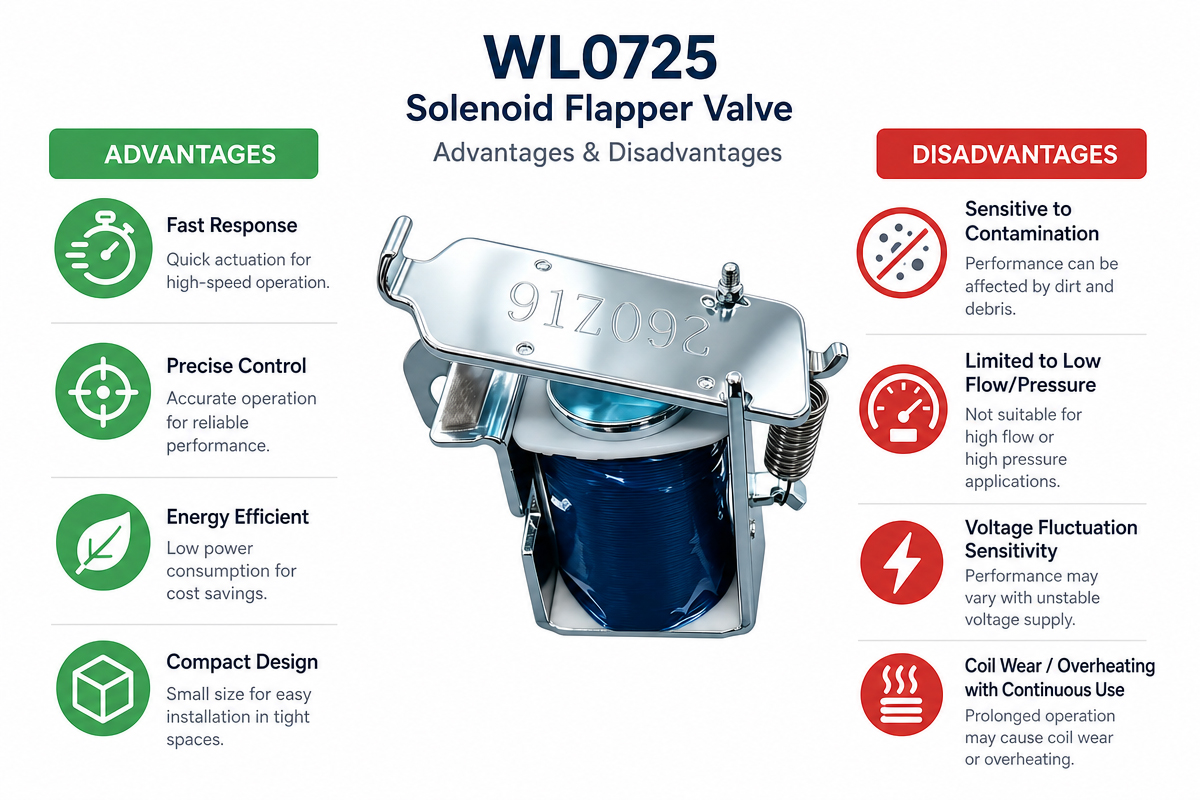
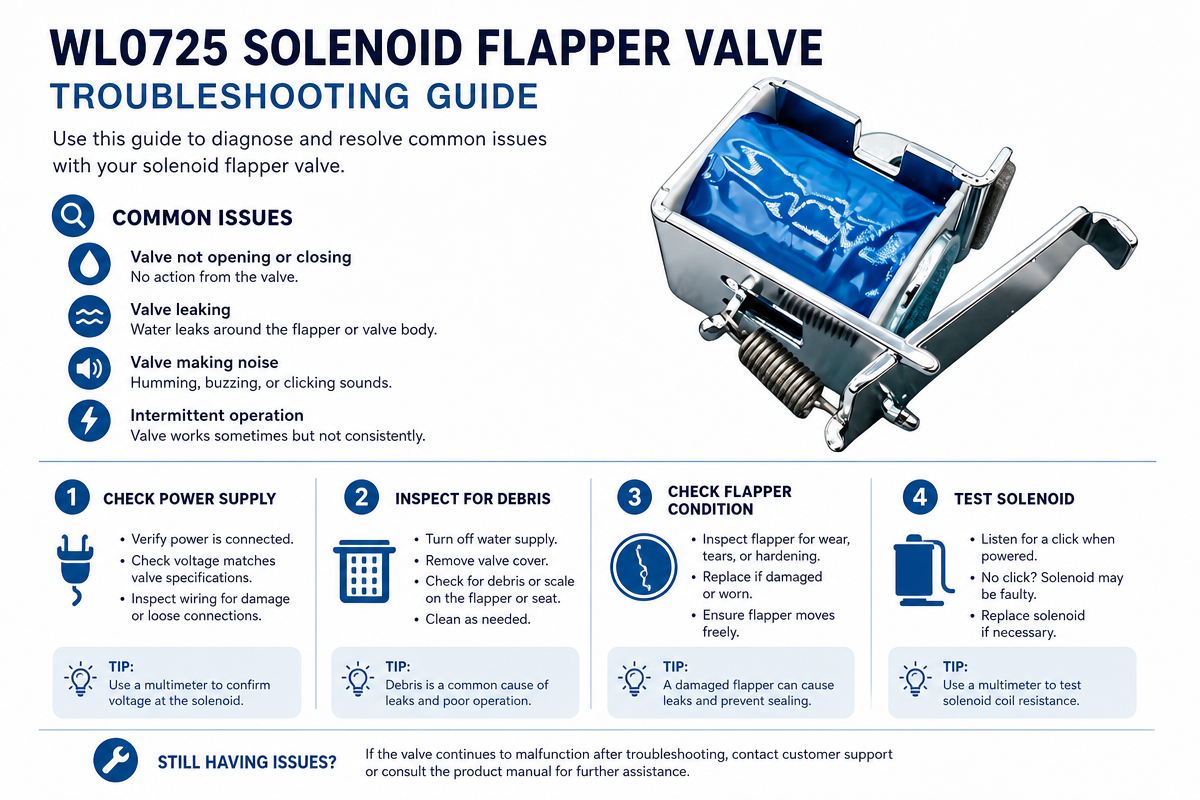
| Brand |
Weilong Technology |
Model Number |
WL0725 |
| Rated Voltage (V) |
DC 3–48V |
Rated Power (W) |
3-6 W |
| Work Model |
Flapper Type Design |
Holding Force (N) |
50 Gf |
| Stroke (mm) |
19.7 MM |
Reset Time(s) |
50 Ms |
| Service Life |
300 Thousand Times |
Certification |
CE, RoHS, ISO9001 |
| Material |
Carbon Steel Housing with Zinc-Plated Coating |
Lead Wire Length (mm) |
200 |
| Install Style |
Adjustable Screw |
Tolerance of Dimension |
± 0.1 MM |
| Water-proof |
None |
Insulation Class |
F 155 Cel. Degree |
| Hi-Pot Test |
AC 600V 50/60Hz 2s |
Non-excitation Holding Force |
0 |
| Working Temperature |
-10°C-100°C |
Duty Cycle |
1-100% |
| Thread Depth (mm) |
/ |
Payment Term |
TT, or LC at Sight |
| Sample Order |
Yes. |
Warranty |
1 Year |
| MOQ |
500 pcs |
Supply Ability |
5000 pcs per week |
| Delivery Time |
30 Days |
Port of Loading |
Shenzhen |
Solenoid Flapper Valve vs. Latching Solenoid Valve—Difference in Working Principles and Applications
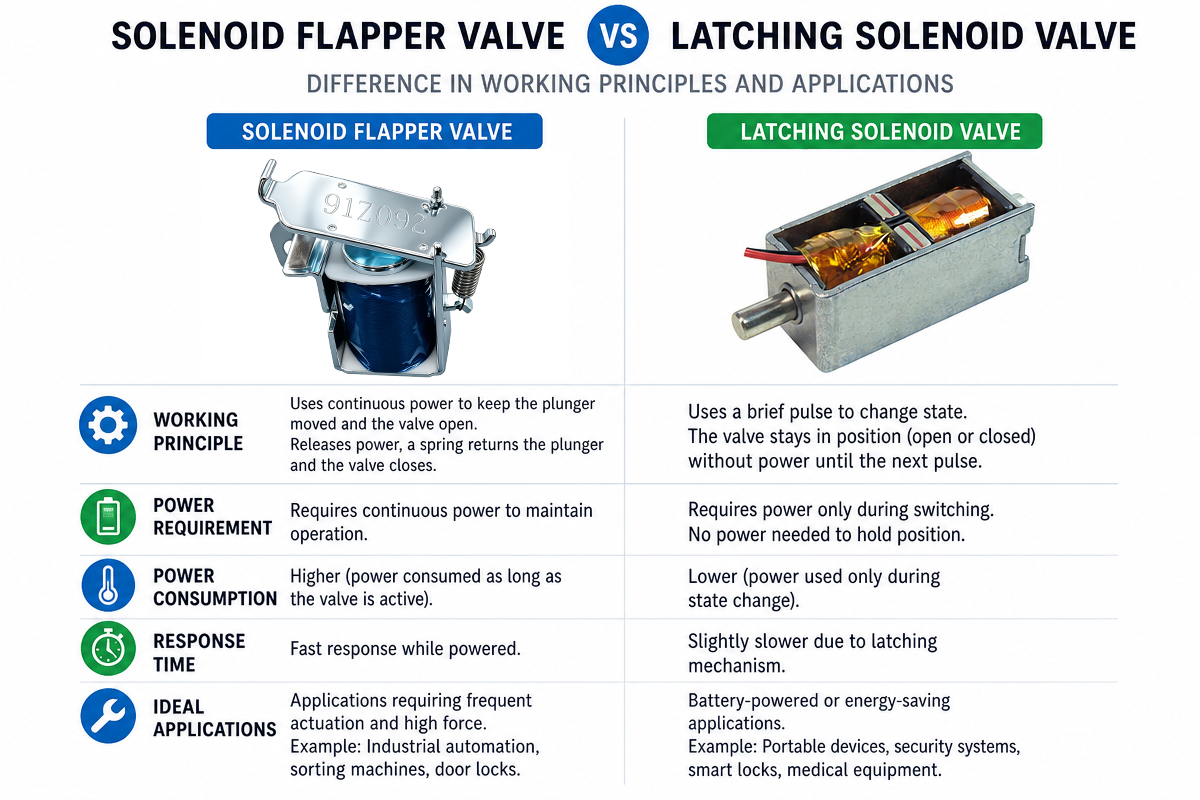
Solenoid valves are widely used in industrial automation, printing machinery, medical equipment, fluid control systems, and smart machines. There are several types of electromagnetic valves to be chosen depending on project requirements. The solenoid flapper valve and latching solenoid valve are examples of such solutions, which offer high control performance but work in a different way.
The choice of solenoid flapper valve or latching solenoid valve depends on specific application needs such as power consumption, response time, operational mode, holding performance, and working conditions.
1. Difference in Working Principles
Flapper Solenoid Valve
The solenoid flapper valve is designed to use an electromagnetic force to move a flapper to open or close a flow channel.
Upon applying voltage:
- Electromagnetic force is generated by a coil
- Inside armature moves
The flapper opens or closes the fluid passage.
- Control fluid flow, air, gas, or ink.
If voltage is not applied, a spring or an elastic force returns a flapper to its initial position.
The valve should have a continuous power supply if it is necessary to keep the valve in an active position.
Latching Solenoid Valve
Latching Solenoid Valve The design of the permanent magnet keeps a valve in place without a continuous power supply.
The working principle:
- A coil operates with a short electrical impulse.
- A plunger is moved by the electromagnetic force.
- A permanent magnet keeps the position.
- No continuous power supply is necessary.
A reverse impulse shifts the valve to another position.
The design is particularly useful for battery-powered or energy-efficient applications.
2. Relative Power Consumption
One of the main differences of these technologies is power consumption.
Solenoid Valve (Flapper)
Pros:
- A simple control method
- Quick activation speed
- Suitable for frequent switching
Cons:
- Requires continuous power when used
- Heat generation upon long-time usage
Typical applications are
- Print press
- Industrial control systems
- Pneumatic control systems
Solenoid Valve with Latch
Pros:
- Ultra low power consumption
- Does not generate heat during holding
- Suitable for battery applications
Cons:
- Needs special pulse control electronics
- Complex control system
The typical applications are
- Smart meters
- Battery-operated gadgets
- Energy-efficient fluid control system
-
Comparison of Response Time
Flapper Valve Solenoid
The solenoid flapper valve generally has a very quick response time due to the light weight of the construction and optimization for quick movement.
Advantages:
- Quickly opens or closes
- High switching frequency
- Precise flow control
It is particularly useful for printing applications, where the timing is important.
Latch Solenoid Valve
The latching valves also have a fast response; however, they are primarily designed for position holding instead of quick switching in continuous mode.
They are more appropriate for applications where the valve changes position occasionally and then stays at one position for a long time.
4. Design of Mechanical Structures
Design of Solenoid Flapper Valve
Main components:
- Solenoid coil
- Core magnetic
- Armature
Flapper
Features:
* Easy integration
Design of Latching Solenoid Valve
Main components:
- Solenoid coil
- Magneto fix
- Plunger
- Housing magnetic
- Return mechanism
Features: •
- Magnetic holding feature
- Energy efficient
- Position stability
-
Comparison of Applications
Solenoid Flapper Valve Applications
Popular industries:
Printing Machines
For use:
- Fluid control
- Cleaning machines
- Air pressure control
Medical devices
For use:
- Fluid control
- Gas control systems
Automation Devices
For use with
- Equipment for dispensing
- Pneumatic control
Latching Solenoid Valve Uses
Popular industries:
“Smart water meters”
Pros:
- Battery operated
- Long life
Portable Devices
Pros:
Remote Control Systems:
Pros:
- Advantages and Disadvantages Summary
| Item |
Solenoid Flapper Valve |
Latching Solenoid Valve |
| Power Consumption |
Higher |
Very Low |
| Holding Power |
Requires power |
No power required |
| Response Speed |
Very Fast |
Fast |
| Control Method |
Simple ON/OFF |
Pulse control required |
| Heat Generation |
Higher |
Very Low |
| Structure |
Simple |
More complex |
| Best For |
Frequent switching |
Long-holding operation |
7. How to choose the solenoid flapper valve or the latching solenoid valve?
If you need a solenoid flapper valve, choose:
- Quick switchover
- Continuous use
- Simple control
- Compact fluid control
Latching Solenoid Valve Features If you need to choose:
- Low power requirements
- Battery operated
- Long holding period
- Low heat output
8. Conclusion
Both the solenoid flapper valve and latching solenoid valve are reliable electromagnetic control solutions but are designed for different applications.
The solenoid flapper valve is optimal for high-speed switching applications such as printing machines, automation devices, precise fluid control systems, etc.
If the application is energy saving and the valve should stay in position without power, it is better to choose a latching solenoid valve.
Understanding of working principles, power consumption, reaction speed, and application requirements helps engineers to choose the best solenoid solution for their projects.