Toroid Power Inductor for Industrial Automation Systems
Toroid Power Inductor Core Materials and Performance
Toroid Power Inductor for Smart Energy Equipment
Toroid Power Inductor for Energy Storage and Conversion
Compact Toroid Power Inductor for Modern Electronics
Toroid Power Inductor Manufacturer for Custom Solutions
Toroid Power Inductor for Industrial Automation Systems
Toroid Power Inductor Core Materials and Performance
Toroid Power Inductor for Smart Energy Equipment
Toroid Power Inductor for Energy Storage and Conversion
Compact Toroid Power Inductor for Modern Electronics
Toroid Power Inductor Manufacturer for Custom Solutions

WL40025 Toroid Power Inductor for High Efficiency Industrial Use

A toroid power inductor is a magnetic component used in power electronic circuits to store and convert energy, control the current flow, and filter the voltage variations. They have the shape of a torus, providing high efficiency of the magnetic field, a low level of electromagnetic interference, and lower energy losses compared to traditional inductors. The toroid power inductors are used in power supplies, converters, renewable energy systems, EVs, communication systems, and automation devices. They have high current-carrying capability with stable performance and magnetic characteristics. The toroid power inductors can be customized in different frequency ranges and power ratings using ferrite, iron powder, or alloy materials.

Custom toroid inductor Product Overview

A toroid power inductor is a passive component that uses the magnetic field to store energy. It is a toroidal magnetic core with windings of the wire. The toroidal design provides the closed magnetic path, reducing losses and improving efficiency. These components are designed for use in circuits requiring high-current conversion and filtering. The toroid power inductors can be manufactured from the ferrite, iron powder, and metal alloy cores to meet various frequency and power requirements. They are commonly used in industrial equipment, switching power supplies, renewable energy systems, and automobile electronics.

How does an inductor work?

Power Toroid Inductors When the electric current passes through the winding of a toroid power inductor, it converts the electrical energy into the magnetic energy. The magnetic field of the toroid core is formed by the electric current. During the variation of the current, the magnetic field stores and releases energy. Thus, it helps to control the current and voltage variations.

The toroid core has the closed magnetic path, reducing losses and improving the efficiency of the magnetic field. It reduces the electromagnetic interference and increases the power density. The toroid power inductors are used in the switching power supplies and converters to smooth the current ripple, filter the noise, and provide the continuous energy flow between the electrical components.

Compact Custom toroid inductor Video

Custom toroid inductor Detail Display

Toroid Power Inductor Technical Datasheet

Sendust Toroidal Coil Model Catalog 1

| Parameter | Typical Value |
| ——————— | ——————– |
| Core Material | Sendust (Fe-Si-Al) |
| Inductance Range | 10 µH – 100 mH |
| Rated Current | 3A – 10A |
| Saturation Current | Up to 15A |
| Operating Frequency | 10 kHz – 100 kHz |
| Operating Temperature | -40°C to +125°C |
| Insulation Type | Enameled Copper Wire |
| Core Shape | Toroidal |

Why Is a Toroid Power Inductor So Popular?

The toroid power inductors are becoming increasingly popular. Modern electronic systems require higher efficiency, smaller size, and better electromagnetic performance. And the sealed magnetic circuit allows them to ensure their energy efficiency with low magnetic losses.

The increasing demand for electric vehicles, renewable energy systems, smart devices, and industrial automation has increased the demand for reliable power components. The toroid inductors are the ideal solution for high current handling, low losses, and stable performance.

They are a preferred solution for advanced power electronics, providing EMI reduction, improved power density, and reliable performance in harsh environments. With the industries constantly paying attention to energy-efficient designs, the toroid power inductors will remain a key technology in future power management systems.

Toroid Power Inductor Applications

High Performance Toroid Power Inductor Applications

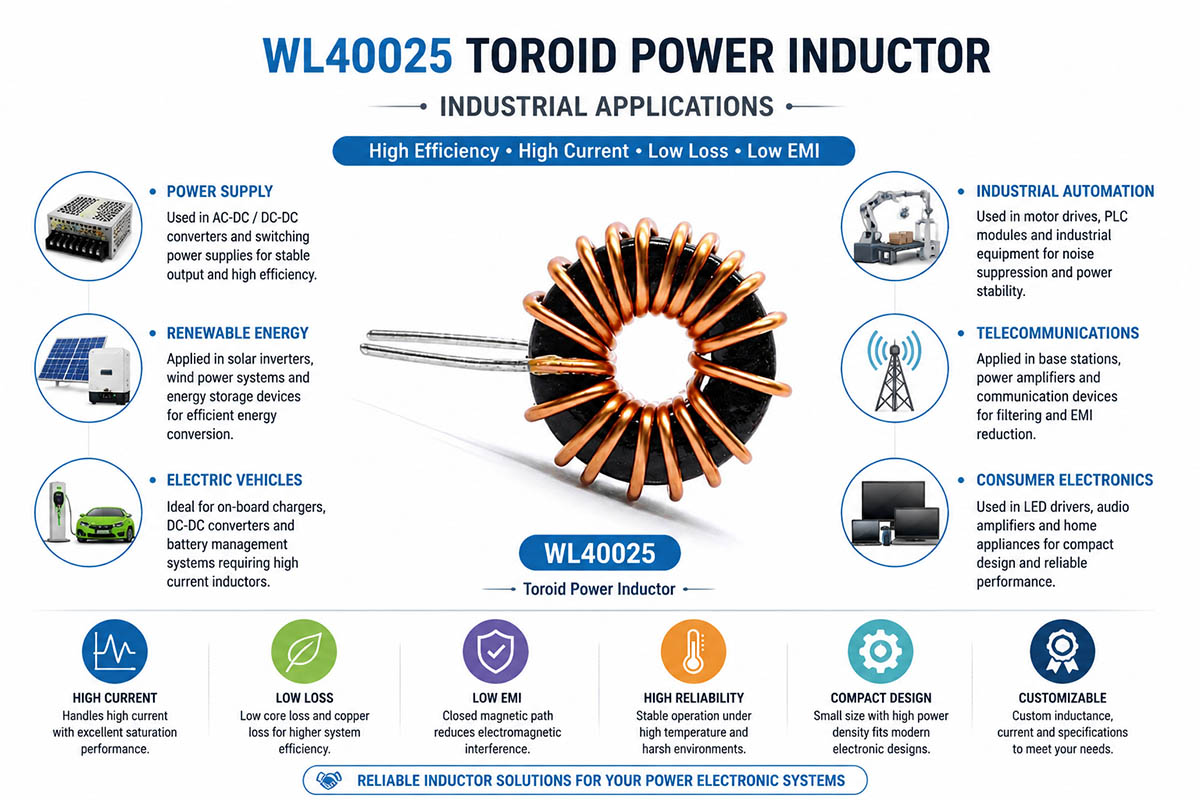
Toroid power inductors have been widely used in many industrial and electronic systems due to their high efficiency and good magnetic properties.

They are used in switching power supplies for controlling the current, reducing ripple noise, and increasing the efficiency of the energy conversion. The toroid inductors are used for voltage regulation and energy storage in DC-DC converters of industrial control systems, telecommunications, and consumer electronics.

The toroid power inductors are necessary to provide the stable filtering and power transmission in renewable energy systems such as solar inverters and wind power converters. They have high current capability and are used in electric vehicles (battery management systems, charging equipment, and power conversion modules).

The toroid inductors are perfect for industrial automation equipment, robotics, and motor control systems, offering reliable filtering and noise suppression. They are also used in medical devices, audio amplifiers, UPS systems, and communication devices where low EMI and good performance are required.

The demand for efficient power management is constantly increasing, and the toroid power inductors are still an important part of modern energy systems and advanced electronics.

Toroid Power Inductor Advantage and Disadvantage

Toroid Power Inductor Benefits in Industrial Electronics

Toroid Power Inductor Benefits and Drawbacks

Pros

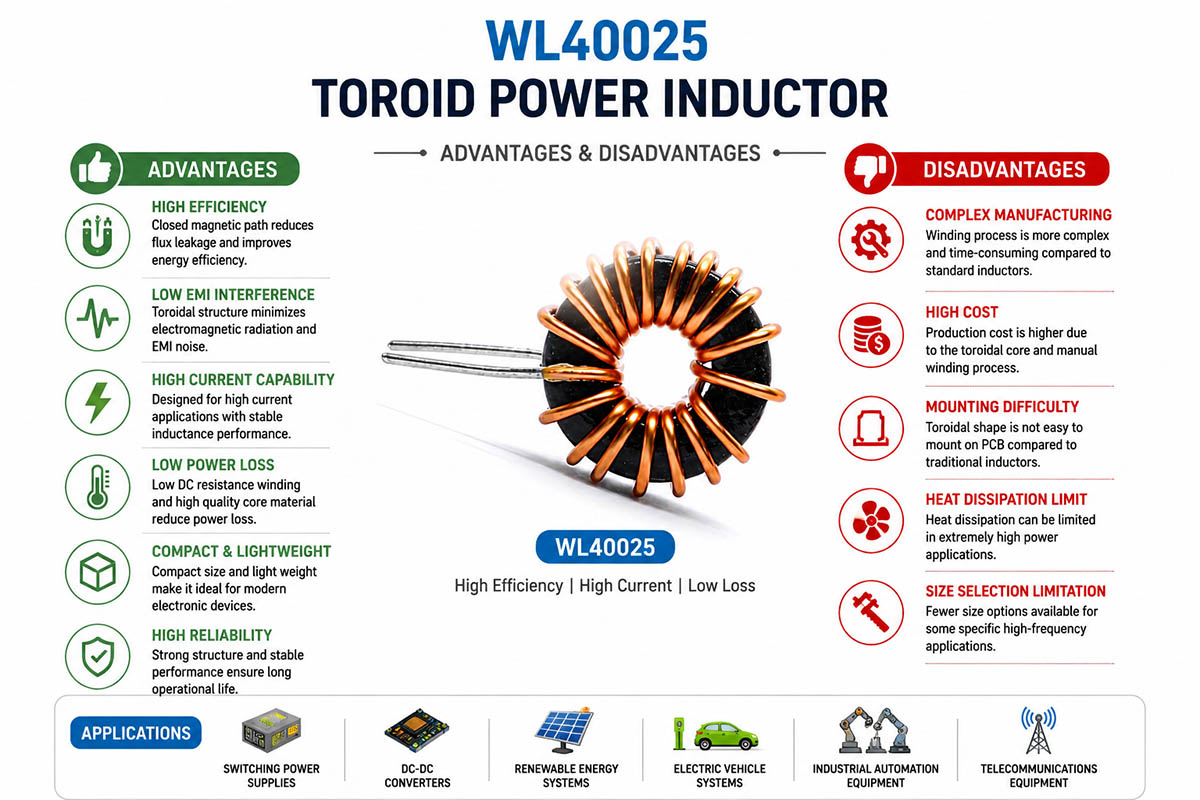
The toroid power inductors have very good magnetic efficiency because the closed magnetic path minimizes flux leakage. They generate less electromagnetic interference compared to the conventional open-core inductors. Compact design allows achieving high values of inductance in a small volume. They have high current capability, low power loss, and stable performance in demanding environments.

The toroidal design allows for improved thermal distribution and reliable long-term performance. Good for high-frequency switching applications. It can be customized for different industrial needs.

Downside

Toroid power inductors have many advantages, but there are some disadvantages also. The process of winding can be more complicated and pricier than the case of normal inductors. The automated manufacturing requires the dedicated equipment. Their ring shape makes them more difficult to install and mount onto a PCB.

Cooling options for high-power toroid inductors can be limited. Using the wrong core material can also make them inefficient at some frequencies.

To summarize, the toroid power inductors are the preferred choice in high-performance power electronics due to their advantages.

Toroid Power Inductor Selection Guide for Engineers

Troubleshooting of Toroid Power Inductor

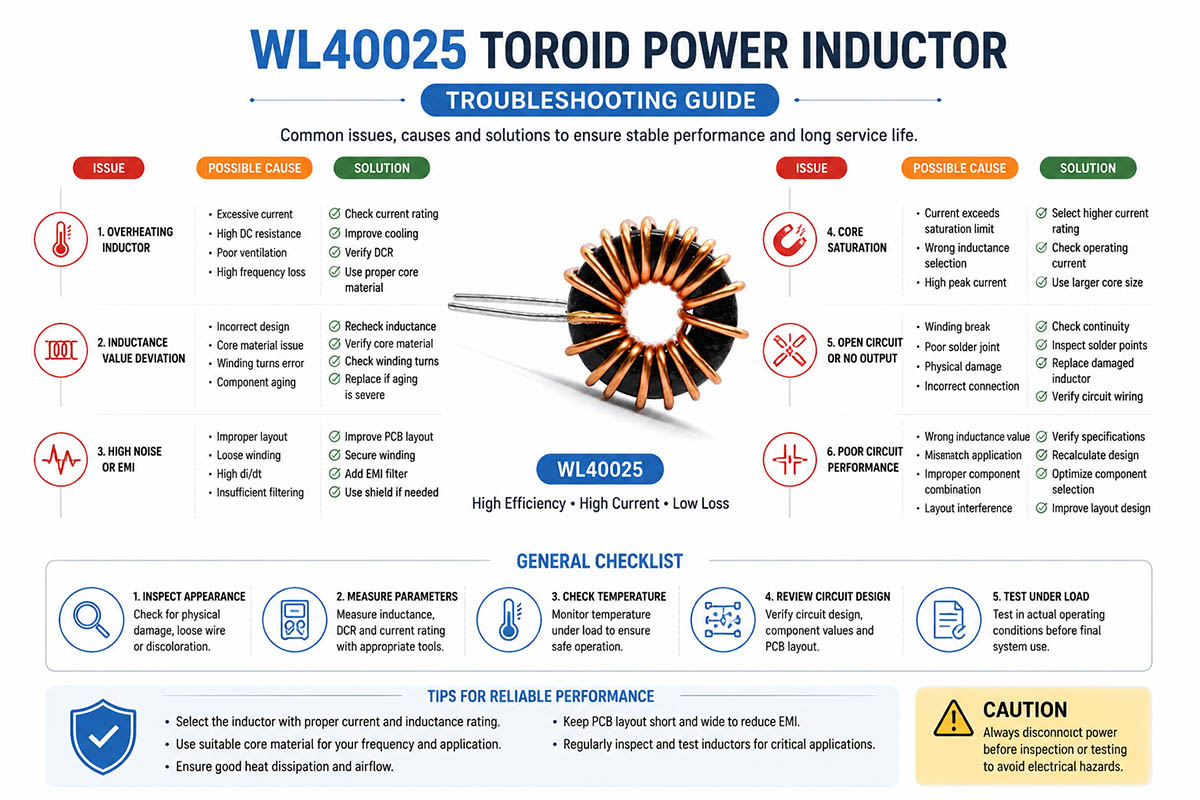
The common problems of toroid power inductors are overheating, decrease of inductance, abnormal noise, and unexpected circuit performance problems.

1. Overheating:

Temperature rise—caused by excessive current, high-frequency losses, or insufficient cooling. It is necessary to check present ratings, winding resistance, and operating conditions.

2. Variation in Inductance:

Wrong choice of core or problems with windings or aging of the components can change the inductance values. It is necessary to verify the specifications and measure the inductance with the proper test equipment.

3. Magnetic saturation;

When the current hits the saturation limit, the inductance falls off sharply. Use the bigger current-rated inductor.

4. EMI Problems:

Design or installation errors can increase the electromagnetic interference. It is necessary to verify winding configuration and filtering requirements.

5. Physical

Loose winding, damage to the insulation, or mechanical stress can affect the reliability. The parts must be verified during the installation and testing.

The toroid power inductors have stable performance, and the failures can be prevented by the regular electrical testing, thermal monitoring, and proper component selection.

FAQs on Toroid Power Inductor

1. What is the function of a power inductor toroid?

The main use of a toroidal power inductor is energy storage and power control in electronic circuits. It is applied in switching power supplies, DC-DC converters, PV inverters, EV systems, automation equipment, and communications products. Toroid transformer core design will minimize magnetic leakage and EMI.

2. Why a toroid power inductor but not a common inductor?

Toroidal power inductors are superior in terms of magnetic efficiency for magnetic fields enclosed inside the closed loop core. This makes them feature less EMI radiation, higher inductance stability, a compact structure, and better performance in power handling. All these make them fit in industrial power applications.

3. How to choose toroid power inductor?

Toroid Power Inductor Selection In choosing a toroid power inductor, the inductance value, rated current, saturation current, working frequency, core material, temperature range, and physical dimensions shall be considered. The inductor should work at maximum current without overheating and magnetic saturation. The right selection will give better efficiency and longer service life.

4. What are the core materials of toroid power inductors?

Ferrite, powdered iron, sendust, and metal alloy are core materials used in the common core of toroid power inductors. Ferrite cores will perform well at high frequencies with less loss, while powdered iron and metal alloy cores will be applicable in high current and energy storage. Core material selection is based on frequency, power level, and working environment.

5. Does the toroid power inductors reduce EMI noise?

Yes. The closed magnetic path structure in a toroid power inductor minimizes magnetic flux leakage, thus minimizing the EMI radiation. Toroid power inductors are widely applied in power filtering circuits, noise reduction circuits, and electronics equipment requiring low EMI performance.

6. Why the power inductor of toroid become overheated?

Overheating is caused by excess current, frequency loss, DC resistance, and wrong selection of components. To solve this problem, verify operating current, improve heat dissipation, and select the proper core material and inductor rating.

7. Can the toroid power inductors be applied in high current applications?

Yes. The efficient magnetic structure design in the toroid power inductors makes them suitable for high-current applications. It enables efficient energy storage and minimizes power loss. Toroid power inductors are widely applied in renewable energy equipment, EV power systems, industrial converters, and high-power switching circuits.

8. Is the toroid power inductors customizable?

Yes. The toroid power inductors can be custom designed to meet your requirements. Manufacturers can customize the core size, turns, wire size, inductance value, current rating, insulation style and mounting style.

How to choose a toroidal power inductor?

When choosing the appropriate toroid power inductor, you must consider several electrical and mechanical factors to ensure reliable operation of the system.

First of all, it is necessary to determine the value of the inductance required for the circuit design. The inductance should be suitable for the operating frequency of the application, its voltage ratings, and current levels.

Secondly, the rated current and saturation current must be considered. The power inductor should be a toroid sized for the maximum operating current, without excessive temperature rise or magnetic saturation. If the current rating is too low, it can lead to overheating and inefficiency in the system.

It is also necessary to select the appropriate core material. The ferrite cores are used in high-frequency applications with low power losses; powdered iron and alloy cores are used when greater energy storage and DC applications are required.

The temperature performance must be verified under the working conditions. It is necessary to choose inductors rated for industrial or outdoor applications with suitable thermal ratings.

The physical size and mounting requirements must also be considered. The inductor should be selected to fit the available space and to dissipate heat properly.

The engineers must verify the parameters such as DC resistance (DCR), impedance characteristics, frequency response, and tolerance values. The lower the DCR, the lower the copper loss and the higher the efficiency.

The winding technique, core size, wire gauge, and type of insulation can be modified by manufacturers for custom applications.

Choosing the right toroidal power inductor will improve the reliability of the system, reduce power losses, and increase the lifetime of the product.

Tips to avoid common mistakes in designing toroid power inductors

Never choose an inductance without regard for the operating frequency.

Don’t exceed the rated current saturation.

Choose the correct core material for the application.

Think about thermal management during high current operation.

Avoid small wire diameters; they will increase copper loss.

Please confirm EMI requirements before the design freeze.

[Component reliability and manufacturing tolerances.]

Before going into production, test the inductors under actual working conditions.

Get A Free Quote Now

Contact Form

Related Products

Related News

Scroll to Top

Get A Free Quote Now !

Contact Form
If you have any questions, please do not hesitate to contact us.
Weilong Solenoid Company Culture
