Electric Pinch Valve Actuator for Automation Solutions
High Performance Pinch Valve Actuator Manufacturer Guide
Custom Pinch Valve Actuator Design and Manufacturing
Compact Pinch Valve Actuator for Precision Flow Control
Pinch Valve Actuator Features Benefits and Applications
Reliable Pinch Valve Actuator for Industrial Automation
Electric Pinch Valve Actuator for Automation Solutions
High Performance Pinch Valve Actuator Manufacturer Guide
Custom Pinch Valve Actuator Design and Manufacturing
Compact Pinch Valve Actuator for Precision Flow Control
Pinch Valve Actuator Features Benefits and Applications
Reliable Pinch Valve Actuator for Industrial Automation

WL37104 Pinch Valve Actuator for Industrial Flow Control Solutions

The Pinch Valve Actuator is a mechanism for reliable automatic opening and closing of the pinch valves in the industrial processes. It provides precise flow on/off control without any mechanical contacts to the process medium with the help of applying the mechanical force for compressing of the flexible sleeve.

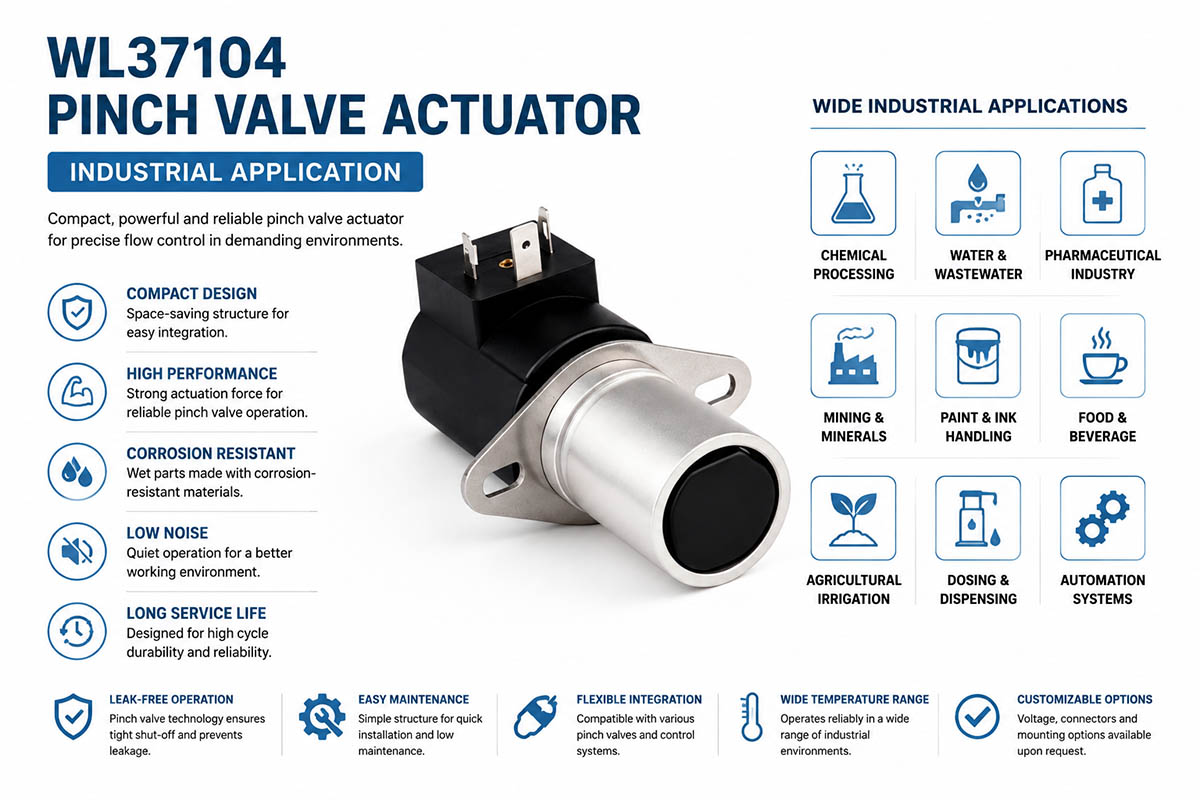
Pinch valve actuators are compact in design and resistant to corrosion, easy in maintenance and have a long operating life. These actuators are resistant to the aggressive fluids, abrasives, powders and slurries. Electric actuators can be easily combined with control systems, while pneumatic actuators have high operational speed and efficiency.

The typical applications include the chemical processing, mining, wastewater treatment, pharmaceutical equipment, food processing and automated dispensing systems. Customization according to the requirements of various voltages, mounting structures, stroke length and operating conditions is possible.

Pinch Valve Actuator Product Overview

The pinch valve actuator is a compact and effective automation part for operating pinch valves in the industrial applications. It provides reliable opening and closing force using the electrical, pneumatic, or mechanical operation. The actuator has a compact housing, the advanced magnetic or mechanical construction, and the flexible mounting system. It can operate reliably in the high cycle applications for the long operating life. The pinch valve actuators are highly popular in the chemical, pharmaceutical, food, water treatment and automation industries due to the advantages such as contamination-free operation, chemical resistance and low maintenance.

What is the working principle of a pinch valve actuator?

The pinch valve actuator is a mechanism for controlling the pinch valve sleeve, converting electrical, pneumatic, or mechanical energy to linear motion.

The operation includes the following steps:

Input signal:

The control system provides the signal for actuator energizing.

Movement of actuator

The actuator converts the electrical or pneumatic input signal into the linear motion using the electromagnetic coil or motor or air pressure.

Compression of Tubes

The actuator then squeezes a plunger or pressing device on the flexible tube and thus closes it.

Flow Control

When the actuator releases the force, the tube opens and the fluid flow becomes possible.

Since the actuator is not in contact with the medium, there is no risk of contamination, and the service life of the device is increased.

Pinch Valve Actuator Main Features

Pinch valve actuators provide several important features for industrial automation processes. They have compact design and are easy to install in the limited space. The actuator provides reliable foa compactput for exact valve control and supports frequent switching cycles. Contamination risk is reduced, as the process fluid only contacts the replaceable tube. The material is corrosion-resistant and the actuators are able to operate in the aggressive environments. Low-noise operation provides better performance of the actuators in the sensitive applications. Different voltage, connectors, mounting options and control types are available. Due to the low maintenance requirements and high durability, the actuators are ideal for automacorrosion-resistant,stems.


Compact Pinch Valve Actuator Feature Presentation Video

Compact Pinch Valve Actuator Detailed Display

Pinch Valve Actuator Technical Data Sheet

Brand Weilong Model Number WL 37104
Rated Voltage (V) DC12V  or 24V Rated Power (W) 26W
Work Mode Air or Liquid Control Valve Working Pressure (MPa) 0.1 MPa
Air-Flow Rate 0-0.5 L/minute Reset Time(s) 1 S On, 1 S Off
Service Life 200 Thousand Times Certification CE, ROHS, ISO9001,
Pipe Gate Outside Dia.: 8 mm, inside: 6 mm Type Single Tube Normal Open
Install Style Screw Tolerance of Dimension ± 0.1 MM
Water-proof None Insulation Class B
Hi-Pot Test AC 600V 50/60 Hz 2s Non-excitation Holding Force 0
Working Temperature -10°C-100°C Duty Cycle 1-100%
Thread Depth (mm) / Payment Term TT, or LC at Sight
Sample Order Yes. Warranty 1 Year
MOQ 1000 pcs Supply Ability 5000 pcs per week
Delivery Time 30 Days Port of Loading Shenzhen

Why is the pinch valve actuator getting so popular?

The pinch valve actuators become more and more popular due to the increasing requirements for the cleanliness, safety, and reliability of the flow control in the modern industries.

Traditionally, valves are susceptible to corrosion, contamination, and complex maintenance. In case of pinch valve actuators the issue is solved by the isolation of the medium from the actuator mechanism.

The major advantages are

No leakage.

Low maintenance cost

Excellent chemical resistance

Easy integration with the automation

Compact design

Long operating life

The expansion of the pharmaceutical, food processing, semiconductor, laboratory automation, and wastewater industries increases the demand for hygienic and reliable valve control systems.

Electric pinch valve actuators are especially useful for the smart factory development due to the simple integration with PLC and automated equipment.

Due to the advances in materials, control technology, and design, pinch valve actuators are likely to become an important element of future industrial automation.


Compact Pinch Valve Actuator Industrial Application

Pinch valve actuator industrial application guide

The pinch valve actuators are used in the industries that require reliable, contaminant-free flow control.

Chemical Engineering

Pinch valve actuators are used in the chemical industry to control of corrosive fluids, chemicals and aggressive media. The fluid is in contact with the replaceable sleeve only.

Drug Industry

The pharmaceutical equipment is required to operate in accordance with the high hygienic requirements. Pinch valve actuators avoid contamination and assist in the accurate dosing process.

Food & Beverage

Pinch valve actuators are used in food processing where the sanitary performance, easy cleaning and precise control of liquids and semi-solids are required.

Water Purification

Pinch valve actuators are used in wastewater treatment facilities for handling of sludge, wastewater, and abrasive materials.

Mining Sector

Valves for slurry and abrasive materials are required in the mining applications. The pinch valve technology is highly durable.

Automation Equipment

Compact pinched valve actuators are applied in the industrial automation systems such as robotic dispensing, laboratory instruments and precision fluid control.

Today the pinch valve actuators are gaining more and more popularity due to their reliability, contamination-free operation, and availability of custom designs.


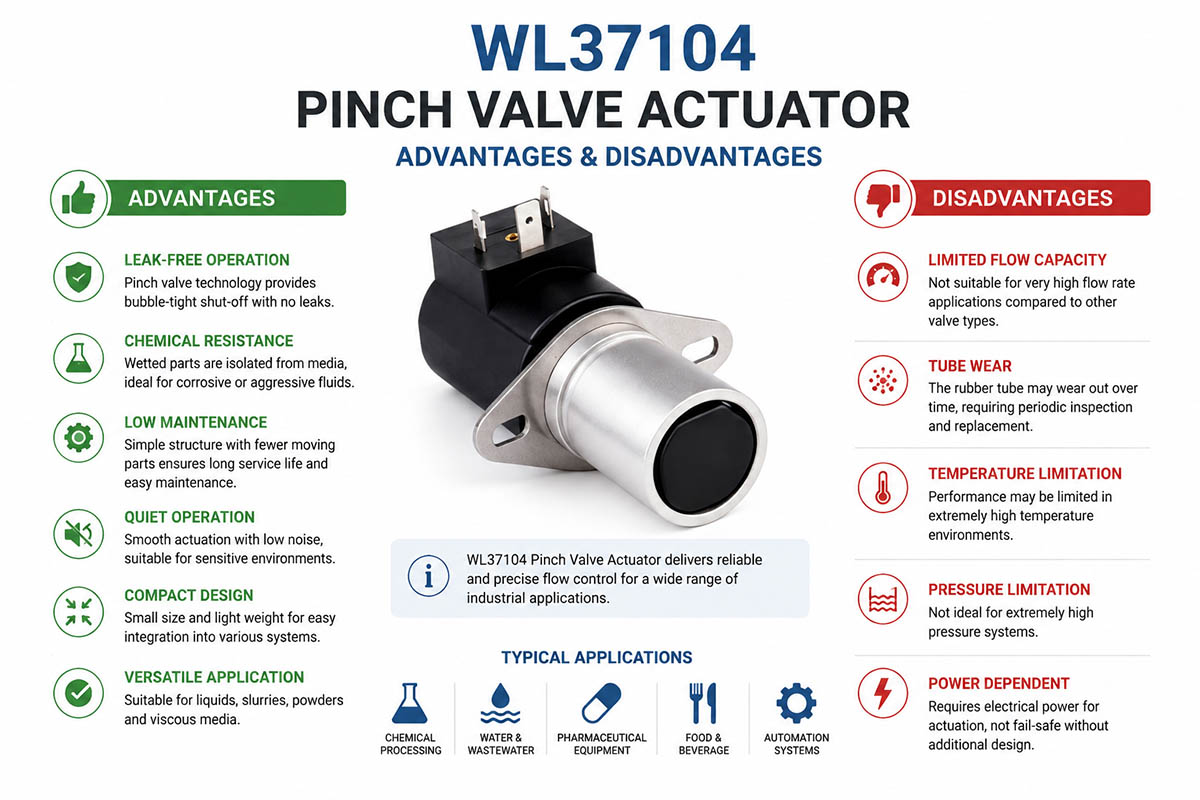
Pinch Valve Actuator Advantage and Disadvantage

Pinch Valve Actuator Advantage and Disadvantage

Pinch Valve Actuator Advantages

Leak-free operation

The actuator controls the sleeve without the contact to the fluid reducing the risk of leakage.

Good chemical resistance

The medium touches the sleeve material only. It allows you to use it with aggressive chemicals.

Easy to maintain

The simple design reduces the mechanical failures and maintenance expenses.

Clean operation

Appropriate for the pharmaceutical and food industries with the absence of the internal valve contamination.

Compact design

The small dimensions are advantageous for the integration with the automated equipment.

Wide Application Range

Applicable for liquids, powders, slurry, and abrasive materials.

Pinch Valve Actuator Disadvantages.

Limited pressure capability

Pinch valves are not suitable for very high-pressure systems.

Tube life

The flexible sleeve is subjected to the mechanical stress and should be replaced.

Flow Restriction.

For the larger flow rates, the larger valves are required.

Temperature limitations.

The material of the tube limits the maximum operating temperature.

Power dependence.

The electrical actuators require a stable power supply.

Overall, pinch valve actuators are an excellent solution for the applications requiring clean and reliable flow control.

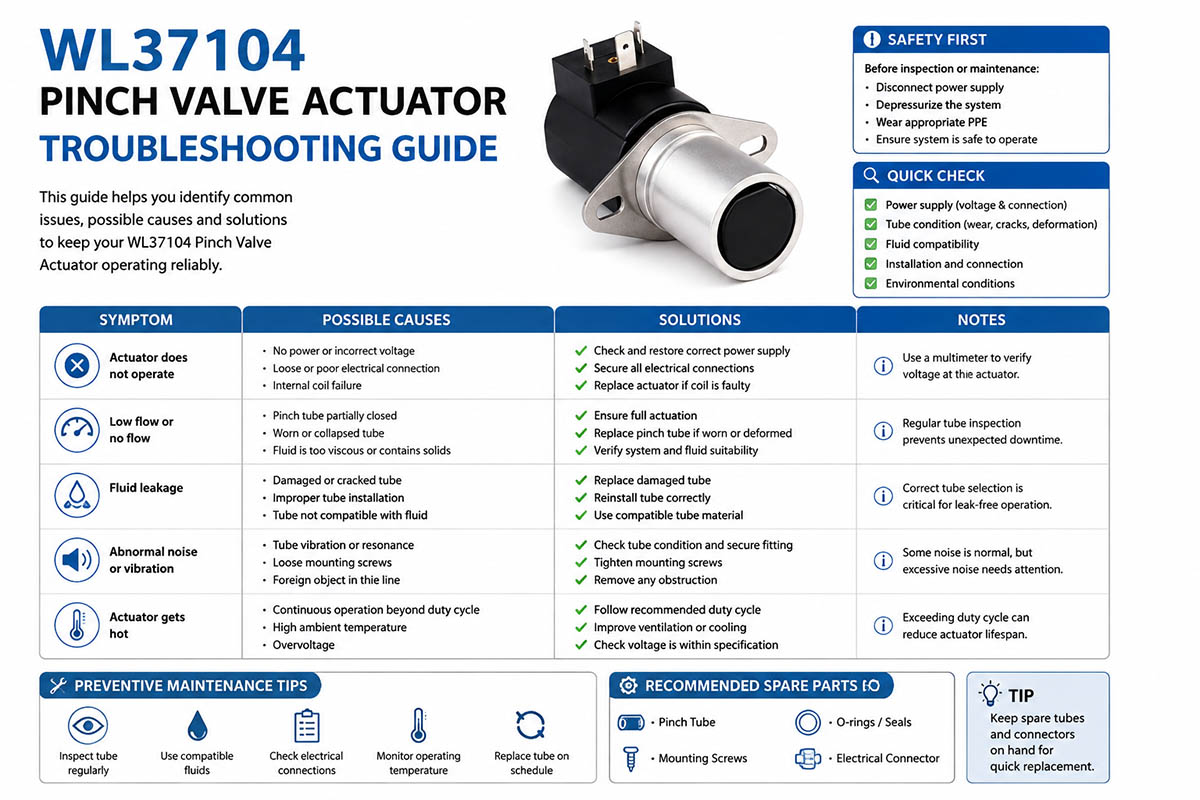
Pinch Valve Actuators Troubleshooting Guide

Pinch valve actuator Troubleshooting guide

1. The actuator does not work

Possible causes

Power supply absence.

Wrong voltage

Loose wiring

Coil failure

Solutions:

Check the electrical connections.

Check the operating voltage.

Replace the damaged parts.

2. Valve does not fully close

Possible causes:

Too low actuator force

Incorrect tube size

Wear out of the tube

Solutions:

Check the actuator specification

Remove the damaged tube.

Install

3. Leakage problem

Possible causes:

Damaged cover

Wrong tube material

Incorrect assembling

Solutions:

Tube replacing

Check for compatibility.

Correct installation

4. Too much noise or vibrations

Possible causes:

Loose mounting

Mechanical resonance

Fault

Solutions:

Tightening mounting hardware

Check the installation conditions

5. Too hot

Possible causes:

High-duty-cycled

Wrong voltage

Poor ventilation

Solutions:

Decrease surgery.

Check voltage.

Improve cooling.

Proper inspection and preventive maintenance significantly increase the actuator life.


8 Common Questions About Pinch Valve Actuators

1. What is a Pinch Valve Actuator?

The pinch valve actuator is a mechanism that opens and closes the pinch valve automatically with the help of the mechanical force applied for squeezing or releasing the flexible tube in the valve. The actuator may be driven by either electric, pneumatic, or any other control method. The valve provides precise control of flow of liquids, powders, slurries and abrasive materials with isolation of the actuator from the process medium. Pinch valve actuators are widely used in chemical processing, pharmaceutical equipment, food and beverage systems, wastewater treatment, mining, and industrial automation.

2. How Does a Pinch Valve Actuator Work?

Pinch valve actuators convert energy into linear movement. In response to the control signal the actuator produces a force that pushes a plunger or some compression mechanism against the flexible sleeve of the valve. Squeezed tube means stopped material flow. When the actuator releases the force, the elastic sleeve restores its initial shape and the fluid flow becomes possible.

Electric pinch valve actuators are usually the electromagnetic force or motor-driven mechanisms, while the pneumatic actuators operate with the help of the compressed air. This simple mechanism guarantees the reliable and contamination-free flow control.

3. What are the major advantages of a pinch valve actuator?

The major advantages of a pinch valve actuator are

Complete tube closure providing leak-proof operation

Excellent chemical resistance, since the medium only contacts the sleeve

Low maintenance, having fewer moving parts

Easy integration with the equipment due to the compact design

Clean operation providing the hygienic applications

Long operating life due to the proper material selection

Ideal for the handling of abrasive materials like slurry or powders

These advantages make pinch valve actuators a perfect solution for the industries requiring clean and reliable flow control.

4. Which Industries Use Pinch Valve Actuators?

The pinch valve actuators are used in many different industries, namely:

Chemical Processing

For controlling the aggressive fluids and corrosive chemicals.

The Pharmaceutical Industry

For controlling the hygiene fluids and preventing contamination.

Food and drink

For hygienic processing and liquid handling systems.

Water Treatment

Sludge and liquids with particles for wastewater

Mining Sector

For the slurry handling.

Automation Equipment

Dosing machines and precise liquid control systems for laboratory instruments.

They are versatile and can be used in the industrial and special applications.

5. How to Choose the Right Pinch Valve Actuator?

When choosing the pinch valve actuator, take into account the following:

Required force for the closure

It is important to make sure that the actuator is able to fully compress the valve sleeve.

Valve size and pipe diameter

Larger valves require larger actuator force.

Power supply

Check and determine the voltage requirements, such as DC 12V, DC 24V, or DC 48V.

Operation environment:

Take into account the temperature, humidity, chemicals, and dust presence.

Duty cycle

Check whether the actuator is intended for the continuous or intermittent operation.

Increasing needs

Check dimensions, connectors, and mounting space.

The professional manufacturer will help you to optimize the actuator design according to your application requirements.


6. Pinch Valve Actuator vs Solenoid Valve: What is the Difference?

The pinch valve actuator operates on the basis of physically pinching the flexible tube. The solenoid valve controls the flow of the fluid directly with the internal valve components.

Difference:


Key differences:

Feature Pinch Valve Actuator Solenoid Valve
Medium Contact Only tube contacts fluid. Internal valve parts contact fluid.
Contamination Risk Very low Higher
Chemical Resistance Excellent Depends on material
Maintenance Simple tube replacement More complex
Suitable Media Slurry, powder, corrosive fluids Clean liquids and gases

Pinch valve actuators are preferred when cleanliness, chemical resistance, and easy maintenance are important.

7. What Are Typical Problems With Pinch Valve Actuators?

The most common problems are

Actuator Does Not Move

Possible Causes:

Power Supply Problem

Wrong Voltage

Wiring problem

Valve Does Not Fully Close

Possible Causes:

Too low actuator force

Wrong tube size

Worn sleeve

Leakage occurs.

Possible Causes:

Damaged tube

Wrong tube material

Bad installation

Actuator overheating

Possible Causes:

Too high duty-cycled

Wrong voltage

Poor heat dissipation

Proper installation, regular inspection, and tube selection will prevent most of the problems.


8. Are Pinch Valve Actuators Custom Made?
  1. The pinch valve actuators are custom-made according to the various industrial needs.

Customization Options include:

Operating voltage (6V DC, 12V DC, 24V DC, 48V DC, etc.)

Actuator force

Stroke length

Mounting structure

Connector type

Housing material

Degree of protection

Operating temperature range

Application-specific specifications

The custom pinch valve actuators are intended for use in medical devices, laboratory systems, automation machines, and industrial control applications.


How to choose a pinch valve actuator?

Several important engineering considerations should be taken into account when choosing the appropriate pinch valve actuator.

1. Required Operating Force

The actuator should provide sufficient force to fully close the pinch tube. Determine the necessary force according to the diameter of the tube, the hardness of the material, and the pressure.

2. Valve Size Compatibility

Choose the actuator corresponding to the pinch valve size. The large diameter requires a large actuator structure and more operating force.

3. Control Method

Consider whether the system requires:

Electrical actuator.

Pneumatic actuator.

Solenoid actuator.

Electric actuators are suitable for the automatic equipment, while pneumatic actuators have better performance in the high-speed industrial applications.

4. Voltage Selection

In the case of the electric pinch valve actuators, check the available power supply, such as

12V DC.

24 V DC.

48 volts DC.

The inappropriate selection of the voltage will result in the decreased performance or even the damage of the actuator.

5. Duty Cycle

Determine if the actuator is intended for continuous or intermittent operation. The high-frequency applications require the optimized thermal design.

6. Conditions—Environment

Take into account the following:

Temperature Range.

Moisture.

Chemical exposure.

Protection from dust.

The materials should be compatible with the operating environment.

7. Special Requirements

Special applications discussion:

Increased dimensions.

Type of connector.

Length of stroke.

Design of cable.

Level of protection.

There is a professional actuator manufacturer that will help you to optimize the design for the best performance and cost-effectiveness.

Common mistakes to avoid when designing pinch valve actuator

Do not underestimate needed force

The lack of force will result in incomplete closure of the valve and leakage.

Wrong tube selection

The material of the tube should be compatible with the chemical and temperature.

Inadequate thermal design

It is important to provide good heat and coil management for continuous operation.

Voltage selection mistake

Make sure of voltage compatibility before manufacturing.

Overlooking installation space

Check the mounting dimensions and mechanical interferences.

Lack of life cycle testing

Durability should be checked through the prototype testing before mass production.

Neglecting maintenaIt is important to ensure that the design allows for the replacement of the tubes and components.components.


Get A Free Quote Now

Contact Form

Related Products

Related News

Scroll to Top

Get A Free Quote Now !

Contact Form
If you have any questions, please do not hesitate to contact us.
Weilong Solenoid Company Culture