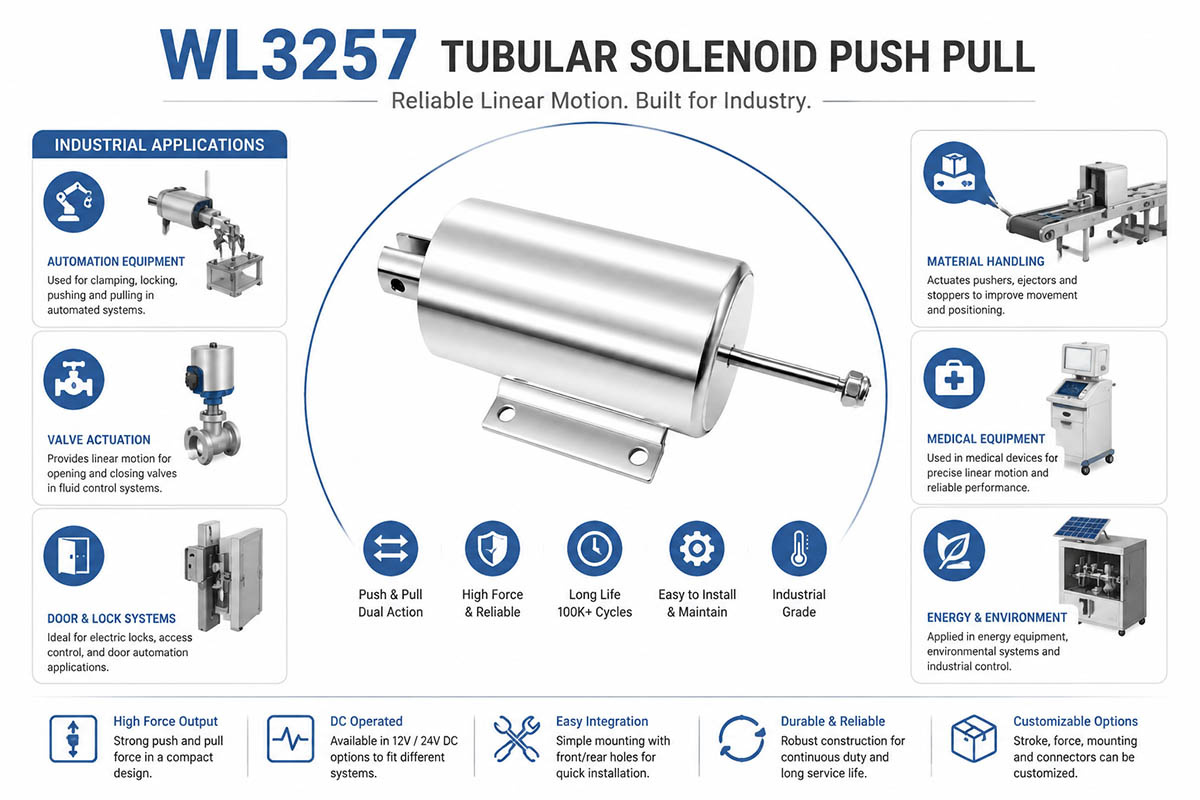
How to Choose the Tubular Solenoid Push Pull?
There are several technical factors to be considered in order to choose the right tubular solenoid push-pull.
1. Determine the force required
The first step is to determine the required push force and pull force. Different applications require different force values. The wrong selection of the solenoid that is too weak can lead to failure, while the excess of power will increase costs and power consumption.
2. Stroke length determination
Stroke is the distance the plunger has to move. The common stroke requirements are 5 mm, 10 mm, 20 mm, or custom length. The longer strokes usually are less powerful.
3. Choose operating voltage
The common voltage values are DC 5V, 12V, 24V, and 48V. For staboperation, the power supply must matchith the coil parameters.
4. Verify the duty cycle
The duty cycle determines the duration of the solenoid operation. If you want to operate the solenoid continuously, then you need to choose the 100% duty cycle design. The intermittent duty cycle models can be used for short activation periods.
5. Consider installation space
Before the solenoid selection, it is necessary to measure the available space for the installation. The tubular solenoids have very good space efficiency but still require proper mechanical integration.
6. Consider working environment
It is necessary to consider the temperature, humidity, vibration, dust, and corrosion conditions. In harsh environmental conditions, special materials and coatings may be required.
7. Discuss your custom requirements
For OEM projects there can be special shafts, connectors, springs, mounting brackets or special force curves needed. The professional manufacturer can help you to optimize the design.
The correct choice will increase reliability and decrease energy usage, ensuring the product performs well over a long period.
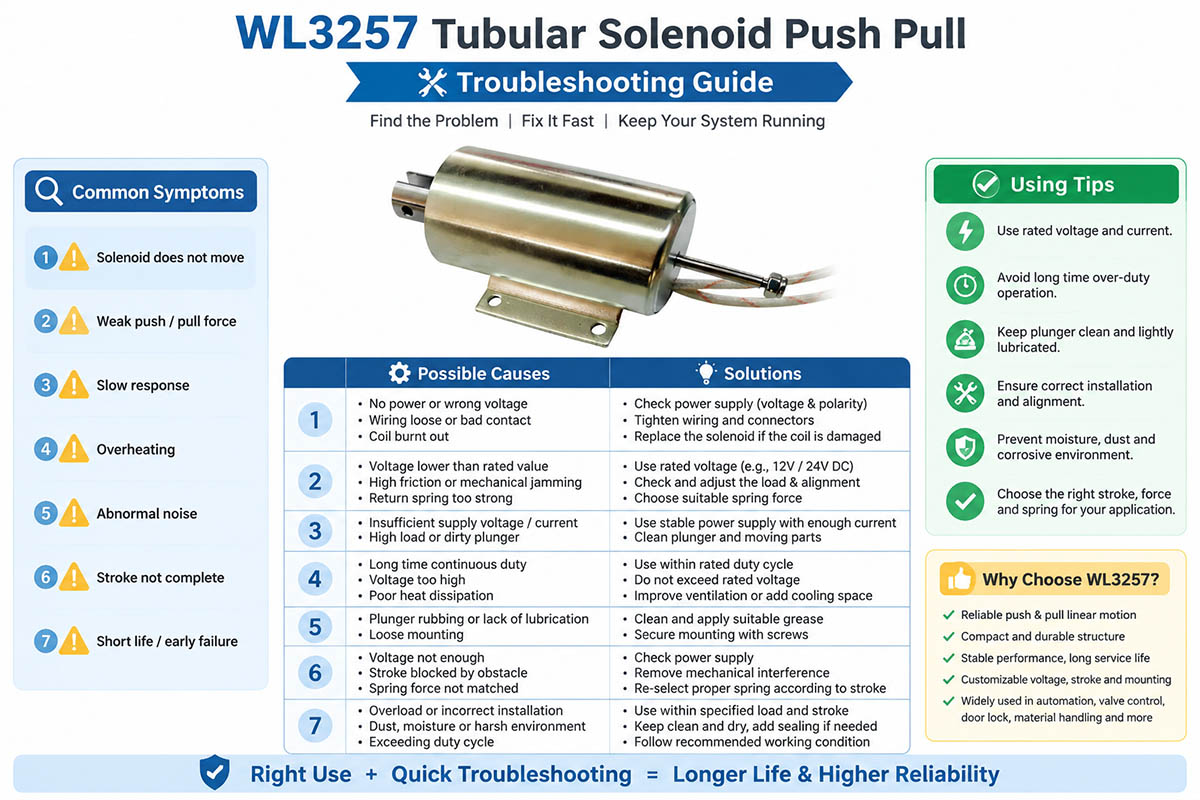
How to avoid the comment “Error in Tubular Solenoid Push-Pull Design”
Many designers assume the constant force value along the entire stroke. But with the increasing of the air gap, the electromagnetic force decreases.
Selecting the wrong voltage and current
Insufficient current leads to insufficient force. Excess of current can cause overheating.
No duty cycle consideration
Solenoids are intermittent devices. The continuous operation can shorten their life.
Heat management ignoring
Good design is required to control the temperature of the coil.
Wrong mechanical load calculation
The force of the solenoid has to be enough for the friction, spring force, and safety margin.
Ignoring the alignment during installation
Misalignment causes the friction and lowers performance.
Omitting the prototype testing
Before the mass production, the real application testing is necessary.
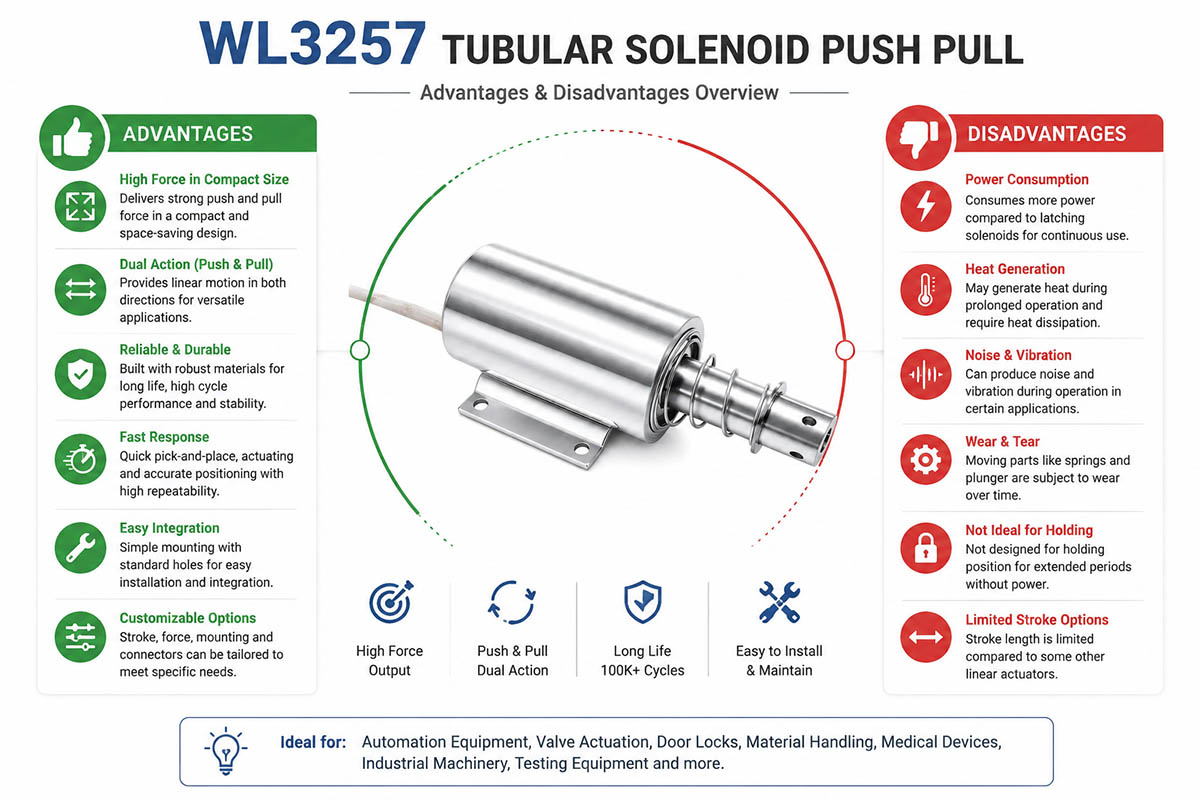
Advantages and Disadvantages of Tubular Solenoid Push Pull Advantages
The tubular solenoid push-pull has many advantages for industrial applications.
Minimal impact:
Cylindrical design allows generating high force output in limited space.
High magnetic efficiency:
Optimizing the magnetic path improves the electromagnetic performance.
Dependable operation:
Simple mechanical design reduces the risk of failure.
Customization ability:
Force, stroke, voltage, mountings and connectors can be customized.
Long life.
High-quality materials and testing to provide millions of operation cycles.
Downsides
Heat generation:
Continuous operation causes heating of the coil that has to be thermally managed.
Force limitation:
Force reduction with increasing of the stroke distance.
Power consumption:
Higher-force models require higher electric power.
Limited holding capacity:
A common tubular solenoid requires energy to hold its position.
Custom designs require development time:
Special structures require special tooling and engineering.
In general, the tubular solenoid push-pull is the excellent solution when compact size, reliable movement, and custom electromagnetic performance are required.