Air Proportional Valve for Industrial Automation
Air Proportional Valve for Medical Equipment
Air Proportional Valve for Pneumatic Control
Best Air Proportional Valve for OEM Projects
Compact Air Proportional Valve for Automation
Precision Air Proportional Valve Manufacturer
Air Proportional Valve for Industrial Automation
Air Proportional Valve for Medical Equipment
Air Proportional Valve for Pneumatic Control
Best Air Proportional Valve for OEM Projects
Compact Air Proportional Valve for Automation
Precision Air Proportional Valve Manufacturer

WL1745 High Precision Air Proportional Valve Solutions

An Air Proportional Valve is an electronically controlled pneumatic valve. The Air Proportional Valve continuously controls the air pressure or air flow proportional to an input electrical signal such as 0-10 V, 4-20 mA or PWM. In contrast to conventional on/off solenoid valves which merely open or close, it provides smooth and precise regulation. The electromagnetic actuator precisely positions the valve spool or poppet inside the valve which controls the pressure and flow smoothly. Air proportional valve is widely used in industrial automation, medical devices, robotics, packaging machinery, laboratory equipment, and precision manufacturing where precise pneumatic control increases productivity, energy efficiency, and process consistency.

Compact Air Proportional Valve Product Overview

Air proportional valves are sophisticated pneumatic control devices which are designed to provide precise and constant control of air flow and pressure. They provide smooth proportional control driven by electrical input signals utilizing a combination of electromagnetic actuation and precise valve mechanisms. They are designed to meet the needs of automation, medical, packaging, robotics and industrial manufacturing and are available in various pressure ranges, flow capacities and control interfaces. High-quality air proportional valves have compact design, fast response, outstanding repeatability, low energy consumption and long service life. The OEM customization options include voltage, pressure range, connectors, mounting configurations, and communication interfaces for various industrial applications.

Compact Air Proportional Valve Video

Compact Air Proportional Valve Detailed Display

Precision Air Proportional Valve DataSheet

Brand Weilong Model Number WL 7145
Rated Voltage (V) DC12V  or 24V Rated Power(W) 2W
Work Mode Air Control Valve Working Pressure ( Mpa) 0.2 Mpa
Air-flow Rate  0-0.5L/ per Minute Reset Time(s) 1 S On,1S OFF
Service Life 200 Thousand Times Certification CE,ROHS,ISO9001,
Material Superior Magnet Iron Lead Wire Length(mm) 200 MM
Install Style Screw Tolerance of Dimension  +/-  0.1 MM
Water-proof  None Insulation Class B
Hi-Pot Test AC 600V 50/60Hz 2s Non-excitation Holding Force 0
Working Temperature -10°C-100°C Duty Cycle 1-100%
Thread Depth(mm) / Payment Term TT, or LC At Sight
Sample Order Yes Warranty 1 Year
MOQ 1000 pcs Supply Ability 5000 pcs per Week
Delivery Time 30 Days Port of Loading shenzhen

How Does an Air Proportional Valve Work?

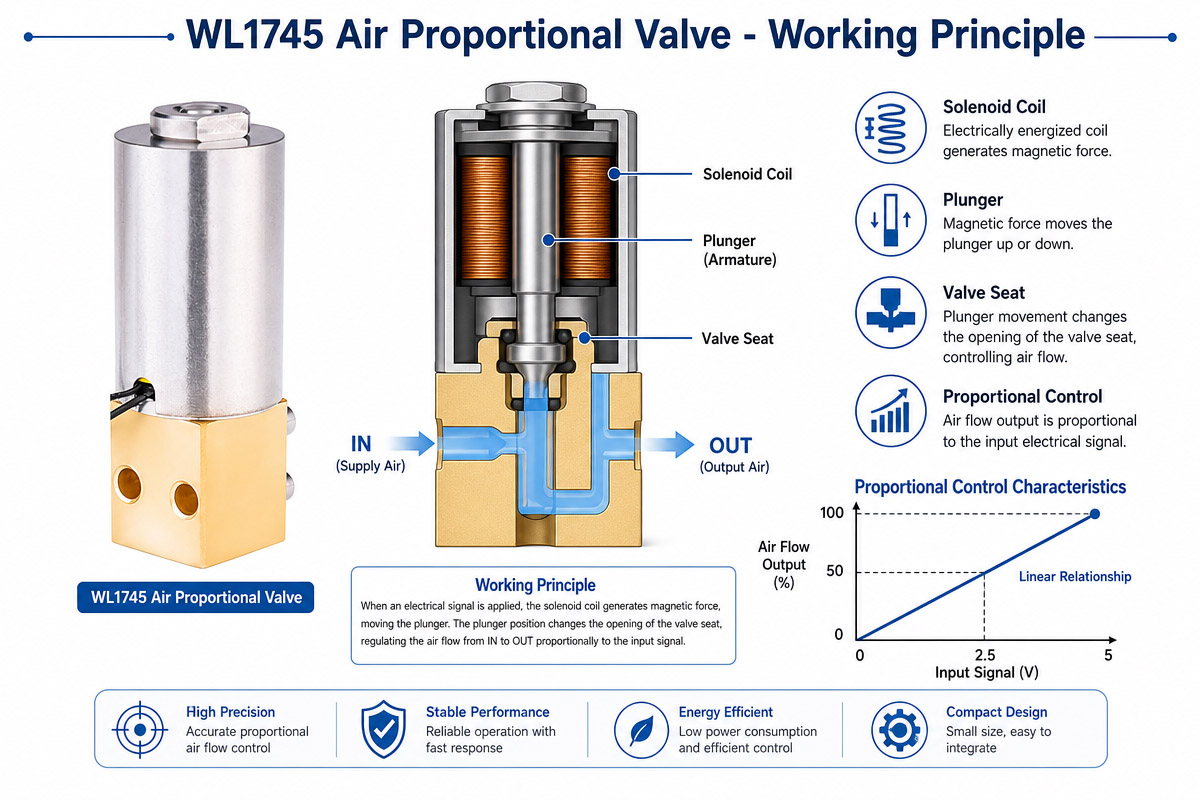
Air Proportional Valve Working Principle

Air proportional valve operates through conversion of electrical control signal into proportional mechanical motion. The control circuit applies electrical voltage, current or PWM signal to the electromagnetic coil. The magnetic field generated moves the armature or plunger. The movement changes the position of the valve spool or poppet, changing the air passageway opening.

The opening varies and the air flow or outlet pressure is constantly adjusted rather than being just switched on or off. In many models the integrated sensors and electronic feedback circuits continuously monitor the output pressure and adjust to any load variation.

The closed-loop control enables precise pressure regulation, fast response, outstanding repeatability and precise air flow control. Air proportional valves are indispensable for applications where precise pneumatic control is required.

Why Is the Air Proportional Valve Becoming So Popular?

The increasing adoption of industrial automation, smart manufacturing and energy-efficient production systems drives the demand for air proportional valves. Unlike traditional on/off valves, proportional valves provide continuous and very precise control of air pressure and flow. This provides smoother machine operation, better product quality and reduced consumption of compressed air.

The productivity and waste reduction necessitate precision pneumatic control for industries such as robotics, medical equipment, semiconductor manufacturing, packaging, automotive and laboratory automation. The air proportional valve is easily integrated with PLCs, sensors and IIoT platform, which makes it an ideal choice for modern intelligent factories.

The advances in electronics, control algorithms and manufacturing technologies make these valves more reliable, compact and cost effective. Air proportional valves are the preferred solution for equipment designers and manufacturers around the world, because they help to reduce maintenance, ensure process consistency, lower operating costs and customize for OEM applications. The Industry 4.0 is here and the demand for air proportional valves is going to grow steadily in all segments of automation.

Air Proportional Valve Industrial Application

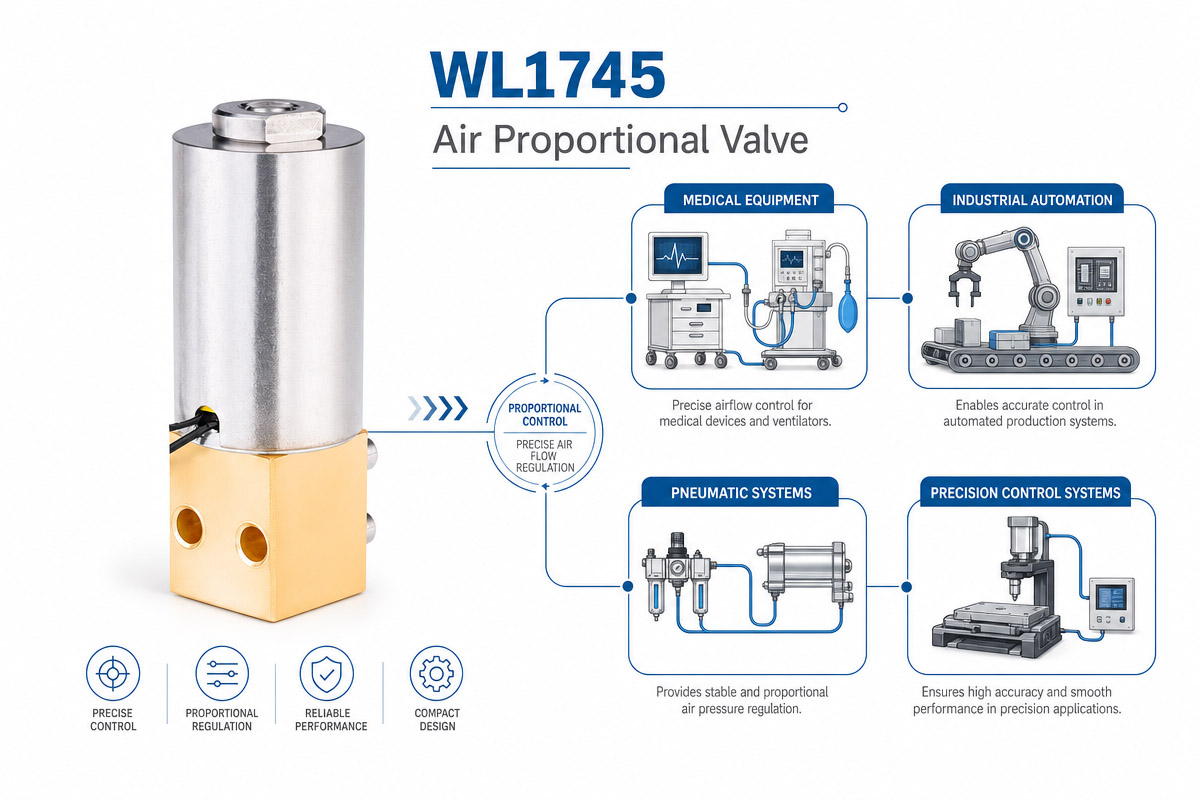
Air Proportional Valve Industrial Application

Air proportional valves are used in industries where precise and responsive pneumatic control is required. They control the speed of actuators, gripping force and cylinder positioning, which improves the production precision in factory automation. The proportional valves are used in robot systems to control pneumatic grippers for handling of delicate components.

Air proportional valves are used in medical devices, including ventilators, anesthesia machines, oxygen delivery systems and laboratory instruments where the precise and stable pressure is critical for patient safety and measurement. They are used in packaging machinery to control the sealing pressure, filling operations, labelling and handling of products with high repeatability.

Clean compressed air is precisely controlled by proportional valves to ensure the highest standards of contamination-free manufacturing processes in semiconductor production. They are used in textile machines to ensure a stable air pressure for weaving and handling of yarn. Proportional valves are used in automated assembly, testing equipment and leak detection systems in automotive production.

They are used in food processing equipment, printing machines, laser cutting systems, environmental test chambers, pneumatic conveying systems and research laboratories. Air proportional valves can provide precise air flow control, save energy, reduce compressed air consumption and prolong the lifespan of equipment.

Advantages and Disadvantages of Air Proportional Valve

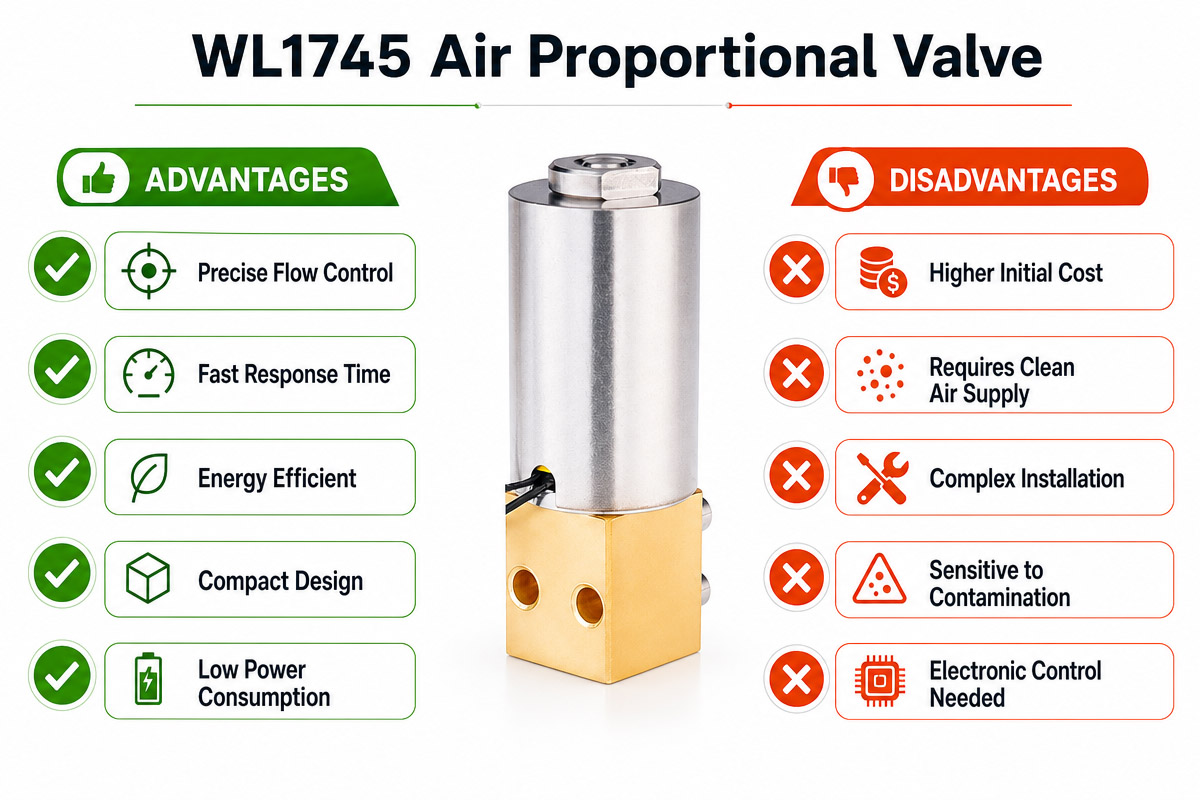
Air Proportional Vavle Advantage and Disadvantage

Air proportional valves provide many advantages over the conventional pneumatic valves. The main advantage is the precise and constant control of air flow and pressure that enable the equipment to operate more accurately and efficiently. The fast response time allows quick adjustments and the high repeatability provides consistent production quality. Another main advantage is energy savings, since the valve delivers only the amount of air flow necessary rather than operating continuously at full capacity. Less mechanical shocks prolong the life of pneumatic cylinders and other parts. Compact design facilitates installation and many models can be easily integrated with PLCs and industrial automation systems.

However, the air proportional valves have some disadvantages as well. They are more expensive than standard on/off solenoid valves due to the electronic control system. You will need clean, dry and compressed air to get accurate readings, thus, a high-quality filter is a must. The performance of these valves can be reduced by poor electrical signal quality or wrong settings of the controller. Additionally, proportional valves frequently require calibration upon installation and maintenance to guarantee long-term accuracy. The wrong valve size or pressure range can also cause instability of the system.

Troubleshooting Air Proportional Valve

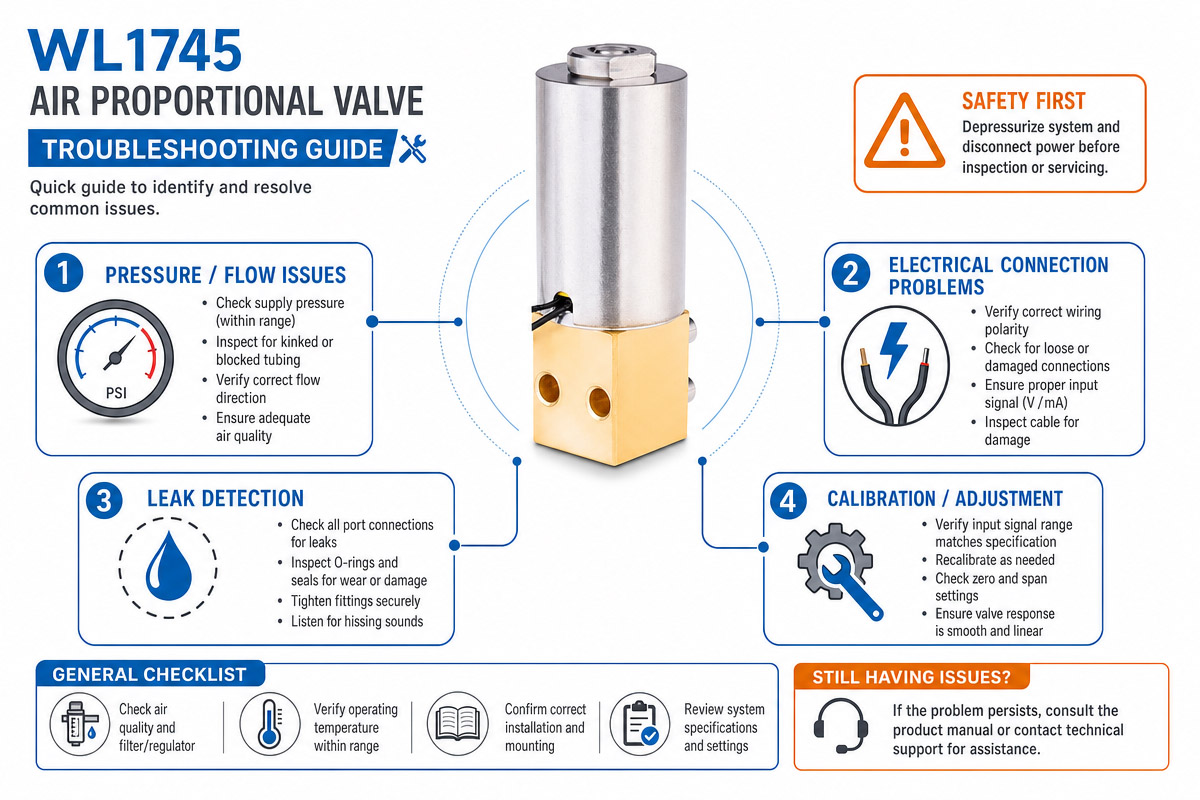
Air Proportional Vavle Troubleshooting Guide

Air Proportional Valve Troubleshooting If an air proportional valve is not operating as required, following a systematic troubleshooting procedure will help you identify the root cause of the problem. If the valve does not react, check the power supply and the input control signal. Loose connections or wrong voltage is a common issue. Make sure that the controller generates the correct PWM, voltage or current signal.

If the pressure is not stable, check the compressed air supply for contamination, moisture or low pressure. Contaminated filters and clogged air passages limit valve performance. Check the seals and fittings for leaks that could influence pressure regulation.

If the reaction is slow, it can be caused by mechanical wear, contamination inside the valve or wrong settings of parameters in the controller. In most cases the problem can be solved by cleaning the internal components and calibrating the valve. The unstable air pressure, damaged seals and worn moving parts can cause excessive noise.

The overheating is usually caused by too much voltage to the coil, constant overload or poor ventilation. Make sure that the operating conditions comply with the manufacturer’s specifications.

Regular maintenance such as air filters replacement, periodic calibration, checking for leaks and electrical testing helps to prevent unexpected failures. A preventive maintenance program is vital to extend the life of the valve and provide accurate and stable operation in harsh industrial environment.

FAQs of Precision Air Proportional Valve

1. An Air proportional valve is a valve which controls the flow of air proportionally to an electrical input.

An Air Proportional Valve is an electronically controlled pneumatic valve which provides the continuous regulation of air pressure or air flow in response to an electrical input signal (0-10 V, 4-20 mA, or PWM). In contrast to the conventional on/off solenoid valves, it provides smooth and precise control for applications which require variable pressure or flow.

2. How does an Air Proportional Valve work?

An air proportional valve is an electromagnetic actuator which converts an electrical control signal into a proportional mechanical movement. The actuator controls the valve opening. This controls the air flow or outlet pressure precisely. Most of the models have a closed-loop feedback to maintain a steady pressure despite of varying system demand.

3. What is the advantage of an Air Proportional Valve?

Major advantages include:

  • Precise pressure and flow control
  • Fast response time
  • Outstanding repeatability
  • Reduced compressed air consumption
  • Reduced wear on equipment
  • Pneumatic smooth movement
  • Easy integration with PLC and automation systems
  • Long service life
4. What industries use Air Proportional Valves?

Air proportional valves have many applications, including:

  • Automation in industry
  • Robots
  • Medical equipment
  • Packaging equipment
  • Semiconductor manufacturing
  • Machines for clothes
  • Food processing machinery
  • Automobile manufacturing
  • Laboratory and testing equipment
  • Systems for printing and labeling
5. How do I select the correct Air Proportional Valve?

When selecting a valve, consider the following:

  • The pressure range required
  • The flow rate (the capacity of air flow)
  • The control signal (PWM, 0-10V, 4-20 mA)
  • Power supply voltage
  • Turnaround time
  • Installation space
  • Environmental conditions
  • Port size and connection type
  • Required service life

OEM customization requirements

6. What causes an Air Proportional Valve to fail?

The main causes include:

  • Wet or contaminated compressed air
  • Voltage error on input or control signal
  • Air infiltration
  • Clogged filters
  • Damaged seals
  • Overheating of the coil
  • Incorrect installation
  • Mechanical wear during long time operation

The majority of these issues can be avoided through regular maintenance and clean air filtration.

7. How often to service an Air Proportional Valve?

The operating environment defines the maintenance frequency, but the general recommendation is to:

  • Check air filters regularly.
  • Check electrical connections.
  • Check response and accuracy of pressure.
  • Check seals for leakage.
  • Clean the internal air passages in case of contamination.
  • Periodic calibration of valve in case of precision applications.

Regular preventive maintenance ensures the longer service life and maximum performance.

8. Air Proportional Valves can be customized for OEM applications.

Yes. Many manufacturers provide OEM and ODM customization services, including:

  • Custom operating voltages (e.g. 12V, 24V, 48V DC)
  • Customizable pressure and flow ranges
  • Special electrical connectors and wiring
  • Custom port sizes and mounting configurations
  • Materials of housing – aluminum, stainless steel, brass
  • Protection degrees (IP rated)
  • Private labeling and logo printing
  • Application specific firmware or control settings

The OEM customization ensures that the valve is fully integrated into your equipment and meets the particular performance and design requirements.

How to Select an Air Proportional Valve

Understanding the operating requirements of your application is vital for correct selection of the air proportional valve. First, decide the pressure range and maximum air flow necessary, since they are directly related to the performance of the valve. If the valve is too small, the efficiency of the system will be reduced; if the valve is too large, the control accuracy will be reduced.

Then, you need to define the necessary control signal. Common input options are PWM, 0-10V, and 4-20mA. Make sure that the valve is compatible with your PLC, controller or automation system for seamless integration.

Another important parameter is the response time. For high-speed applications, such as robots, semiconductor equipment and automated assembly lines, you will need a valve with fast response and high repeatability. For precise medical or laboratory equipment, you will require a valve with low hysteresis and closed loop pressure control.

Take into consideration the environmental conditions, including the operating temperature, humidity, dust, vibration and exposure to chemicals. Choose proper enclosure materials and protection rating for the valve in harsh environments.

Evaluate the valve power consumption, since energy-efficient models will decrease the operating costs and heat generation. The long service life and reliable sealing will save the maintenance costs and equipment uptime.

Also, installation requirements, including mounting dimensions, port sizes, electrical connectors and available installation space should be considered. For restricted space, compact valves are preferable.

Finally, select a manufacturer which provides full technical support, quality certifications, customization services and reliable after-sales support. The OEM capability is especially valuable for equipment manufacturers who require customized voltage, pressure range, connectors or mounting options.

Taking into account these factors, buyers can choose an air proportional valve which will provide reliable performance, increased efficiency, reduced operating costs and long-term value for their automation systems.

Common Mistakes in Air Proportional Valve Design and How to Avoid Them

Proper determination of pressure and flow requirements prior to design.

Proper selection of the valve size to prevent instability.

Selection of proper control signal according to the output of the controller.

Do not operate the valve at maximum capacity.

Use proper air filtration to avoid contamination.

Use stable power supply to reduce control errors.

Proper heat dissipation design.

Selection of sealing materials suitable to the working environment.

Optimization of piping routes to reduce pressure drop.

Response time check meeting application requirements.

Consideration of maintenance accessibility during installation.

Post-installation calibration.

Test in actual operating conditions prior to production.

Selection of manufacturers with quality systems.

Consideration of the future maintenance and availability of spare parts.

Get A Free Quote Now

Contact Form

Related Products

Related News

Scroll to Top

Get A Free Quote Now !

Contact Form
If you have any questions, please do not hesitate to contact us.
Weilong Solenoid Company Culture
