
Chapter 1: Introduction of Proportional Solenoid Valve Market
The proportional solenoid valve market keeps growing in Europe because of the following:
Automation industrial
Robots
Medical equipment
Semiconductor processing
Energy, renewable
Food processing
Mobile hydraulics
Industry 4.0 (smart manufacturing)
Proportional solenoid valves accurately control flow, pressure, and force, while conventional valves work on an on/off principle. Continuous adjustment possibility made them inevitable in modern automation.
Germany, Italy, Denmark, the Netherlands, and the UK are leading manufacturing countries of such valves, but demand grows rapidly in Eastern Europe.
Forecasting shows that the global proportional valve market will keep growing at a CAGR of approximately 5–7% up to 2030, while Europe can be called one of the most technologically advanced regions in this respect.
Chapter 2. What Is a Proportional Solenoid Valve?
A proportional solenoid valve is a valve that allows regulating the flow of a gas or liquid in dependence on the electric signal received from the controller.
In contrast to the conventional solenoid valve, it provides infinite variability.
Typical control signals are
0 to 10 V
4-20 mA
PWM signals
Proportional valves have the following benefits:
Accurate flow regulation
Pressure control
Force calibration
Smooth flow
Lower power consumption
Chapter 3: How does the proportional solenoid valve work?
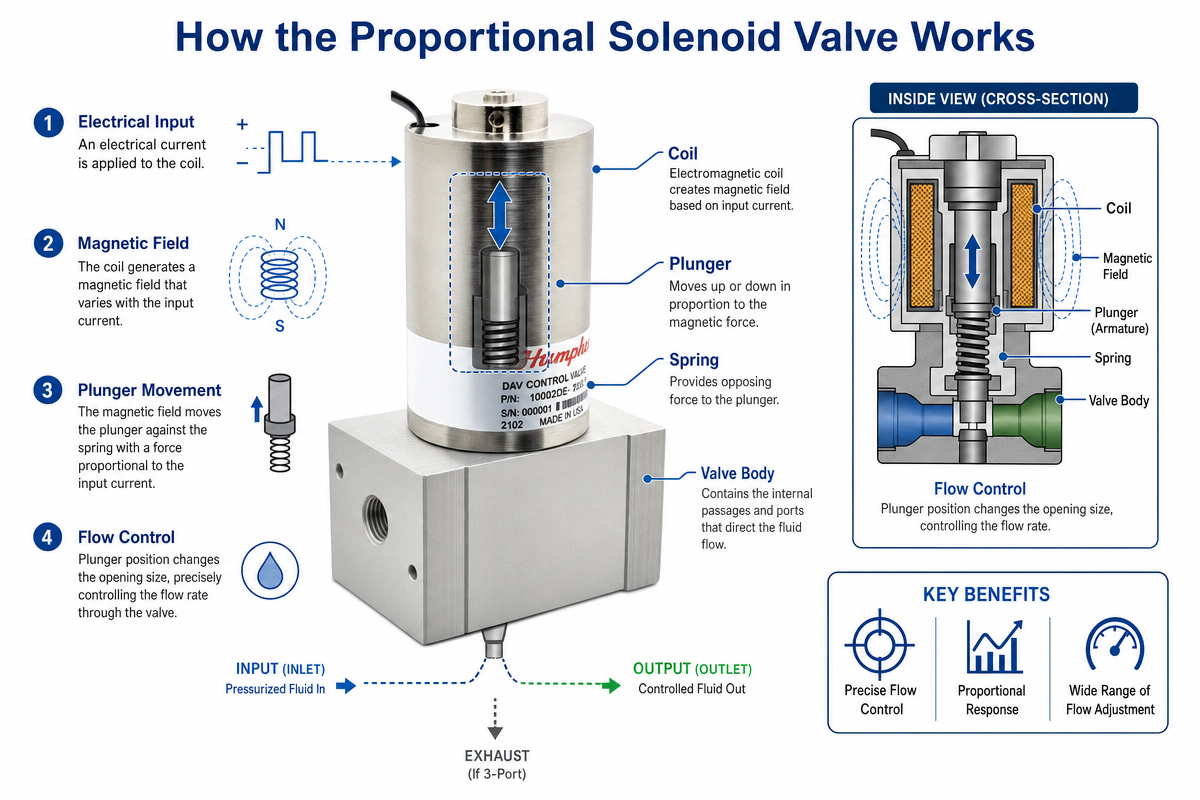
A proportional solenoid valve transforms an electrical signal into a mechanical motion proportionally to control the flow of fluids and gases precisely.
While an ordinary solenoid valve can operate only in either the ON position (when the valve is opened) or the OFF position (closed), the proportional valve offers continuous adjustment of its opening degree to ensure exact control of flow rate, pressure, and force.
Operation Process of Proportional Solenoid Valve
The operation process can be described as follows:
3.1: Input Electrical Signal
Application of any of the following types of electrical signals to the valve leads to a flow of current:
0 – 10 VDC
4 – 20 mA
PWM (Pulse Width Modulation).
3.2: Formation of Magnetic Field
The flow of current generates a magnetic field whose force depends on the amount of electricity supplied:
More current → More force.
Less current → Less force.
3.3: Movement of the Armature/Plunger
The generated magnetic force pulls the armature (or plunger) against the counteracting spring force inside the valve housing.
However, in contrast to usual solenoid valves in which the plunger just changes its position, the armature of a proportional solenoid valve moves proportionally to the electric current supplied.
3.4: Adjusting the Valve Orifice Opened Degree
The valve is adjusted by moving its armature/plunger.
This adjustment provides precise regulation of the orifice diameter, which, in turn, allows control of the following parameters of flow:
Flow rate.
Pressure.
Vacuum level.
Volume of gas or liquid.
In most cases, modern advanced proportional solenoid valves have built-in electronic control circuits for continuous and precise adjustment of the electric current supplied.
This ensures high stability of pressure regulation and precise flow control.
Key Components of Proportional Solenoid Valve
The following components make up the proportional solenoid valve:
Solenoid coil.
Transforms electrical signal into magnetic field.
Armature (plunger).
It responds to the changes of the magnetic field and moves accordingly.
Return spring.
It opposes the magnetic force and retracts the armature/plunger upon switching off of the valve.
Valve seat and orifice.
They regulate the diameter of fluid/gas passage.
Housing.
It accommodates all other components and provides protection from high pressure.
Electronic controller (optional).
Ensures precise current adjustment and regulation via feedback.
Simplified Diagram of Operation
Electrical Signal
(0-10V / 4-20mA / PWM)
Solenoid Coil
↓
Magnetic Field
↓
Armature (Plunger) Motion
↓
Changing Valve Orifice Size
↓
Flow Rate / Pressure Control
Example of Use (Air Pressure Regulation)
For example, suppose the valve regulates the pressure of compressed air supplied into a pneumatic system:
20% of current → The valve is partly opened → The air pressure is low.
50% of current → The valve is opened halfway → The air pressure is average.
100% of current → The valve is fully opened → The air pressure is high.
Since the valve orifice can vary depending on the current supply, the proportional valve offers accurate pressure regulation.
Chapter 4: The Types of Proportional Solenoid Valve
The following types of proportional solenoid valves are known based on the role that they perform in the control process of the fluid medium. There are proportional flow control valves, proportional pressure control valves, hydraulic proportional valves, pneumatic proportional valves, and servo-proportional valves.
4.1 flow control proportional solenoid valve
A proportional flow control valve ensures precise control of the flow of fluids. These valves are often used in water purification systems, analytical apparatus, and other medical equipment.
4.2 pressure control proportional solenoid valve
The proportioning valve of pressure control is used to adjust the output pressure with an accurate valve opening based on the input signal. This valve is typically applied in pneumatic devices, packaging machines, and industrial automation systems.
4.3 High-pressure control proportional solenoid valve
High pressure proportional valves are specifically developed to use with hydraulic systems. They are widely utilized in the design of construction machines, injection molding machines, farm equipment, and mobile hydraulics.
4.4 Pneumatic control proportional solenoid valve
Pneumatic proportional valves ensure the precise control of compressed air. In addition, they are often used in robots, the manufacturing of semiconductors, and automated factory processes.
4.5 Pneumatic control proportional solenoid valve
Servo proportional valves have the highest accuracy and response rate among all proportional valve types. This class is applicable to many sophisticated engineering systems, including aerospace devices, test stands, metal processing facilities, and others.
Chapter 5: The Pros and Cons of Proportional Solenoid Valve
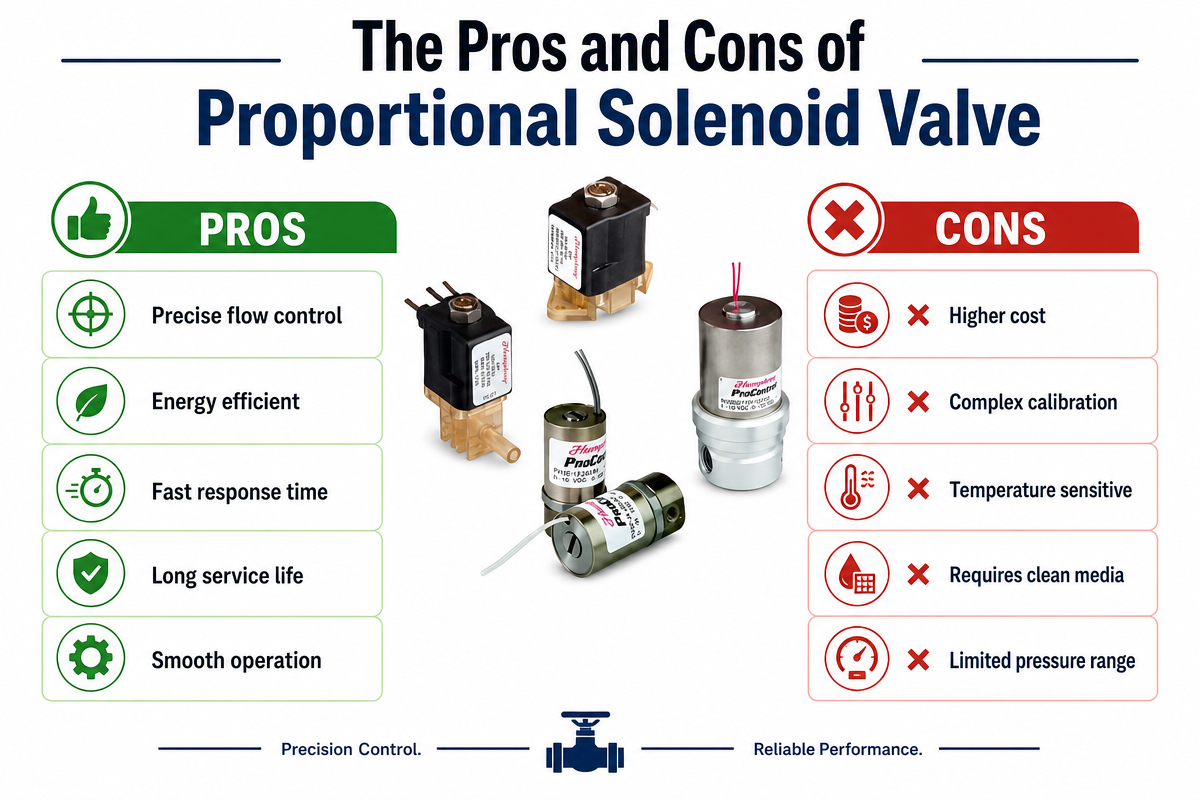
There are plenty of reasons why industrial facilities, medical facilities, and even consumers choose proportional solenoid valves. Nevertheless, like all other technical components, proportional valves have their pros and cons that should be considered.
Pros of Proportional Solenoid Valves
5.1. Precise Fluids or Gases Flow/Pressure Regulation
Unlike ordinary on-off valves, proportional solenoids can provide accurate continuous flow/pressure regulation depending on the electrical signal received.
5.2. Quick Response
Such valves can respond immediately to any changes in electrical signals, thus becoming suitable for various applications that need immediate flow and pressure modifications.
5.3. Increased Energy Efficiency
With proportional valves installed, it is possible to deliver just as much fluid or gas flow/pressure that is needed, reducing energy wastage.
5.4. Smooth Functionality
Since there are no abrupt changes in valves’ functionality, pressure shocks and mechanical wear are avoided, thus improving the system’s stability and longevity.
5.5. Compact Dimension
Most proportional valves come with a small and simple structure, allowing them to easily integrate into automation systems.
Cons of Proportional Solenoid Valves
5.6. High Cost
In comparison with regular solenoid valves, proportional solenoids are generally expensive to manufacture due to their specific structure.
5.7. Vulnerability to Dirt
Internal clearance is rather small in such valves, meaning that they are likely to get clogged.
5.8. Additional Hardware Requirements
In most cases, proportional valves need additional electronic components to work properly.
5.9. Specific Manufacturing Process
To manufacture proportional solenoid valves, a complex process including magnetic circuit design, machining, and tests should be applied.
5.10 Frequent Maintenance
For smooth operation, proportional valves require regular maintenance.
| Advantages | Disadvantages |
| Precise flow and pressure control | Higher initial cost |
| Fast response speed | Sensitive to contamination |
| Energy-efficient operation | More complex electronic control |
| Smooth and stable performance | Requires higher manufacturing precision |
| Reduced mechanical wear | Additional maintenance may be required |
| Compact and lightweight design | More expensive than standard valves |
Chapter 6: Common Applications of Proportional Solenoid Valves
Proportional solenoid valves have many advantages due to their precision and control capabilities that allow using them in various industries.
6.1. Factory Automation
Due to fast response time and accurate pressure and flow control, proportional solenoid valves are common in manufacturing facilities where they serve as components of automation equipment controlling airflow, gas flow, and liquid flow. The list includes:
Packaging lines
Assembly lines
Robotics
CNC
6.2. Medical Devices
Medical equipment requires accurate flow control; therefore, proportional valves are often used in the following:
Ventilators
Oxygen concentrators
Anesthetic machines
Diagnostic equipment
6.3. Hydraulic Power Transmission
In heavy-duty hydraulic machines, proportional valves are used to control pressure and flow. They are commonly applied in:
Excavators
Injection molding machines
Agri-machinery
Mobile hydraulics
6.4. Compressed Air Control
Pneumatic proportional valves are used in regulating compressed air in such industries as the following:
Manufacturing
Semiconductor production
Pick-and-place equipment
Handling machinery
6.5. Automotive Industry
Various automotive components are equipped with proportional valves as an important element in automatic transmissions, fuel injection systems, exhaust gas treatment systems, and suspension control systems.
6.6. Water Purification and Treatment
Proportional solenoid valves can precisely control flow and pressure, thus making them an integral part of water purification systems, chemical dosing, beverage dispensing equipment, and irrigation systems.
6.7. Aerospace and Aviation Industry
Proportional solenoids provide reliable flow and pressure control that makes them an integral part of the following:
Aircraft hydraulic systems
Fuel delivery system
Environmentally controlled enclosures
Test equipment
6.8. Laboratory and Analysis Devices
Precise regulation of gas and liquid flow is a critical factor in gas analyzers, chromatography equipment, biochemical analyzers, and other analytical instruments.
6.9. Food and Beverage Processing
Process control is the key factor in food and beverage processing. Therefore, proportional solenoid valves are used in coffee makers, beverage dispensers, dairy processors, and food packaging machinery.
6.10. Renewable Energy Technologies
The rapid development of renewable energy technologies increased the demand for proportional solenoid valves, which are used in hydrogen generation systems, fuel cells, battery manufacturing machinery, and energy storage equipment.
Chapter 7: Key Points to Prevent Errors in Choosing Proportional Solenoid Valve
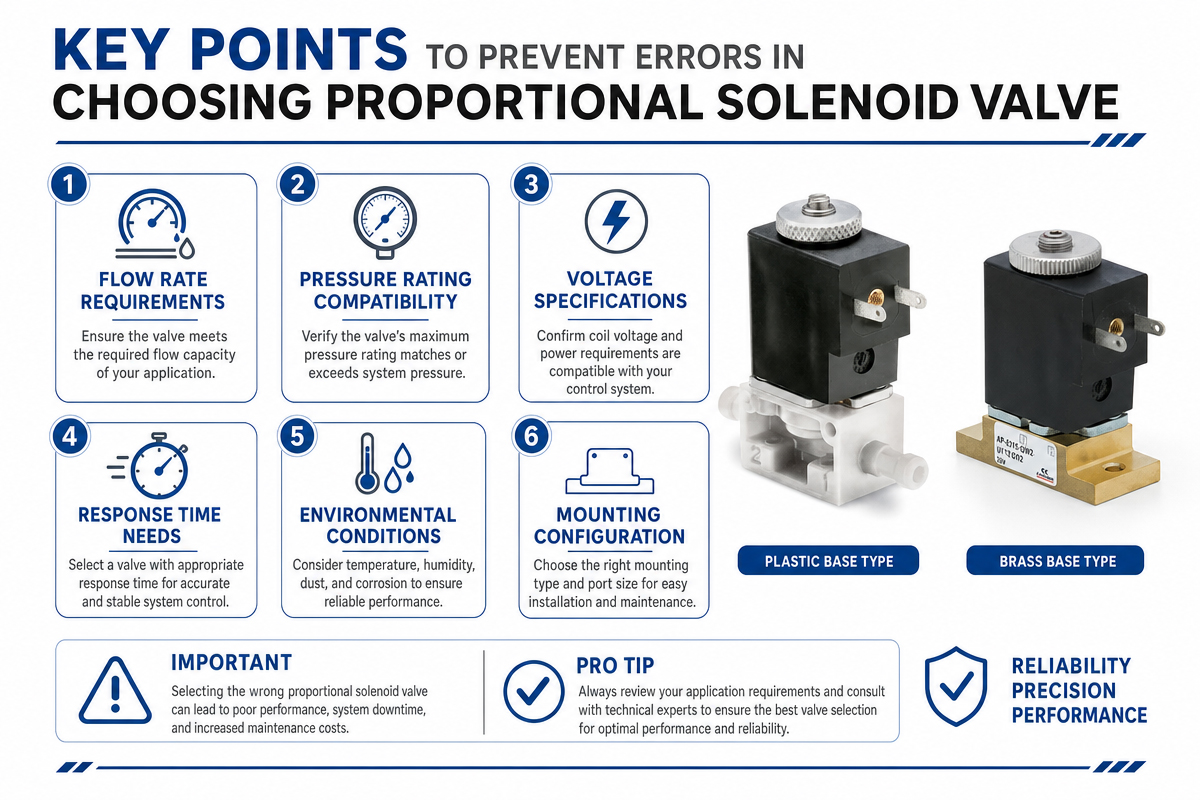
The choice of a proportional solenoid valve has a direct impact on the stability of system operation, durability, and cost-effectiveness. There are some typical mistakes made by the users while selecting this type of equipment, which can lead to low accuracy and premature wear of the valve. The following points will help to avoid errors.
7.1. Do Not Choose the Least Expensive Valve
Such a choice will save money at first glance but can cause problems in the form of inadequate accuracy and reduced durability. In addition, the valve will have to be repaired more often, which will entail additional costs.
7.2. Calculate Required Flow Rate Correctly
Too small or too large valves lead to either restricted flows or loss of control accuracy. It is necessary to calculate the required flow rate and check the Cv value.
7.3. Check Operating Pressure Range
Each valve has the maximum and minimum operating pressures indicated. If the chosen valve is not designed for the selected range, the operation will be unstable or there will be risks of premature wear and failure.
7.4. Choose Proper Materials of Valve Body and Seals
The selection of working fluid is crucial. It is vital to choose valve models resistant to corrosion and having seals with properties required for the medium used in the system.
7.5. Pay Special Attention to Response Speed
Some applications require extremely fast operation of the valves. If the response time is ignored, then the performance of the system may become worse.
7.6. Check Voltage and Control Signal Compatibility
Make sure that there is compatibility between the voltage of the proportional solenoid valve and the power supply and control signal. Some of the most popular combinations are:
– 12 VDC;
– 24 VDC;
– 48 VDC;
– 0-10V signal;
– 4-20 mA signal;
– PWM control.
In case of incompatibility, malfunction may occur.
7.7. Do Not Ignore Information about Duty Cycle and Heat Generation
When choosing valves for continuous-duty operations, it is vital to take into account their cooling systems because overheating can damage the coil. In this case, it is recommended to choose valves designed for continuous operation.
7.8. Provide Protection from Particles and Impurities
Proportional solenoid valves have a complex structure with precise tolerances and are very sensitive to contamination. Using filters is necessary.
7.9. Consider Working Environment
Valves for outdoor and indoor operation have special environmental requirements. Therefore, temperature range, degree of protection, humidity, and vibrations need to be considered while choosing a valve.
7.10. Take Into Account Support from the Manufacturer
For example, if you are developing OEM equipment, it is essential to have engineering support and the ability to develop samples quickly and customize them.
Chapter 8. Proportional solenoid valve selection parameters
Selection of proper valves requires detailed assessment of different parameters.
Criteria Description
Flow rate
Amount of liquid passing through the valve when valve is completely opened
Operating pressure range
Minimum and maximum pressures that valve can operate
Response time
How fast valve works
Resistance to Wear and Fatigue
How robust is the valve
Interface type
Electrical and mechanical compatibility of valve
Power consumption
Electrical power consumed in process
Temperature ratings
Operating temperature range
Installation requirements
Size and shape of the valve
Serviceability
Possibility of valve serviceability
Certifications
The valve should be certified
Additional Criteria for Selection
Voltage of the Coil: 12V, 24V, 48V, 110V, 220V
PWM frequency
Cv (flow coefficient)
Leakage Specifications
Protection rating
IP 65, IP 67
Lifetimes
Choosing the right proportional solenoid valve requires careful evaluation of several factors.
| Criterion | Description |
| Flow Rate | Volume of fluid passing through the valve when fully open |
| Operating Pressure Range | Minimum and maximum pressure limits |
| Response Time | Speed of valve actuation |
| Durability | Resistance to wear and fatigue |
| Interface Type | Electrical and mechanical compatibility |
| Electrical Power Consumption | Energy efficiency considerations |
| Temperature Ratings | Operating temperature limits |
| Installation Requirements | Size, weight and port dimensions |
| Maintenance Ease | Accessibility and serviceability |
| Certifications | ISO and industry approvals |
Chapter 9: Future trends for European Proportional Solenoid Valve
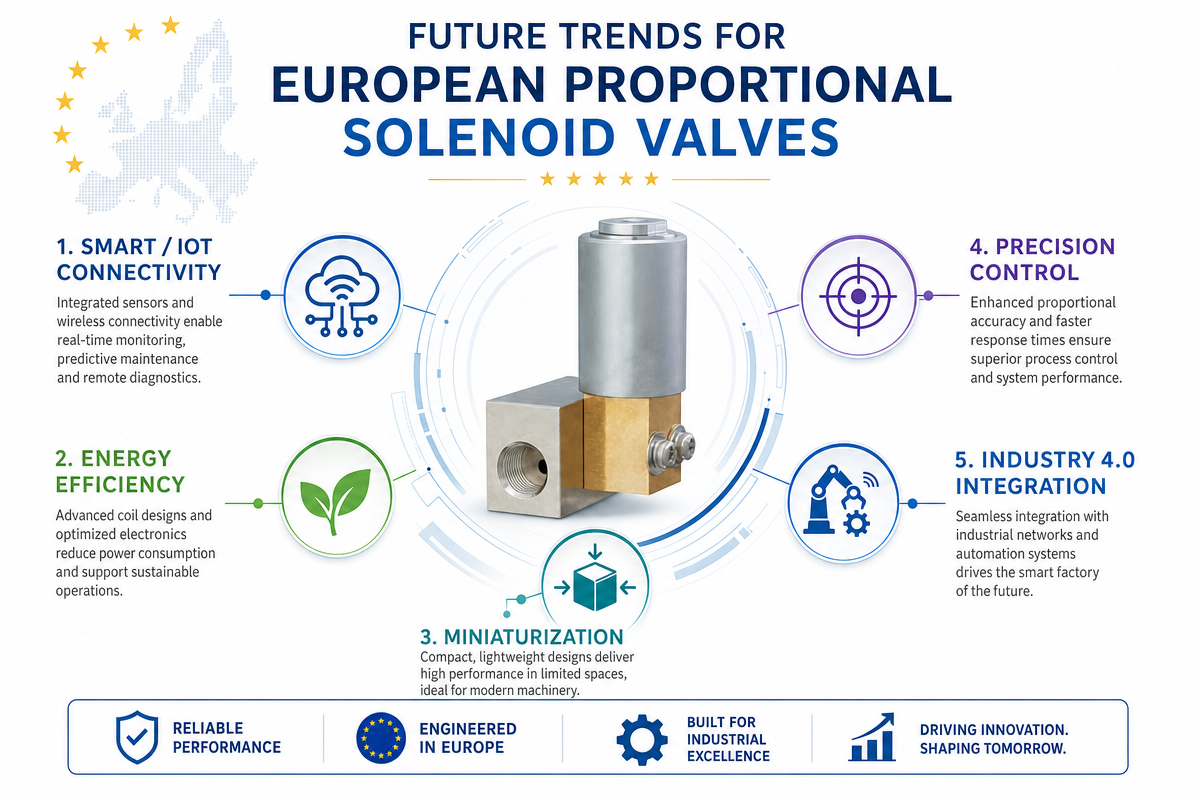
Proportional valves are expected to be in great demand within Europe during the period from 2022 to 2030 because of the ongoing processes of industrial automation, the development of Industry 4.0, increased electrification, and the need for energy-efficient solutions to control the flow of fluids.
9.1. Development of Industry 4.0
It goes without saying that Europe still takes an active part in industrial automation. With time, smart factories would require more advanced systems to measure and monitor flow parameters, making it necessary to apply modern intelligent proportional valves featuring built-in sensors and digital control systems.
9.2 Environmental regulations
As European manufacturers become concerned about energy efficiency and sustainability, future valves will demonstrate the following properties:
Lower energy consumption
Increased efficiency
Less heat generation
Increased lifespan
As a result, energy-saving solutions become an important competitive advantage of manufacturers.
9.3. Growing popularity of medical industry
With the increase in healthcare expenditures and investment in diagnostic technologies, there are new opportunities for the application of miniature proportional solenoids in medical instruments. The most promising fields are:
ventilators;
oxygen concentrators;
dialysis machines;
laboratory equipment.
The demand for medical equipment is constantly growing.
9.4. Miniaturization
Due to the ongoing miniaturization process, manufacturers will have to develop smaller and lighter valves. Moreover, it is expected to produce valves featuring ultra-low power coils and high flow rates despite compact dimensions. This requirement becomes especially relevant for medical devices, laboratory analyzers, and portable equipment.
9.5. Electrification
In connection with the ongoing trend of electrification, there emerges a need for valves to be applied in innovative energy-related equipment such as hydrogen generators, fuel cell technology, battery manufacturing equipment, EV cooling, and energy storage systems.
9.6. Customized proportional solenoids
OEM manufacturers will increasingly require customized proportional solenoids rather than catalog valves. Customers expect valves with certain parameters, including:
customized flow properties;
specific operating pressure range;
different options of voltage;
particular sealing material;
individual design of connectors.
9.7. Electronic solutions
In addition to traditional proportional valves, there would be a growing demand for electronic devices with embedded microprocessors. The following features will be included in future valve design:
PWM control;
communication via CAN bus;
digital feedback loops;
inbuilt sensors;
diagnostics of performance.
9.8. Diversification of supply chain
Recent disruptions have prompted many companies in Europe to look for alternative suppliers, which is why manufacturers increasingly tend to establish cooperation with Asian partners that can offer the following:
competitive prices;
faster delivery;
flexible approach to customization;
secure supply chain.
Thus, the number of OEMs cooperating with Asian manufacturers increases.
9.9 Outlook for 2026–2030
Several megatrends will continue to shape the European proportional solenoid valve market:
| Future Trend | Impact on Market |
| Industry 4.0 | Higher demand for intelligent valves |
| IoT Integration | Smart monitoring and diagnostics |
| Energy Efficiency | Lower power consumption requirements |
| Medical Technology Growth | Demand for miniature precision valves |
| Electrification | New applications in EVs and hydrogen systems |
| Miniaturization | Smaller and lighter valve designs |
| Customization | Stronger OEM demand |
| Supply Chain Diversification | More global sourcing strategies |
| Digital Control Systems | Advanced communication capabilities |
| Higher Precision Requirements | Continuous technological innovation |
Chapter 10: Top 10 European Proportional Solenoid Valve Manufacturer Introduction
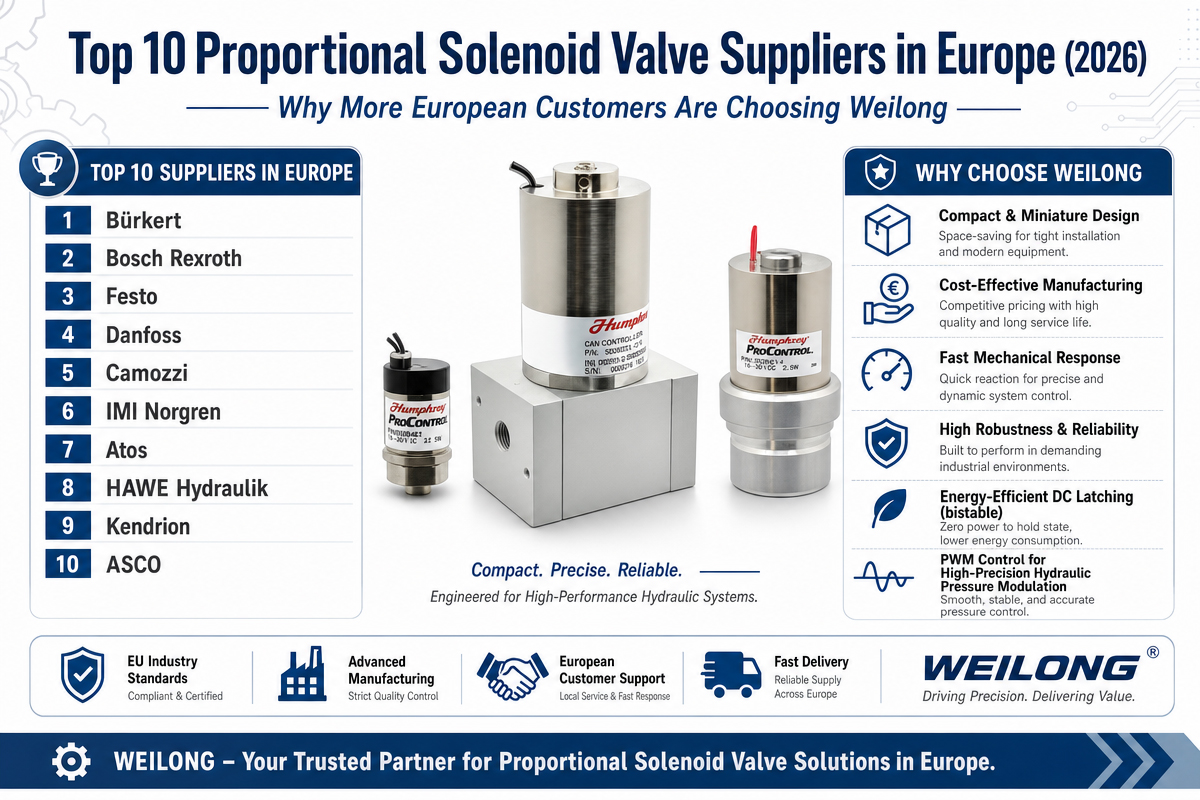
10.1 Bürkert Fluid Control Systems GmbH
Headquarters Germany
Bürkert, founded in 1946, is one of the world’s most renowned specialists in fluid control. Their proportional valves are used industry-wide in the following: • Medical equipment • Laboratory equipment
• Treatment of water
• Food and beverage systems
Benefits • High accuracy control
• Small footprint
• Outstanding repeatability
• Widespread support network worldwide
10.2 Kendrion N.V.
Headquarters: The Netherlands
Kendrion specializes in electromagnetic actuators and proportional valves for liquids and gases. It’s 63P and 68P Series valves are popular in • Respiratory apparatus
• Implants for teeth
•Analytical Equipment
• Aviation applications
Benefits • Low energy consumption
• Small hysteresis
• High flow performance
• Custom valve manifolds
10. 3. Festo SE & Co.
Headquarters: Germany
Festo is a world-leading manufacturer of industrial automation and pneumatic technology.
Key Products • Proportional pressure regulators VPPM
• Proportional valves VPPE
• Pressure control electronic schemes
Use cases • Industrial Automation
• Robots…
• Packaging machinery
• Semiconductor Manufacturing Industry
10.4. Bosch Rexroth AG
Location: Germany Headquarters
Bosch Rexroth is a leader in hydraulic and electro-hydraulic proportional valves.
Major Strengths • High flow rate • Strong industrial design
• Industries with a Lot of Hydraulic Knowledge
• Equipment for construction
• Injection moulding
• Steel plants
• Mobile hydraulics
10. 5. Danfoss A/S
Headquarters Denmark
Danfoss provides proportional valves for hydraulic systems and mobile equipment.
Common uses • Agricultural equipment • Material Handling
• All-terrain vehicles
• Hydraulics for the industry
Benefits • High efficiency • Operation stability
• Wide product range
10. 6. Parker Hannifin Europe
Headquarters: UK / Europe Division
Parker has proportional valves for pneumatic and hydraulic systems.
Industries We Serve • Aerospace
• Énergie
• Transportation
• Advantages of industrial automation
• High durability
• Worldwide Distribution Network
• Comprehensive engineering support
10.7 Atos S.p.A.
Headquarters: Italy (Italy)
Atos is an important Italian producer of electrohydraulic proportional valves.
Product Highlights • Digital proportioning valve • Servo proportional valve
• Applications of integrated electronics
• Machines for pressing
• Processing of plastic
• Metal forming
10.8. ODE S.r.l.
Headquarters: Italia
ODE has over 60 years of experience in manufacturing solenoid valves and proportional control solutions.
Sectors of industry • Kaffeemaschinen
• Treatment of water
• Medical equipment
* Automation of the industry
10.9. IMI Precision Engineering (Norgren)
Location: United Kingdom Headquarters
Pneumatic systems require proportional valves and pressure regulators, which are supplied by Norgren, a part of IMI plc.
Uses • Process control • Factories’ Automation
•Packaging
• Transportation Pros
• High response rate
• Exact pressure regulation
• Highly reliable
10. 10. Dolphin Fluidics
Headquarters: in France
Dolphin Fluidics specializes in miniature proportional valves based on Shape Memory Alloy (SMA) technology.
Best For • Medical devices
• Aerospace systems
• Analytical instruments
• Small fluid control applications
Benefits • Ultra low power consumption
*Miniaturization*
• Silent operation
10.11. Comparison Table
| Company | Country | Specialty |
| Bürkert | Germany | Precision fluid control |
| Kendrion | Netherlands | Gas and liquid proportional valves |
| Festo | Germany | Pneumatic automation |
| Bosch Rexroth | Germany | Hydraulic proportional valves |
| Danfoss | Denmark | Mobile hydraulics |
| Parker Hannifin | UK | Pneumatic and hydraulic systems |
| Atos | Italy | Electrohydraulic valves |
| ODE | Italy | Industrial solenoid valves |
| IMI Norgren | UK | Pneumatic control |
| Dolphin Fluidics | France | Miniature proportional valves |
Chapter 11: Why Weilong Is Favored by More European Customers?
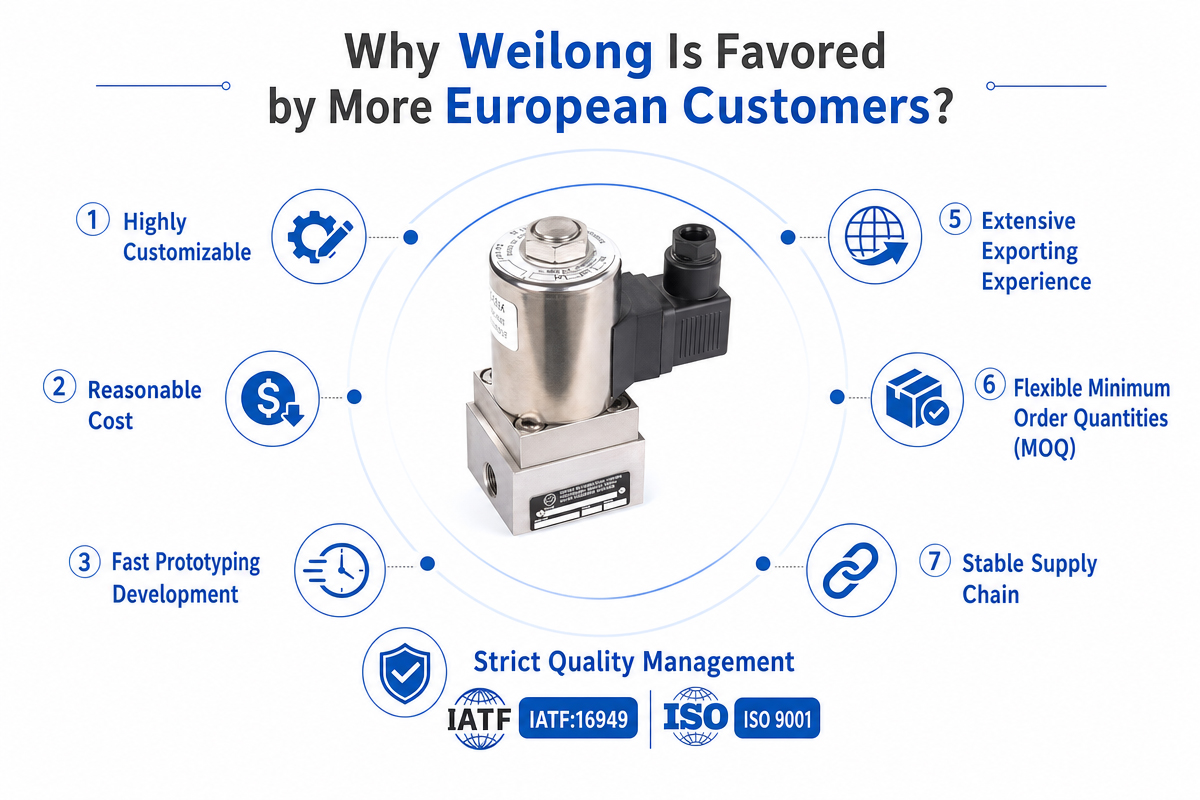
There are many high-quality valve manufacturers in Europe, yet OEM customers increasingly opt for cooperation with Weilong Intelligent Technology (Dongguan) Co., Ltd.
11.1 Highly Customizable Product Range
Weilong specializes in the following:
Flow patterns
Pressure Range
Coils Design
Connector Types
Special sealing compounds
11.2 Reasonable Cost
Significant cost savings without compromising product performance.
11.3 Fast Prototyping Development
Lead time example:
1-3 weeks
Mass production lead time:
3-6 weeks
11.4 Strict Quality Management
IAFT:16949
ISO 9001
100% Verified Reviews
Life Cycle Testing
Force Test
Materials Inspection
11.5 Extensive Exporting Experience
20+ years serving Europe, North America, and Asia.
11.6 Flexible Minimum Order Quantities (MOQ)
Best suited for:
Pilot projects
Small Batch Production
OEM mass production
11.7 Stable Supply Chain
Vertical integration allows for providing reliable delivery even if there are any disruptions in the supply chain.
11.8 Comparison: European Brands vs. Weilong
| Criteria | Leading European Brands | Weilong Intelligent Technology |
|---|---|---|
| Product Quality | Excellent | Excellent |
| Customization Capability | Medium to High | Very High |
| Sample Lead Time | 3–8 Weeks | 1–3 Weeks |
| Mass Production Lead Time | 6–12 Weeks | 3–6 Weeks |
| Cost Competitiveness | Medium | High |
| OEM/ODM Support | Limited | Strong |
| Minimum Order Quantity | Medium to High | Flexible |
| Engineering Support | Excellent | Excellent |
| Prototype Development | Available | Fast Response |
| Global Export Experience | Extensive | Extensive |
| Price-to-Performance Ratio | High | Very High |
| Communication Efficiency | Good | Fast and Responsive |
Chapter 12: Why Proportional Solenoid Valves Are Difficult to Manufacture and So Expensive?
In general, a proportional solenoid valve is much more sophisticated compared to an ordinary on-off solenoid valve. The high demands on the technical qualities of such devices and their manufacturing technologies make the process difficult and costly. These are the main difficulties associated with this type of solenoid valve.
Difficulties in Manufacturing and Reasons Behind This
12.1. Complicated Electromagnetic Design
First of all, such a valve is much more complicated due to the need to create a specific electromagnetic system.
It implies:
Magnetic circuit simulation
Coil design
Air gap adjustment
Optimized hysteresis characteristics
Otherwise, there may be problems related to improper operation.
12.2. Extremely High Precision Engineering
The working principle of proportional valves implies extremely small gaps.
The requirements include:
Micrometer engineering accuracy
Exact alignment of the armature and tube
Uniformity of spring action
Smooth surfaces to minimize friction
Otherwise, the efficiency of such valves may be compromised.
12.3. High-Quality Coil Winding Technology
The key component of such a device is the coil.
It has to provide:
A stable magnetic field generation
Minimum losses of power and energy
Resistive to overheating
Uniform inductance
All that requires additional effort.
12.4. Thorough Calibration and Testing
Each proportional valve needs thorough calibration and testing.
It may include:
Testing of flow-current dependence
Measuring hysteresis characteristics
Response speed verification
Leakage testing
Life cycle testing
All that takes much time.
12.5. Special Requirements to Materials
The longevity of such devices depends heavily on the materials used.
They should include:
Magnetic stainless steel
Abrasion-resistant material for an armature
Heat-resistant sealants (NBR, EPDM, FKM)
Corrosion-resistant housing materials
Otherwise, the device performance will deteriorate soon.
12.6. Thermal Properties Are Important
Proportional valves work continuously, which means that coils generate heat constantly.
Thus, it is important to take care of the following:
Thermal dissipation
Stable resistance depending on temperature
No changes in performance due to overheating
It adds to the complexity of engineering.
12.7. Additional Functionality in Electronic Control Systems
Many proportional solenoid valves have to function in electronic control systems.
Such systems require:
0–10V or 4–20mA A A control signal
PWM or closed-loop drive controllers
Linearization of the signal
All that complicates the manufacturing process.
12.8. Requirements of High Reliability
Manufacturers produce such products taking into account:
Millions of operating cycles
Years of stable performance
Minimal requirements to maintenance
That requires much investment in tests.
12.9. Low Tolerance to Mistakes in Manufacturing
Proportional valves imply the following:
Narrow operational range
Consistency of quality
High rejection rate
It makes manufacturing costs higher.
12.10. Special Features in OEM Production
A lot of such valves are manufactured according to customer requirements.
They include:
Particular flow curves
Specific voltages
Customized connectors
Specialized sealing materials
All that also complicates the manufacturing process.
Chapter 13: Frequently Asked Questions
Q1. What is the Difference Between Solenoid Valves and Proportional Solenoid Valves?
A standard solenoid valve operates in “ON/OFF” mode. It is either open or closed when activated, so it is great for switching tasks.
A proportional solenoid valve allows continuous control over the flow, pressure, or force using an electric signal (e.g., a 0-10V, 4-20mA, or PWM signal). The opening of the valve can be controlled proportionally.
Main differences
Feature Standard Solenoid Valve Proportional Solenoid Valve
On/off operation: ON/OFF Continuous
Valve position: Closed/Open Variable
Accuracy: Low, High
Responsiveness Switching Fine-tuning
Application: Water, air, automation systems Medical equipment, robots, automation, hydraulics
Price More economical Less economical
Q2. Why Are Proportional Solenoid Valves So Expensive?
Unlike standard valves, proportional valves are more expensive due to such factors as
Advanced magnetic circuit design
Strict tolerance requirements for armatures and valve parts
Special winding method
Stricter testing and calibration, including flow, hysteresis, and response time checks
Using top-quality magnetic circuit, springs and seals materials
High operational life cycle up to millions of operations
Although proportional solenoid valves are expensive to purchase, their accuracy and energy efficiency result in low operation costs.
Q3. How Many Locks Do You Have? What Voltage Are You Running?
Proportional solenoid valves come in a variety of AC and DC configurations designed specifically for industrial use.
Common voltage options are:
AC Voltage Options
24VAC
110V AC
220VAC
230VAC
DC Voltage Options
6VDC
12VDC
DC 24V
Additional options include:
Analog voltage (0-10v; 0-5v)
Current output: 4-20 mA
PWM pulse width modulated
CAN bus
Custom OEM voltage
Q4. What is the Service Life Expectancy of Proportional Valves?
Depending on the following factors, the service life of a proportional valve can vary:
Operating medium
Working pressure.
Duty cycle
Heat
Liquid cleanness
Quality of coil and materials
Under proper operation conditions, high-quality proportional solenoid valves usually last for decades.
Regular maintenance and inspection.
Q5. What is the difference between a domain controller and Active Directory? Are proportional valves customizable?
Absolutely. One of the major advantages of proportional solenoid valves is their ability to customize.
Such OEM requirements include:
- Flow rates
- Pressure scale
- Voltages of coils
- Connectors’ type
- Seals, materials
- Fast response time
Chapter 14: Conclusion
Due to the advent of Industry 4.0, medicine, robotics, and intelligent manufacturing, demand for high-precision proportional solenoid valves is only going to grow in Europe.
European leading brands such as Bürkert, Festo, Bosch Rexroth, Danfoss, Parker, and Atos remain leaders in the premium market, but more and more OEM manufacturers start seeking partners who would provide them with high-quality products, fast delivery, and custom solutions at a reasonable cost.
Having 20 years of experience in electromagnetic technology, Weilong Intelligent Technology (Dongguan) Co., Ltd. has become a reliable partner of global customers, offering high-quality proportional solenoid valves.

