

Chapter 1 : Custom High-Temperature Solenoid overview
The continuous application of electromagnetic actuators in increasingly harsh environments in industrial automation, metallurgy, energy systems, and intelligent control equipment puts higher demands on the durability of the components. Operating in a high-temperature environment is one of the most severe conditions for traditional solenoids and electromagnets. Extreme temperatures accelerate the degradation of insulation, magnetic properties, sealants, and cause the failure of electrical components.
Custom high-temperature solenoid can be considered the answer to the shortcomings of electromagnetic components. Advanced insulation systems, new materials for winding and core construction, optimized magnetic circuit design, and advanced sealing technology help achieve reliable operation in 220-degree ambient temperature.
High-temperature models allow maintaining strength, reliability, and performance characteristics comparable to conventional models, but resistant to the effects of heat without reducing suction force, response rate, electrical safety, and service life. They are successfully used in applications related to metallurgy, injection molding equipment, energy systems, aerospace systems, furnaces, and other high-temperature equipment.
This guide is designed to give an overview of customized high-temperature solenoids and covers their features, applications, design principles, and selection recommendations.
Chapter 2 : What Is a Custom High-Temperature Solenoid?
A custom high-temperature solenoid is an electromagnetic component, specifically designed for operations in an environment above 130 degrees Celsius. Industrial solenoids use Class B insulation, and their maximum operating temperature is 130 degrees. High temperature solenoids employ special materials and technologies to function stably within the wide range of high temperatures.
Normal Solenoids: The adverse effect of high temperature leads to:
Aging of the insulation of the coil
Cracking of the enamel
Short circuiting
Burn-out of the coil
Magnetic field weakening
Distortion of the body
The higher the temperature, the larger the internal resistance of the coil, the greater its power, and thus faster destruction. It is impossible to ensure reliable operation of standard solenoids under these conditions.
The following improvements ensure operation at high temperatures in the case of custom high-temperature solenoids:
High-temperature enamel;
Special insulation system;
High-temperature bobbin;
Pure copper wire;
High-temperature epoxy sealant.
Frame-type solenoids are more popular due to high magnetic attraction force and compact installation.
The operating temperature range of high-temperature solenoids depends on the insulation class:
130°C – 150°C (Class F)
150°C – 180°C (Class H)
180°C – 200°C (Class C)
200°C – 220°C (Class N)
In some cases, it is possible to raise the upper bound of the permissible temperature with a more advanced insulation design.
Chapter 3 : Main Features of Custom High-Temperature Solenoids
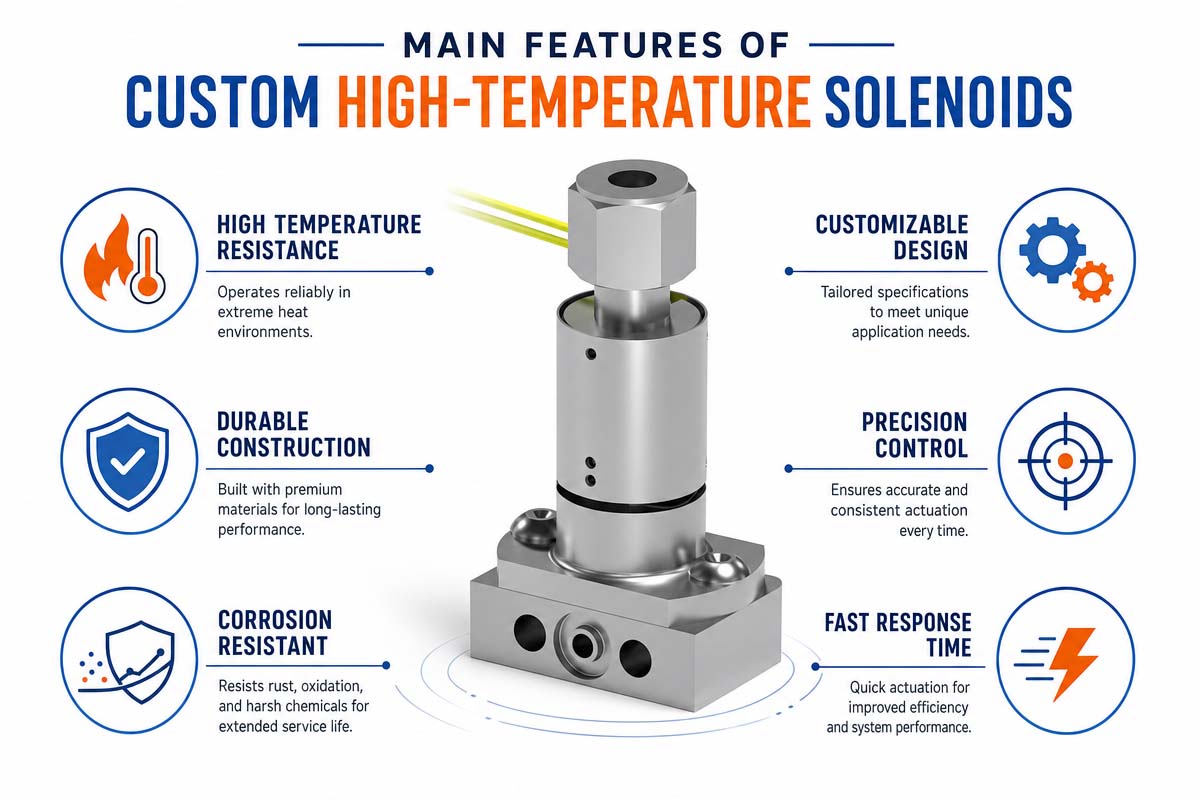
Customized high-temperature solenoids have a number of features compared to regular solenoids.
3.1 Thermal Insulation Resistance
The first important feature of a high-temperature solenoid is its insulation system that prevents high-temperature insulation degradation.
The insulation properties provided by the special insulation materials:
Protect against short circuits;
Prevent current leakages;
Eliminate failures of the insulation layer;
THERMAL INSULATION CRACKS
Thus, long-term high-temperature operation will not cause deterioration of the insulation.
3.2 Stability of magnetic properties
In the operation of traditional solenoids at a high temperature, significant magnetic losses are associated with poor thermal stability of material and overheating of the coil.
In order to solve these issues, custom high-temperature solenoids:
Are equipped with a specially optimized magnetic circuit;
Use pure copper wires as windings;
Have heat-resisting iron core;
Apply advanced technologies of winding the wire.
Such optimizations ensure that magnetic fluxes remain stable and provide consistent suction force and response rate.
3.3 Increased service life
Heat accelerates aging of the materials. Custom high-temperature solenoids are made of:
Heat-resisting bobbins;
Advanced epoxy insulation;
Oxidation-resistant contact points;
Heat-resistant structure.
As a result, the service life of high-temperature solenoids in comparison with standard models increases two to three times.
3.4. Excellent environmental protection
In addition, many industrial environments often have:
Moisture;
Dust;
Oil vapor;
Corrosive substances.
Custom high-temperature solenoids with an advanced insulation system can resist moisture and dust.
3.5 Ability to customize
Each industrial setting has its own special needs. Custom high-temperature solenoids can be manufactured in accordance with the following parameters:
Voltage;
Stroke length;
Forces required;
Duty cycle;
Room temperature;
Size of installation place;
Required response time;
Protection rating.
Chapter 4 : Construction of High-Temperature Solenoids
Despite having similar external appearance, the internal components of custom high-temperature solenoids are significantly upgraded.
4.1 The iron core and the yoke
The magnetic circuit consists of two parts:
The iron core;
The yoke.
In order to achieve high-quality insulation, the magnetic circuit consists of high-temperature resistant materials:
High magnetic permeability;
Resistance to deformation;
Good structural rigidity;
Heat resistance;
Low magnetic losses.
4.2 High-temperature coil
The coil of a solenoid determines a whole bunch of its parameters:
Operating temperature range;
Power consumption;
Magnetic force;
“Operational stability”.
High-temperature coils are designed based on:
High-temperature enameled copper wire;
Advanced precision winding technologies;
Increasing the insulation thickness.
4.3 Heat-Resisting Bobbin
The winding is mounted on the bobbin. The role of this component is to isolate the coil from the body of the solenoid.
Due to the softening of the plastic bobbin, the following undesirable consequences occur:
Displacement of the coil;
Loss of insulation quality;
Short-circuited wire;
The construction of high-temperature solenoids uses special heat-resistant bobbins.
4.4 High-temperature Epoxy Sealing
Epoxy seals help to protect inner components from the outside influences:
Moisture;
Particles of dirt;
Oil pollution;
Mechanical shocks.
Special high-temperature epoxy is resistant to cracking and melting.
4.5 High-Temperature Wiring Terminals
In order to ensure reliable operation of the terminals, the special heat-resistant anti-oxidation material is used:
Improper contact;
Degradation of the terminal material;
Electrical instability.
Chapter 5 : Insulation Class of Custom High Temperature Solenoid
When selecting an appropriate high-temperature solenoid, attention should be paid to the class of insulation.
Standard insulation classes include:
Insulation class
Max Temperature
A 105 °C
E 120 °C
B 130’C
F 150 °C
H 180 °C
C 200 °C
N 220 °C
Therefore, any solenoid, operating at a temperature above 130 degrees, can be called a high-temperature solenoid.
Chapter 6 : Basic Design Principles of High Temperature Solenoid
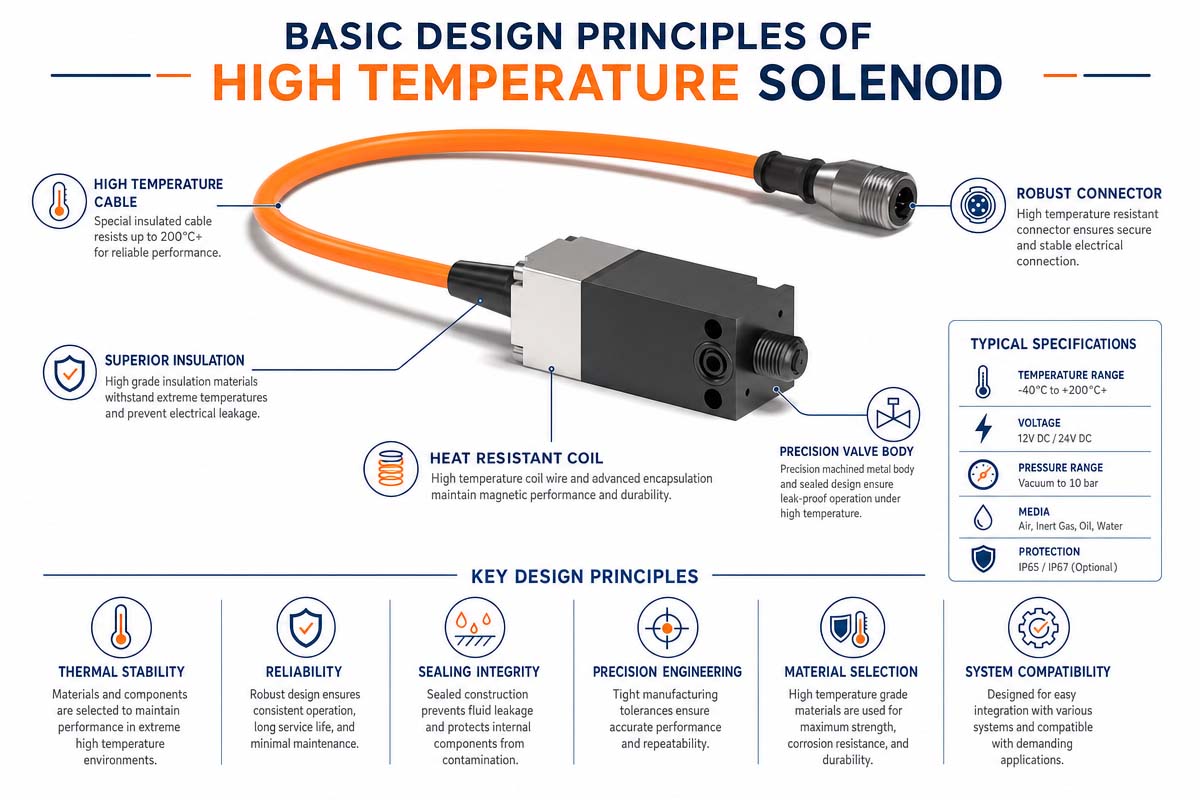
6.1 Proper temperature alignment
The maximum operating temperature must be exceeded by the insulation class of the materials.
For the sake of safety margins, we recommend adding:
Additional 20–30 % for temperature fluctuation;
Accounting for the self-heating of the coil;
Continuous operation;
6.2 Synchronization of materials
In addition to the coil, it is necessary to use heat-resistant materials in other parts of the design:
Wire, coils;
Bobbins;
Copper conductors;
Epoxy sealing glue;
Heat-resistant insulation terminals.
Often, the failure of the solenoid occurs because of the mismatch between the materials.
6.3 Optimization of the magnetic circuit
High temperature reduces the magnetic permeability and electrical resistance.
It is important to optimize the magnetic circuit for:
The number of turns in the coil;
The diameter of the winding wire;
The air gap for creating strong force of the magnetic field.
6.4 Heating design
Under continuous operation, the heat is additionally produced.
Custom high-temperature solenoids may include:
Heat dissipation structures;
Hollow frames;
Insulation materials;
Paths of heat transfer;
Features reduce the effect of heating and increase service life.
Chapter 7 : Main Applications of Custom High-Temperature Solenoids
7.1 Metallurgical processes and heat treatment
High temperature solenoids are widely used in:
Automating furnaces
Steel processing
Manufacturing processes
Equipment for automatic heat treatment
Metallurgical plants operate at a temperature range of 150 – 200 degrees.
7.2 Injection Molding Systems
Plastic injection molding machines generate a lot of heat during continuous operation.
High temperature solenoids can be used for:
Valves;
Material transport;
Locking position;
Switching systems
7.3 Electrical systems and energy reservoirs
High temperature electrical cabinets and battery systems operate continuously at a high temperature.
Examples of usage:
High temperature electrical equipment cabinet;
Battery systems;
Power distribution unit;
Thermal control system for electric cars
7.4 Space and aerospace systems and other specialized equipment
For certain applications, it is particularly important to have a long-lasting device, which will maintain the necessary performance throughout its service life.
Among others, there are the following:
Service life extension;
Stable force generation;
Precise response rate;
Heat and vibration resistance;
7.5 Outdoors with extreme weather conditions
Certain applications can have both:
Excessively high temperatures
Dust, humidity, water
Custom high-temperature solenoids are designed to withstand moisture and dust.
Chapter 8 : Selection Criteria of Custom High-Temperature Solenoid
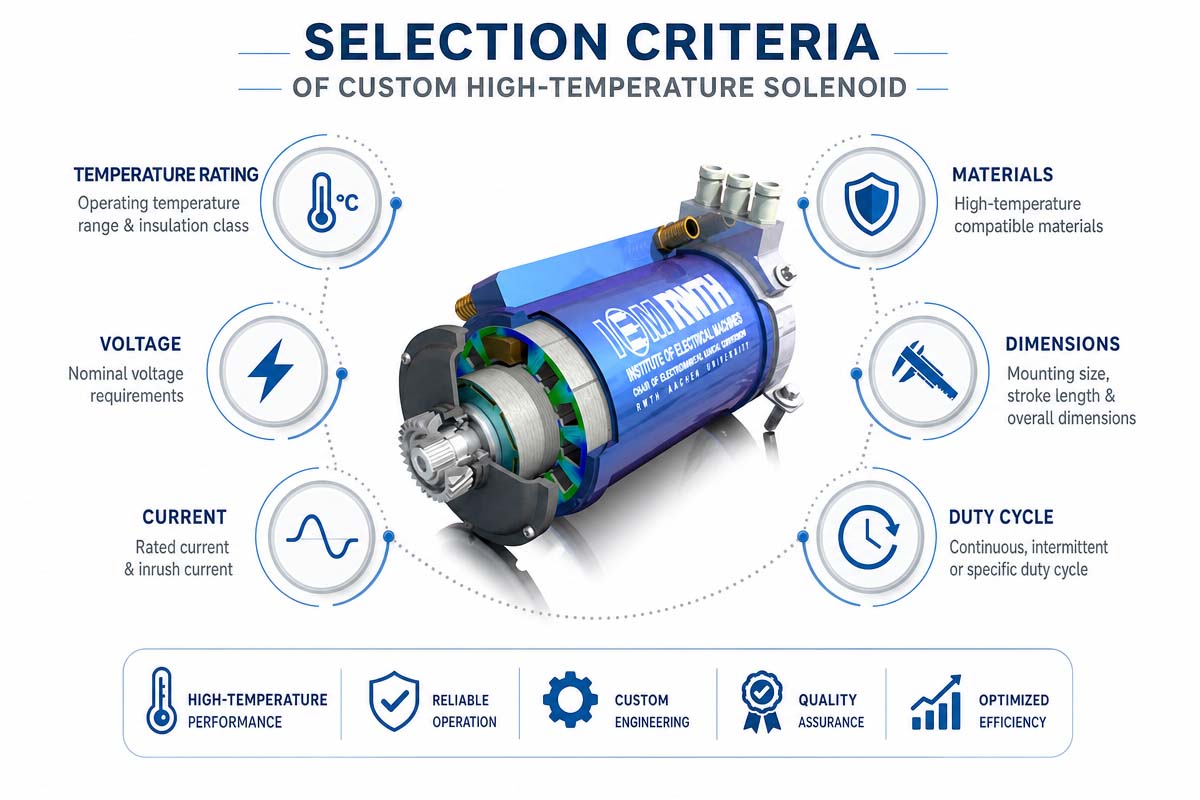
Selection of customized high-temperature solenoids requires taking into account a large number of criteria.
8.1 Ambient temperature analysis
This is one of the most critical criteria when choosing a high-temperature solenoid.
Depending on operating temperature:
130 – 150°C – use of Class F insulation;
150 – 180°C – Class H;
180 – 200°C – Class C;
200 – 220°C – Class N;
It is strictly forbidden to exceed the operating temperature.
8.2 Calculating of Duty Cycle
When calculating the thermal properties of the solenoid, it is important to take into account:
Continuous operation;
Operation with pauses;
Frequent switching;
Cooling designs need to be improved for continuous operation.
8.3 Analysis of Mechanical Parameters
Among the most important mechanical properties are:
Stroke distance;
Operating force;
Let us answer
Dimensions of installation;
Higher temperature decreases magnetic force, therefore, an increased reserve is recommended.
8.4 Analysis of Materials Compatibility
It is very important to check all heat-resistant materials that are used in construction.
Do not purchase devices that use a single heat-resistant winding wire with other usual components.
8.5 Taking Environmental Protection into Account
Consider:
Operating conditions that have high levels of moisture or dust;
Construction with an epoxy sealant;
Moisture-proof protection;
High-temperature oxidized-resistant materials.
Chapter 9 : How to avoid Common mistakes When Manufacturing High-Temperature Solenoid
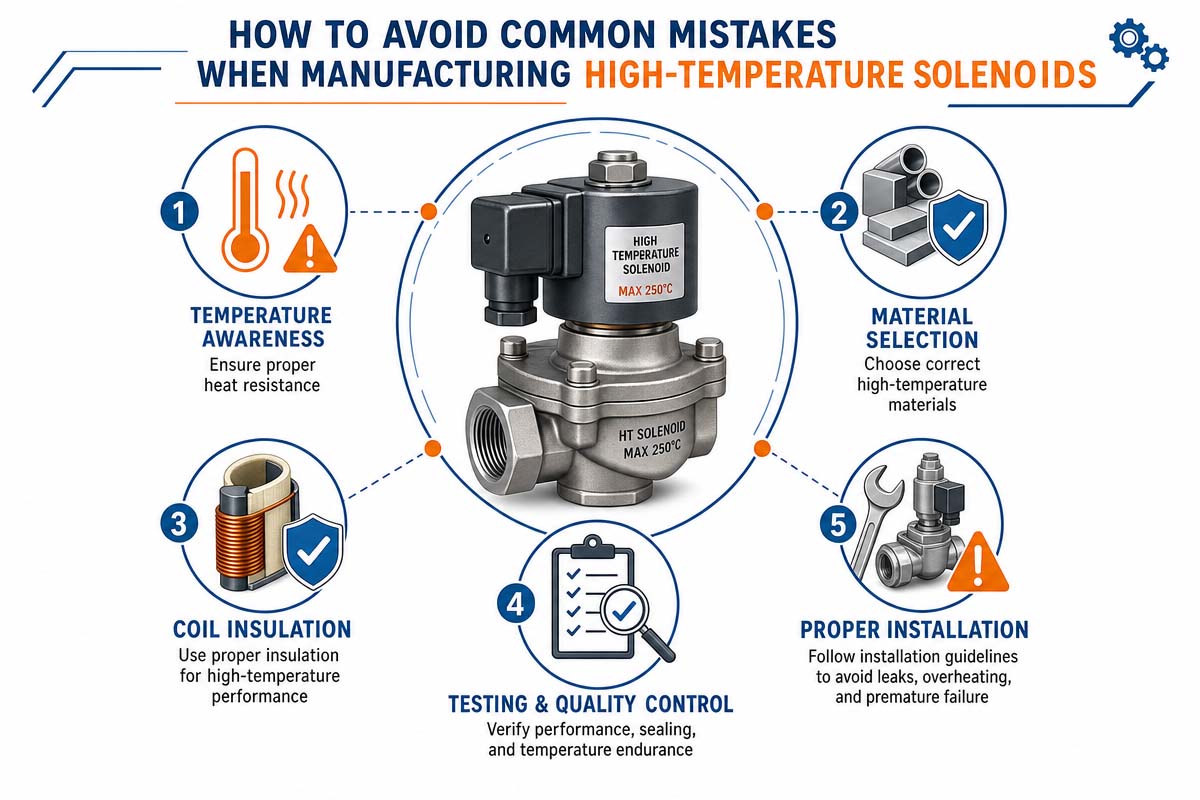
9.1 Burn-out of the coil
Possible reasons:
Class insulation too small;
Deformation of the bobbin;
Improper adhesion;
Answer:
All heat-sensitive components should be upgraded together.
9.2 Reducing magnetic force
Possible reasons:
Improper design of the magnetic circuit;
Overheating;
Answer:
Optimization of the parameters of the coil and heat dissipation.
9.3 Failure of joint seals
Reason:
Insufficient quality epoxy;
Answer:
Use high-temperature epoxy sealant.
9.4 Inconsistency of the lifespan
Reason:
Variety of quality winding wire;
Lack of a sufficient temperature margin;
Answer:
Precision production and thermal tests;
9.5 Failure of the contacts;
Reason:
Poor quality of terminal material;
Answer:
Use heat resistant oxidation resistant terminals;
Chapter 10 : Possible Trends of Future Development
With the development of industry, more and more advanced electromagnetic actuators that can perform reliably at high temperatures are required.
Trends:
Further optimization of magnetic circuits;
Improved thermal management;
Miniaturization and light weight;
Reduced energy consumption;
Development of advanced sealing systems;
Maintenance of equipment using artificial intelligence.
Custom high-temperature solenoids will be increasingly required for the following applications:
Robotics;
Renewable energy;
Aerospace;
Industry 4.0 and smart manufacturing;
IOT for industrial equipment.
Chapter 11 : Conclusions
Custom high-temperature solenoid is more than a regular solenoid with better insulation winding. Truly high-temperature performance implies full optimization of all structural components such as coils, bobbins, copper wires, magnetic circuits, and insulating seals.
A modern high-temperature solenoid provides reliable operation in the environment at a temperature ranging from 130 to 220 degrees with stable magnetic force and excellent protection from the surrounding medium. Today they are essential in metallurgy, plastic processing, energy systems, aerospace, furnaces, and high-temperature manufacturing processes.
In selecting or designing a high-temperature solenoid, the following points should be taken into account:
Selection of the appropriate class of insulation;
Compatibility of the materials;
Sufficient temperature margin;
Effective heat dissipation;
Effective environmental protection.
Chapter 12 :Frequently Asked Questions About Custom High-Temperature Solenoids
Q1: Up to which temperature do custom high-temperature solenoids operate?
Most of the standard industrial high-temperature solenoids allow continuous operation at the temperatures of 220°C.
Q2: Can standard solenoids be upgraded to high-temperature solenoids by replacing a coil with heat-resistant wire?
No. The truly high-temperature solenoid should include upgraded all heat-sensitive parts including the bobbin, adhesion, terminals, and insulation structures.
Q3: Is it possible to make high-temperature solenoids waterproof?
Yes. Waterproof protection is achieved with high-temperature epoxy sealing technology in customized solenoids.
Q4: Do high temperatures reduce magnetic force?
Yes. Higher temperatures reduce the magnetic permeability somewhat while increasing electrical resistance of the coil.
Q5: Why is the temperature margin important?
This 20 to 30% temperature margin is essential to prevent aging of the insulation due to the effect of ambient temperature and self-heating of the coil.
Q6: What industries use high-temperature solenoids?
High-temperature solenoids can be found in the following areas of industry:
Metallurgy;
Plastic injection molding;
Production of energy accumulators;
Industry 4.0, automation;
Spacecraft production and maintenance;
Heat treatment machine building;
Control systems for industrial furnaces.
Q7: What is the difference between regular and high-temperature solenoids?
The difference lies in insulation, materials, sealing design, and thermal optimization.

