

Chapter 1:Introduction
Electromagnetic pumps are positive displacement pumps that operate with the use of electromagnetic power to ensure precision flow of liquids. Electromagnetic pumps make use of a solenoid or magnetic force to drive a diaphragm, plunger or conductive fluids . They are different from traditional motor operated pumps. In addition, these pumps have reduced mechanical wear as well as the risks of leakage and high accuracy of operation.
Electromagnetic pumps have been used in various industries requiring highly regulated and contamination free liquid transfer since these pumps lack many traditional moving parts. These industries include: chemical dosing systems, medical equipment, semiconductor manufacturing, wastewater treatment, laboratory automation and liquid metal circulation systems.
Electromagnetic pumps have become popular in recent years due to silent operation, longevity and better chemical compatibility.
Chapter 2: What Is An Electromagnetic Pump?
Electromagnetic pumps are a form of fluid transfer device that uses electromagnets to transfer fluid. In other words, they transfer fluids without the aid of conventional mechanical rotating devices.
Types of electromagnetic pumps
Electromagnetic pumps driven by solenoids
They use electromagnetic coils to drive pistons or diaphragm to push fluid.
Magneto hydrodynamic (MHD) Pumps
They work by using Lorentz forces to push electrically conductive fluids such as molten metals or molten salts.
Here, there is an electric current running through a conductive fluid that is placed within a magnetic field to generate an electromagnetic force that pushes the fluid forward.
Chapter 3:How Does An Electromagnetic Pump Work?
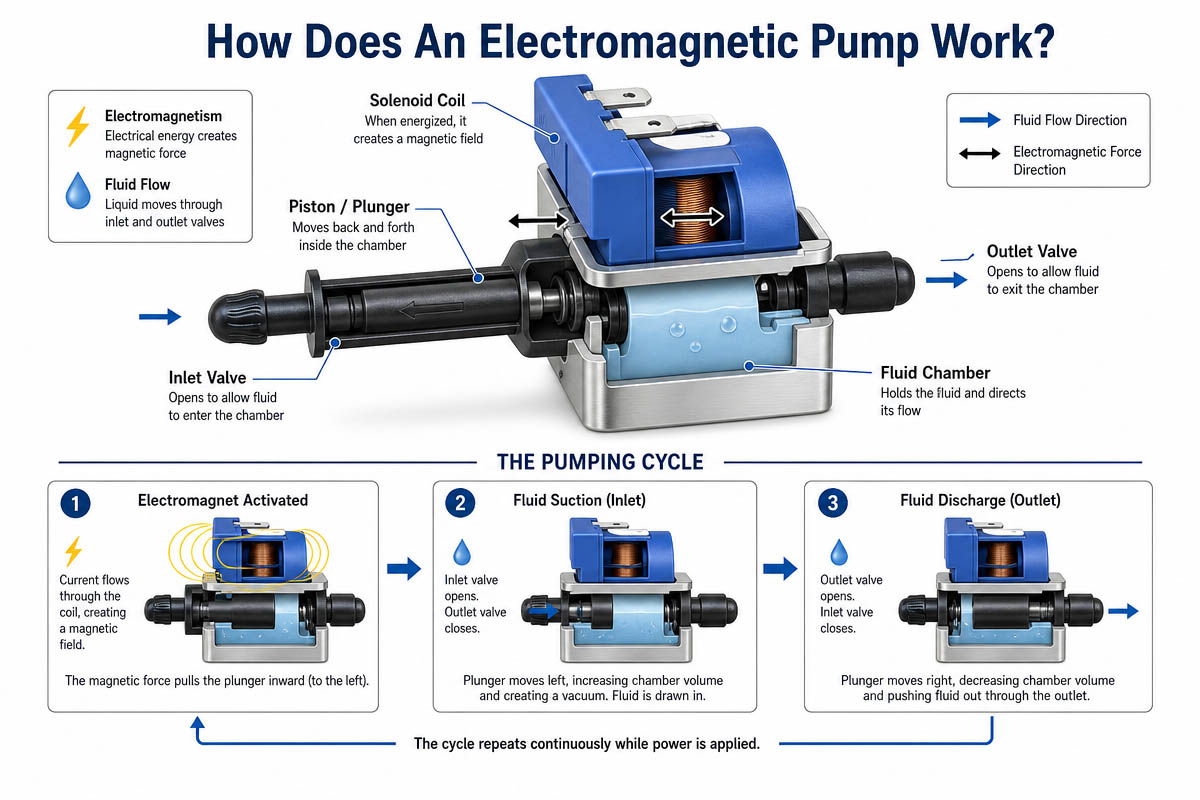
Electromagnetic pumps function on the principle of generating Lorentz force as a result of interaction between:
Electric current (I) Magnetic field (B) Flow direction of the fluid (L) The force generated is given by:
F = B × I × L
This electromagnetic force generates flow through flow channels without the help of rotors and mechanical shafts.
Diaphragm electromagnetic pumps generate flow by continuously pulling and releasing the diaphragm to suck and discharge the fluid.
Chapter 4:Component Electromagnetic Pump
Typically, an electromagnetic pump consists of:
Pump chamber/ Conductive fluid
This section houses conductive liquid, chemicals or dosing liquid depending on the type of pump.
Electromagnetic coil/magnet field generator
This comprises either electromagnets or permanent magnets used to generate magnetic forces.
Flow channel/ piston/membrane
It displaces the fluid
Electrodes
This applies in case of liquid metal pumps whereby an electric current is fed through the conductive liquid via electrodes.
Control Circuit 1.
In today’s era, electromagnetic pumps are equipped with digital controllers to achieve better flow control.
Electromagnetic pumps contain less moving parts leading to quieter operation, reduced maintenance and increased longevity.
Chapter 5:the Types of Electromagnetic Pump
Knowing different types of pumps will make it easier for you to choose an electromagnetic pump.
5.1 Solenoid Actuated Diaphragm Pumps
These are the most common pumps. The pumps make use of electromagnetic coil to drive a flexible diaphragm back and forth to suck and discharge fluid.
Advantages
It is highly resistant to chemicals
High accuracy
Non-leak operation
Disadvantages
Easy to maintain
Low pressure capacity
Heat buildup in case of continuous operation
Applications:
Chemical feeding
Water purification systems
Medical instruments Laboratory equipment
5.2 Linear Electromagnetic Actuator Pumps
These pumps make use of linear solenoids to actuate a piston/plunger.
Advantages
Performance at high pressure
Better stroke control
Viscous fluid compatibility
Disadvantages
Complex design (
Expensive
Applications:
Industrial automation systems
Precision dispensing devices Transfer of viscous fluids
5.3 Electromagnetic Tube Pumps
These are tubular pumps used in specialized industries for transferring liquid metals.
Advantages
Absence of moving mechanical parts
Handles very hot liquids
Suitable for radioactive or corrosive liquids
Disadvantages
High power requirement
Only conducts conductive liquids
Applications:
Nuclear power stations Circulating molten metal
Aluminum casting
Chapter 6 : How to Choose the Correct Electromagnetic Pump
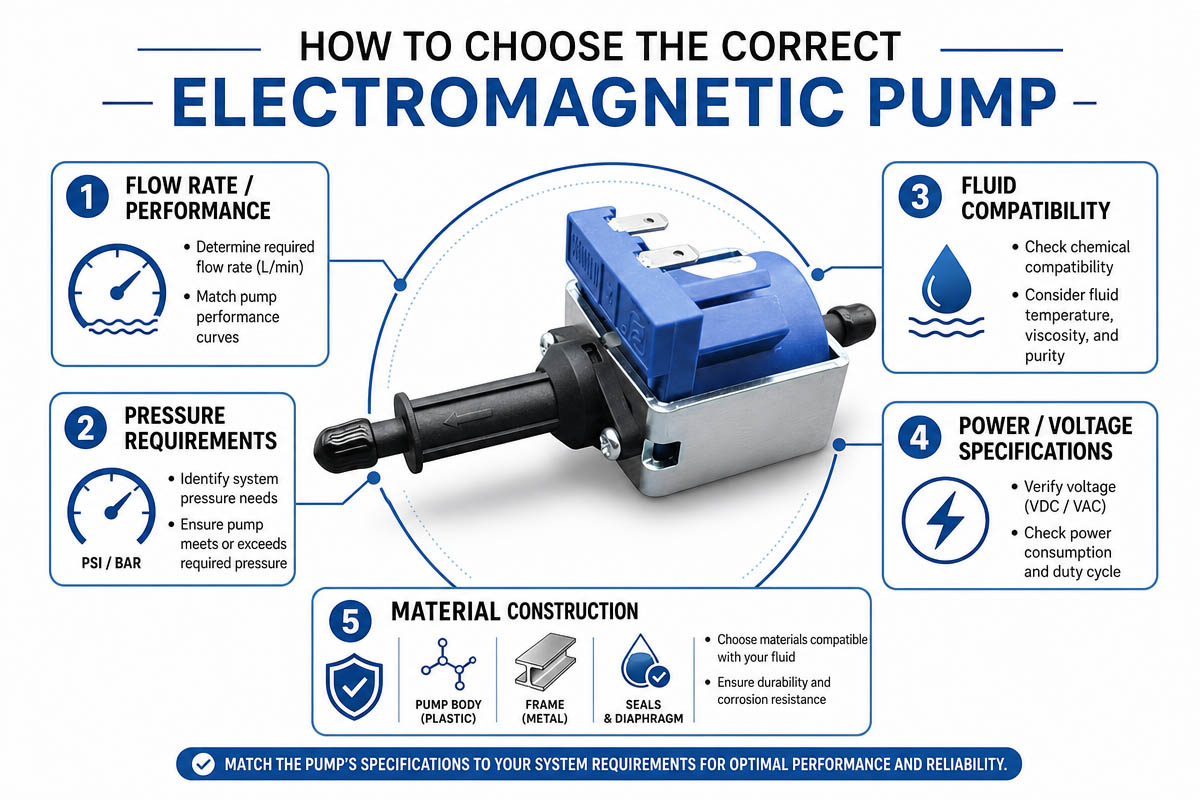
6.1: Flow Rate
Find out the required flow of the liquid per hour or minute.
6.2: Calculating Total Head
Total Head = Static Head + Frictional Loss + Pressure Head
This calculates the pressure that the pump must overcome.
6.3 Determining Fluid Properties
Consider the:
Kinematic viscosity, Density,
Temperature,
corrosiveness and Solid content.
These are crucial in selecting the correct pump.
6.4 Cavitation Prevention
Ensure that:
NPSHa > NPSHr
Cavitation damage can be prevented using proper suction conditions.
6.5 Determination of Power Requirement
For water uses:
kW = Q x H / 367 (kW)
Where:
Q = Flow rate
H = Total Head
Leave a safety margin of 10-20 percent.
6.6 Properties of the Fluids
Consider: Chemical Compatibility –
Temperature Viscosity and Conductivity
6.7 Environmental Conditions
Presence of extreme temperatures, humidity or explosion hazards requires specialized design.
6.8 Energy Efficiency
Electromagnetic pumps are efficient and economical.
6.9 Maintenance Considerations
Select pumps with modular designs and parts that are replaceable.
6.10 Cost versus Performance
A cheaper pump is not always the best solution. Consider factors like efficiency and longevity.
Chapter 7: How to Avoid comment mistake when make an electromagnetic pump selection
Don’t assume that electromagnetic pumps can be used for non-conductive liquids like water and oil.
Don’t neglect cavitation issues; always calculate NPSHa against NPSHr.
Consider fluid temperature since high temperatures impact materials.
Avoid “meta discrimination” by generalizing about pump types without considering their application.
Always verify performance curve data from manufacturer specifications.
Maintenance, Safety, and Compliance
Maintenance entails checking the diaphragms and valves after every 6–12 months depending on use. For precipitating substances, clean the inner passageways. Disconnect electricity before servicing the machine.
For safety purposes, ensure proper grounding and overpressure protection using relief valves. In hazardous environments (e.g., explosive atmosphere), ensure that the equipment is certified either by ATEX or IECEx standard.
From a legal perspective, electromagnetic pumps in regulated industries must comply with industry-specific standards. For instance, in the pharmaceutical industry, ISO 8373 and NSF/ANSI 61 should apply.
Chapter 8: Advantage and disadvantage of electromagnetic pump
8.1 Benefit of Electromagnetic Pump
Less Mechanical Abrasion
Reduced maintenance due to absence of moving parts.
Leaking No
Ideal for use in hazardous or sterile environments.
Accurate Flow Control
Suitable for dosing applications.
Silent Operation
Suitable for medical equipment and laboratories.
Increased Longevity
Due to low friction.
8.2 Limitation of Electromagnetic Pump
Compatibility with fluid
Only suitable for some conductive fluids.
Higher Initial Costs
They require advanced materials and electronics which increase the initial costs.
Cooling System Requirements
Some may require a cooling system for continuous operations.
Chapter 9 : Why Electromagnetic Pumps are Becoming Popular
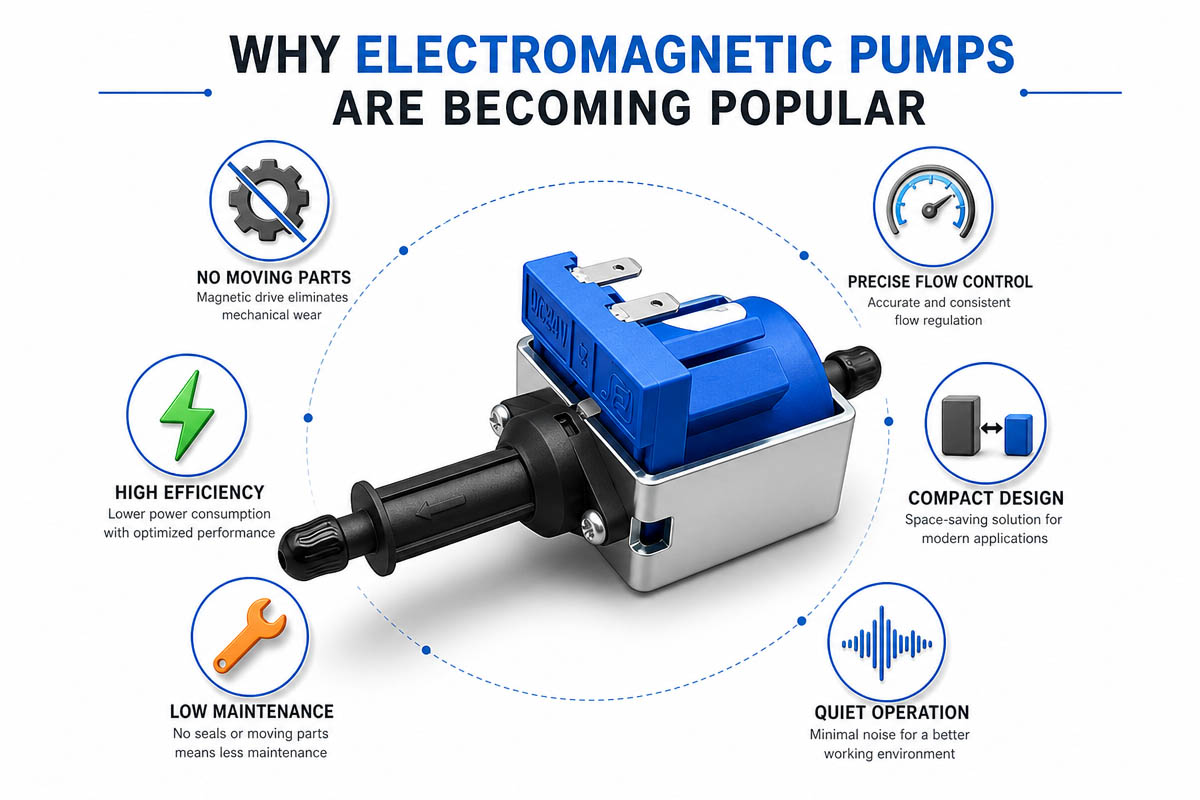
9.1 saving and compact design
Components that are small and light-weight are now needed for modern equipment. Unlike the usual rotary pumps, the electromagnetic pumps are designed to be small and compact and hence can be used for:
Mobile equipment.
Small electronic products
Integrated Fluid Systems.
Compact size makes transportation and installation much simpler.
9.2.Accuracy in controlling fluid flow
The electromagnetic pump enables accurate:
Flow rate
Pressure
Amount of dose
Frequency of pumping.
The electromagnetic pumps provide accurate fluid control. This can be useful in many situations, including:
Medicine dispensers.
Systems using ink jets
Systems injecting chemicals
Laboratory uses
Accurate delivery of fluid increases the performance of the systems.
9.3.Low Noisy Performance
Compared with pumps driven by motors, electromagnetic pumps generally have reduced noise levels.
It will benefit:
Domestic electronics
Medical apparatus
Offices products
Coffee machines.
Low noise improves the perception of product quality and its performance.
9.4. Energy Efficiency
Since the pump uses energy only when the coil is energized, it is an effective device for lowering the amount of energy consumed in the operation process.
Advantages include:
reduced power usage
Low amounts of heat generated
Higher energy efficiency
Further increase in the energy efficiency is done by using pulse or intermittent drive system in various modern designs.
9.5.Simplified Mechanical Design
The electromagnetic pumps are usually more reliable compared with conventional motor-based pumps because of having less mechanical parts.
This provides:
fewer mechanical problems
lower maintenance cost
extended working period
Reliable performance
And it simplifies production and minimizes maintenance cost too.
9.6.Fast Responsiveness
Controlled by electromagnetic actuation, the movement of the fluid can be switched very fast.
Advantages include:
Useful in computer controlled systems
Precision dosing
Industrial control system
Fuel injection systems
Fast response is advantageous for increasing accuracy and system performance.
9.7.High Compatibility with Automation Systems
Currently there is high adoption of automation technologies in most industrial sectors.
Thus, electromagnetic pumps can be easily integrated with:
Programmable controllers,
Sensor,
Microcontroller,
Internet-of-things based systems.
This feature helps making them ideal for intelligent manufacturing and Industry 4.0.
9.8.Extensive Applications Range
There are very versatile and able to manage:
Water
Air
Chemicals
Fuel
Medical solutions
Cleaning liquids (Continued)
Their versatility means manufacturers can make similar pumps that can be used in various industries.
9.9.Improved Durability and Reliability
New generation of electromagnetic pumps utilize:
High quality magnetic material
Excellent coil insulation
Components that are not easily corroded
Precision Machining
This helps to:
Ensure reliability in operation
Constant operation
Tolerance of the environment
Thus, they have higher durability and fewer failures. In other words, it reduces the maintenance cost.
9.10.Trend towards Intelligent and Green Technology
There is an ever growing trend towards:
Saving energy
Protecting the environment
Automated intelligence
Intelligent manufacturing
Electromagnetic pump provides this features as follow:
Reduced power consumption
Low noise production
Compact size
High precision in delivering fluid
This makes them a promising future direction.
Chapter 10: The Electromagnetic Pump Troubleshooting shooting guide
Common Problems with Electromagnetic Pumps and Their Possible Solutions
Electromagnetic pumps have been employed in many applications including those associated with medical devices, coffee machines, chemical dosing systems, vehicles and industrial fluid control processes. Proper troubleshooting will help to improve the performance of electromagnetic pumps.
10.1 Electromagnetic pump doesn’t start
Possible Causes
Power Failure
- Lack of input voltage
- Loose wiring connection
- Power cable failure
Broken coil
- Coil burn out
Solenoid coil open circuit
Controller Fault
- Bad PCB board
- Relay failure
- Blown fuse
Debugging
- Measure input voltage with multimeter.
- Inspect the terminals and connectors of the wiring.
- Test coil resistance:
- Low coil resistance means short circuit
- Replace fuse and other faulty parts of the controller.
- Test the pump under external power source.
- Possible causes of poor pumping action
Low Voltage
- Low driver current
- Unstable power source
Clogging inside
- Contamination of pump chamber
Deterioration of some parts
- Diaphragm aging
- Springs fatigue
- Valve wear
Steps to troubleshoot
- Make sure the voltage/current rating is correct.
- Clean/scrub intake filter and pump chamber.
- Inspect the diaphragm.
- Replace worn-out check valves/springs.
- Remove kinking/blockages from tubing.
10.2 Over load due to continuous operations
- Pump operates beyond rated duty cycle
High temperatures in the environment
- Insufficient ventilation• Heat buildup
Excessive current consumption by the coil
- Incorrect voltage application* Driver malfunction
Steps to troubleshoot
- Ensure proper operating duty cycle.
- Make sure you use correct voltage
- Monitor the current consumption of the coil.
- Intermitting operation if necessary.
- Potential causes of high noise/vibration level
Parts that are too loose
- Screws on pump mounts
- Poor installation
Wear and tear in the mechanical component
- Damaged plunger
- Old spring;
- Fluid flow air bubbles
Troubleshooting
- Tighten all the mounts.
- Replace any damaged mechanical components.
- Drain air bubbles from tubes.
- Insert vibration absorbing pads.
- Inspect internal component’s alignment.
- Possible causes of fluid leak
10.3 Bad seals
- Seal aging Damage to housing
- Cracked pump housing
- Open ports Too much fluid pressure• Pressure beyond rated value
Steps to troubleshoot
- Check all the seal points.
- Replace broken O-rings/gaskets.
- Tighten tubing connectors.
- Check the rated pressure.
- Repair damaged housing immediately.
- No fluid output from pump runs
10.4 Causes Air locked
Troubleshooting steps
- Priming the pump.
- Check flow direction.
- Replace/clean the valves.
- Ensure adequate fluid.
- Lower suction height if necessary.
- Possible causes of intermittent pump operations
10.5 Power supply problem
- Inconsistent voltage
- Poor electrical contact
Thermal protection activated
- Overheating trigger Shutdown due to controller instability
- Timing signal fault
Troubleshooting steps
- Stabilize the power source.
- Inspect electrical contacts.
- Cool down the pump.
- Set PWM/frequency correctly.
- Replace control board if faulty.
Troubleshooting Tips and Maintenance Schedule
10.6 Daily Inspection
- Checking noise/vibration
- Look for fluid leakage Weekly Maintenance
- Check normal flow rate
- Tubes/filters cleaning
- Check wiring connection
- Check operating temperature
10.7 Regular Maintenance
- Change diaphragm/seals
- Coil resistance test
- Lubricate components where necessary
Preventative Measures
Safety Instructions for Handling Electromagnetic Pumps
Electrical Safety
- Disconnect power prior to service
- Handle tools with insulating covers
Fluid Safety Check Grounding
- Don’t perform dry runs
- Use compatible fluid
- Depressurize system before dismantling
Heat Safety
- Never touch overheated coil(s)
- Let the system cool down before service
Chapter 11 : FAQs Regarding Electromagnetic Pumps
11.1 Can electromagnetic pumps be used for pumping water?
No. Most MHD electromagnetic pumps are inefficient for normal water because of low conductivity.
11.2 Can electromagnetic pumps be used for chemical dosing?
Yes. Electromagnetic diaphragm pumps (solenoid driven) are widely used for dosing chemicals.
11.3 How Industries Using The Electromagnetic Pump
Chemical Processing
Medical Devices
Semiconductor Manufacturing
Nuclear Power Plants
Laboratory Automation
11.4 Does the Electromagnetic pumps is maintenance-free.
All pumps require some maintenance, but electromagnetic pumps generally require less maintenance than conventional mechanical pumps.
Chapter 12 : Conclusion
Selecting the appropriate electromagnetic pump requires consideration of flow needs, fluid characteristics, pressure conditions, temperature range, and system compatibility. A good understanding of the different types of pumps and their technical specifications can improve the efficiency and reduce costs of the system.
As automation continues to advance in industry, electromagnetic pumps are becoming an essential technology for numerous industries. Proper selection of the electromagnetic pump can ensure optimal performance for your specific application.

