

There are some customers who would like us to increase residual magnetism of the solenoid projects, whereas there are some other consumers who have inquired us about the meaning of residual magnetism in solenoids and the reasons behind the significance of the same. It has become clear to us that residual magnetism is a highly technical topic. We would like to write an article about residual magnetism for the project engineer and the beginner.
Chapter 1 : What is residual-magnetism?
the Residual is the magnetic field remaining in ferromagnetic objects when the magnetizing field disappears. In other words, residual-magnetism is a leftover of magnetism after turning off the power source.
Magnetism working principles in electromagnets and solenoids:
– Electric current produces a magnetic field;
– If the power source is disconnected, the magnetic field must disappear;
– There will always be some amount of residual magnetism present.
In simple terms: residual-magnetism is magnetism left over after turning off the power.
Chapter 2 : Why does residual magnetism exist?
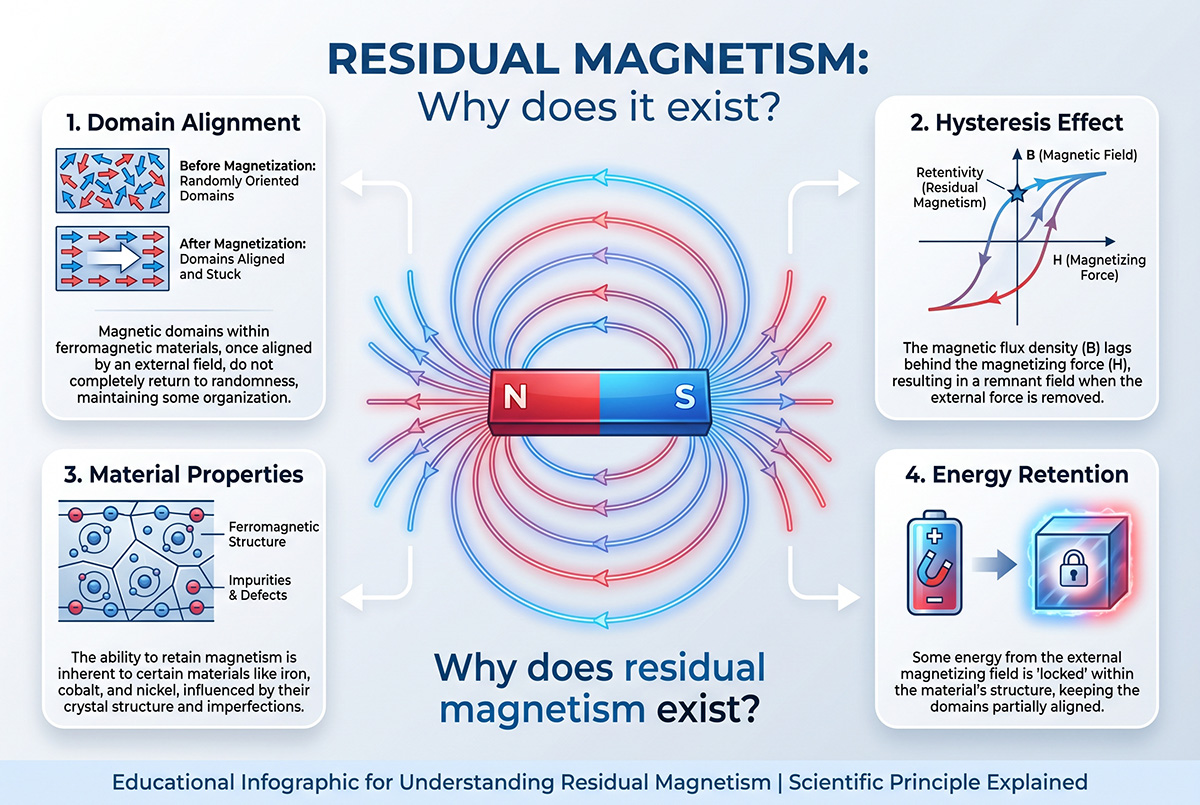
Residual-magnetism occurs because of the characteristics of ferromagnetic materials.
2.1 Alignment of Magnetic Domains
– Magnetic domains are small areas inside magnetic substances.
– Before passing a current through an electromagnet or solenoid, magnetic domains are randomly oriented.
– Passing current through an electromagnetic or solenoid aligns domains to produce a magnetic field.
– When the electric current stops flowing, some magnetic domains remain in place.
2.2 Material Hysteresis
– It takes time for the magnetic field to dissipate.
– Energy storage in the magnetic field causes remanent flux.
2.3 Factors Affecting Residual Magnetism Strength
– High permeability materials like soft iron and low-carbon steel.
– Presence of closed magnetic circuits in design.
– Longer energization period, stronger magnetic field, and higher current.
– Lack of air gaps in magnetic paths.
Chapter 3: Most Important Properties of Residual Magnetism
– Weak and measurable – always much weaker than the original magnetic field.
– Persistent – will not go away unless there is an effort to destroy it.
– Demagnetization procedure necessary for removal, alternating current or physical shock.
Effects of residual magnetism in solenoids
Residual-magnetism in solenoids affects their functionality.
3.1 Slow Release of Armature (most common effect)
– After switching off the current, the armature may move back slowly or get jammed and fail during a fast cycle.
– Very important when dealing with automated systems, high-frequency solenoids, and medical devices.
3.2 Jamming
– The spring may not have enough strength to separate the armature if residual magnetism is too powerful.
– In the extreme case, the solenoid fails to release the armature at all.
3.3 Reduced Accuracy and Repetition Rate
– May lead to inconsistency of stroke, variable output force, and unreliability of cycles.
– Critical when used in metering equipment and other precision applications.
3.4 Higher Resistance, Greater Energy Consumption, and Increased Wear
– Residual-magnetism may increase resistance to mechanical stress, consume additional energy, and accelerate wear of components.
Chapter 4: Applications of residual-magnetism in real-life situations
4.1 Positive Applications (beneficial use)
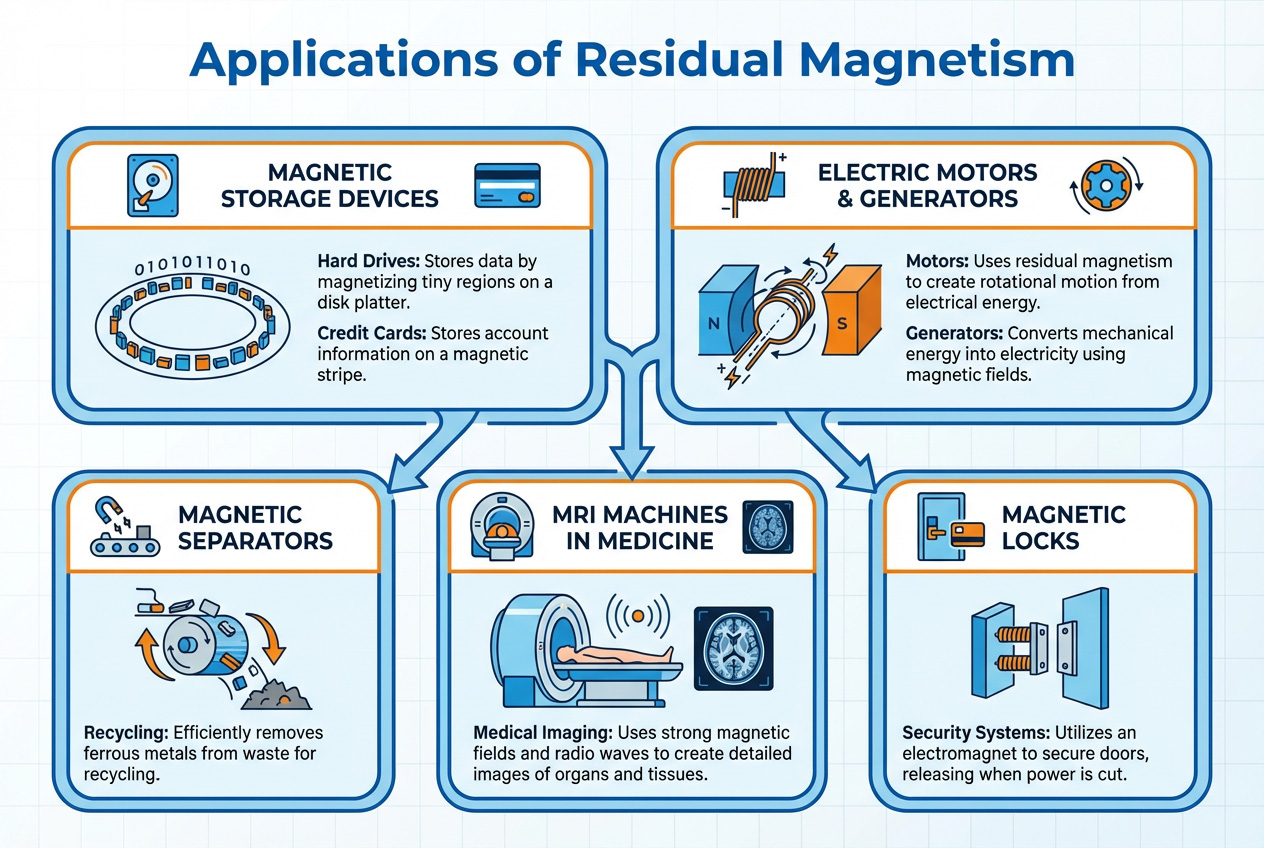
– Self-excited DC machines use residual magnetism in generators to produce voltage when starting.
– After disconnecting from power supply, lifting magnets retain sufficient magnetism to carry small loads.
– Bistable solenoids rely on residual magnetism to maintain the engaged state.
4.2: Negative Effects (problems)
– Sticking of contactors and relays.
– Magnetic contamination of engines and machinery by attracting metal dust from wear and tear.
– Arc-blowing in welding (distortion of welding arcs due to the influence of residual magnetism in steel tubes and plates).
Chapter 5 : How to Reduce Residual-Magnetism in Solenoids
Here is how to effectively minimize residual magnetism and prevent associated problems.
5.1 Air gap introduction (best solution)
– Adding air gaps to magnetic circuits lowers residual magnetism, increases speed, and stabilizes operation.
– The disadvantage: reduced magnetic force.
5.2 Using non-magnetic materials
– Use materials with low coercivity and hysteresis: soft magnetic alloys, specially treated low carbon steel, and silicon steel.
5.3 Electric demagnetization
– Apply a reverse voltage pulse on disconnect.
– Implement diode or RC circuits for demagnetization.
– Most modern drive systems come with built-in demagnetization functions.
5.4 Mechanical improvements
– Increasing spring tension.
– Decreasing the area of contacts as much as possible.
– Optimizing armature motion.
5.5 Surface treatment of materials
– Applying nickel or zinc coatings minimizes sticking and improves durability.
Chapter 6: Design Recommendations (By Solenoid Type)
| Solenoid Type | Recommendation |
| High-Speed Solenoids | Minimize residual magnetism. Use air gaps + fast release design. |
| Tubular (Pull/Push) Solenoids | Combine air gap + strong spring. Optimize stroke clearance. (Note: Tubular types are extra sensitive due to compact, closed magnetic structures.) |
| Latching/Bistable Solenoids | Residual magnetism can be partially utilized but must be carefully controlled, not eliminated. |
Chapter 7: How to fix your solenoid that won’t release
If the solenoid won’t release after turning it off, it is most likely due to residual magnetism.
Symptoms:
– Failure of the armature to release.
– Unreliable return operation.
Other possible causes:
– Insufficient spring tension.
– Excessive friction.
– Poorly aligned.
Solutions:
– Introducing air gaps.
– Increasing spring pressure.
– Choosing better materials.
– Implementing demagnetizing circuits.
Conclusion: Most problems with sticking are related to magnetism, not mechanics.
Chapter 8: Difference between residual-magnetism and hysteresis
– Hysteresis refers to the magnetic loop – the magnetizing and demagnetizing time.
– Residual-magnetism is the actual magnetism in the absence of an external magnetic field.
– Final takeaway: Hysteresis causes residual- magnetism.
Chapter 9: How to reduce the residual-magnetism from solenoid cores
When necessary, here is how to eliminate it:
Methods:
– Reverse current method. Applying a reverse polarity voltage pulse of sufficient current.
– Using AC to demagnetize gradually.
– Controlling the current decay through a degaussing circuit.
Precautions: Do not overheat the device. Monitor current strength.
Will residual- magnetism decrease solenoid lifetime?
Yes, residual-magnetism affects solenoid lifetime:
– Increases mechanical wear;
– Raises temperature of operation;
– Reduces cycle repetition rate.
Possible long-term consequences: Spring fatigue, wear of surfaces, loss of performance.
Conclusion: To prolong lifetime, ensure proper design and material selection.
Chapter 10: Final Conclusion
Residual-magnetism is a relatively insignificant phenomenon, which has an engineering significance.
Without proper measures: delayed response, sticky failures, reduced accuracy.
However, with good engineering solutions: residual magnetism is easy to manage, potentially useful in designing high-quality solenoids.
Chapter 11: Residual Magnetism Common Question
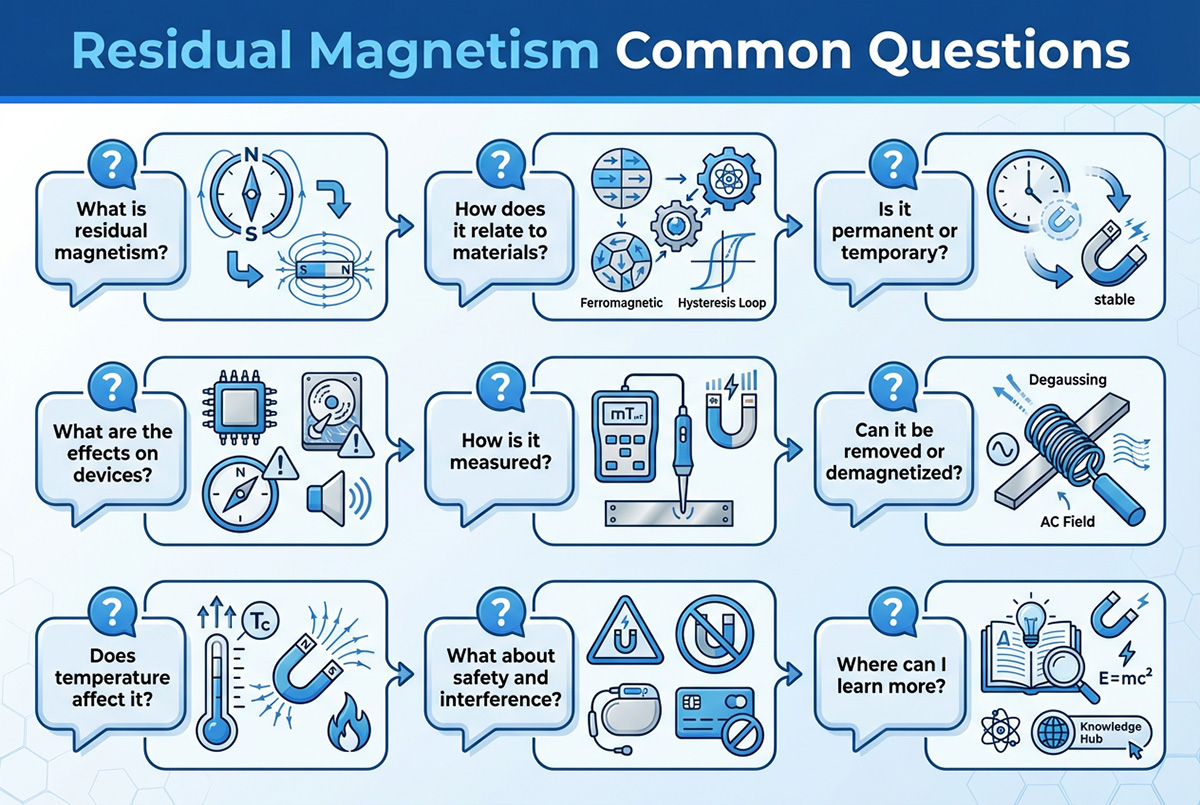
1. what is residual-magnetism?
Residual magnetism is the remaining magnetic flux densit magnetic substance after removal of magnetizing field.
2. Why residual-magnetism exists?
It exists because magnetic domains in ferromagnetic materials do not fully switch to a random state after magnetizing. Some domains remain in position.
3. Which materials possess significant residual-magnetism?
Hard magnetic materials (permanent magnets): alnico, ferrite, and neodymium magnets have high remanence. Soft magnetic materials (for instance, silicon steel) have very low residual magnetism.
4. What is the unit of measurement for residual-magnetism?
Residual-magnetism is usually measured as residual flux density (Br) in tesla (T) or gauss (G).
5. Is residual-magnetism good or bad?
– Positive use cases: making permanent magnets, audio speakers, generators, and motors.
– Negatives: causes magnetic interference, part sticking or malfunction of measurement devices.
6. How can residual-magnetism be removed?
Degaussing removes residual magnetism using an alternating magnetic field of decreasing strength.
7. How does residual-magnetism affect generators?
Self-excited generators use a small amount of residual magnetism in field poles to create voltage. Without residual magnetism, the generator will not be able to produce voltage.
8. Difference between residual-magnetism and retentivity.
Residual magnetism is the actual magnetism while retentivity is intrinsic properties of material that determine magnetism.

