

Solenoids are critical elements that widely used in industrial automation, electronic engineering, and accurate control systems. Operational stability of the solenoid is directly connected to the effectiveness and reliability of the entire equipment.
One of the most common covert risks is solenoid overheating–it related to the solenoid temperature rise, also a key factor that influences its durability and accuracy.
This blog provides a thorough analysis of solenoid temperature rise :
The principal reasons behind the heating process
The risks of being overheated
Methods of protection during designing the system
Practical approaches to solve the problem
It offers recommendations for designers, producers, and engineers.
Chapter 1: Reasons for Solenoid Heating
There are two main causes of energy losses that lead to overheating during solenoid operation:
1.1 Copper Losses (Joule Heating)
Electricity flows through the coil, creating thermal losses due to resistance:
High current – high losses.
Higher resistance – higher losses.
This is a primary source of energy losses in DC solenoid temperature rise.
1.2 Iron Losses (Core Loss)
Core generates in alternating magnetic fields:
Eddy current losses
Hysteresis losses
Both of these losses increase in case of high frequency magnetic field and low quality materials used for manufacturing.
1.3 Additional Factors
Too dense winding blocks the airflow
Poorly designed solenoid does not allow dissipate heat
High ambient temperature
Continuous duty cycles that also caused the solenoid temperature rise in high
1.4 Aging of Insulation (a covert but highly influential factor)
Aged insulation contributes to:
Decreased conductivity
Leakage currents
Higher losses
That starts vicious circle:
Heat → Aging → Increased Heat → Failure
Chapter 2: The Dangers of Solenoid temperature rises with overheating
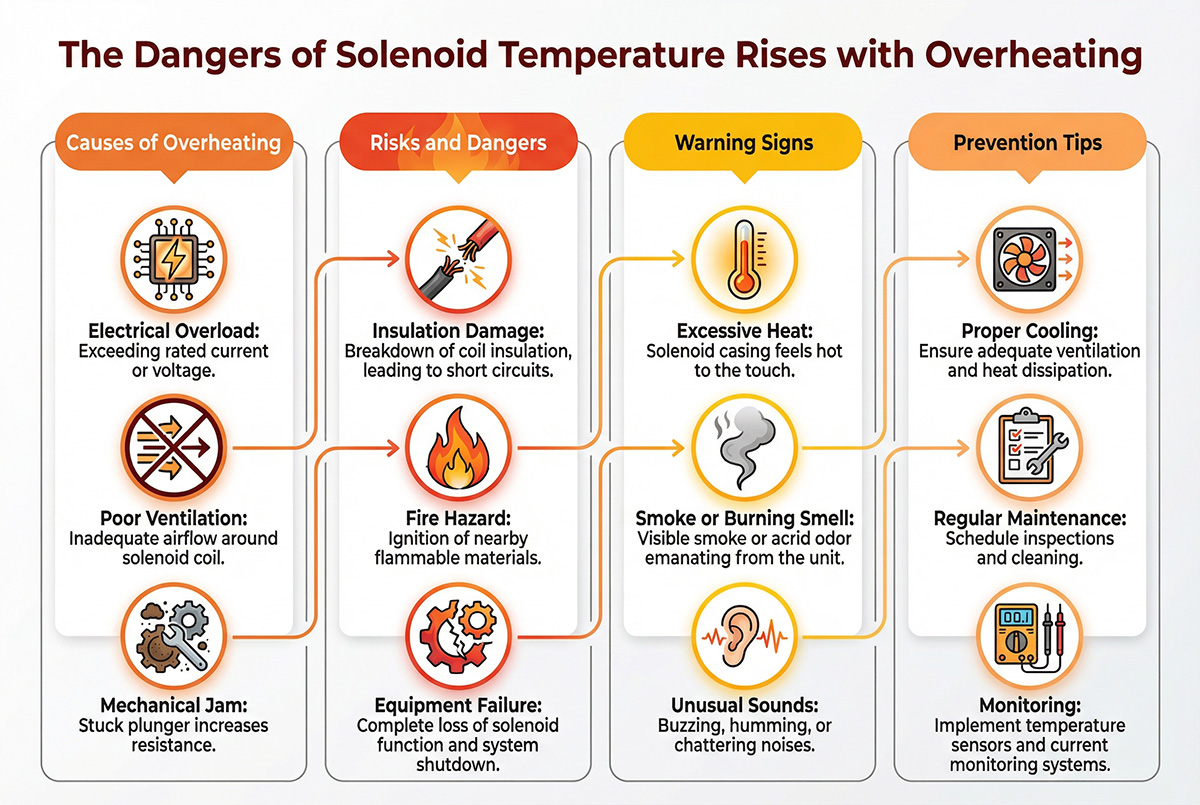
Continuous overheating significantly impacts performance and puts you at risks of safety issues:
2.1 Reduced Life-Time
Faster aging and brittleness of insulation
Higher risks of insulation breakdown → short circuit
The decrease of magnetic core’s permeability.
Lower force required for operation
2.2 Decreased Accuracy
Increased resistivity leads to current instability.
Instability of magnetic field intensity.
Higher response time.
This issue particularly relevant in:
Automation systems
Medical devices
High-accuracy tools
2.3 Safety Risks
Warped housing
Damage to adjacent parts
Increased fire hazards especially in sealed or easily flammable environment
Higher maintenance and operating expenses
Chapter 3: How to prevent problems of solenoid temperature rises?
Proper thermal management starts during the design stage. The principle here is:
Minimizing losses and maximizing heat dissipation
3.1 Improving Coil Design
Optimization of material usage (high-purity copper).
Finding the right balance between the number of turns and diameter.
Avoid excessive use of current and poor design.
Creating spaces for better air flow within windings
3.2 Proper Core Materials
Usage of non-magnetic core materials (such silicon steel laminations).
Reducing paths for eddy currents
Enhancing thermal conductivity
Using small-sized cores that do not absorb heat
3.3 Optimized Conditions of Operation
Establishing the right duty cycles (intermittent or continuous)
Avoiding long-time overloads (never operate in full capacity).
Considering surrounding temperature
3.4 Reduction of Contact Resistance
Using high-quality terminals (silver-plated)
Ensuring proper electrical connections
Limiting additional thermal losses during the connection
Chapter 4: Practical ways to manage the solenoid temperature rise
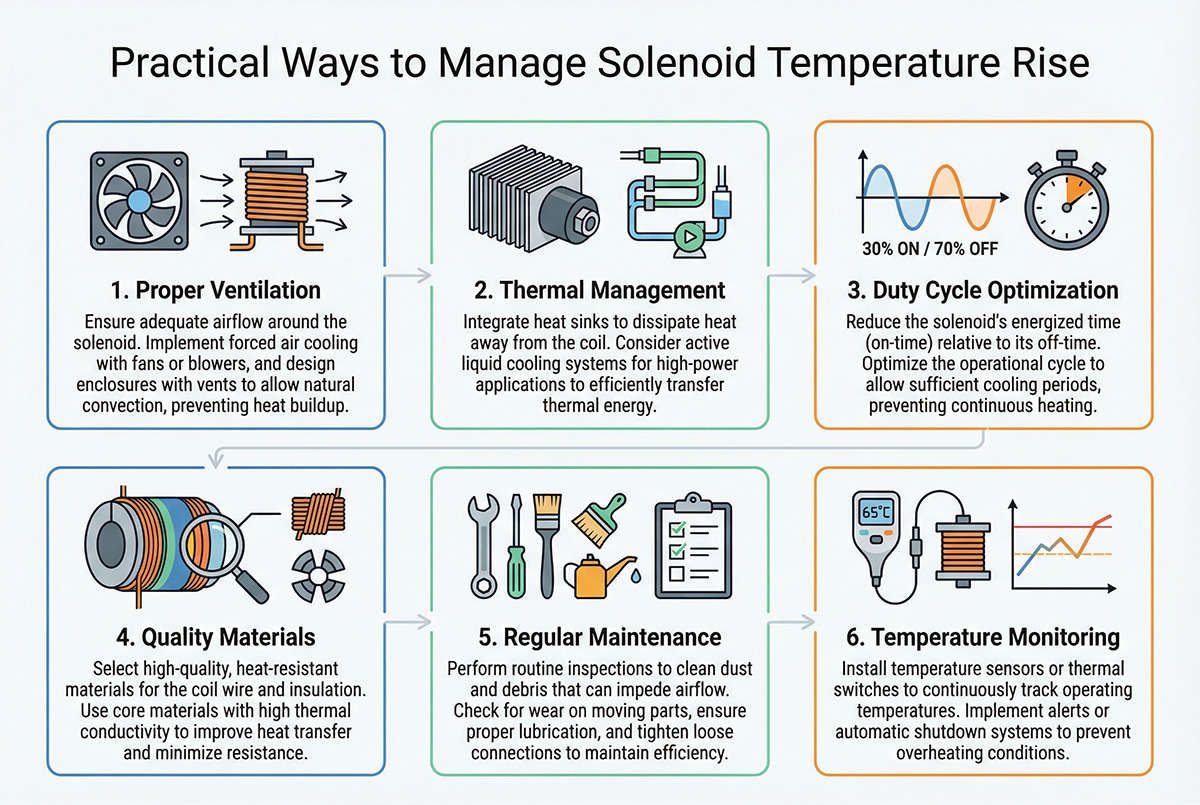
Four approaches can be combined to fit the specific amount of power and conditions of use:
4.1 Structural Optimization (Passive Cooling)
Most effective for: Applications with low or average power usage
Increasing heat dissipation surfaces via installation of fins
Usage of layer-wise or segmented winding
Leaving 1-2mm free space between the vents
Arranging windings in such a way that would prevent them to end up in hot spots.
For instance:
Small DC solenoids (toys, relays, etc.) could remain cold enough even without using any active measures (temperature <60°C).
4.2 Thermally Conductive Materials
Most suitable for: Applications requiring insulation and having average power consumption
Thermally conductive silicone pads
Insulated heat-conducting coverings
Thermally conductive core materials
Advantages:
Enhanced heat exchange
Securing electrical insulators
Improved reliability
For example:
Outdoor solenoids with nano-heat dissipation coating allows reducing temperature of the surface by 15-20 degrees Celsius and prevents corrosion
4.3 Forced Cooling (Active Cooling)
Suitable for: Power-hungry applications and applications working continuously
Air-cooling systems
Cooling fans or ventilation systems
Better venting and airflow paths
Installation of dust filters for safety. Advantages:
Low cost
Easy maintenance
Liquid cooling
Cooling systems with circulating fluid.
Heat-exchanger equipment.
Advantages:
Extremely efficient
Temperature regulation is stable.
For example:
Lifting electromagnets for industry uses water cooling systems to keep the temperature below 80°C
Chapter 5: Intelligent Solenoid Temperature rise Control
Best for: Applications with a need of accuracy and reliability
Installing temperature sensors (PT100, thermoplastic)
Constant monitoring
Automated temperature control system
Functionality:
Current limiting in case of overheating
Activation of cooling systems on the spot
Adjusting speeds of fans or coolant flow.
Advanced Design:
Internal heat dissipation paths
Combination of natural and forced convection.
For example:
Automobile transmissions use special channels for airflow inside the motor compartment to avoid overheating
Chapter 6: Conclusion
To efficiently deal with solenoid heat it is crucial to develop a comprehensive strategy including:
Minimizing losses
Effective heat conduction
Active cooling
Intelligent temperature control
Principal Recommendations:
Use passive cooling for applications with low-power solenoids
Utilize both active cooling and temperature control for power-hungry or high-precision systems
Ensure appropriate thermal management according to practical conditions.
Integrated Case Example:
In automotive EV charge station solenoids work under a high pressure and strict requirements regarding reliability. Our approach:
Heat-conductive insulation
Cooling air systems
Intelligent temperature control system
Guarantees:
Temperature stability
Extended life-time
Reliable long-term operation
Final thought
Only through:
Maximizing performance
Ensuring longer life-time
Safety and effective operation
you can achieve maximum benefits from your solenoids
Chapter 7 : FAQs of Solenoid Temperature Rise
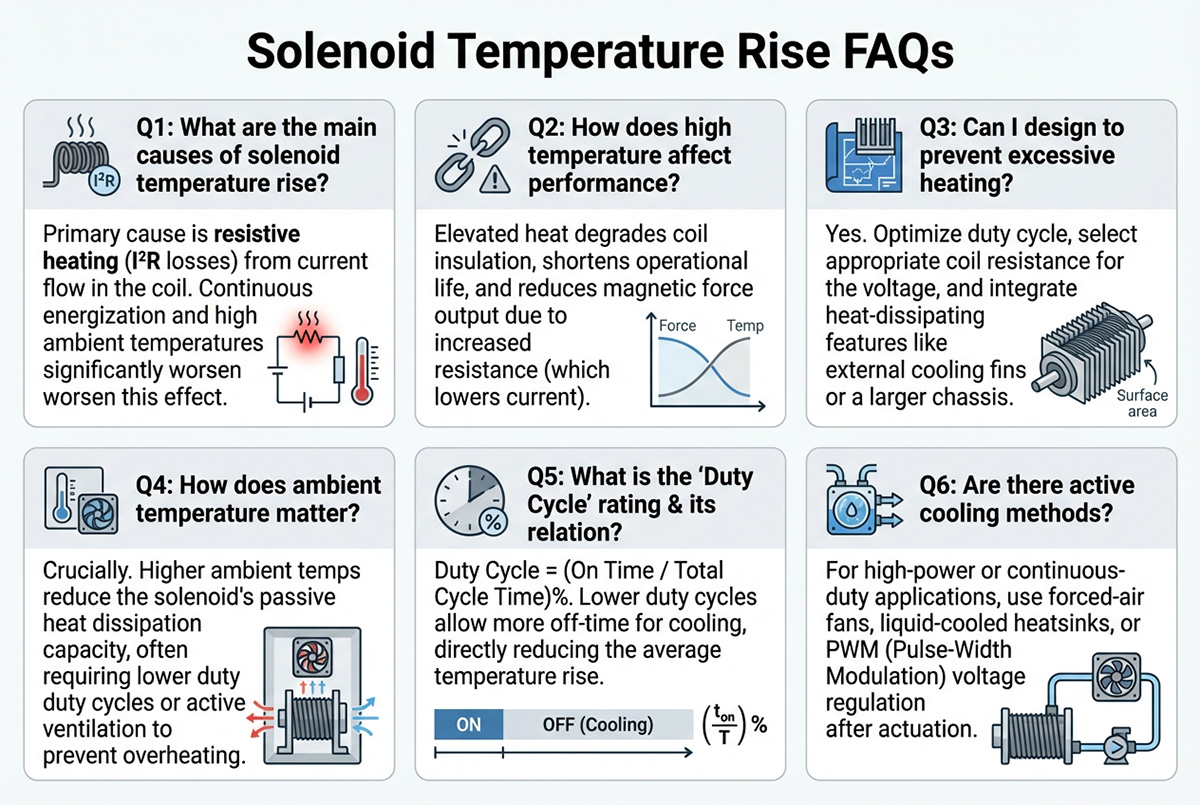
7.1 Why does solenoid temperature rise increases?
Copper loss (resistance of the coil) and iron loss (eddy currents and hysteresis) are leading reasons for solenoid heating. Poor venting and high ambient temperature may affect overheating as well.
7.2 What is the optimal solenoid temperatureriserange?
Depending on the class of insulation and design, most solenoids perform effectively within the temperature range between 40-80°C. Certain high-performance designs might be able to withstand higher temperature.
7.3 How to prevent overheating of my solenoid?
There are some preventive measures you could take:
Improving design of coils
Using superior core materials
Enhancing ventilation
Installing cooling systems (air/liquid)
7.4 Is solenoid overheating dependent on the applied voltage?
Indeed. In case of unchanged resistance, voltage increase will lead to higher current thus resulting in copper loss and overheating.
7.5 Can solenoid start a fire in case of overheating?
Yes. Excessive heat may damage insulation causing short circuit and other irreversible damage to the coil.
7.6 Which method of cooling solenoids is the most effective?
The choice of the most efficient cooling system greatly depends on the application. However, here is a general classification:
Passive cooling for low-power systems
Air cooling is moderate-power
Liquid cooling is for heavy loads.
7.7 What is the effect of the duty cycle on solenoid’s temperature?
Continuous duty cycle increases the rate of heat generation whereas intermittent mode allows cooling down thus ensuring smaller temperature increase.
7.8 What are the most efficient materials to dissipate heat?
Here are several popular materials that dissipate heat effectively:
Thermally conductive silicone pads
Core made of silicon steel
Aluminum casing
Nano heat dissipation coatings

