

Air-Core Coil is often used in high-frequency circuits, as the magnetic losses have to be kept as low as possible. Air core coils do not use a magnetic core, as is the case with the iron core or ferrite core inductors. The coil is simply twisted around the air or a non-magnetic substance that does not have a magnetic field.
Air core coils are often used in RF circuits, antennas, wireless systems, and measuring devices, as they have low losses, are highly linear, and have excellent high-frequency performance.
This book discusses the basic idea of the air core coil, its construction, the various types of Air-Core Coil , how to use the correct type, and how to use them for practical applications, along with some troubleshooting aids and fast reference data.
1 What is an Air-Core Coil ?
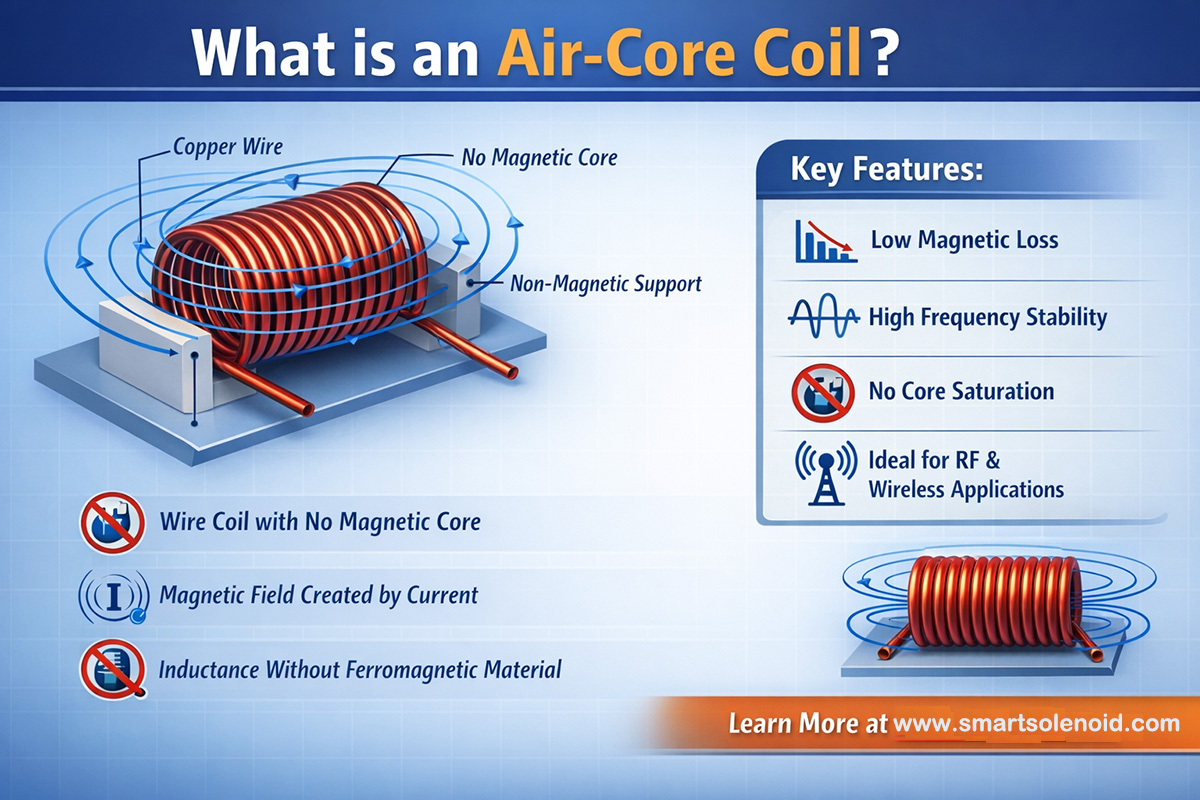
An air-core coil is a type of electrical inductor that uses a conductor wire to make a coil without a magnetic core material. The coil may be supported by air, plastic, ceramics, and other materials that do not attract magnets.
The inductance is provided by a magnetic field that is produced by a current running in a coil.
Important Things
No core materials needed
Low magnetic losses
Very stable, especially at high frequencies
Very straight
Low inductance compared with iron core inductors.
Air core coils are best used in circuits where signals are processed and communicated and where RF is used.
2 How An Air-core coil works
Electromagnetic induction is what makes an air core coil function.
When electricity flows in a coil, a magnetic field is formed around the wires. The inductance is provided by a magnetic field.
There are a few factors that affect inductance:
How many times
How wide the coil is
How long the coil is
How far apart wires are
Permeability of the medium, or air
The inductance of a simple air-core solenoid coil can be estimated using:
L=lμ0N2A
Where:
L = inductance (H)
μ₀ = permeability of free space
N = number of turns
A = cross-sectional area
l = coil length
Because air has a low magnetic permeability, air-core inductors typically have lower inductance values compared with ferrite-core inductors.
3 Different kinds of air-core coil
There are different types of air-core coils depending on their application or construction.
1Air-Core Coil with One Layer
A coil constructed by coiling wires one time.
Uses: RF tuning circuits
Oscillators
Antennae
2 Air-Core Coil with Multiple Layers
The wires are coiled multiple times to increase the inductance.
Uses:
RF filters
Transmitters that work without wires
3 Coil with a variable air core
You can increase or decrease the inductance by increasing or decreasing the wire.
Uses: RF tuning
Radio receivers
4 Flat Spiral Coil
The wires are coiled like a flat spiral.
Uses: Charging without wires
Sensors that use induction
Systems for RFID
4 Structure and Main Types
The following are the parts of an air-core coil:
Main Parts
Part Function
Wire made of copperCarries current
Winding coilsMakes a magnetic field
Frame of supportGives mechanical stability
Layer of insulationStops short circuiting
Sorting by Shape
The following are the different types of air-core coils:
The people have classified air-core coils into the following categories:
Coils of solenoids
Coils that spiral
Coils in a helix
Coils in a plane
Each of the above has different inductance values and works at different frequencies.
5. Air-core coil Main Features: Pros and Cons
The advantages of air-core coils:
✔ No losses in the magnetic core
✔ Great performance at high frequencies
✔ High linearity (no magnetic saturation)
✔ Inductance is stable throughout temperature
✔ Low distortion in RF circuits
The disadvantages of air-core coils:
✘ with Lower inductance values
✘ Need Larger physical size
✘ Lower magnetic coupling efficiency
✘ Sensitive to external electromagnetic interference
6. Comparison Table: Air-Core vs Iron-Core vs Ferrite Inductors
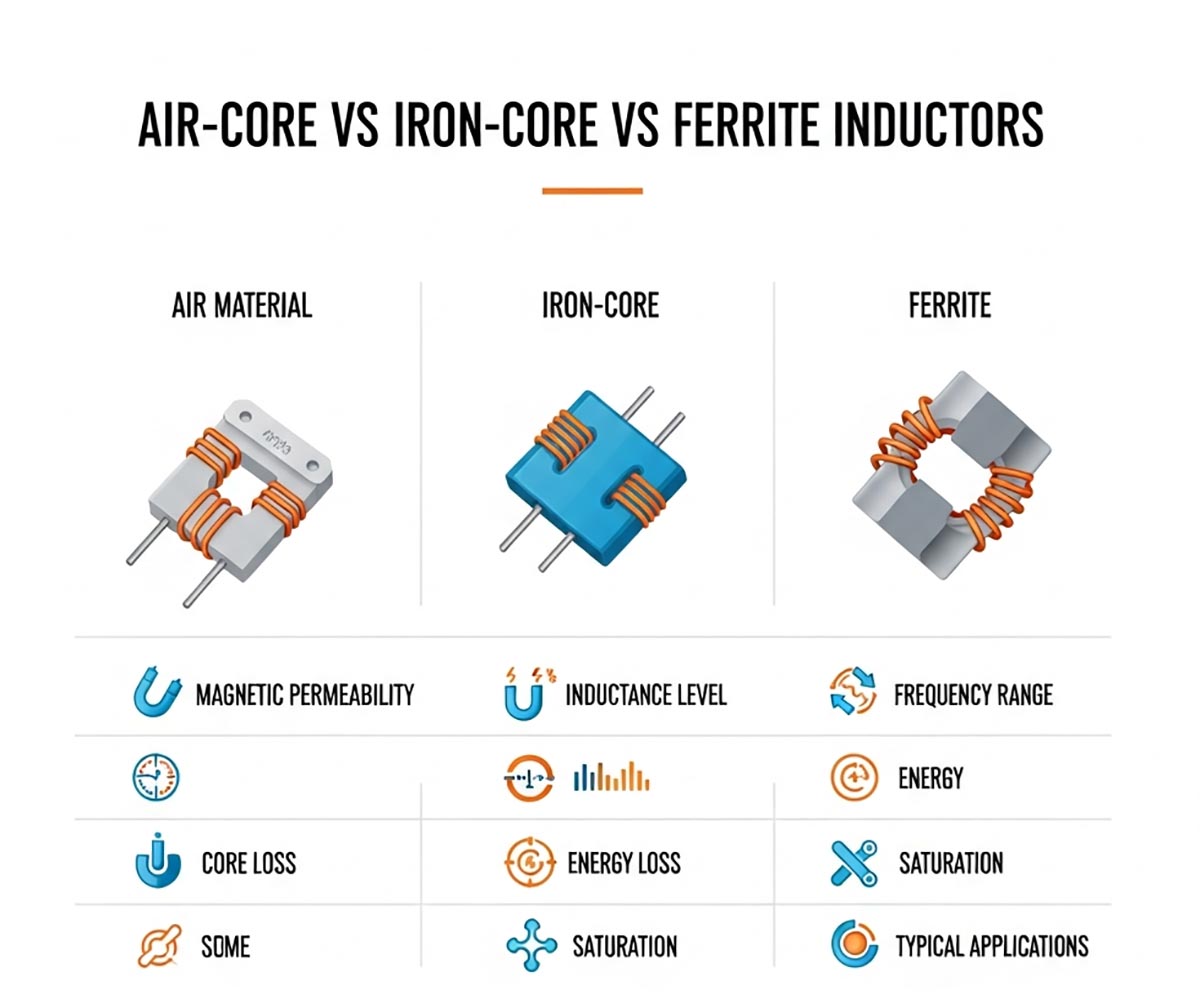
| Feature | Air-Core Coil | Iron-Core Inductor | Ferrite-Core Inductor |
| Core Material | Air | Iron | Ferrite |
| Magnetic Permeability | Very low | High | Medium |
| Inductance Value | Low | High | Medium |
| Frequency Range | Very high | Low | Medium-high |
| Core Loss | Very low | High | Medium |
| Saturation | None | Yes | Yes |
| Applications | RF circuits | Power supplies | Filters & transformers |
7. Applications Across Industries
Air core coils are employed in various modern electronic devices.
- Radio Frequency (RF) Systems
These are employed in transmitters, receivers, and oscillators.
- Wireless Charging Systems
Flat spiral air core coils are employed in various applications, including:
Wireless charging of smartphones
Electric toothbrush chargers
- Communication Equipment
These are employed in various applications, including:
Antenna tuning
RF filters
Signal coupling
- Medical Electronics
These are employed in various applications, including:
MRI coils
Precision sensors
Medical signal processing
- Test and Measurement Equipment
High-frequency test equipment requires low-loss inductors, where air core coils are employed.
8. Why Air- Core Coils are Getting More Popular
There are a few technological developments that are making air core coils more popular.
- The rise of wireless technology
Wireless communication devices require high-frequency inductors.
For example, 5G devices
Devices that connect to the Internet
RFID devices
- Less Magnetic Loss
Air core inductors completely eliminate hysteresis losses as well as losses from Eddy currents.
- Very Linear
Air core coils are perfect for applications that require a very linear response, as they will not saturate.
- Design of Small RF Circuits
In modern RF circuits, it is necessary to tune at high frequencies.
9. How to Pick an Air Core Coil (A Guide for Engineers)
While choosing an air core coil, engineers must look for a few factors.
- The value of inductance
Find out how much inductance is needed.
Normal range: 1 nH to 100 µH
- Frequency of Operation
The best environment for air core coils to operate is:
RF Frequencies
Circuits with High Frequencies
- The size of the coil
A coil that is larger means:
More inductance
More space needed
- The size of the wire
A wire that is larger means:
Less resistance
Less loss of power
- Quality Factor (Q)
The higher the Q factor, the lower the loss of energy.
- Stability of Temperature
The coil must operate well at all temperatures.
10. Frequently Asked Questions About Engineering Problems and Solutions
Problem 1: The inductance is too low
Possible causes:
Too few spins
The diameter of the coil is too small
Solution:
More twists needed
Make the coil larger
Problem 2: Heating the coil
Cause:
Too much current flowing through the coil
Solution:
Make the wire larger or decrease the current
Problem 3: The coil is experiencing interference caused by electromagnetic waves
Cause:
Magnetic fields are coming from outside the coil and are affecting it
Solution:
Fix the problem by using a good PCB design
Problem 4: The frequency is unstable
Reason:
The coil is changing shape because of some mechanical forces
Solution: Use support material to fix the coil.
12 Tips for keeping things in good shape and common mistakes people make when using them
Engineers should avoid common faults to ensure that their work is reliable.
Don’t make these mistakes
Wrong calculation of inductance
Too much current flowing through a thin wire
Not very stable mechanically
Improper spacing of coil
Tips for keeping your coils in good shape: ✔ Check the structure of the coils on a regular basis ✔ Avoid mechanical deformation ✔ Keep the insulation in good shape ✔ Keep the coils safe from moisture and corrosion
13. Quick Reference Data Table
| Parameter | Typical Range |
| Inductance | 1 nH – 100 µH |
| Operating Frequency | kHz – GHz |
| Q Factor | 50 – 300 |
| Wire Material | Copper |
| Coil Diameter | 2 mm – 100 mm |
| Temperature Range | −40°C to 125°C |
14. Maintenance Tips and Common Application Mistakes
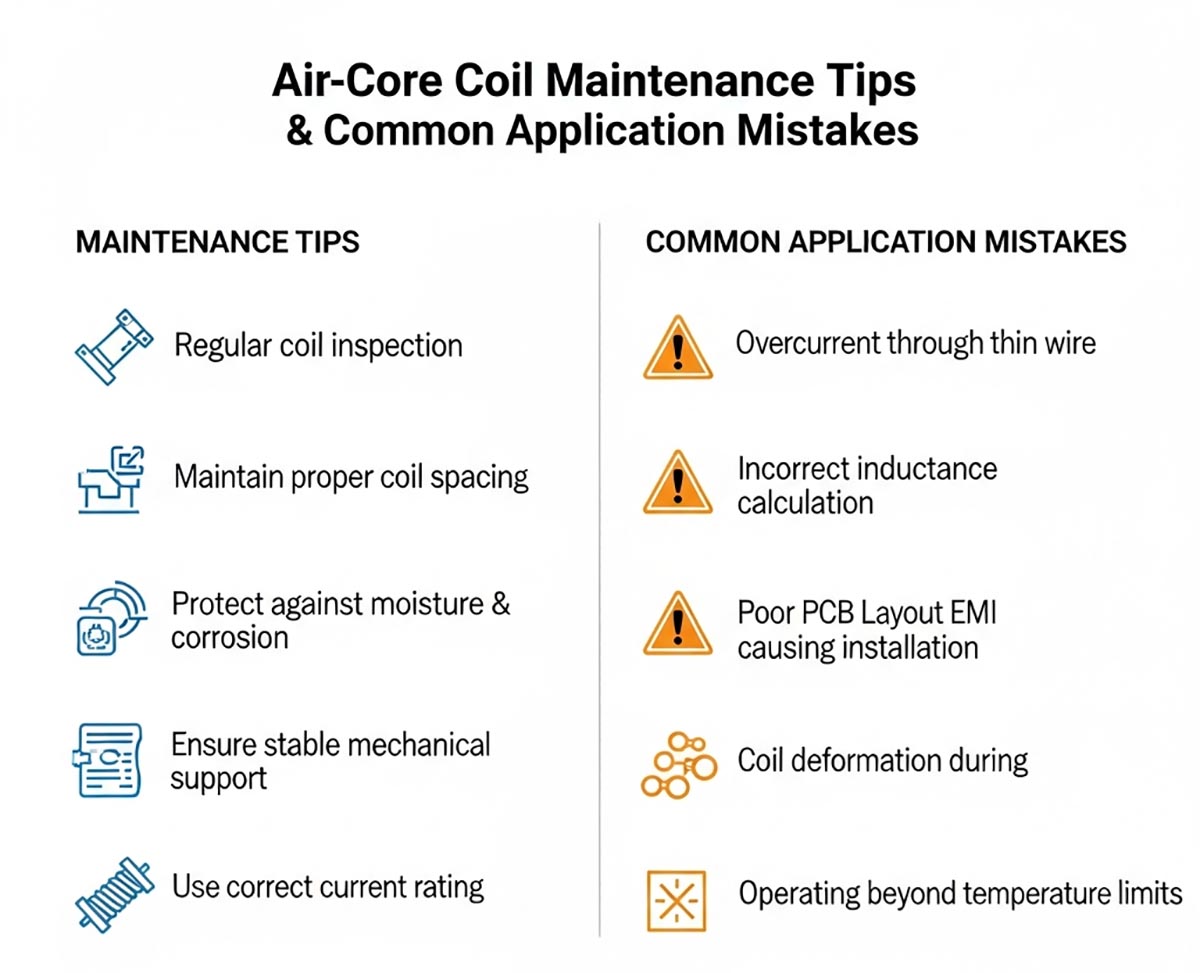
To ensure that air core coils perform well, several maintenance tips should be followed. Engineers should also be aware of the common mistakes that should be avoided at all costs. The common mistakes include:
Avoid These Errors
Incorrect inductance calculation
Excessive current flowing through thin wires
Poor mechanical stability
Improper coil spacing
Maintenance Tips
✔ Regularly check the coil’s structure
✔ Ensure no mechanical deformation
✔ Ensure proper insulation
✔ Ensure no exposure to humidity and corrosion
15. Summary
Air core coils have played a crucial role in high-frequency electronic devices and RF circuits. The unique advantages that air core coils offer make them an essential component in modern communication and wireless technology. The advantages include minimal magnetic losses, high linearity, and high-frequency stability.
Air core coils offer a lower inductance value compared to other inductive components such as magnetic core inductors. The absence of core saturation makes air core coils suitable for use in electronic circuits. The working principles, design aspects, and selection methods help in choosing the right air core coil for optimal circuit performance.

