

Chapter 1: 1:Introduction
The tubular push and pull solenoids are the most commonly used electromechanical actuators in modern-day industrial automation. Its function is the conversion of electrical power into straight motion so that machines can perform tasks such as locking, pushing, pulling, lifting, or letting go of objects.
The most commonly used tubular solenoids are
Push Solenoids with Tubular housing
Pull Solenoids with Tubular housing
Push-Pull Solenoids with Tubular housing
For an individual who is an engineer, product designer, or integrator of systems, it is imperative that they have knowledge of the differences that exist between these three solenoids so that they can choose the correct one for the job.
Chapter 2: What Do Tubular Push and Pull Solenoids Do?
A tubular solenoid is an electromagnetic device that converts electrical power into straight motion.
The Main Parts of a Tubular Solenoid
Coil Winding: This is the part that makes the magnetic field when it is energized.
Plunger or Armature: This is the movable part of the solenoid that is made of iron.
Magnetic Housing: The solenoid’s outer shell completes the magnetic field.
Return Spring: This is the spring that pushes the plunger back when the solenoid is not energized.
The tube that directs the plunger to ensure smooth movement is called the guide tube.
When the solenoid is energized, the electric current makes the coil create a magnetic field that pushes the plunger towards the center of the solenoid.
Chapter 3: How Tubular Push and Pull Solenoids Work
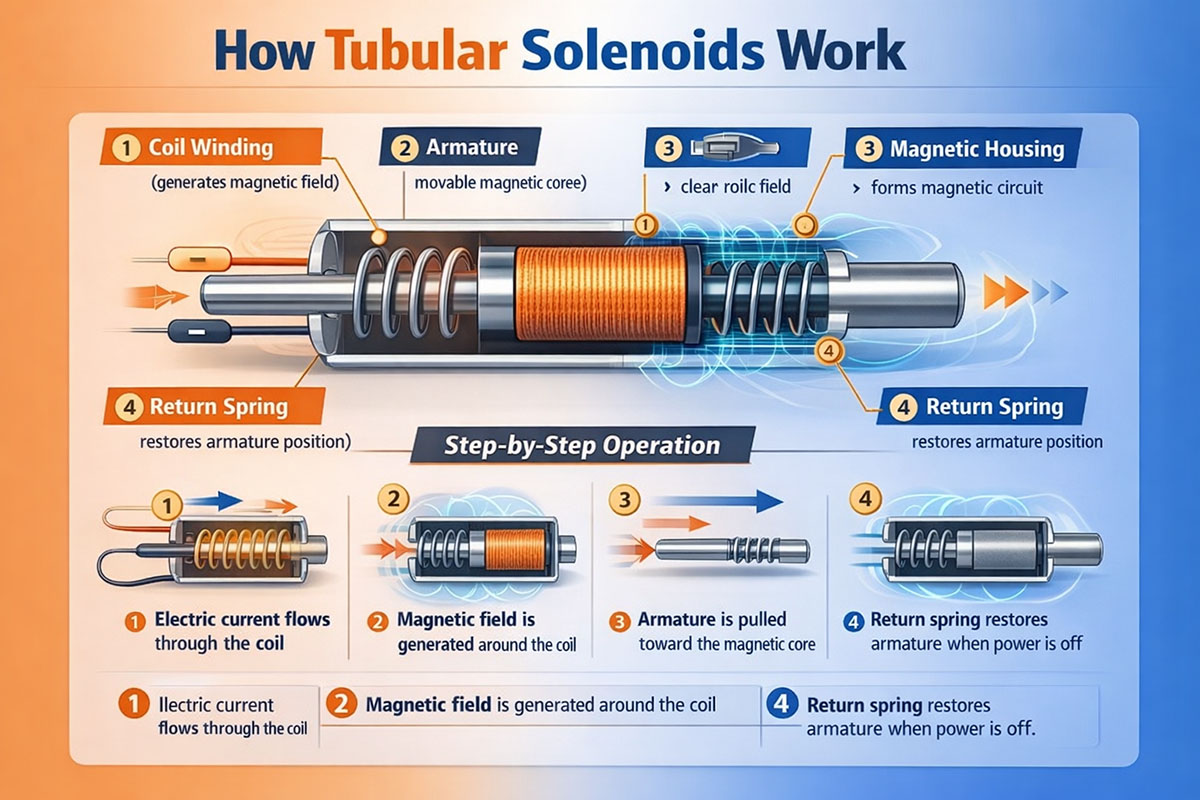
The solenoid makes use of electromagnetism so that it can function.
The solenoid coil is able to conduct electricity.
A magnetic field is created around the coil.
The magnetic circuit pulls the plunger, which is made of ferromagnetic materials, toward the core.
The plunger creates a mechanical action that moves a load.
The spring returns the plunger to its original position when the power is turned off.
The main difference between a push and a pull solenoid is how the output is mechanically used.
Chapter 4: What is a tubular push solenoid?
What is a solenoid that pushes a tube?
When the solenoid is turned on, the plunger moves out, and this creates a pushing action.
The magnetic field inside the solenoid is still pulling something toward it, and this creates a movement that is mechanically converted into a push.
Motion for work
When you turn on the power, the plunger pulls out.
Power OFF: The spring pulls the plunger back.
Pros
Direct action: press
Easy to connect to levers and actuators
Simple design
Easy to connect to levers and actuators
Good for eject mechanisms
Cons
Less force than a pull solenoid
Short length of stroke
A little less efficient
Tubular push solenoid Common application
Machines that sell things
Machines that give out tickets
Machines that are used in pinball games
Solenoids with Tubes
Chapter 5: What is a tubular pull solenoid?
When the solenoid is turned on, a tubular pull solenoid moves by drawing the plunger into the solenoid body.
This is the most popular and efficient solenoid configuration because the magnetic field is used to pull the armature toward it.
Motion of work
Power ON: The plunger moves in.
Power OFF → The spring pushes it back.
Pros
More magnetic force
Ability to stroke longer
Very efficient
Design that is stable and dependable
Cons
You might require an external link to make a push motion.
Installation may need more room for mechanics.
Common uses
Locks on doors
Systems for latching
Grippers for robots
Tools for automating factories
Locking devices for safety
Chapter 6: Tubular Push-Pull Solenoids
What is a solenoid that pushes and pulls?
Depending on where the load is connected, a push-pull solenoid can provide push or pull mechanical action.
When the rod of the push-pull solenoid is pushed or pulled, it can move in any direction, but the plunger moves inward.
Benefits
Installation can be changed
Can move in two ways
Small
Good for mechanical systems that move in more than one way
Cons
More complicated mechanical setup
More expensive for making
Common uses
Machines for sorting things automatically
Systems for automating factories
Locks that are smart
Packaging machines
Chapter 7: Comparison of Push vs Pull vs Push-Pull Solenoids
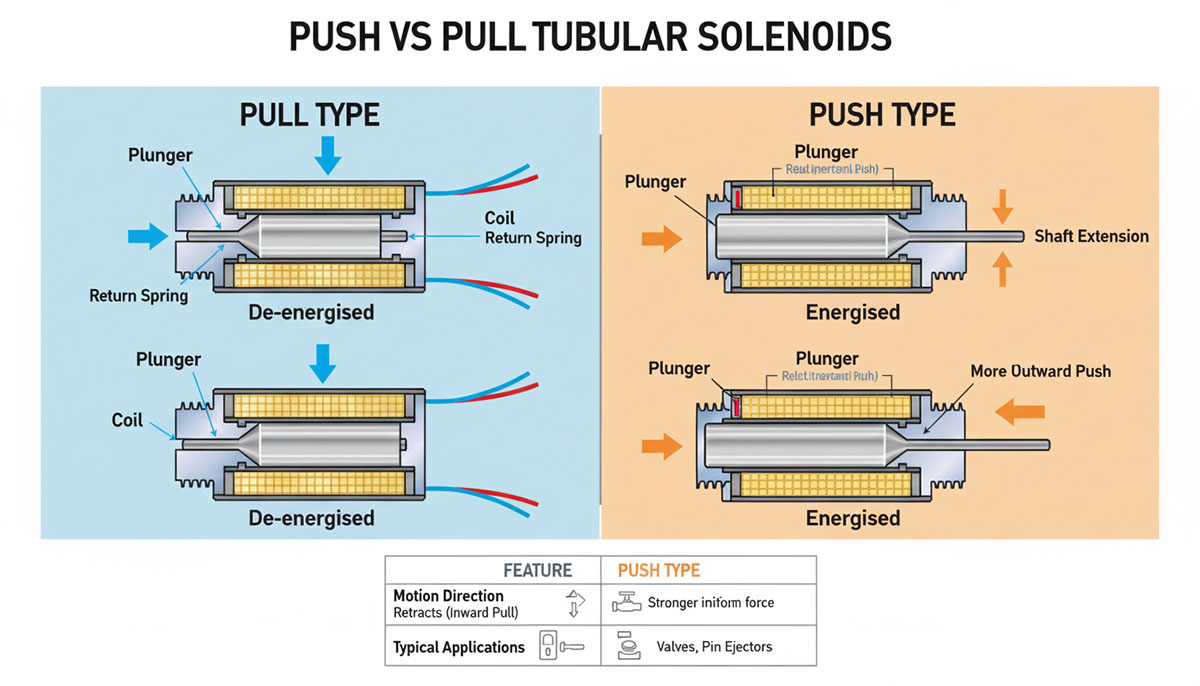
| Feature | Push Solenoid | Pull Solenoid | Push-Pull Solenoid |
| Motion direction | Outward push | Inward pull | Push or pull |
| Magnetic efficiency | Medium | High | High |
| Stroke capability | Short–medium | Medium–long | Medium |
| Installation flexibility | Medium | Medium | High |
| Typical use | Ejection | Locking | Flexible automation |
Chapter 8: Design Considerations for Tubular Solenoids
In designing tubular solenoids, engineers should consider the following factors.
8.1. The Force Needed
The need for force depends on:
Weight of the load
Friction of machines
Factor of safety
The force of a solenoid diminishes as the stroke length increases, so calculations should be accurate.
8.2. Length of the Stroke
The strokes of a common tubular solenoid are
2 mm to 20 mm
Longer strokes require:
Bigger size of the solenoid
More power used
8.3. Power and Voltage
Some common voltages are
12V DC
24 volts of direct current
48V DC
8.4 Duty Cycle
You must also consider the duty cycle:
Duty to work all the time
Duty that comes and goes
Duty cycle refers to how long a solenoid can be used.
Example:
10% duty cycle = short periods of time
50% duty cycle = moderate periods of time
100% duty cycle means it runs all the time
If a wrong duty cycle is used, it can get too hot.
8.5. Weather Conditions
Industrial solenoids must be protected against:
Dirt
Wetness
Very hot
Vibration
Some common methods of protecting yourself are
Housings with an IP rating
Insulation for high temperatures
Coatings that don’t rust
Chapter 9: How to Pick the Right Tubular Push and pull Solenoids
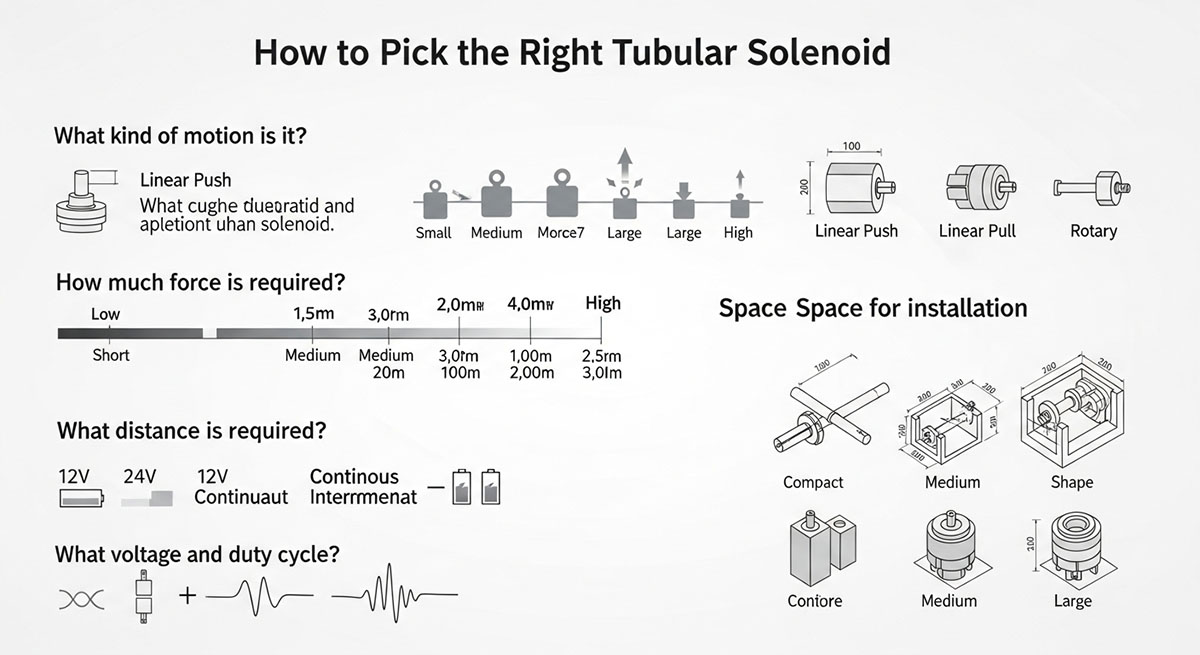
This is a simple method of picking a tubular solenoid.
Step 1: What kind of motion is it
Make a selection based on the type of motion:
Push action
Push solenoid
Pull motion
Pull solenoid
Push-pull solenoid
Flexible motion
Step 2: How much force is required
Add:
Weight of load
Friction
Safety factor
Step 3: What distance is required
Choose a solenoid that can deliver the required force at the end of the stroke.
Step 4: What voltage and duty cycle
Make sure it can work with your voltage supply.
Step 5: Space for installation
Make sure that the size of the solenoid is suitable for the design of the machine.
Chapter 10: Final Thoughts
Tubular push and pull solenoids are a fantastic option for many different types of industrial and business applications.
Engineers can select the right type of actuator for their design by understanding the differences between push, pull, and push-pull solenoids.
In general, the differences are that:
Pull solenoids are the most powerful and efficient.
Push solenoids are ideal for applications that must move directly outward.
Push-pull solenoids make it simple to connect different pieces of a complex automation system.
Engineers can make systems more effective and extend the service life by thoughtfully evaluating the force, stroke, duty, and installation requirements.
Chapter 11: Questions and Answers About Tubular Solenoids
- What is the main difference between push solenoids and pull solenoids?
When a push solenoid is activated, it moves things outward, and a pull solenoid pulls things toward the center.
- What type of solenoid has the most power?
Pull solenoids are usually the most powerful because the magnetic circuit naturally pulls the armature toward the center of the coil.
- Is it possible to use a pull solenoid as a push solenoid?
Yes. A pull solenoid can be utilized to make a pushing motion by using a mechanical link or rod extension.
- How long do tubular solenoids usually last?
High-quality industrial solenoids can last for millions of cycles depending on the duty cycle and operational environment.
- Tubular solenoids operate on what voltage?
12V DC, 24V DC, and 48V DC are just a few of the voltages they can operate on.
- Can tubular solenoids be utilized for continuous duty?
Yes, provided they have coils for full duty cycle operation.
- How can you make the solenoid stronger?
By doing the following, you can make your solenoid stronger:
Increasing the current in the coil
Shortening the distance of the stroke
Improving the magnetic materials’ performance
- What kinds of businesses utilize tubular solenoids?
Some of the industries are
Automation in industry
Robotics
Devices for health care
Machines that sell things
Smart locks
Automobile systems

