Advantages of the C-Frame Solenoid
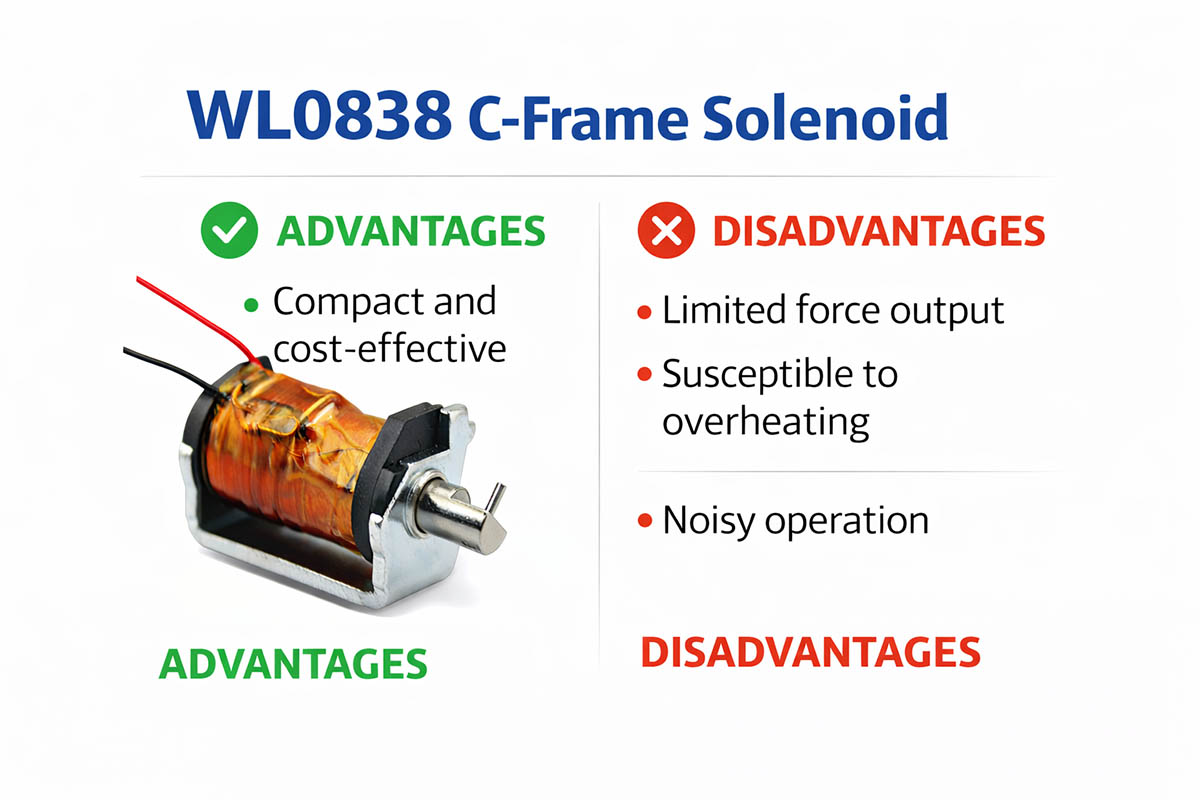
Compact design
Being open in its construction, it easily integrates into compact spaces. This actuator is great for small devices and embedded electronics.
Cost-effective
This component has a cheap price since it has a simple and easy-to-manufacture design.
Quick reaction
This feature allows C-Frame solenoids to operate quickly during the process of automation.
Easy installation and maintenance
Since C-Frame solenoids have an open-frame design, they are easy to assemble and service.
High cooling rate
An open-frame design ensures better airflow, thus minimizing overheating risks in comparison with closed counterparts.
Adjustable options
One can vary voltage rating, stroke length, and output force.
Lightweight
This feature allows for using this actuator in portable devices.
🔻 Disadvantages of the C-Frame Solenoid
1 Poor magnetic efficiency
Due to the open structure, magnetic fluxes leak through the gaps and reduce magnetic efficiency in comparison with closed solenoids.
2 Low output force
Due to lower power, C-Frame solenoids have poor output force and cannot perform heavy-duty tasks.
3. Environmental sensitivity
Since the internal elements of the C-Frame solenoid are exposed, they can operate poorly under adverse environmental conditions.
4. Increased noise level
Noise generation happens because of frequent clicks and vibrations at the high switching frequency.
5, Decreased durability
Since C-Frame solenoids have an open structure, they are vulnerable to harsh environmental factors.
6, Reduced lifespan in continuous duty cycle
C-Frame solenoids are intended for intermittent duty cycles and deteriorate faster under continuous usage.
How to repair C-Frame solenoid
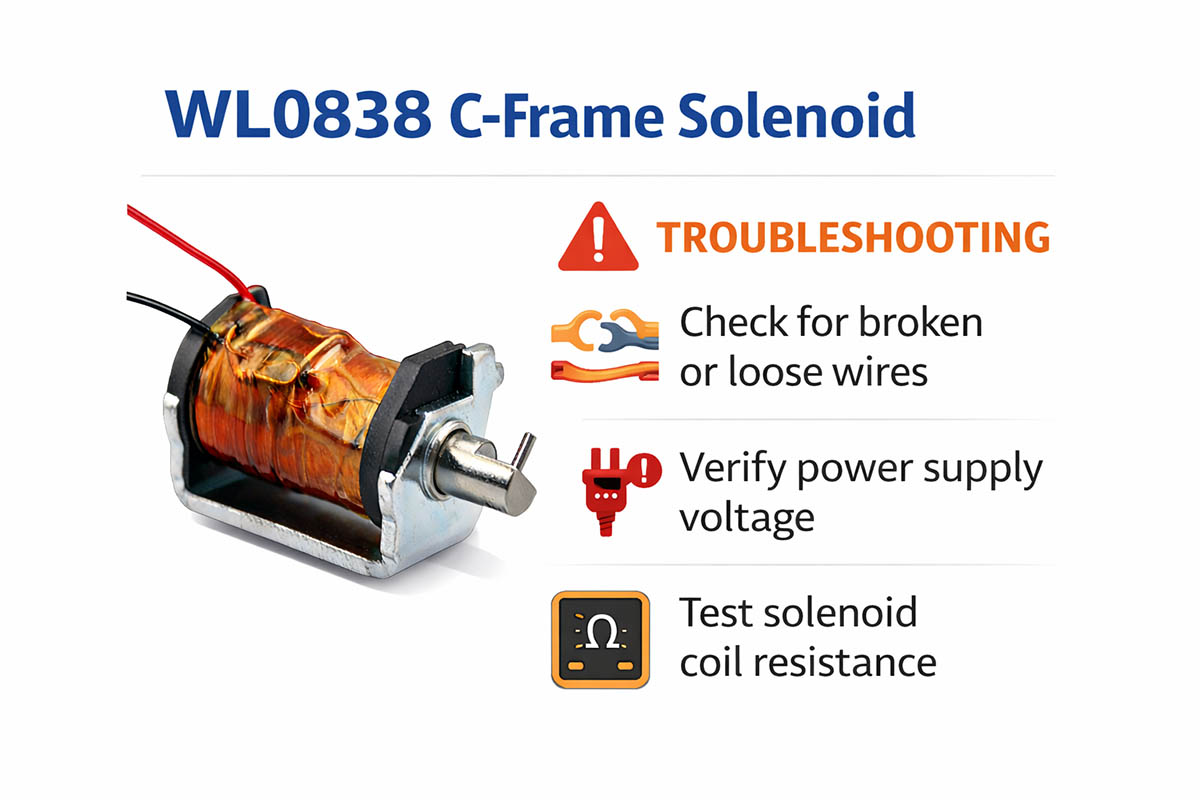
Repair guidelines for C-Frame solenoids.
1. Not working (malfunction)
Possible reasons:
No power supply;
Incorrect voltage rating; burned-out coil; loosened wires
Solutions:
Check voltage supplies for compatibility with C-Frame solenoid’s parameters;
Perform a resistance check of the coil with multimeter;
Inspect connections of wiring;
If the coil is burned out, then replace it.
2. Insufficient force output
Reasons:
The voltage supplied is too low;
Excessive load;
The coil overheats;
Electromagnetic interference; misalignment
Solutions:
Make sure that the power supply meets all requirements;
Replace the solenoid with a higher force output rating or decrease load;
Wait until the coil cools down or adjust the duty cycle.
Check whether the solenoid is aligned and perform adjustments if required.
3. Overheating under usage
Reasons:
Usage of a wrong duty cycle (for continuous);
Increased voltage;
Inadequate ventilation of the area
Solutions:
Pick C-Frame solenoid with higher rating;
Check power supply stability and make adjustments if required;
Revise the design and improve airflow for better cooling;
Apply additional thermal protection methods.
4. Delayed response
Reasons:
Contamination with dirt and dust;
Return spring wear;
Insufficient power or instability of the power supply;
Parts rub against each other during operation
Solutions:
Maintain cleanliness of internal elements;
Replace return spring or reinforce it with another;
Ensure the stability and sufficiency of the power supply.
Apply oils to the surfaces with friction.
5. Increased noise level and vibration
Reasons:
Improper mounting;
Wear or damage of return spring or plunger;
Noise generation in AC C-Frame solenoids;
Misalignment
Solutions:
Check and fix the mounting;
Check solenoid elements and replace damaged ones;
Employ DC solenoid to eliminate the noise.
Ensure plunger alignment with the housing of C-Frame solenoid.
6. Stuck plunger (jamming)
Reasons:
Effects of residual magnetic fields;
Weak return spring;
Contamination;
Stuck by adjacent mechanical parts;
Solutions:
Employ a non-magnetic spacer or demagnetize object;
Replace worn-out return spring with a new one;
Remove any dirt from the surface of the plunger;
Check for mechanical damages or malfunctions.
7. Erratic motion
Reasons:
Loosened connections of wires and contacts;
Interrupted or unstable electricity;
Broken insulation of coil, thermal cut-off engagement
Solutions:
Inspect wiring connections;
Check stability of power supply, make changes if necessary;
Perform coil insulation check and make repairs.
Make sure that there are no overheat conditions for coils.
Tips for proper C-Frame solenoid operation:
✔ Ensure the compliance of voltage and duty cycle ratings;
✔ Do not exceed rated force output of the actuator;
✔ Maintain cleanliness and dryness of the component;
✔ Align it properly during installation;
✔ Put the component into protective enclosures in harsh environment;