How to Select a Direct-Acting Medical Solenoid Valve
Choosing a proper direct-acting medical solenoid valve should start with application, not valve size.
1. Define your media
Identify exactly what will pass through the valve:
air, water, oil, oxygen, nitrogen, chemicals, or other liquids.
The media defines required valve body and seal materials. Chemical compatibility of the valve should always be checked before production.
2. Determine Flow Requirements
Flow rate and port diameter directly affect valve performance. A larger port does not always mean that the valve is better. It should be compatible with the required flow, pressure, and available space for installation.
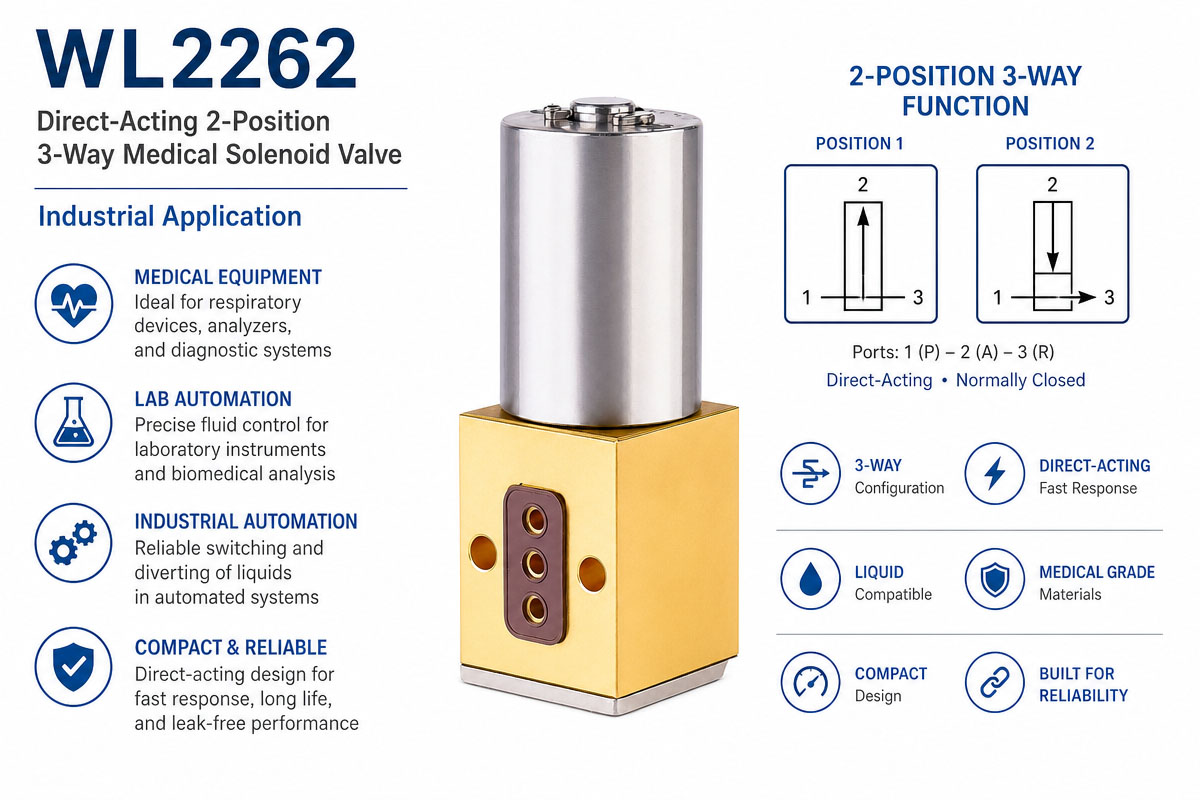
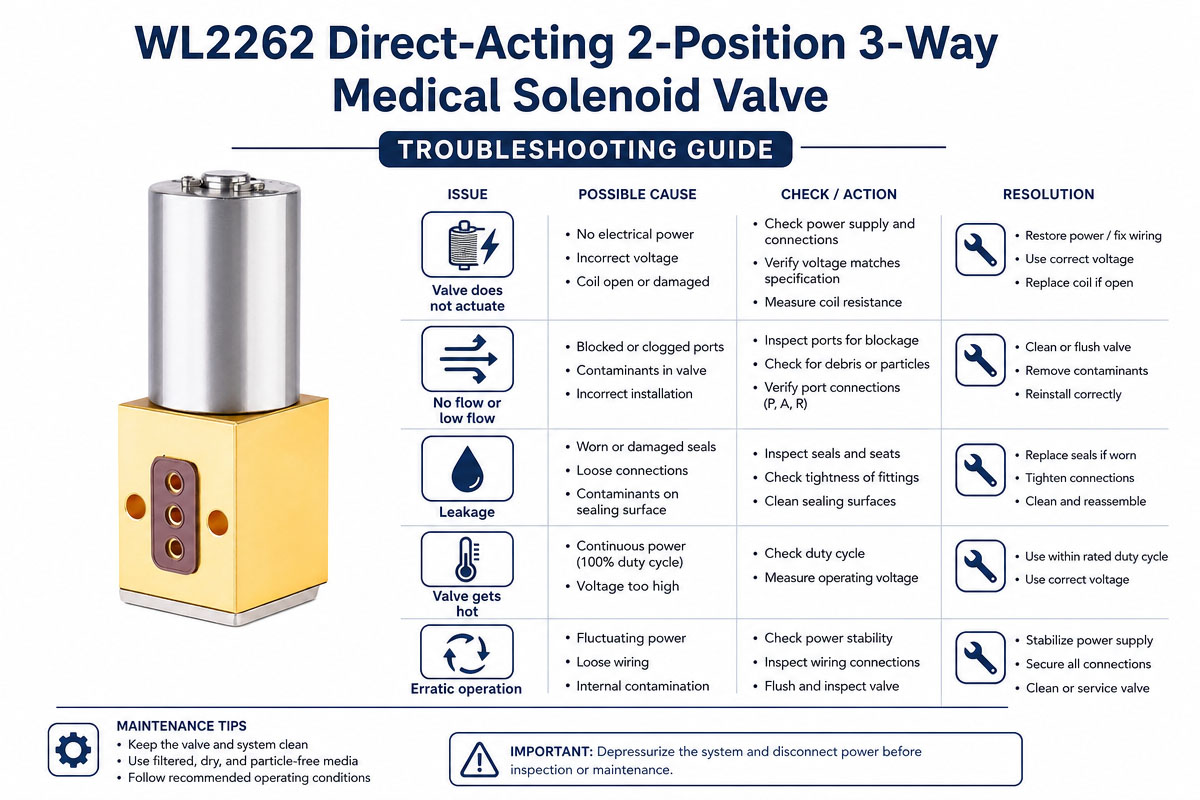
For example, the WL2262 valve is available in port sizes from 0.8 mm to 2.0 mm.
3. Verify Pressure and Vacuum
Check:
max inlet pressure,
NC Pressure,
NO Pressure,
operating pressure at minimum,
vacuum (stage).
The allowable pressure will vary significantly depending on port size and flow direction.
4. Electrical Configuration Confirmation
Confirm:
rated voltages,
AC or DC,
Now,
power of coil,
duty cycle,
connector or lead wire type.
For example, the WL2262 valve is DC24V and 4W.
5. Check Temperatures
Consider both of them:
ambient temperature and media temperature.
The valve seal, body, coil insulation, and surrounding materials should operate within the specified temperature range.
6. Leakage Requirements Check.
Leakage is a very important issue for medical and analytical systems. Determine the allowable leakage and choose the valve.
The example specification says:
Leakage < 0.002 ml/min
7. Mechanical Integration Check:
dimensions and weight,
orientation of ports,
holes for mounting,
tube link,
installation clearance,
orientation of coil
8. Verify Switching Requirements
Discover:
turnaround time,
frequency switching,
life span,
noise specification,
time to keep,
duty cycle
9. Get Engineering Samples
Check before mass production:
system integration + temperature + switching + flow + leakage + pressure
The best valve is not always the cheapest one but the one providing stable performance in the entire equipment operation range.
How to Avoid Common Mistakes in the Design of Direct-Acting Medical Solenoid Valves
Mistake #1: Choosing a Valve Based On Port Size Only
The port size doesn’t mean the valve is good just because it’s of a certain diameter. Other factors are pressure, flow, media, leakage, and response requirements.
Mistake 2: Not considering the direction of pressure
Different ports of a three-way valve may have different allowable pressure ratings. Always check IN, NC, and NO pressure ratings.
Mistake 3: Choosing the wrong seal material
Compatibility of the seal depends on the actual media and temperature. FKM material can be suitable for many applications, but each case should be checked separately.
Mistake #4: Incorrect calculation of coil temperature
A solenoid is the device that converts electrical energy into magnetic force and heat. Calculate coil temperature using the actual duty cycle.
Mistake #5: Upgrading to a higher-power coil without checking heat.
Higher electrical power doesn’t mean better valve performance. Excessive power results in higher temperature, higher energy consumption, and additional strain on the surrounding components.
Mistake 6: Not considering vacuum performance
The valve designed for positive pressure applications may fail in vacuum applications.
Mistake 7: Not Checking For Leaks
Sometimes valve switches correctly but fail to meet equipment requirements due to excessive leakage.
Error 8: Not designing Valve taking installation into account
Mechanical design freeze. Consider tubing, mounting holes, orientation, connector position, and space available.
Mistake 9: Going from design to high-volume production
Don’t approve production tooling and large quantities until you have engineering samples and validation testing.
Error 10: Not Defining the Application with Supplier
The application specification allows the manufacturer to optimize the coil, plunger, spring, seal, port, and valve structure for the application rather than supply a standard off-the-shelf model.