Ferrite Loop Antenna Coil Future Development
Ferrite Loop Antenna Coil Design Considerations
Ferrite Loop Antenna Coil Quality Testing Guide
Ferrite Loop Antenna Coil for Wireless Systems
Ferrite Loop Antenna Coil Frequency Optimization
Industrial Ferrite Loop Antenna Coil Solutions
Ferrite Loop Antenna Coil Future Development
Ferrite Loop Antenna Coil Design Considerations
Ferrite Loop Antenna Coil Quality Testing Guide
Ferrite Loop Antenna Coil for Wireless Systems
Ferrite Loop Antenna Coil Frequency Optimization
Industrial Ferrite Loop Antenna Coil Solutions

WL0420 Ferrite Loop Antenna Coil Magnetic Core Design

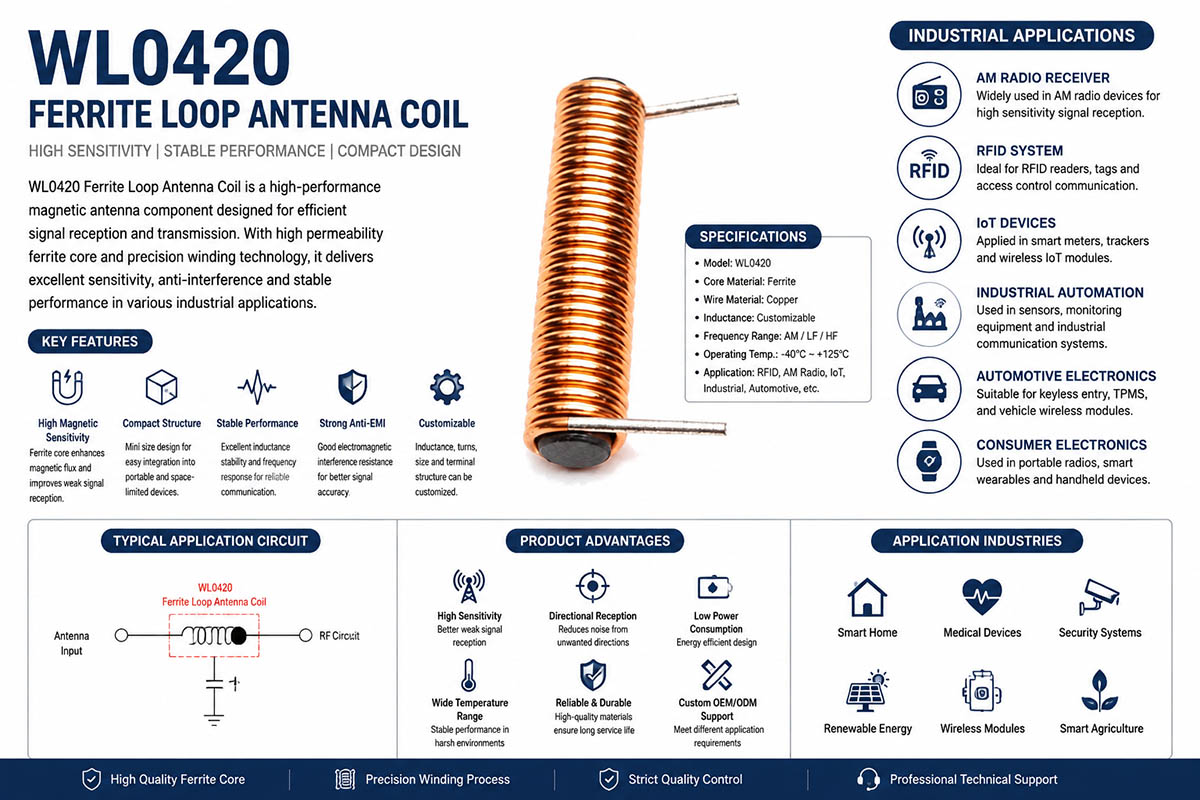
Ferrite Loop Antenna Coils are high performance magnetic components for efficient reception and transmission of electromagnetic signal. The winding is precision copper and the core is ferrite. Together they create highly sensitive magnetic circuit. The ferrite core improves the concentration of magnetic field, improves the signal strength and reduces the external interference. These antenna coils are widely used in AM radios, RFID readers, wireless communication systems, smart meters, industrial sensors and IoT devices. Compact in design, they are easily integrated into space-constrained electronic products. Ferrite loop antenna coils can be customized by manufacturers with different core materials, number of turns, size and frequency specification, to meet different application requirements. As the demand for smart communication and connected devices keeps growing, ferrite loop antenna coils remain an important solution for reliable wireless signal performance.

Ferrite Loop Antenna Coil Description

Ferrite Loop Antenna Coil A ferrite loop antenna coil is a magnetic antenna component which uses ferrite core and wire winding to transmit or receive the electromagnetic signal. Compared with the conventional air-core antennas, the ferrite core can improve the magnetic permeability and concentration of magnetic flux to strengthen the signal sensitivity. Ferrite loop antenna coils are widely used in AM radios, RFID systems, wireless communication equipment, sensors, IoT devices and industrial control systems. They are small in size, good in frequency characteristics and stable in performance, and can be used for the efficient reception of the electromagnetic signals. Custom ferrite loop antenna coils can be designed according to frequency range, inductance, size and electrical requirements.

How Does Ferrite Loop Antenna Coil Work?

How it works: The Ferrite Loop Antenna Coil converts the Electromagnetic waves into an electrical signal (by magnetic induction).

When radio frequency electromagnetic waves act on the antenna coil, they produce a changing magnetic field around the ferrite core. The ferrite core enhances the concentration of magnetic flux inside the coil winding, thus increasing the induced voltage and improving the receiving sensitivity.

Working process:

Reception of Signals

The external electromagnetic waves generate the change of magnetic flux around the antenna.

Concentration of magnetic flux

Ferrite core concentrates and intensifies the magnetic field in the coil.

Generation of voltage

The time-varying magnetic field generates an electrical signal in the copper winding.

Signal processing

The electronic circuit processes the received signal.

Ferrite loop antenna coils have directionality, high sensitivity and outstanding performance in small communication devices.


Ferrite Loop Antenna Coil

Ferrite Loop Antenna Detail Display

Ferrite Loop Antenna Coil Data Sheet

Item Description
Ferrite Loop Antenna Coil Enameled copper wire
Wire Diameter 0.2 (AWG options available)
Winding Type Single-layer round or sectional  winding
Core Material  Magnetic Rod
Footprint length 20 mm
Encapsulation Optional varnish, epoxy, or coating
Mounting Through-foot / Custom

Electrical Specifications (Typical)

Parameter Description
Inductance Range 0.1 µH – 50 µH (customizable)
Inductance Tolerance ±2%, ±5%, ±10%
DC Resistance (DCR) Custom
Q Factor High Q, optimized for frequency range
Self-Resonant Frequency High, application-dependent
Operating Frequency kHz to MHz range
Rated Current Custom per design
Insulation Resistance ≥50 MΩ

Why Ferrite Induction Coils Are Gaining Popularity

Ferrite induction coils are increasingly becoming popular in order to meet the demands of modern electronic systems for higher efficiency, smaller size and better energy management. Rapid growth of wireless charging, electric vehicles, renewable energy systems, IoT devices and smart electronics has increased the demand for advanced magnetic components.

Ferrite materials offer excellent high frequency performance, low energy loss and good electromagnetic control. Its compact design enables the manufacturers to produce smaller, more efficient products.

Industrial designers are attracted by the flexibility of adapting ferrite induction coils to many applications. With the development of electronic technology towards higher power density and energy efficiency, ferrite induction coils will be an important part of future electrical and electronic systems.

Ferrite Loop Antenna Coil Applications

Ferrite Loop Antenna Coil for IoT Applications

Ferrite Loop Antenna Coils are widely used in communication, sensing and electronic systems requiring reliable electromagnetic signal reception.

AM Radio Equipment

For AM radio receivers, ferrite loop antenna coils are a traditional solution as they provide high sensitivity and directionality of signal reception in a compact design.

RFID Systems

In RFID readers and tags, ferrite antenna coils are used to ensure efficient near field communication and stable signal transmission.

IoT Devices

Ferrite loop antenna coils are used in IoT devices to provide compact wireless communication solutions.

Industrial Automation

Ferrite antennas are used in industrial control systems in sensors, monitoring equipment and wireless communication modules where reliable signal performance is required.

Automotive Electronics

The coils of ferrite loop antennas are used in vehicle key systems, tire pressure monitoring systems and automotive communication devices.

Consumer Electronics

Small and highly sensitive ferrite antennas can be used in portable radios, smart devices and wearable products.

Due to the advantages of high magnetic performance, low power consumption and easy integration, ferrite loop antenna coils remain an important part of modern wireless electronic systems.

Ferrite Loop Antenna Coil Adv. & Disadv

Ferrite Loop Antenna Coil Manufacturing Process

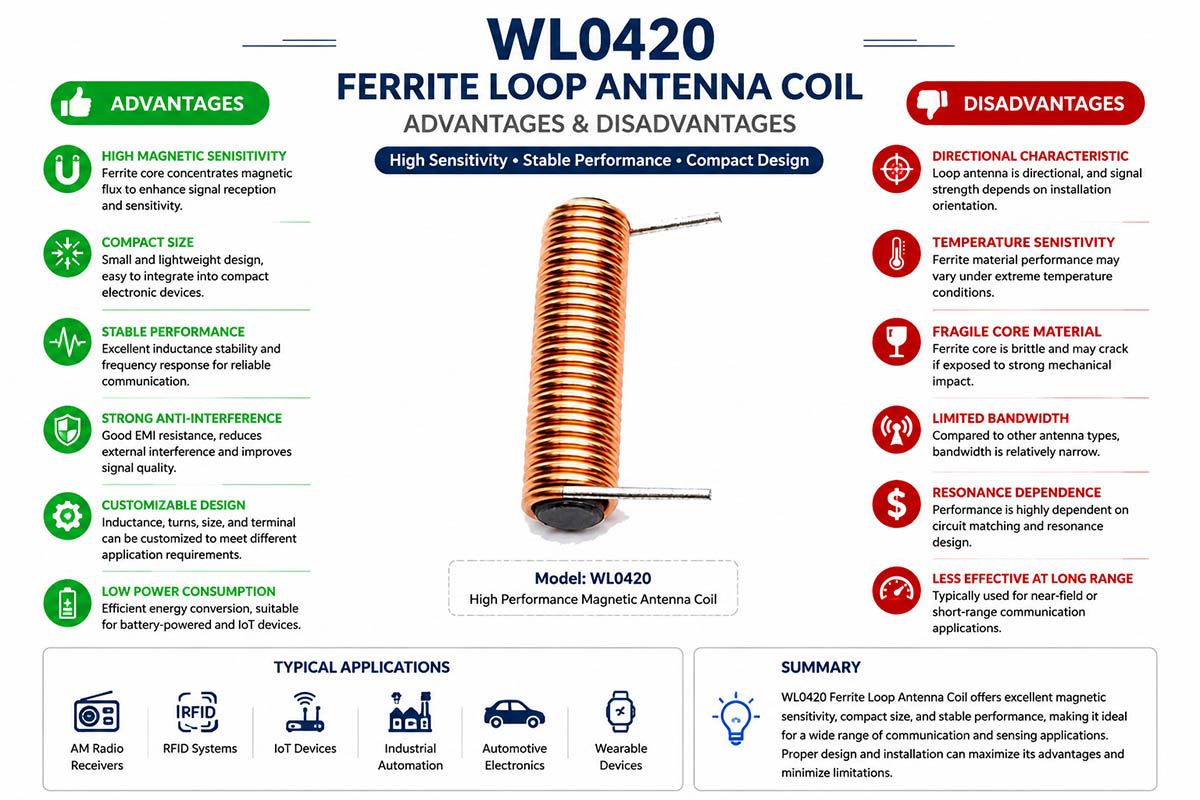
Advantages and Disadvantages of Ferrite Loop Antenna Coil

Advantages

Ferrite loop antenna coils are characterized with high magnetic sensitivity and compact size. The ferrite core increases the concentration of the magnetic flux and enhances the efficiency of the signal reception. They are characterized with low power consumption, good interference protection, and stable frequency performance. Their small size provides easy integration into portable electronics and embedded systems. The ferrite antenna coils are cheap and suitable for mass production.

They are reliable performers in RFID, AM radio, IoT sensors and wireless communication devices etc.

Disadvantages

Ferrite loop antenna coils also have certain limitations. Directional characteristic means that the installation orientation affects the signal performance. Ferrite materials are sensitive to mechanical stresses and can be fragile. Performance of these antenna coils may vary at extreme temperatures. In comparison with larger antenna systems, ferrite loop antennas have shorter communication distances.

Proper materials selection, circuit matching and mechanical protection can reduce these disadvantages and improve the performance.

Ferrite Loop Antenna Coil Signal Receiving Guide

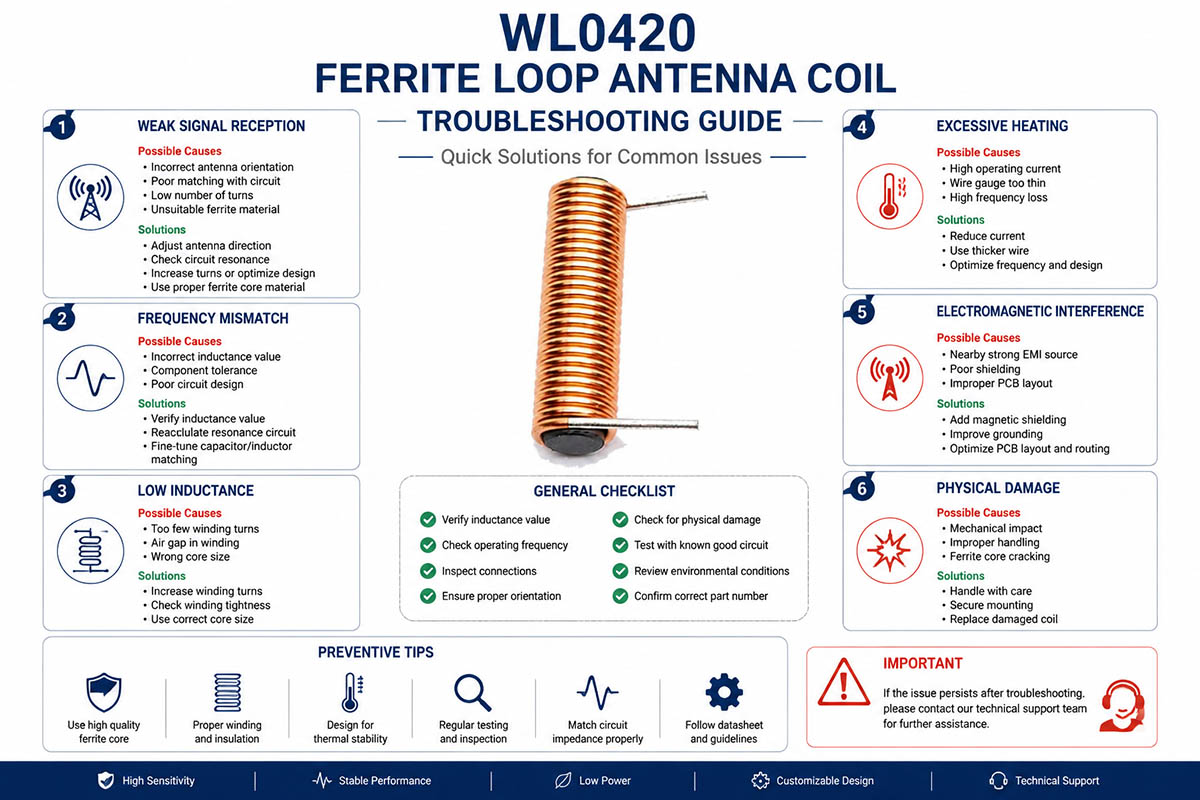
Troubleshooting of Ferrite Loop Antenna Coil

1. Bad Signal Reception

Reasons Possible:

Antenna direction Wrong
Bad coil match
Bad Ferrite Core

Solutions:

Modify the antenna orientation.
Resonant frequency check
Replace with appropriate ferrite material

2. Frequency Fluctuations

What could be the reasons:

Variation in temperature
Wrong inductance component tolerance

Solutions:

Enhanced thermal design
Check coil specifications
Use stable components

3. Reduced Sensitivity

Possible Causes:

Not enough winding turns
Wrong ferrite core size
Interference magnetic

Solutions:

Coil structure optimization
Improved shielding
Suitable core design selection

4. Too Much Interference

Possible Reasons:

Poor PCB layout.
External electromagnetic interference

Answers:

Better grounding Shielding

5. Injury to the Body

Possible reasons:

Mechanical shock Improper assembly

Solutions:

Enhanced protection
Enhanced installation procedure

Ferrite Loop Antenna Coil are tested regularly for inductance, frequency response, sensitivity and environmental performance.


FAQ

2. How does a Ferrite Loop Antenna Coil enhance signal reception?

High-permeability ferrite core helps to focus magnetic energy, thus enhancing the signal reception of the Ferrite Loop Antenna Coil. The ferrite core acts as an amplifier of the magnetic field passing through the winding when electromagnetic waves act on the coil and enhance the induced voltage. This design provides improved sensitivity, better noise immunity and better reception performance compared to conventional air-core antenna coils of the same size.

3. What are the benefits of Ferrite Loop Antenna Coils?

The main benefits are:


magnetic sensitivity

structure compact and light weight

fantastic frequency stability

low power usage

good interference resistance

simple integration into electronic products

inductance and dimensions, tailorable


These benefits make ferrite loop antenna coils suitable for portable devices, wireless communication systems and industrial electronics.

4. How to choose the correct Ferrite Loop Antenna Coil?

Choosing the right Ferrite Loop Antenna Coil

Operating frequency range

The inductance value required

Signal sensitivity

Ferrite core materials

Coil size limits

Installation direction

Temperature conditions

Application Process

For high performance designs, the engineers should also verify the resonance match, electrical parameters and manufacturer testing capability before mass production.

5. Are ferrite loop antenna coils adjustable?

Yes, ferrite loop antenna coils can be made for various product requirements. The manufacturers can change:

SIZE AND SHAPE OF FERRITE CORE

Number of turns in winding

Wire size

Inductance value

Frequency band

Structure end

Installation procedure

We also provide OEM and ODM service for RFID equipment, wireless modules, sensors and industrial applications.


6. Why does a ferrite loop antenna coil work badly?

The common reasons for poor performance are:


Wrong antenna direction

Poor frequency match

Wrong ferrite material

Poor winding design

Electromagnetic interference (external)

Poor PCB layout

Physical damage of the ferrite core

The solutions include optimizing the coil design, improving shielding, selecting the right ferrite material and application-level testing.


7. What is the difference between a normal antenna and a Ferrite Loop Antenna Coil?

A Ferrite Loop Antenna Coil uses ferrite magnetic core to increase the concentration of magnetic fields, whereas many conventional antennas use electric field radiation. Ferrite loop antennas are smaller, more directional and very helpful in near field magnetic communication applications. They are especially suitable for the situations requiring compact size, low power consumption and stable signal reception.

8. Why Ferrite Loop Antenna Coils are popular in the modern electronics?

Ferrite Loop Antenna Coils become more and more popular as modern electronic products require smaller, more efficient and reliable wireless components. Due to their compact design, high sensitivity, low energy consumption and excellent electromagnetic performance, they are suitable for IoT devices, RFID systems, smart meters, automotive electronics and wireless communication products. Custom manufacturing allows the engineers to integrate them in various advanced electronic applications.

How to Choose a Ferrite Loop Antenna Coil?

“Choosing the right Ferrite Loop Antenna Coil requires careful evaluation of electrical performance, application requirements and environmental conditions.

1. Find Operating Frequency

First thing is to define the required frequency range. Different ferrite materials have different magnetic properties so the proper core material selection is required to ensure the best sensitivity and signal response.

2. Check Inductance Needs

Inductance affects circuit matching and resonance frequency. The antenna coil is to be matched to the receiving circuit for the strongest signal.

3. Consider the Type of Ferrite Material

There are different ferrite materials such as MnZn and NiZn, they differ in frequency characteristics. The appropriate material should be selected according to the frequency band, sensitivity and environment of use.

4. Assess Coil Size

The physical size should be suitable for the product structure. Small coils are suitable for small devices, while large coils may provide improved sensitivity.

5. Sensitivity analysis of Signals

For applications requiring long distance or weak signal reception, the antenna coils with high magnetic sensitivity are required.

6. Environmental Conditions Evaluation

Antenna performance may be influenced by temperature variations, vibrations and humidity. Products with the right reliability specifications should be selected.

7. OEM Customization Capabilities

For special applications, manufacturers should provide the customization options including:

Dimensions of core
Diameter of wire
Number of turns Inductance value
Terminal design

8. Quality Control

Good vendors should provide electrical tests, frequency tests, inductance measurement and performance verification.”

Selection of the right ferrite loop antenna coil will improve the reliability of communication, reduce interference and ensure stable performance of the product.

Tips for Avoiding Common Ferrite Loop Antenna Coil Design Mistakes

1. Wrong ferrite material selection

The wrong material choice can result in low sensitivity and high signal loss.

2. Poor Frequency Matching

The wrong inductance value can lead to poor signal reception and resonance problems.

3. Antenna Orientation Neglect

Directional ferrite loop antennas performance depends on the installation position.

4. Wrong coil winding design

Improper winding turns or spacing can influence the efficiency of the antenna.

5. Neglecting EMI Protection

External interference can affect the signal quality.

6. Selecting the wrong size

If the coil is too small, it may not be sensitive enough.

7. Not doing prototype testing

Product testing is necessary for verifying the performance of the application.

8. Low Quality Ferrite Material

Wrong materials may result in unstable frequency characteristics.

Get A Free Quote Now

Contact Form

Related Products

Related News

Scroll to Top

Get A Free Quote Now !

Contact Form
If you have any questions, please do not hesitate to contact us.
Weilong Solenoid Company Culture