Ferrite Induction Coil for Automotive Electronics
Ferrite Induction Coil Manufacturing Challenges
Ferrite Induction Coil Quality Control Requirements
Ferrite Induction Coil Thermal Performance Analysis
Ferrite Induction Coil for Power Conversion Systems
Ferrite Induction Coil for Smart Electronic Products
Ferrite Induction Coil for Automotive Electronics
Ferrite Induction Coil Manufacturing Challenges
Ferrite Induction Coil Quality Control Requirements
Ferrite Induction Coil Thermal Performance Analysis
Ferrite Induction Coil for Power Conversion Systems
Ferrite Induction Coil for Smart Electronic Products

WL0415 Ferrite Induction Coil for Industrial Power System Solutions

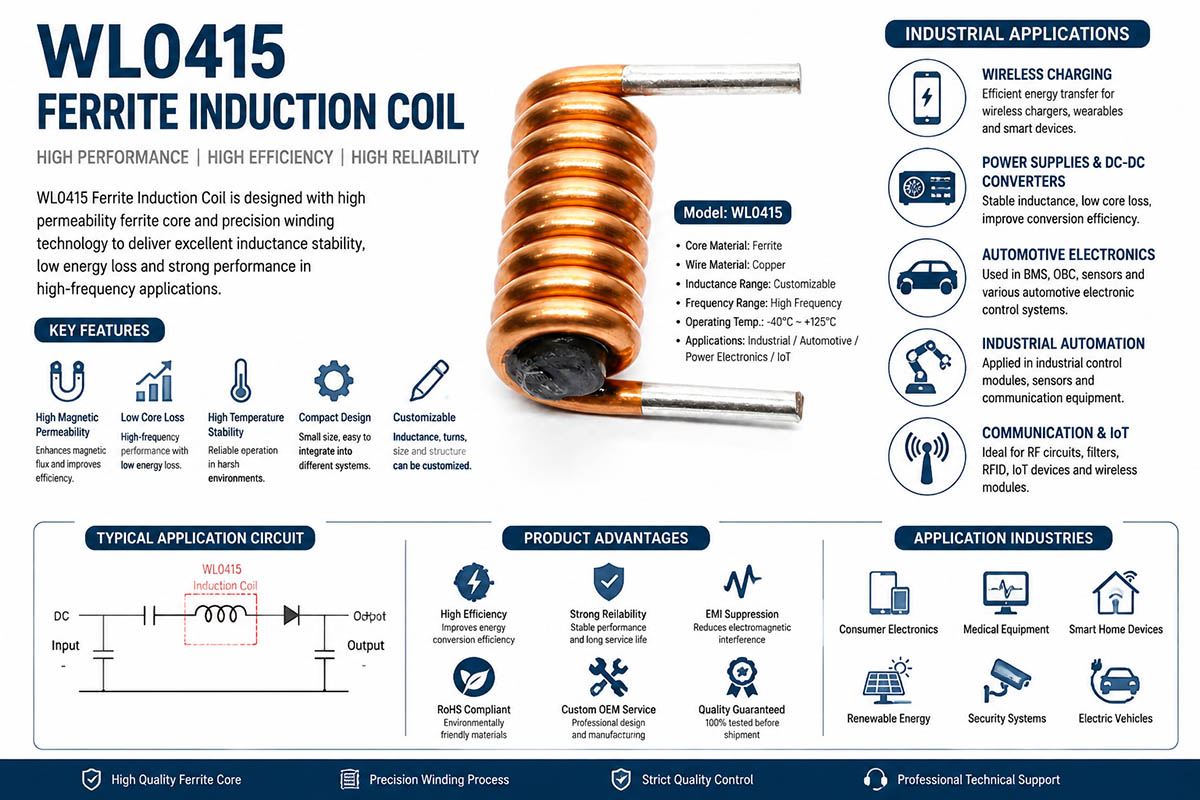
Ferrite induction coils are advanced magnetic components used in converting electromagnetic energy effectively. With ferrite core and precise winding technology, the coils have excellent inductance stability, low power loss and advanced magnetic field control. Ferrite induction coils are used in power supplies, wireless chargers, electronic sensors, communication systems and industrial automation equipment. Ferrite materials have high magnetic permeability and low eddy current loss, making them ideal for high-frequency applications. Custom-made ferrite induction coils can be fabricated in different core shapes, wire types, sizes and electrical specifications. With increasing demand for energy-efficient electronic products, ferrite induction coils continue to be significant in modern electrical and electronic technologies.

Ferrite Induction Coil Description

A ferrite coil is an electromagnetic component using a ferrite core and conductive coils to transmit magnetic energy effectively. A ferrite core increases the magnetic flux concentration and lowers the energy loss. Ferrite induction coils are used in power conversion, wireless charging, sensors, RFID systems, automotive electronics, and industrial control equipment. High permeability, good frequency characteristics, and compact structure make ferrites suitable for applications needing stable inductance and efficient electromagnetic performance. Manufacturers can make ferrite induction coils to customer specification depending on the size, frequency, power, and electrical requirements.

How Does a Ferrite Induction Coil Work?

The working principle of a ferrite induction coil is electromagnetic induction. When the coil winding connects to an AC source, a changing magnetic field is generated around the ferrite core. The ferrite core concentrates and directs the magnetic flux, thus increasing the inductance and improving energy transfer efficiency.


Ferrites have low magnetic losses at high frequencies than the traditional metal cores. In case the magnetic field interacts with other coils or circuits, it can transfer energy. This is known as electromagnetic coupling.

The process involves;

  • Current flows through the coil winding
  • Ferrite core produces the magnetic flux
  • Ferrite core concentrates the magnetic field
  • The magnetic field temporarily stores energy
  • Whenever required, the magnetic energy converts to electrical energy

This principle explains why ferrite induction coils can be used to convert, filter, sense and transmit energy wirelessly.

Ferrite Induction Coil Video

Ferrite Induction Coil Detail Display

Ferrite Induction Coil Technical

Item Description
Ferrite Inductor Coil Enameled copper wire
Wire Diameter 0.2 (AWG options available)
Winding Type Single-layer round or sectional winding
Core Material Magnetic Rod
Footprint length 15mm
Encapsulation Optional varnish, epoxy, or coating
Mounting Through-fool / Custom

Electrical Specifications (Typical)

Parameter Description
Inductance Range 0.1 µH – 50 µH (customizable)
Inductance Tolerance ±2%, ±5%, ±10%
DC Resistance (DCR) Custom
Q Factor High Q, optimized for frequency range
Self-Resonant Frequency High, application-dependent
Operating Frequency kHz to MHz range
Rated Current Custom per design
Insulation Resistance ≥75 MΩ

Why Ferrite Induction Coils Are Gaining Popularity

Ferrite induction coils are increasingly becoming popular in order to meet the demands of modern electronic systems for higher efficiency, smaller size, and better energy management. Rapid growth of wireless charging, electric vehicles, renewable energy systems, IoT devices, and smart electronics has increased the demand for advanced magnetic components.

Ferrite materials offer excellent high-frequency performance, low energy loss, and good electromagnetic control. Its compact design enables the manufacturers to produce smaller, more efficient products.

Industrial designers are attracted by the flexibility of adapting ferrite induction coils to many applications. With the development of electronic technology towards higher power density and energy efficiency, ferrite induction coils will be an important part of future electrical and electronic systems.

Ferrite Induction Coil Applications

Ferrite Induction Coil OEM Customization Solutions

Because of their excellent magnetic properties and high-frequency performance, ferrite induction coils are extensively used in many industrial and electronic applications.

In wireless charging systems, ferrite induction coils are used to concentrate the magnetic flux between the transmitter and receiver coils to improve the energy transfer efficiency. They can be found in smartphones, electric vehicle chargers and consumer electronics.

Ferrite induction coils are used in power electronics in transformers, DC-DC converters, switching power supplies and filtering circuits. Their low core loss helps increase system efficiency and minimizes heat generation.

In automotive electronics, the coils are used in battery management systems, electric vehicle charging modules and sensors and control units which need stable electromagnetic performance.

Ferrite induction coils are used in proximity sensors, monitoring devices, communication systems and control equipment in the field of industrial automation.

Ferrite coils ensure reliable signal transmission and reception performance in RFID and communication equipment.

Other applications include medical devices, smart devices, IoT products, security systems, and energy harvesting devices. Demand for smaller and more efficient electronic systems is driving the increasing use of ferrite induction coils in industry.

Ferrite Induction Coil Applications

Ferrite Induction Coil Future Market Development

Advantages and Disadvantages of Ferrite Induction Coil

Advantages

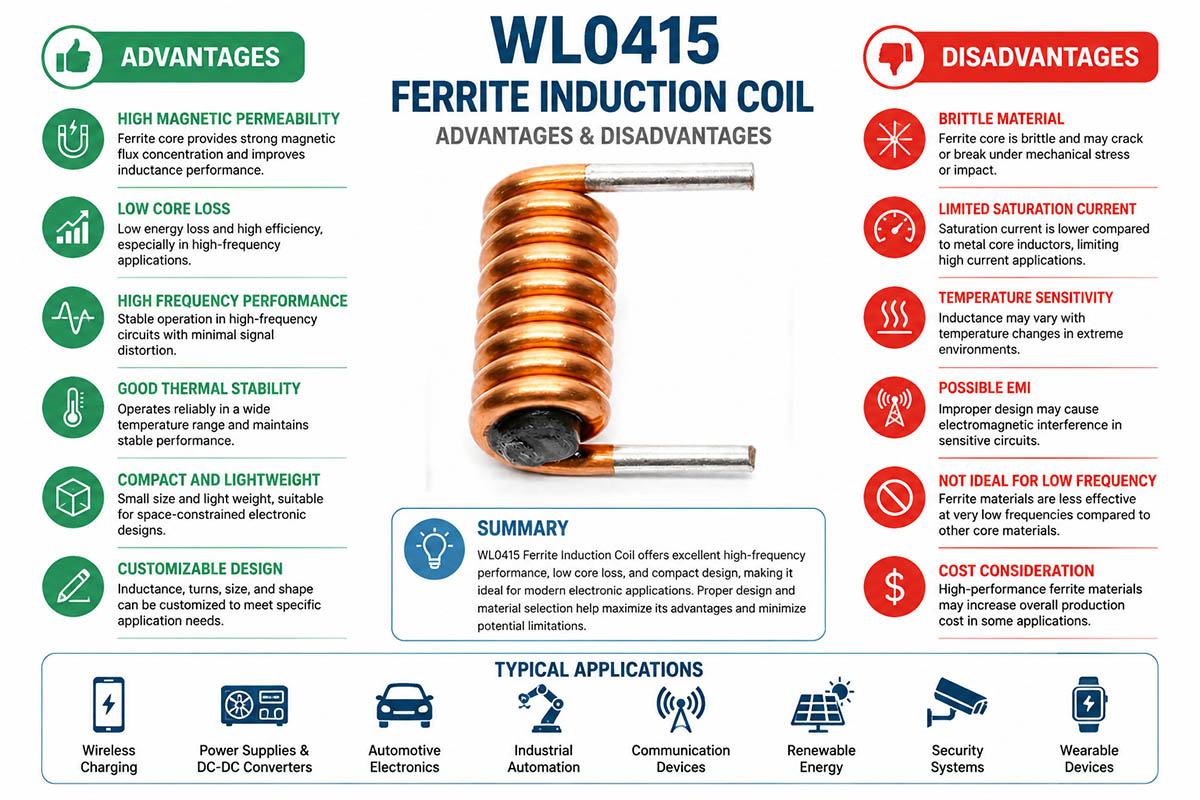
Ferrite induction coils have some advantages for modern electronic applications. The high magnetic permeability is favorable for the magnetic field concentration and the energy transfer efficiency. Ferrite cores are favorable for high frequencies since they have low eddy current losses. They are lightweight, compact, and have excellent electrical insulation. Ferrite induction coils have excellent temperature stability and can be designed to suit different applications.

This makes them favorable in sensitive electronic systems, where they can reduce electromagnetic interference. They are popular because they are reliable and inexpensive to produce.

Disadvantages

However, ferrite induction coils have some disadvantages despite their advantages. Ferrite materials are fragile and prone to cracking when subjected to mechanical stress. This limits maximum current handling capability because of their magnetic saturation characteristics. Wrong material selection can reduce efficiency at some frequencies. At some applications, ferrite coils may have lower magnetic strength than some metal-core solutions.

Proper design, material selection, and testing can minimize these disadvantages and ensure reliable operation.

Custom Ferrite Induction Coil Manufacturer Guide

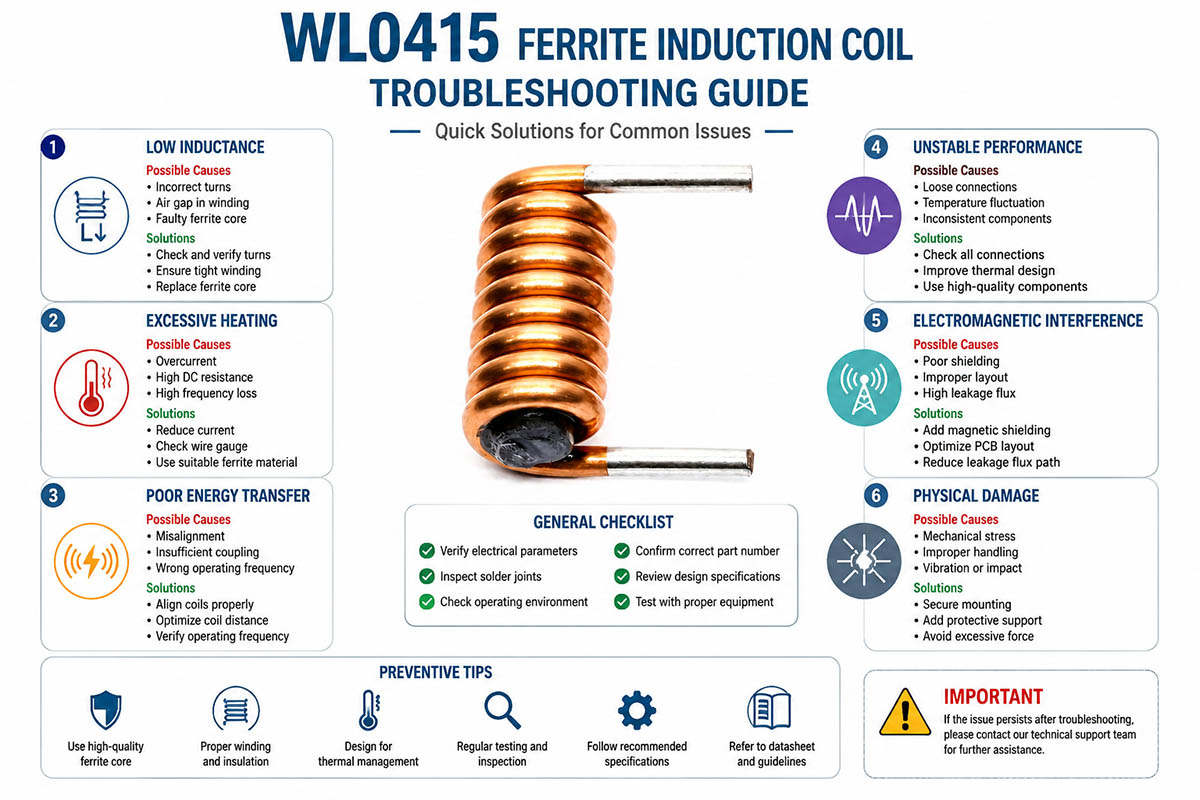
Ferrite Induction Coil Troubleshooting 1. Low Inductance Figure

Possible causes: wrong number of winding turns, damaged ferrite core, wrong core material.
Solution: Consider winding specifications and replace incompatible parts.

2. Overheating

Possible Causes: Overcurrent, high resistance, or high-frequency loss.
Solution: Select a suitable ferrite material or reduce the operating current.

3. Poor Energy Transfer

Possible causes: Misalignment of coils, poor magnetic coupling, or design.
Solution: Optimize coil position and magnetic structure.

4. Performance Not Steady

Causes: Material variation, changes in temperature, and manufacturing defects.
Solution: Quality control, stable ferrite material.

5. Electromagnetic Interference Issues

Possible Causes: Poor shielding, poor placement of coil.
Solution: Increase shielding measures and optimize layout design.

Routine testing of inductance, resistance, temperature, and frequency response will facilitate prompt identification of potential problems and ensure reliable performance of ferrite induction coils.

FAQs On Ferrite Induction Coil

1. What is ferrite induction coil?

A ferrite induction coil is used for electromagnetic energy conversion, signal transmission, filtering, and wireless energy transfer. Widely used in wireless charging devices, power supplies, transformers, RFID systems, sensors, automotive electronics, and industrial control equipment. Helps to increase magnetic flux concentration, reduce energy loss, and improve efficiency of the coil in high-frequency applications.

2. Why ferrite material is used in induction coils?

Ferrite is used in induction coils because of its high magnetic permeability, low electrical conductivity, and low eddy current loss. These features allow working effectively at high frequencies with minimal heat generation and power losses. Ferrite cores are applied to control magnetic fields and improve electromagnetic compatibility in electronic systems.

3. How does a ferrite coil improve energy efficiency?

A ferrite core induction coil increases energy efficiency by concentrating the magnetic flux into the ferrite core. This increases inductance and electromagnetic coupling between components. Low core loss characteristics of ferrite materials not only reduce wasted energy but also improve the energy efficiency of devices such as wireless chargers, power converters, and energy transfer systems.

4. What are the key factors in choosing a ferrite induction coil?

There are many factors including inductance value, operating frequency, current rating, ferrite material, coil size, temperature range, power requirements and installation space. The application conditions including electromagnetic interference, mechanical environment and reliability requirement also should be considered. Proper selection of ferrite induction coil ensures stable performance and long product life.

5. Can ferrite induction coils be customized?

Yes, ferrite induction coils can be designed and modified to fit the requirements of certain applications. Specifications such as core geometry, number of turns of wire in each coil, wire gauge, inductance value, operating frequency, size, and mounting are available to be specified. OEM and ODM customization can help designers to customize ferrite induction coils for industrial equipment, automobile systems, wireless chargers, and special electronic devices.

6. What are the common problems of ferrite induction coils?

Typical problems of ferrite induction coils include incorrect inductance values, overheating, unstable performance, low energy transfer efficiency, and electromagnetic interference. These issues can be caused by incorrect selection of materials, excessive current, improper design of winding, and wrong installation. Proper electrical testing, thermal analysis, and quality control can prevent most of the failures of the ferrite induction coils.

7. What is the difference between air-core induction coils and ferrite?

Air-core coils do not have any magnetic core, so the magnetic medium of the coil is just air. Ferrite induction coils have a magnetic ferrite core, which allows increasing inductance and magnetic flux concentration. Compared to air-core, ferrite induction coils have higher inductance, better energy transfer efficiency, and high-frequency performance. In some applications, an air-core coil is preferred because of lower distortion and a simple design.

8. What are the advantages of ferrite induction coils in industrial applications?

Since the electronics industry requires compact, efficient, and reliable electronic components, ferrite induction coils have become increasingly popular. Due to high-frequency performance, low energy loss, compact size and good electromagnetic properties, they can be widely applied in modern applications such as electric vehicle, renewable energy systems, automation equipment, IoT device and wireless power technology.

Choosing a Ferrite Induction Coil

While choosing the appropriate ferrite induction coil, it is important to consider electrical performance, operating environment, and application requirements.

1. Determination of Operating Frequency

The important factor is 1. Working frequency. Ferrite materials have different frequency characteristics. Thus, a core material that is suitable for the frequency range should be selected. For high-frequency applications, ferrite materials with low core loss are required.

2. Verification of inductance requirements

The inductance value greatly affects the performance of the circuit. Engineers should select the coils having appropriate inductance according to circuit design, voltage, current, and power requirements.

3. Consideration of Current Capacity

The coil should be able to handle the operating current safely. The appropriate wire diameter and winding configuration should be selected.

4. Selection of Ferrite Material

The magnetic characteristics differ with the type of ferrite material. MnZn ferrite is normally used for lower-frequency power applications, while NiZn ferrite is used for higher-frequency applications.

5. Consideration of Size and Installation Space

The physical dimensions, mounting, and weight shall comply with the product design requirements.

6. Check Temperature Behavior

Industrial environments are characterized by high temperatures. Coils with stable thermal characteristics and proper insulation materials should be selected.

7. Consider Customization Requirements

Custom OEM applications have requirements for winding techniques, core configuration, terminals, or electrical specifications.

8. Check Quality Standards

Reputable suppliers should provide testing reports, inductance measurements, insulation tests, and performance verification.

Choosing the appropriate ferrite induction coil enhances efficiency, reduces losses, improves product reliability, and increases system life.

Tips to Avoid Common Mistakes during Ferrite Induction Coil Design: Ignore Frequency of Operation

Choosing the wrong ferrite material can result in excessive losses and poor efficiency.

Inductance Calculations Incorrect

Wrong inductance choices can affect the stability of the circuit and power performance.

Thermal Management: No concern

Failure to consider enough heat can reduce coil lifetime.

Wrong Wire Gauge

Thin wires can cause excessive resistance and heating problems.

Poor Magnetic Shielding Design

Lack of adequate shielding can increase electromagnetic interference.

Disregarding Mechanical Requirements

Coil configuration should suit installation conditions and vibration environment.

Prototype Testing Skip Step

Testing helps to identify performance issues before mass production.

Using Low-Quality Materials

Bad ferrite cores can cause unstable performance and higher losses.

Get A Free Quote Now

Contact Form

Related Products

Related News

Scroll to Top

Get A Free Quote Now !

Contact Form
If you have any questions, please do not hesitate to contact us.
Weilong Solenoid Company Culture