

Chapter 1 :Introduction on overheating in electromagnets
Electromagnets and solenoids are the must-have components in countless applications – from automotive and medical devices to robotics, locks, and big machines. They provide excellent mechanical motion through converting electrical energy into the mechanical one. At the same time, one of the most frequent challenges that both engineers, technicians and users face regularly – electromagnets overheat.
Have you ever tried to use your electromagnet and have realized that it becomes too warm in a matter of minutes, whereas the magnetic force slowly fades out? Indeed, it is one of the most widespread questions. However, why do they usually overheat? What causes the problem? And how can it be prevented from happening? These and many more questions are discussed in this detailed article.
Chapter 2 : Why Do electromagnets Heat Up Quickly and Lose Force During Use?
Many users of the electromagnets notice the rapid heating and fading of magnetic force. It is quite a dangerous phenomenon, and you need to take care of it.
2.1 The Dangers of Overheating
Overheating can bring plenty of damages to your solenoid:
- The insulation coating burns, which causes short circuits and total failure of the entire coil.
- The material ages, which means that its quality decreases.
- The lifetime of the insulation system reduces twice per 10 degrees increase above the rated operating temperature.
- The coil can actually become burnt and even catch on fire.
- The increased resistivity of the copper increases and causes magnetic field decrease.
Therefore, it is highly important to keep track of the temperature of your electromagnet and control it.
2.2 What Causes Electromagnet Overheating?
The basic principle of overheating is when I²R losses surpass the heat dissipated by the surroundings. However, there are some factors that are distinguished from one another:
2.3 Circuit Failures
First of all, circuit failures are the most widespread cause of the overheating problem:
- The circuit interruptions occur due to broken wires, poor connections and loose solder points.
- Poor contact because of the corrosion or loose connections causes excessive heat generation.
- Insufficient wire gauge results in increased resistivity and therefore the heat.
2.4 Excessive Loading
Each electromagnet has certain load parameters, and exceeding of them leads to:
- Increase in the current to generate the required force.
- The I²R heat generation increases because of that.
- Continuously working at the overload conditions causes the temperature to exceed the allowed values.
Such situation usually happens when the load changes or when the wrong solenoid is selected.
2.5 Poor Cooling System Design
Usually the cooling system of the electromagnets is passive convection or conduction. The poor cooling occurs when:
- The housing is closed.
- The ventilation is impossible.
- The radiation and convection cooling is limited.
- The proximity of the heat generating elements adds additional heat.
2.6 High Voltage Conditions
Surprisingly enough, both high voltages and low voltages can cause the overheating:
- The overvoltage conditions are the case when the voltage generates the additional current to flow through the coil. The plunger closes with additional power, but the holding current remains too high and therefore it overheats the coil and burns the insulation.
- Undervoltage conditions do not allow the plunger to seat fully, which means that the coil is still in the high-current state (the pull-in).
2.7 Mechanical Damage
It is obvious that physical problems cause overheating of the device:
- Hammering effect occurs when the plunger strikes the C-stack or field with the extra power, caused by overvoltage or low load.
- The cracked core, misaligned plunger or broken bearings cause extra friction and misalignment, which makes the operation harder and generates additional heat.
Chapter 3: Understanding Duty Cycle and Its Relationship with Overheating
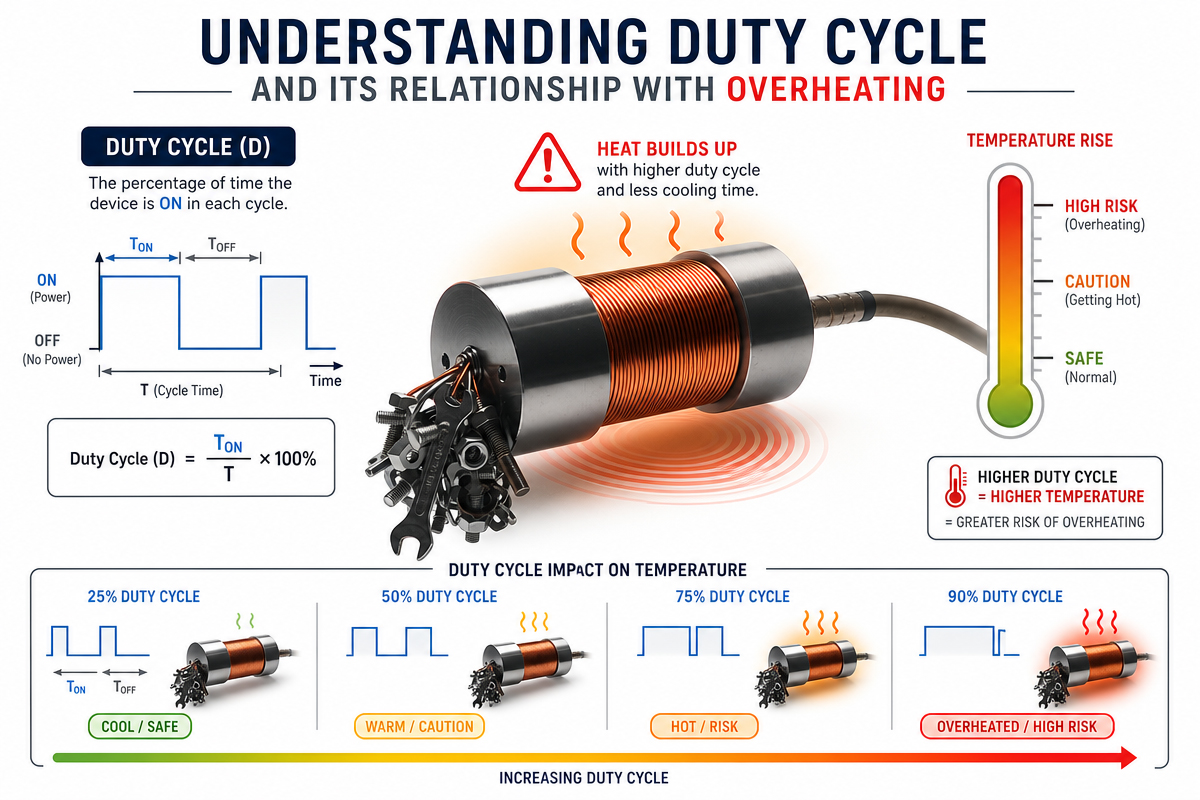
One of the most important, but often misunderstood factors affecting electromagnet overheating is duty cycle. Most of the overheating problems can be caused by the mismatch between duty cycle of the solenoid and the actual usage conditions.
3.1 What Is Duty Cycle?
Duty cycle is the ratio of “on” time to the total time, expressed in percent:
Duty Cycle (%) = (On Time / Total Time) × 100
For instance:
- The electromagnet works for 2 seconds and stops for 8 seconds. In this case duty cycle is 2/(2+8) = 20%.
- It operates constantly, which means the 100% duty cycle.
How Duty Cycle Affects Temperature
The dependence of duty cycle and temperature is quite straightforward:
3.2 Common Duty Cycle Mistakes
- You assume that continuous-duty solenoid can work intermittently, but not vice versa.
- You forget about the cumulative effect – even with low duty cycle, if the “off” period is too short for the cooling, heat accumulates.
- You ignore the ambient temperature – the solenoid rated at 20% duty at 25°C may require significant derating at 60°C.
3.3 How to Match Duty Cycle to Your Application
- Calculate the exact duty cycle according to the actual usage.
- Select the solenoid with duty cycle higher than yours by 20-30%.
- You may consider using the pulse width modulation to get high holding force with less current.
- Include the thermal protection such as thermostats or PTC thermistors cutting the power if the temperature becomes too high.
Chapter 4: How to Deal with the Overheating of an Electromagnet
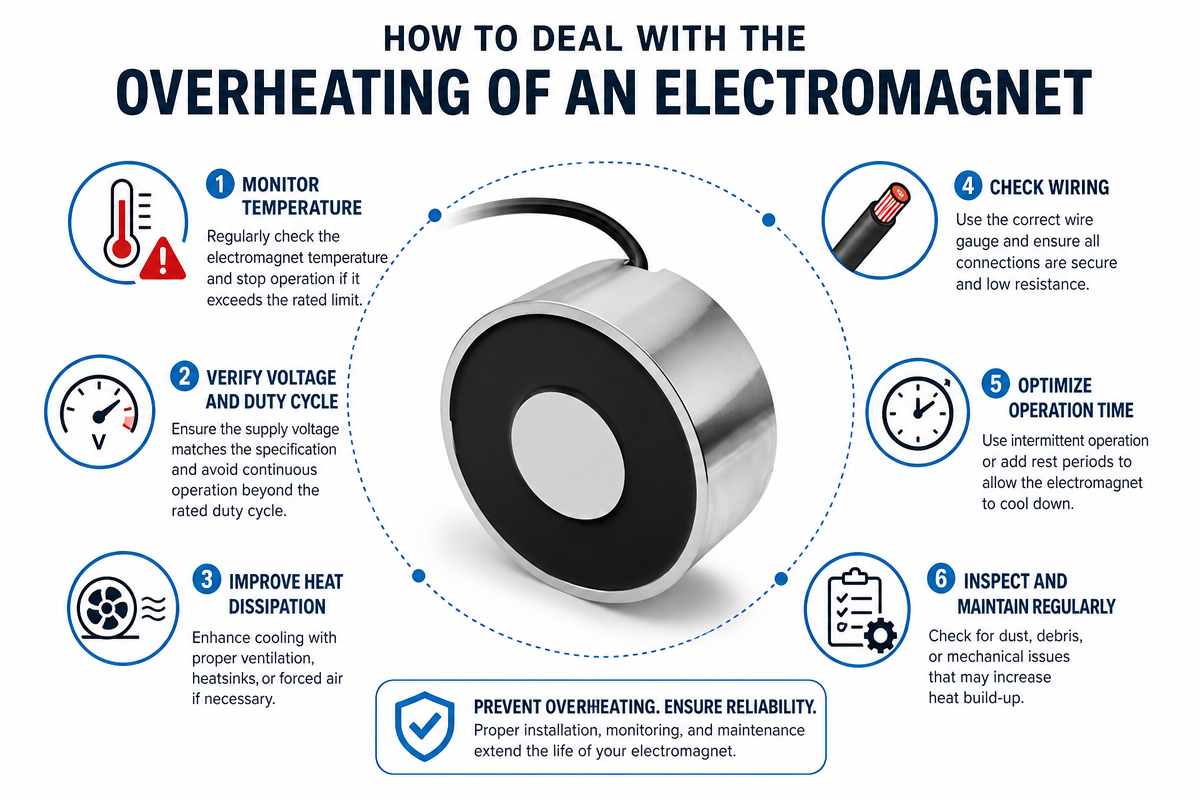
There are the best possible ways to deal with the overheating of your electromagnet if it has occurred. First of all, follow these troubleshooting measures:
4.1 Check the Wiring and Connections
Start with simple measures:
- Inspect all connections. Make sure they are tight and do not suffer from corrosion.
- Make sure that the cross-sectional area of the wiring matches the requirements. Otherwise, it is the main cause of resistance heating.
- Look for any damage in the wiring such as cracks or melting insulation.
Pro Tip: You should use thermal cameras or infrared thermometers during operation in order to identify hot spots in the wiring.
4.2 Reduce Loading
If the electromagnet operates continuously at overload:
- Reduce mechanical load by adjusting the driving mechanism.
- Decrease the duty cycle.
- Replace the electromagnet if you cannot reduce the load.
When you select the new solenoid, make sure that it is rated to operate at least 20-30% higher than the worst-case load.
4.3 Improve Cooling
The thermal management can reduce the overheating considerably:
- Passive cooling – make sure that there is enough ventilation near the solenoid. The mounting place should provide good air circulation.
- Active cooling – for hard conditions, use forced air cooling (fans), liquid cooling (water jacket) and even thermoelectric coolers.
- The thermal interfaces should be used in order to improve heat dissipation from the coil to the housing.
4.4 Improve the Working Environment
Sometimes the problem is not with the solenoid, but with the working environment:
- The ambient temperature – if it is higher than the rated temperature of the solenoid, then it will cause the overheating regardless of its normal operation. You should either move the device or cool down the environment.
- The power supply conditions – fluctuating or “dirty” power (voltage sags, spikes and harmonics) causes the abnormal and thermal stressful operation of the electromagnet. The regulated power supplies and line conditioners should be used.
- Work pressure – in the pneumatic or hydraulic systems, the excessive working pressure will add the load to the solenoid.
4.5 Fix the Problems Related to Solenoid Coils
If the coil is responsible for the problem:
- Make sure that the specifications are correct. The voltage, current and duty cycle of the coil must correspond.
- Identify shorted turns by measuring them with the multimeter.
- Replace the coil in case of any failures or defects.
Chapter 5: Our Solutions to Prevent Electromagnet Overheating
Having more than 20 years of practice in the DC solenoids design and manufacturing, we can offer you a comprehensive solution that will help to prevent the problem. Our approach to the design includes 5 following items:
5.1 Strengthen Insulation Systems
The insulation of the solenoid should be strong enough:
- We use the highest quality insulating materials, such as class H (180°C) and even better insulation materials.
- We add the double or triple insulation layers if it is necessary.
- The insulating gaskets and tapes are installed in the required places.
5.2 Optimize Circuit Design
The optimized circuit reduces the thermal stresses:
- The matching values of the resistance and inductance are calculated and used.
- The voltage regulation and current limiting are provided.
- There is the effective grounding to reduce noise and prevent parasitic currents.
5.3 Reduce Operating Temperature through Intelligent Control
We focus on the root of the problem rather than its consequences:
- All designs go through strict thermal testing in the worst conditions.
- The power management is implemented in case of possibility – pulse-width modulation or similar technique.
- The duty cycle is optimized for the intermittent operation.
5.4 Reduce Electromagnetic Interference (EMI)
We also pay much attention to the EMI, because it is not only a performance factor, but a cause of the overheating:
- The shielding covers are used to protect the solenoid from the external electromagnetic fields.
- The isolation devices are included to isolate the sensitive parts from the noisy ones.
- The careful power and control lines routing minimize the crosstalk and induced currents.
5.5 Rigorous Testing and Validation
Testing and validation are important stages for us:
- The lifespan testing is made for all designs (we often conduct more than hundred thousand cycles simulation).
- Each item is tested and checked against the specifications.
- All arising problems are analyzed and corrected immediately.
📌 For more information about our design philosophy of the solenoid tempterature, you can read our technical guide dedicated to the DC Solenoids.
Chapter 6: Key Tips to Avoid the Most Common Electromagnet Design Errors
Over the years, we have noticed several design errors resulting in overheating problems. Here are our key tips to avoid those common pitfalls:
Tip 1: Do Not Over-size the Voltage
The first thing many people do to increase the speed of reaction or increase force is over-sizing the voltage.
Why it is bad: Higher voltage produces higher current (I = V/R) and therefore higher power losses and heat dissipation (P = V²/R). 20% over-voltage leads to 44% more heat!
What to do: Use the nominal voltage. If speed is an issue, consider solenoids specifically designed for such applications.
Tip 2: Do Not Neglect the Thermal Time Constant
Many people consider temperature increase to happen instantly. In fact, each solenoid has the so-called thermal time constant – the time required to reach 63.2% of the final temperature.
Why it is bad: If your “on” time is shorter than the thermal time constant, your solenoid will never reach thermal equilibrium. On the other hand, if your “on” time is much longer than thermal time constant, the temperature will rise much faster.
What to do: Determine the thermal time constant of your solenoid (normally it is around 5-20 min for small solenoids; bigger ones might have much higher time constant) and design your duty cycle properly.
Tip 3: Take Into Account Ambient Temperature Derating
Nominal characteristics are normally given for 20-25°C ambient.
Why it is bad: At 50°C ambient, the maximum temperature raise until reaching the maximum allowable temperature is limited by 25-30°C. So, you can literally make your nominally designed solenoid fail!
What to do: You should derate your solenoid’s power or duty cycle for high ambient temperature. As a rule of thumb, you should decrease allowable power by 1% for each 1°C of ambient temperature above 25°C.
Tip 4: Consider the Whole Thermal Path
Heat does not remain in the coil; it flows through the core, housing, mounting, and surrounding air.
Why it is bad: If your thermal path has obstacles somewhere (for instance, if you use plastic mounting brackets with poor thermal conductivity), the heat will accumulate there.
What to do: Design your solenoid for efficient heat dissipation:
- Choose thermally conductive mounting material (aluminum, copper).
- Make sure the contacts between the housing of the solenoid and mounting area are good.
- May be, you need additional thermal interface material.
Tip 5: Verify with Testing
Calculations and simulations are very useful but they cannot replace real-world testing.
Why it is bad: Real operating conditions (changing loads, varying power, airflow, etc.) may differ a lot from theoretical ideal calculations.
What to do: Always create prototypes and test them:
- Measure temperature in different points (coil, core, housing).
- Test the solenoid for different cycles in order to see the effect of cumulative heating.
- Test the solenoid for extreme operating conditions.
Tip 6: Do Not Forget About Mechanical Friction
Any friction or mechanical binding causes increased force that has to be provided by the solenoid.
Why it is bad: The higher force needed, the higher is current, and the higher is the temperature.
What to do: Make sure your mechanics works smoothly:
- Properly lubricate the moving parts.
- Check for alignment.
- Make sure that plunger moves smoothly.
Tip 7: Properly Match Wire Size to Required Current
Underestimating the current is one of the most common mistakes when selecting solenoid wire.
Why it is bad: Small wire has higher resistance per unit of length, leading to additional heat generation within the coil. Smaller wire diameter results in less available cross-section of copper.
What to do: Use the recommended wire size for your current needs. In case of DC solenoid, try to limit current density to 3-5 A/mm².
Chapter 7: Frequently Asked Questions (FAQs)
Q1: Why does my solenoid heat up but the magnetic force is strong?
A: While temperature increase is normal when working, the high temperature together with high force is the indication of the overdriving. Despite the fact that now it may work perfectly, it will degrade insulation and reduce lifespan due to overheating. Try to solve this problem.
Q2: What is the maximum allowable temperature for solenoid?
A: It depends on insulation class of the magnet wire:
- Class A: 105°C maximum
- Class E: 120°C maximum
- Class B: 130°C maximum
- Class F: 155°C maximum
- Class H: 180°C maximum
You should always check it in your solenoid’s datasheet. Remember that it includes ambient temperature plus operating temperature rise.
Q3: Is it possible to use higher voltage for short period of time to increase force?
A: It is technically possible for very short pulses (milliseconds) but risky for the solenoid without special design. Shorter overvoltage pulses may produce cumulative effect and damage your solenoid. If you need to increase the force, it is better to use the solenoid specially designed for your requirements.
Q4: Why my
solenoid
heats up while it is rated for 100% duty cycle?
A: 100% duty cycle rating of the solenoid means that it can be continuously energized at rated voltage and current with the following conditions: 20-25°C ambient temperature, free air ventilation. In case of warmer ambient temperature or poor ventilation, or even slight overvoltage, it can heat up. Please check all the operating conditions for compliance with the solenoid’s specification.
Q5: Will reducing the voltage lead to lower heat generation?
A: Yes, reducing the voltage will reduce both current and heat (P = V²/R). But reducing the voltage will also reduce the magnetic force. Plunger will not completely engage and, thus, will require higher current and maybe higher heat generation. You should provide enough voltage for the solenoid to work properly.
Q6: How can I measure whether my electromagnet overheats?
A: There are several ways:
- Infrared thermometer: measure surface temperature.
- Thermocouple: attach it to the coil or core for measuring continuously.
- Resistance method: measure coil resistance in the ambient and in working conditions. The temperature coefficient of copper is 0.393% per °C, so you can calculate temperature as follows: T₂ = T₁ + (R₂/R₁ – 1) / 0.00393.
Q7: Is it possible to install heat sinks on the existing electromagnets?
A: Yes, it is possible. Heat sinks are especially useful if you attach it to magnetic core or housing with the thermal paste. But be careful not to disturb the magnetic or mechanical properties of your solenoid.
Q8: What is the relation between duty cycle and allowable current?
A: Generally speaking, as duty cycle decreases, the allowable current (and thus force) for short time increases:
- If your solenoid is rated for 100% duty at 1A, it might be rated for 2A at 50% duty and 4A at 10% duty.
- But you should always check manufacturer’s particular derating curve.
Q9: Why does my solenoid loses the force with temperature increase?
A: There are two reasons:
- Increase in resistance: as the copper is heating up, its resistance is increasing (0.393% per °C). Less current means less magnetic field.
- Reduction of magnetic permeability: some materials lose magnetic permeability when heated and, thus, produce less magnetic force.
Q10: Is it safe to touch the hot electromagnets?
A: Normally, anything above 60°C is dangerous for prolonged contact. Some electromagnets might reach 100°C or more under normal operating conditions. You should always remember that energized solenoids are considered to be hot surfaces.
Chapter 8: Electromagnets overheating Summary
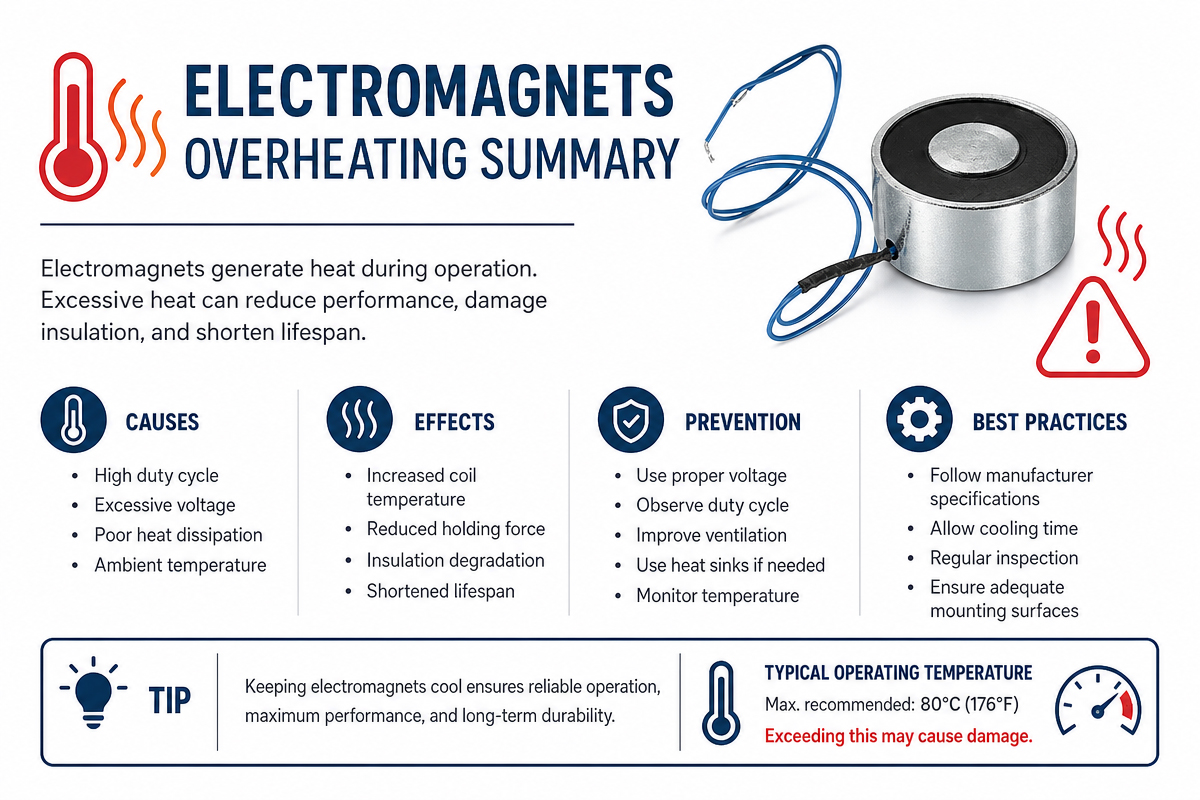
Electromagnet overheating is a problem but it is also a solvable problem. When you notice overheating, the main steps to troubleshoot it are:
- Check your circuit for poor connections, undersized wires, or voltage inconsistencies.
- Reduce the load to meet solenoid’s rated values.
- Provide better cooling by improving ventilation, installing heat sinks, or providing active cooling.
- Evaluate the operating environment for ambient temperature, power quality and pressure.
- Look for defects in the coil and replace the damaged components immediately.
- Make sure that duty cycle corresponds to application requirements.
However, the best way to deal with it is to prevent the overheating at the design stage. When choosing or designing the solenoid, take into account not only the required push/pull force and stroke but also:
- Size of the solenoid and its thermal mass
- Duty cycle and operating frequency
- Environment (ambient temperature, humidity, vibration)
- Push/pull force margins
- Cooling opportunities
- Proper voltage selection
- Temperature path design
With correct design, you will be able to avoid overheating of your solenoid entirely.
Chapter 9 : Final Thoughts
Electromagnet overheating is not a necessary evil of operation but a symptom of an existing problem that you can diagnose and fix. Regardless whether you are already facing overheating issues or you design your new equipment, the recommendations provided in this guide will help you with achieving proper temperature performance.
Remember: the coolest electromagnet is the happiest electromagnet. It provides consistent force, works longer and is safe. Don’t wait until it starts smoking – start managing temperature now.
Do you have questions regarding your particular electromagnet application? Our team of experienced engineers is ready to assist you. Contact us for consulting on your project requirements and let’s create a solution that will work without heating!
About the Author:
With our team’s experience in DC solenoid design, manufacture, and application engineering of more than two decades, we are helping our customers around the world to solve their thermal issues and provide reliable, high-performing electromagnetic solutions.


