Selecting the Right Ferrite Coil Transformer Supplier
Ferrite Coil Transformer for EV and Energy Systems
Ferrite Coil Transformer for Communication Devices
Ferrite Coil Transformer Quality Testing Standards
Ferrite Coil Transformer for Electronic Equipment
Ferrite Coil Transformer for Renewable Energy Systems
Selecting the Right Ferrite Coil Transformer Supplier
Ferrite Coil Transformer for EV and Energy Systems
Ferrite Coil Transformer for Communication Devices
Ferrite Coil Transformer Quality Testing Standards
Ferrite Coil Transformer for Electronic Equipment
Ferrite Coil Transformer for Renewable Energy Systems

WL0425 Ferrite Coil Transformer for High Frequency Circuits

The ferrite coil transformer is a high frequency magnetic component that enables efficient transfer of electrical energy from one circuit to another. This component also has the capability of converting voltage, isolating and impedance matching. The component is constructed using ferrite core material which possesses high magnetic permeability and lower power losses. The component is ideal for use in switching power supplies, communication equipment, LED drives, automobiles, and industrial control systems. When compared with the conventional iron core transformers, the ferrite coil transformers are smaller in size, lighter and operate at a higher frequency. The coil windings of the component can be customized depending on the voltage, current and frequency requirements of the intended applications. Ferrite core materials minimize eddy current losses and enhance high-frequency operation. Ferrite Coil Transformers possess excellent electromagnetic properties, reliable performance and customized options through OEM. Ferrite Coil Transformers are extensively used in modern electronics.

Ferrite Coil Transformer Description

A ferrite coil transformer is an electromagnetic component working on high frequencies that uses a ferrite core and wire coils for the purpose of transferring electrical energy from one circuit to another. Ferrites have low magnetic losses as compared to traditional iron-core transformers at high frequencies, which makes them a more suitable option for smaller electronic devices. The transformer comprises a primary coil and a secondary coil mounted on a ferrite core that enables the conversion of voltages, electrical isolation, and impedance matching. These transformers are frequently used for high-frequency power conversion applications in various types of electronic components.

Ferrite coil transformers are essential magnetic components used in the application of high-frequency power conversion. These transformers are well designed using copper coils and ferrite cores that are highly efficient. They operate within frequencies ranging from a few kHz to MHz, and they are able to offer stability in voltage conversion.

The advantages of using ferrite core transformers are their light weight and superior heat and high-frequency characteristics as compared to regular transformers. Ferrite core transformers are used in various applications like power supplies, LED lighting drives, electric vehicle chargers, medical devices, industrial automation, and communication gadgets. These transformers can be designed according to the application needs in terms of shape, structure, operating frequency, and electrical properties. Therefore, ferrite core transformers are recommended for use in modern electronics.

How does a ferrite coil transformer work?

The principle of the ferrite coil transformer is electromagnetic induction. The current in the primary winding produces a varying magnetic field in the ferrite core. The ferrite core is an excellent way to guide the magnetic flux and transfer energy to the secondary winding.

Faraday’s law says changes in the magnetic field create an electrical voltage in the secondary coil. The ratio of voltages between the primary coil and the secondary coil depends on the number of turns in the coils.

Ferrite cores have properties such as high magnetic permeability and low eddy current loss at high frequencies, which make them more suitable for transformers. This makes the transformer efficient for high-frequency electronic circuits and switching power supplies.

The main functions are

Step-up/step-down voltage conversion
Electrically isolated circuits
Uses of high-frequency power transmission
electronic circuit impedance matching

Ferrite Coil Transformer Video

Ferrite Coil Transformer Detail Display

Ferrite Coil Transformer Data Sheet

Item Description
Ferrite Coil Transformer Enameled copper wire
Wire Diameter 0.3 (AWG options available)
Winding Type Single-layer round or sectional  winding
Core Material  Magnetic Rod
Footprint length 25 mm
Encapsulation Optional varnish, epoxy, or coating
Mounting Through-foot / Custom

Electrical Specifications (Typical)

Parameter Description
Inductance Range 0.1 µH – 100 µH (customizable)
Inductance Tolerance ±2%, ±5%, ±10%
DC Resistance (DCR) Custom
Q Factor High Q, optimized for frequency range
Self-Resonant Frequency High, application-dependent
Operating Frequency kHz to MHz range
Rated Current Custom per design
Insulation Resistance ≥50 MΩ

Why Ferrite Coil Transformer Is Getting More Popular?

As the modern electronic devices need higher efficiency, smaller size and better energy performance, ferrite coil transformers are more and more popular. With the growing popularity of electric vehicles, renewable energy systems, smart devices and industrial automation, the demand for small size high-frequency power solutions has increased.

Ferrite coil transformers outperform conventional transformers at high frequencies, with lower energy loss, less weight and greater design flexibility. They are suitable for next generation power systems because of their support of miniaturized electronic products.

The advances in developing more advanced ferrite materials and automated manufacturing technologies continually improve transformers’ efficiency, reliability and cost-effectiveness. Ferrite coil transformers will continue to be an important technology for future power conversion systems with the industry focusing on energy saving and intelligent electronics.

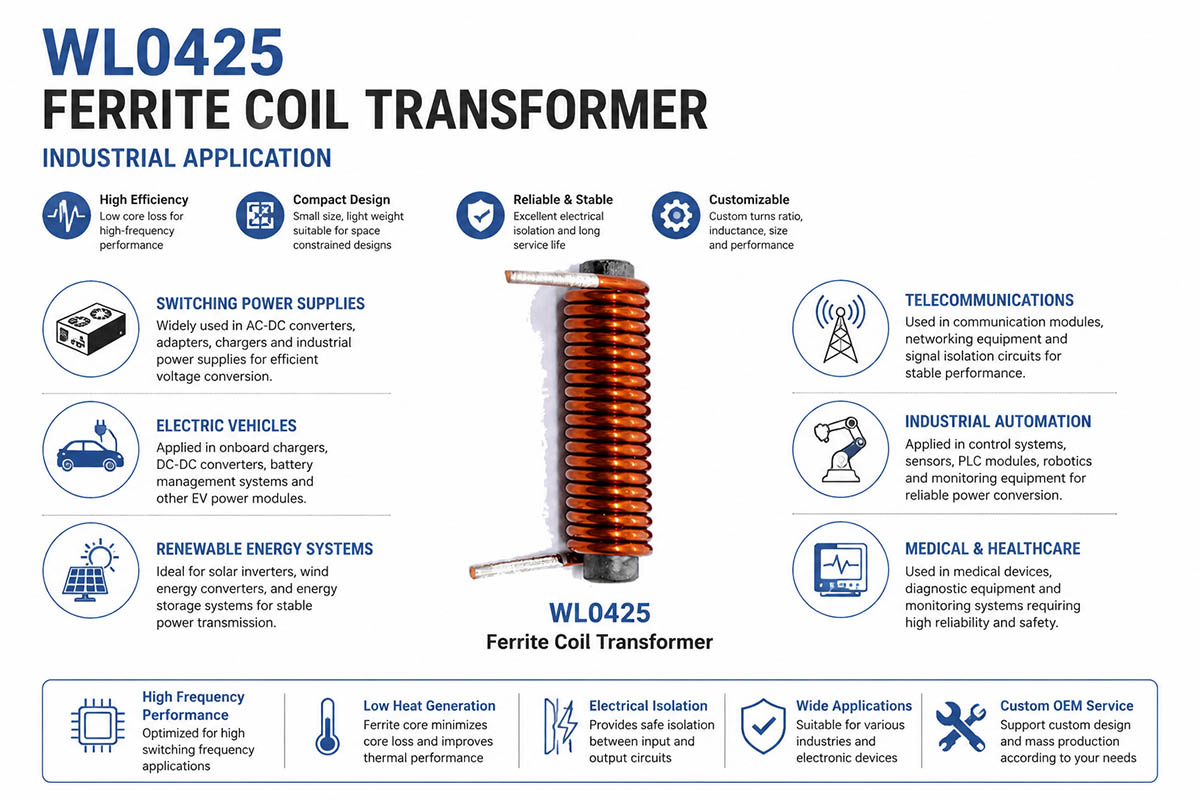
Ferrite Coil Transformer Industrial Application

Industrial Ferrite Coil Transformer Application Overview

The ferrite coil transformers are widely used in the industries that need efficient high frequency power conversion and compact electromagnetic solutions.

Ferrite Transformers are used in switching power supplies for efficient voltage conversion in adapters, chargers, industrial power supplies and embedded power modules.

They are lightweight, highly efficient and used in electric vehicles, battery management systems, onboard chargers, DC-DC converters and other automotive electronics

Ferrite coil transformers are also applied in renewable energy systems, like solar inverters, wind energy converters, and energy storage systems, to provide reliable power conversion.

They provide signal isolation and power regulation for networking devices, communication modules and RF systems in telecommunications equipment.

In industrial automation, ferrite transformers are used in control systems, sensors, robotics and monitoring equipment where stable power performance is needed.

It is also used in medical equipment, LED lighting systems, consumer electronics and aerospace electronics for its low loss, high reliability and small size.

With the development of smart electronics and energy saving devices, ferrite coil transformers are still finding new applications for better magnetic performance.

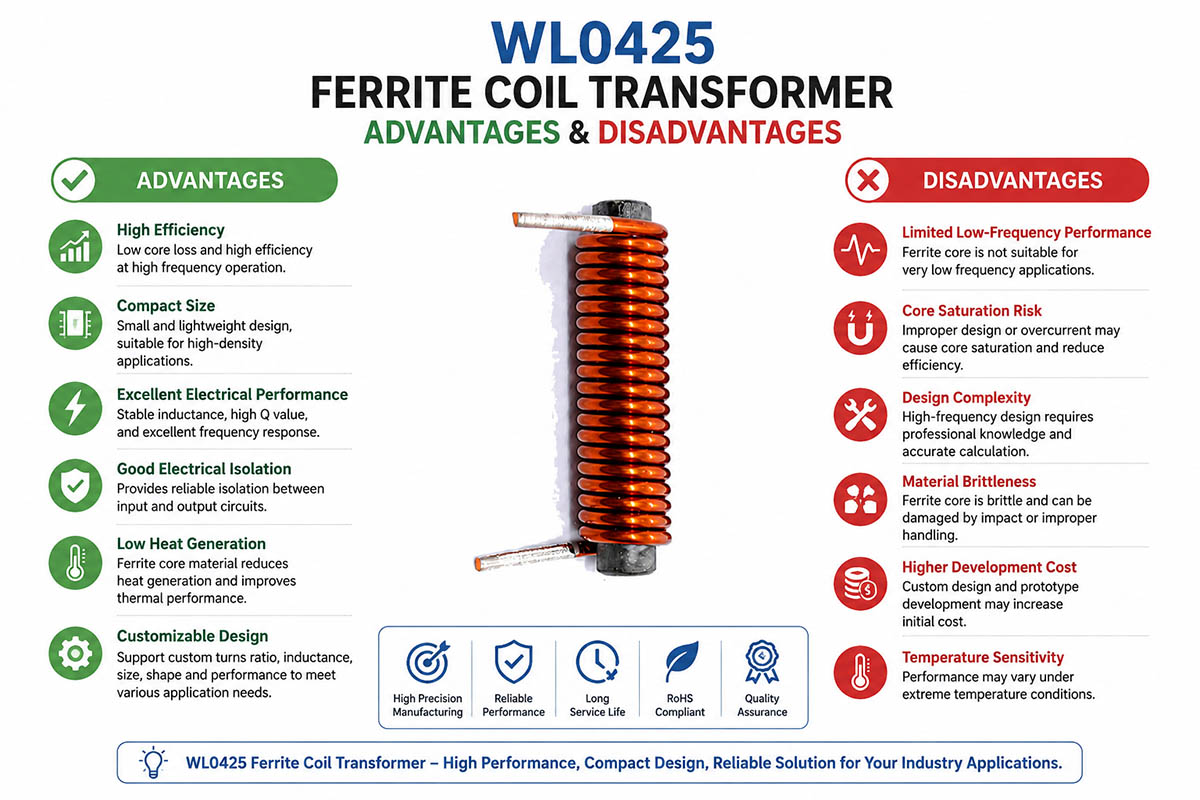
Ferrite Coil Transformer Advantage and Disadvantage

Ferrite Coil Transformer Advantages and Limitations

Advantages and Disadvantages of Ferrite Coil Transformer

Advantages

Ferrite coil transformers have a lot to offer modern electronic applications.

Efficiency: 1. High Frequency
Ferrite cores are good when the magnetic loss is low and the frequency is high.

Small form factor.
They have a greater power density than conventional transformers.

Low heat output:
The lower the core loss, the better the thermal performance.

Lightweight Construction:
They are compact, so they are good for portable electronics.

Improved customization support:
Winding structures, voltage ratios, and dimensions may vary from manufacturer to manufacturer.

Good electrical isolation:
They provide safe isolation between the input and output circuits.

Cons

Bad low-frequency performance:
Ferrite transformers do not work well at very low frequencies.

Risk of Core Saturation.
Poor design can cause magnetic saturation and loss of efficiency.

Complexity of design:
High-frequency transformer design is a professional knowledge.

Material Weaknesses:
Ferrite cores are fragile and must be handled with care.

Development cost is higher up front:
Prototype testing and engineering costs may be required for custom designs.

Despite these disadvantages, ferrite coil transformers are among the best solutions for modern high-frequency electronic systems.

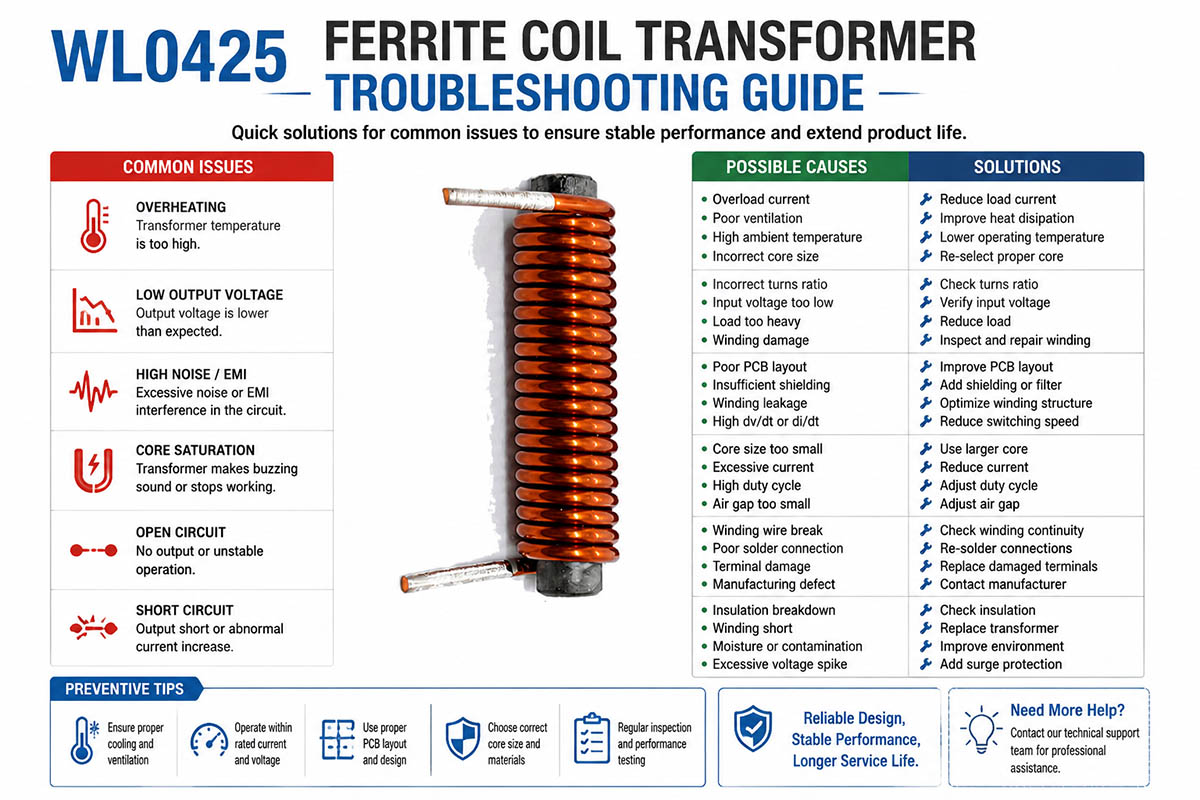
Ferrite Coil Transformer Troubleshooting Solutions

How to troubleshoot a ferrite coil transformer

1. Overheating of transformers

Possible Reasons:
Wrong core choice Overload current
Poorly designed cooling

Solutions:
Lower operating load
Select the appropriate ferrite material. Enhance heat management.

2. Wasteful

Possible causes:
High core loss
Bad winding design
Bad choice of material

Solutions: 1.

Optimize the frequency range.
Improvement of winding construction
Use better ferrite materials.

3. Output Voltage Fluctuation

Possible reasons:

Wrong-ness ratio
Voltage difference
Poor regulation

Solutions:

Number of turns change in winding
Improved circuit regulation

4. Excessive Noise/EMI

Possible explanations:

Leakage inductance: poor shielding layout

Answers: 1

Improve winding design (include shielding measures).
Improved PCB layout

5. Transformer breakdown

Maybe because:
Insulation failure over voltage Thermal stress
Answers
View Safety Ratings
More insulation.
Reliability Testing

FAQs On Ferrite Coil Transformer

1. What is a winding on a ferrite transformer?

Ferrite coil transformer is mainly used in high frequency power conversion, voltage conversion, electrical isolation and signal transmission. It is used in switching power supplies, LED drivers, EV chargers, communication equipment, industrial control systems, renewable energy devices and consumer electronics. The ferrite core permits high frequency operation with smaller size, weight and power loss than the traditional iron core transformers.

2. What is the working of a transformer with a ferrite core?

Ferrite is an induction of electromagnetism in the transformer coil. The AC current in the primary winding produces a changing magnetic field in the ferrite core. The ferrite core also directs the magnetic flux and couples energy to the secondary winding. In secondary winding voltage will be induced. The turns of the primary coil and the turns of the secondary coil determine the voltage conversion ratio. The utilization of ferrite materials improves the performance by reducing the magnetic losses at high operating frequency.

3.Why do transformers have ferrite cores?

Ferrite cores are used because of their high magnetic permeability and low power loss at high frequency. Ferrite materials have lower eddy current losses, better frequency response and higher efficiency than traditional steel cores. These properties make ferrite cores the best choice for small switching power supplies, high frequency converters and modern electronic equipment where light weight and energy efficient transformer design is needed.

4. What are the benefits of ferrite coil transformer?

The main advantages of ferrite coil transformers are:

High efficiency at high frequencies
Lightweight and compact design
Low magnetic loss in the core
Good insulator.
It does not get as hot
Features of OEM customization
High power density uses

These benefits have made ferrite coil transformers a common staple in automotive electronics, telecommunications, industrial equipment and renewable energy systems.

5. How to select the proper ferrite coil transformer?

Here are a few things to consider when choosing the right ferrite coil transformer:

Frequency range of operation
Input and output voltage specifications
Power Rankings
Current Capacity
Ferrite core material
Transformer size restrictions
Temperature conditions: –
Safety & insulation issues

6. Defective wound coil transformer?

Common causes of failure of ferrite coil transformer are:

Overcurrent or Overload Operation
Incorrect selection of ferrite core
High operating temperature
Bad insulation design
Saturation Magnetization
Bad winding layout
Voltage spike or electrical stress

A good magnetic design, heat dissipation, insulation test and quality inspection can greatly improve the reliability and service life of the transformer.

7. Do you make ferrite coil transformers to your spec?

Yes, ferrite coil transformers can be customized to suit application requirements. Manufacturers may differ:

Form and size of the core
Ferrite material class
Turn – primary and secondary
Wire Dia.
Frequency of operation
Ratio of voltages.
power rating
System of installation

OEM and ODM customization services are provided for automotive, medical electronics, industrial automation, energy systems, and other fields.

8. What is the industry of ferrite coil transformer?

Ferrite coil transformers are widely used in many industries such as:

Power electronics: DC-DC converters, switching power supplies, adaptors.
Automotive Car Electronics for Electric Vehicle Charging Battery system
Renewable Energy: Solar inverter, energy storage systems
Telecommunications Communication modules and equipment
Control Systems, Sensors and Robots in Industrial Automation
Consumer electronics: chargers, displays and smart devices

Ferrite coil transformers have the advantages of high efficiency, small volume and reliable operation. Today they have an important role in electronic systems.

How to Choose a Ferrite Coil Transformer

1. Selection of operating frequency

First of all, you should consider frequency of usage. Ferrites are created specifically for high-frequency operations. Ferrites are offered in various grades suitable for specific frequency ranges. Proper material selection results in minimizing energy losses and increasing efficiency.

2. Power requirement evaluation

You have to define input voltage, output voltage, current rating, and power rating. The transformer should have enough capacity and ability to handle the specified amount of power without overheating.

3. Choice of proper ferrite core material

Magnetic characteristics of ferrite materials vary from material to material. Low core losses and high permeability are required for high-frequency operation.

4. Transformer size determination

The size and the weight of compact electronic products are critical issues. Optimal performance can be obtained by proper core design and winding arrangement in small volume.

5. Thermal performance verification

Heat dissipation affects the reliability of transformers. You should choose transformers having proper insulation, cooling, and temperature characteristics.

6. Insulation needs evaluation

The safety standards may require distances, dielectric strength, and isolation performance.

7. Select a Reliable Manufacturer

The reliable manufacturer must include the following:

Material check
Electrical test reports
Design assistance
Quality controls
OEM Manufacturer capabilities

8. Evaluate the Prototype

The prototype testing should be conducted prior to mass manufacturing to verify efficiency, temperature rise, voltage regulation, and reliability.

When properly designed, a ferrite coil transformer guarantees efficiency, stability, and low cost of maintenance.

Typical Errors in Ferrite Coil Transformer Design: Not Considering the Operating Frequency and How to Avoid Them
The wrong material of the ferrite core leads to energy losses and inefficiency.
The core kernel size is incorrect.
If the core size is too small, we will get overheating and magnetic saturation.
Wrong winding layout
Inefficient winding configuration increases leakage inductance.
Insulation distance is insufficient.
There are also safety issues associated with improper insulation.
Not taking into account thermal management
Overheating will decrease the life time of the transformer.
Not considering EMI issues
Poor design causes electromagnetic interference.
Not testing the prototype
We can detect the performance problems by testing the prototype.

Get A Free Quote Now

Contact Form

Related Products

Related News

Scroll to Top

Get A Free Quote Now !

Contact Form
If you have any questions, please do not hesitate to contact us.
Weilong Solenoid Company Culture