Holding Electromagnet for Industrial Automation
igh Force Holding Electromagnet for Robotics
High Force Holding Electromagnet for Robotics
Compact Holding Electromagnet for Metal Fixing
Energy Efficient Holding Electromagnet Design
Holding Electromagnet for Industrial Automation
igh Force Holding Electromagnet for Robotics
High Force Holding Electromagnet for Robotics
Compact Holding Electromagnet for Metal Fixing
Energy Efficient Holding Electromagnet Design

WL2520 Custom Holding Electromagnet solutions

The holding electromagnet is an electrically powered magnet designed for attracting and retaining ferromagnetic objects such as steel or iron. Once an electric current passes through its coil, a magnetic field develops, generating an effective holding force. Unlike lifting devices, the electromagnets do not move any objects – due to magnetic attraction, they remain stationary. These devices are widely applied in automation, locking, lifting, or material handling operations. Voltage, current, coil design, and surface contact influence their operation. The moment electricity ceases, the magnetic field stops to exist, and the retained object is released instantly.

Main features of the holding electromagnet:

On-Demand Magnetism: It means that the magnetic effect occurs exclusively when the magnet is switched on thus easily releasing the load.  High holding force-per-size ratio: Compact construction ensures significant gripping/lifting capacity. Flat Pole Face: Ensures optimal contact and increases the gripping surface. Minimum Power Usage (DC variants): The majority of models are designed to operate continuously having properly selected coils. Fail-Safe Mode: They automatically release when power is cut off thus proving to be essential for safety systems. Various Voltages: Variants available include 12V, 24V, 110V, and 220V for AC and DC input. Weather-resistant and encapsulated magnets are produced for demanding industrial environments. Fast Activation/Deactivation: Instant engagement and release (less than 1 sec)

Product Overview of holding electromagnet

The holding electromagnet (or magnetic holding coil) is a device converting electricity into the magnetic force able to attract or retain ferrous materials. The magnetic force exists while they are energized, contrary to permanent magnets. Holding electromagnets are designed for maximizing their holding capability per unit dimensions and typically have a flat pole face to ensure direct contact with the workpiece. Another critical attribute is the “residual magnetism,” referring to the presence of magnetic forces even when they are turned off. They are commonly used in industrial automation, material handling, or fail-safe situations. Depending on design and input power, they can lift several tons of metal pieces or small amounts of a gramme.

How does a holding electromagnet work?

Electromagnetism lies in the background of the process performed by the holding electromagnet:
Input for Electric Current
When switched on, the DC electricity passes through a coil made of copper.
Production of Magnetic Field
The coil acquires a magnetic field as a result of current action.
Activation of Magnetic Force
An iron core intensifies the magnetic field, hence increasing the attractiveness of the device.
Object Retention
The magnet retains firmly the ferromagnetic elements such as steel or iron.
Power Off Release
Once the electric current is cut off, the magnetic field disappears, releasing the retained object instantly.
Important technical parameters affecting the performance of a holding electromagnet:
Current/voltage value
Resistance/coil turns
Iron core material
State of contact surface

Holding Electromagnet Product Video

WL2520 Holding Electromanget Detailed Display

WL2520 Holding Electromagnet Technical Datasheet

Brand Weilong Technology Model Number WL2520
Rated Voltage (V) DC 12V or 24V Rated Power(W) 3-5 W
Work Mode: Power on, Magnet on Holding Force (N) 14 Kgs
 working duty 100% Resistance 32  Ω
Service Life 100 Thousand Times Certification CE,ROHS,ISO9001,
Material Superior Magnet Carbon Steel Housing Lead Wire Length(mm) 200 MM
Install Style Screw Hole Tolerance of Dimension  +/-  0.1 MM
Water-proof  None Insulation Class B
Hi-Pot Test AC 600V 50/60Hz 2s Non-excitation Holding Force 0
Working Temperature -10°C-100°C Duty Cycle 1-100%
Thread Depth(mm) / Payment Term TT, or LC At Sight
Sample Order Yes Warranty 1 Year
MOQ 1000 pcs Supply Ability 5000 pcs per Week
Delivery Time 30 Days Port of Loading shenzhen

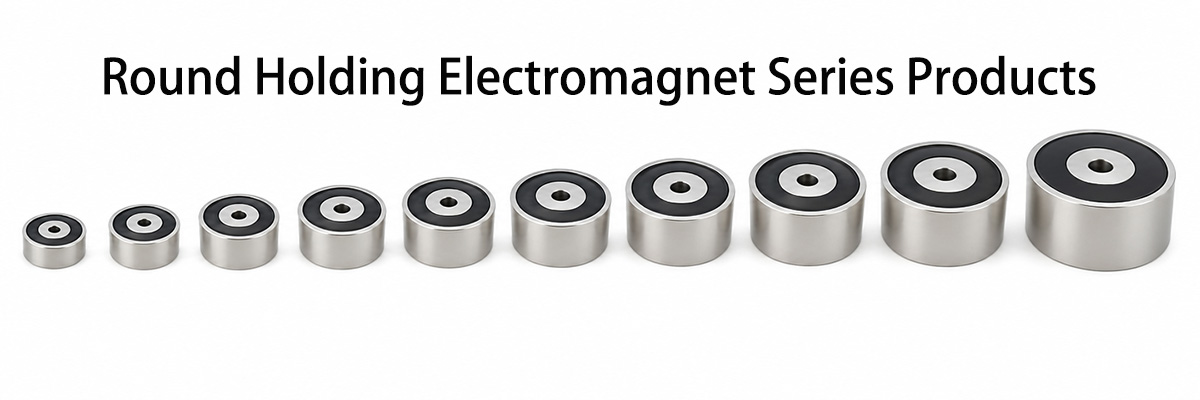
Weilong Round Holding Electromagnet Series Product For Selection

Weilong Round Holding Electromagnet Series Products

Model Size Holding Force Power Install Min thickness

of contact plate

Weight
WL-0820 Ø8*20 3 N 1.6 W _ 1 6.5 g
WL-1010 Ø10*10 3 N 1 W M2_4 1 6 g
WL-1025 Ø10*25 8 N 1.6 W _ 1 12 g
WL-1212 Ø12*12 10 N 1 W M3_6 1 8 g
WL-1327 Ø13*27 15 N 1.6 W  _ 1 8 g
WL-1515 Ø15*15 20 N 1.4 W M4_6 2 12 g
WL-1625 Ø16*25 30 N 1.7 W M4_8 1.5 27.5 g
WL-1811 Ø18*11 45 N 1.4 W M3_6 2 16 g
WL-2012 Ø20*12 35 N 1.4 W M3_5 1.8 22 g
WL-2015 Ø20*15 50 N 1.8 W M3_5 2 28 g
WL-2020 Ø20*20 40 N 1.6 W M4_6 2.5 37 g
WL-2025 Ø20*25 50 N 2.4 W M4_6 2.5 37 g
WL-2520 Ø25*20 140 N 3.6 W M4_6 2.5 58 g
WL-2525 Ø25*25 100 N 2.4 W M6 2.5 71.5 g
WL-3022 Ø30*22 200 N 4.3 W M4_8 3 92 g
WL-3025 Ø30*25 250 N 4.3 W M6_12 3 110 g
WL-3219 Ø32*19 250 N 3.6 W M6_12 3 95 g
WL-3229 Ø32*29 150 N 2.4 W M6_ 3.5 168 g
WL-3231 Ø32*31 200 N 9.6 W M6_15 2.8 136 g
WL-3425 Ø34*25 250 N 9.6 W M6_ 3 126 g
WL-3530 Ø35*30 300 N 4.8 W M6_10 3.5 170 g
WL-4026 Ø40*26 300 N 5.6 W M5_10 5 194 g
WL-4040 Ø40*40 400 N 4.8 W M6_12 5 300 g
WL-4530 Ø45*30 450 N 4.8 W M6_12 5 287 g
WL-4542 Ø45*42 500 N 5.8 W M6_12 5 360 g
WL-5030 Ø50*30 700 N 6 W M5_10 6 331 g
WL-5050 Ø50*50 700 N 9.6 W M8_15 5 580 g
WL-5227 Ø52*27 600 N 5 W 2-M5_5 5 337 g
WL-6037 Ø60*37 800 N 14.4 W M8_8 7 650 g
WL-6060 Ø60*60 1000 N 17.1 W M6_12 6 1000 g
WL-6330 Ø63*30 1000 N 9.6 W M8_ 8 550 g
WL-7035 Ø70*35 2000 N 12 W M8_12 10 800 g
WL-7045 Ø70*45 1800 N 15 W M8_16 10 1000 g
WL-7060 Ø70*60 1400 N 21.3 W M8_12 8 1360 g
WL-8038 Ø80*38 2200 N 15 W M8_16 10 1120 g
WL-8055 Ø80*55 2500 N 14.4 W M8_16 12 1620 g
WL-8060 Ø80*60 2400 N 23.5 W M10_20 10 1780 g
WL-9060 Ø90*60 3000 N 14.4 W M10_20 12 2250 g
WL-10043 Ø100*43 3200 N 21 W M10_20 15 2000 g
WL-10060 Ø100*60 3600 N 38 W M12_20 12 2780 g
WL-12060 Ø120*60 4000 N 41.3 W M12_20 15 4300 g
WL-15056 Ø150*56 9300 N 37 W M16_24 25 5800 g
WL-18063 Ø180*63 15000 N 50 W M24_36 30 9500 g
WL-25080 Ø250*80 30000 N 90 W M24_48 40 23000 g
WL-275110 Ø275*110 40000 N 140 W M24_40 50 38000 g


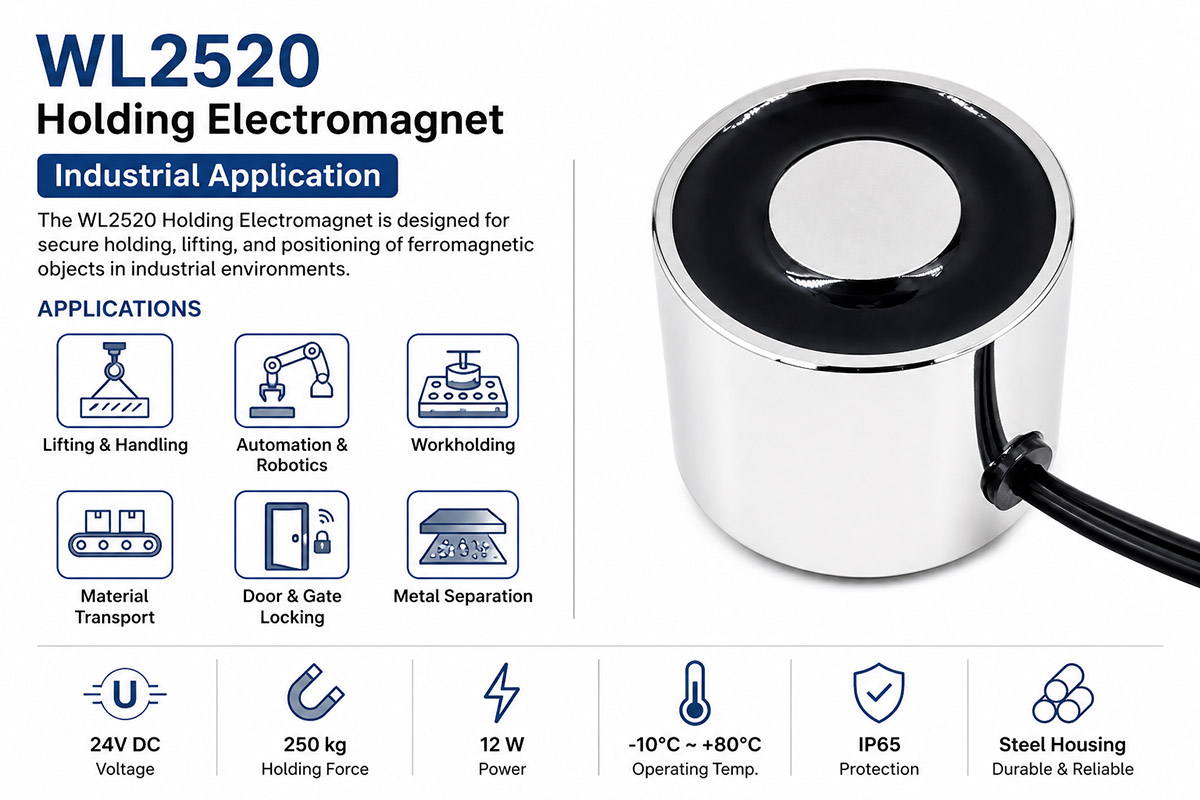
WL2520 Holding Electromagnet Application

Holding Electromagnet Industrial Application

Automation, security systems, material handling, and robotics demand reliable holding electromagnets. They maintain firmly the ferrous workpieces during machining, grinding, or welding procedures carried out on magnetic chucks/fixtures. While lifting ferromagnetic loads, they retain steel plates, bars, or metal scrap with the help of crane systems or automated sorting lines. Maglocks serve as a common door locking system. They ensure that the doors are shut while being open for emergency purposes. The end-effector robots make use of holding magnets to grip and move metallic objects. The automotive assembly lines use electromagnets to hold the assembled parts or weld joints during assembly. Household magnets are employed to keep doors shut on refrigerators or washer machine lids. Precision electromagnets fix the tool sensors or test tools on their surface for calibrations and tests.

Specific examples of electromagnet use are holding molds inside injection presses, securing jigs on CNC tables, and lift magnets used for scrapping. They can be also found in medical equipment, where they keep elements in MRIs. Aerospace industry utilizes holding magnets to fix doors or test fixtures. Battery-powered portable lifting magnets operate using holding electromagnets for short-term retention. The major advantage they offer in all applications is instant release of the object without mechanical intervention (lever or prying). Hence, full automation of procedures becomes possible. Provided appropriate selection, they can work for millions of trouble-free cycles.


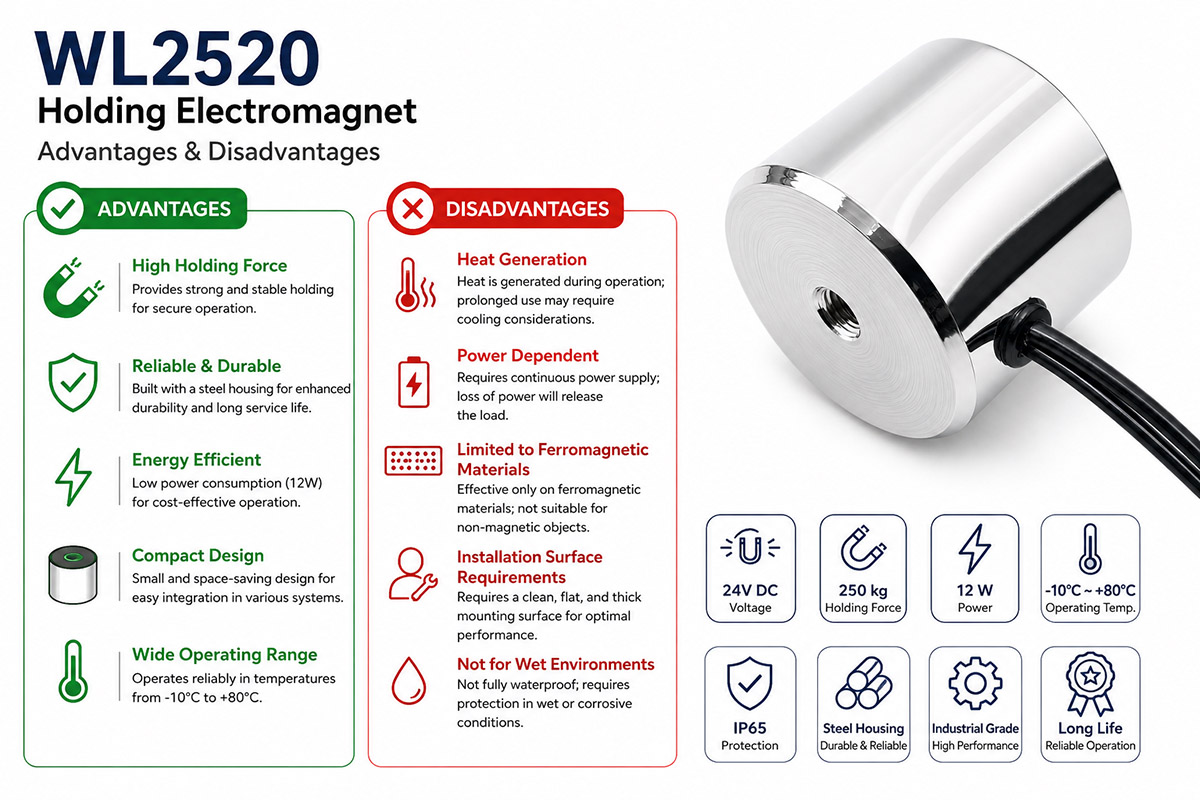
Advantage and Disvantage of WL2520 Holding Electromagnet

Holding an Electromagnet: Advantages and Disadvantage

Holding Electromagnet Advantages:

Remote control

Instant Engagement/Release: Using a simple on-off switch or PLC control, one can activate/desactivate magnets remotely, allowing automation.

Permanent On-Demand Hold: Once activated, the holding can continue indefinitely.

Compact Size and High Capacity: Significant holding force can be provided by a compact magnet (not larger than a coffee cup).

Mechanical wear Absence: Moving parts are absent, except for the electrical contacts.

Adjustable Force: Depending on voltage input one can easily pick up the object or release it in due time.

Minimal maintenance: Regular cleaning of the pole face and electric connections is enough.

Fail-to-Release: Once the current is switched off, the load is released. Can be an asset or drawback, depending on the process.

Disadvantages of Holding Electromagnet

Constant electricity supply requirement: Lack of power leads to dropping loads—potentially dangerous in overhead lifting operations. Solution: permanent electromagnets for fail-safe hold.

Heating Problems: Long periods of high-capacity operation may require cooling or limiting the duty cycle.

Residual Magnetism: After switching off the current, ferromagnetic objects may stick together, requiring additional efforts to remove.

Dependence on air gap: Force dramatically reduces with air gap (inversely proportional to its squared length).

Ferrous loads only: Aluminum, copper, wood or plastics cannot be picked up.

Inrush Current (AC variants): May lead to a breaker tripping.

Weight/Energy ratio: High forces require substantial magnet weights and thick cables.

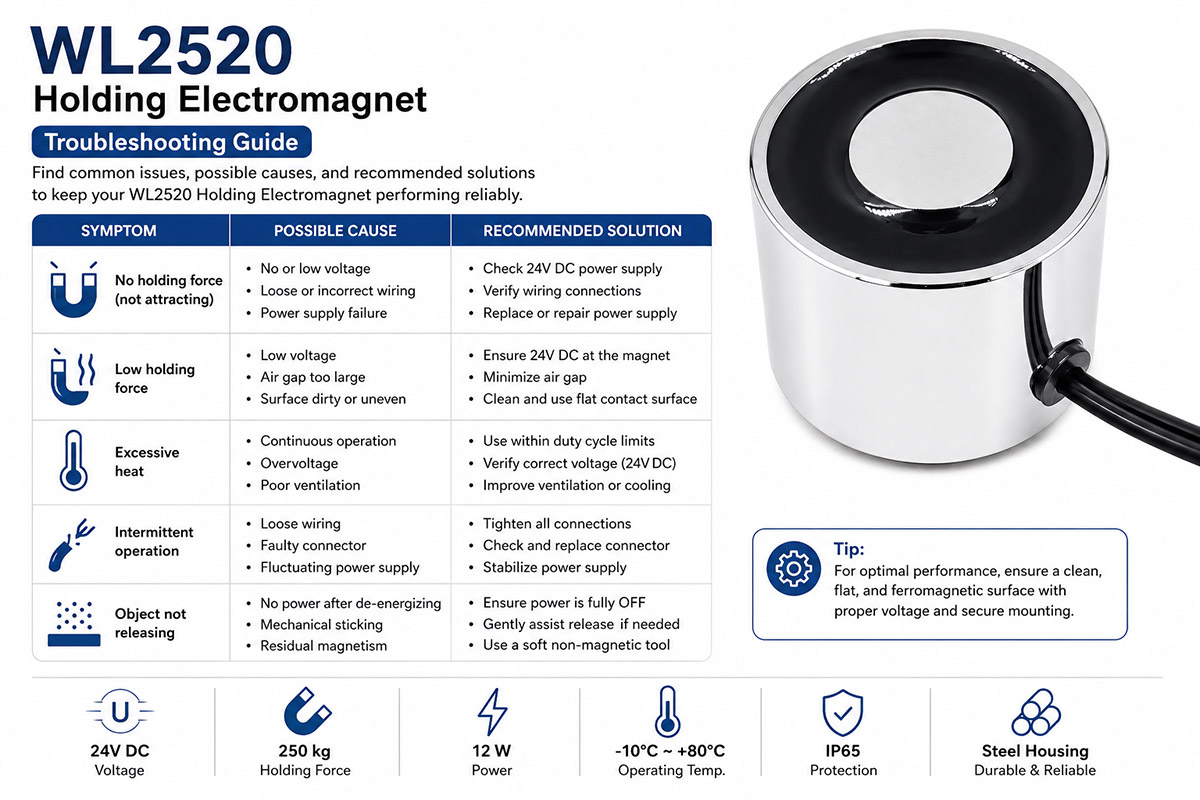
Holding Electromagnet Troubleshooting Guide

Holding Electromagnet Troubleshooting guide

Issues with holding electromagnets can be divided into three major types: either electrical, thermal, or mechanical. This article provides instructions on how to troubleshoot the problem in detail:

1. No magnetic force (has charge, but no magnetic attraction force)

– Make sure that voltage applied to the coil is within 10% of the nominal value.

– Carefully inspect all cables and terminals. The ends of cables may be rusted, loose, or damaged.

– Measure resistance of the winding using a multimeter. An open circuit implies a broken wire, while the coil with extremely low resistance (short) requires a replacement since insulation is destroyed.

– Check polarity: for DC electromagnets with a rectification circuit, a reverse polarity will not generate any magnetic field.

Weaker magnetic force than expected

– Clean both pole faces from any dirt: paint, rust, oil or other contaminants. They may form an air gap, reducing magnetic force by 80%.

– The workpiece should be thick enough. As a rule of thumb, its minimal size should be approximately equal to the diameter of the pole face. Thin sheets may get saturated.

– Use a clamp meter to measure current. Low current reading suggests a voltage drop or a relatively high resistance of the circuit.

– Allow the coil to cool between uses if magnets are used infrequently. Hot coil increases resistance, which decreases magnetic force accordingly.

3 The magnet overheats or burns out

– Check whether the actual duty cycle is lower than stated. Reduce working time and add forced cooling (e.g., a fan).

– Do not exceed rated voltage of the coil (e.g., using 120V on a 24V coil is a danger not only to the coil, but it will increase temperature and destroy the coil eventually).

– For AC magnets, a continuous movement of the armature, if it is present, can result in high current draw and burning the coil.

4. Residual magnetic force doesn’t allow to release the part

– Apply reverse voltage temporarily (DC magnets only), and then release.

– Use an air blast or simply lift the part manually.

– Always use genuine spare parts; otherwise, it may prevent the releasing of the part.


FAQs of Holding Electromagnet

Q1: Can I lift humans with holding electromagnet?

A: Usually not. You need permanent magnets with mechanical interlocks. In the case of power failure, regular holding magnets won’t work safely.

Q2: Does surface rust will reduce the holding electromagnet force?

A: Yes. Dust, paint, oil, or rust creates an air gap and reduces holding force up to 80%. For optimal results, make both surfaces free from contaminants.

Q3: Can I keep the magnet charged permanently?

A: It is OK if the device is rated for 100% duty cycle. Otherwise, continuous use causes demagnetization or overheating, damaging the coil. Read the specifications of your equipment.

Q4: Why does it take so much time for magnets to release the part?

A: The reasons may be residual magnetic force or the stuck pin of the release system. You can try to wait for 1 or 2 seconds or use a demagnetization circuit. Also, check for a stuck armature (AC electromagnets).

Q5: What is the consequence of applying reverse polarity to DC electromagnet?

A: A simple winding will function normally (with a slight reduction of force). On the other hand, an electromagnet with a built-in diode or rectifier will short or turn off.

Q6: Can I use this magnet with stainless steel or aluminum?

A: Yes, but only if stainless steel is ferromagnetic (such as the 400 series grade). Stainless steel grades of the 300 series, aluminum, copper, brass, etc., are not magnetic and should be handled differently.

Q7: How can I improve performance on thin sheet metal?

A: Improve your magnetic circuit by adding a back plate made of a ferromagnetic material. Alternatively, you can purchase a magnet with a bipolar winding.

Q8: My holding electromagnet holds only sometimes. Why?

A: Check whether there is a broken connection wire, a switch or relay, or thermal protection due to high operating temperature (check the presence of a bimetal switch). If it’s hot, check whether voltage drop occurs.

How to choose the holding electromagnet

To guarantee the safety and reliability of the chosen electromagnet, one should consider the multitude of technical and operational aspects.

Requirement for holding capacity:

Calculate the required holding capacity or weight of retained objects, adding an extra safety factor (2-4 times). Manufacturers indicate their capacity under assumption that it operates on a smooth, clean, and horizontal surface. Rough, oily, or inclined surfaces reduce their capacity sharply. Provide extra margin for vibrational or vertically operating magnets.

Operating cycle:

Define whether the magnet will be engaged constantly (100% cycle) or sporadically (e.g., 25%). Continuous models possess oversized coils or lower density due to continuous usage. Intermittent magnets provide higher holding force but overheat if kept on. It is important to match the duty cycle to prevent the burning-out of the coil.

Electricity Input:

Pick either the alternating or direct current type of the input voltage. DC models prevail due to their constant force and minimal surging currents. However, AC models are less efficient in weight but allow direct plugging to the mains (e.g., 12V, 24V, 110V, or 230V).

Pick encapsulated models (IP67) or stainless steel-faced magnets with a special coating to protect from corrosion if necessary. High-temperature coils and insulation is required if ambient temperature exceeds 80 degrees Celsius.

Physical restrictions:

Ensure proper dimensions (height, diameter, mounting holes, or threaded inserts) of the magnet to fit your machine. Decide whether you require a double-sided electromagnet or magnet having an entire hole for mounting.

Magnetic release: In case of residual magnetism concerns (sticking of thin plates after switching off the electromagnet), choose a magnet with a permanent magnet release assist or demagnetization capability.

Safety/Certification requirements:

Employ permanently activated or fail-safe holding electromagnets in critical or human operations or backup systems for safety. CE, UL or RoHS certifications are optional according to your demands. Always test your magnet on the working surface prior to implementation.

Get A Free Quote Now

Contact Form

Related Products

Related News

 Chapter 1 :Introduction on overheating in electromagnets Electromagnets and solenoids are the must-have components in countless applications – from automotive […]

Scroll to Top

Get A Free Quote Now !

Contact Form
If you have any questions, please do not hesitate to contact us.
Weilong Solenoid Company Culture