

Chapter 1: Introduction
Choosing a tubular solenoid push-pull for industrial and automation applications includes many points, but one of the most important is choosing the appropriate voltage. There are 2 kinds of solenoids operating under DC voltage: 12V and 24V. Both voltages can ensure reliable linear motion but are not interchangeable.
12V tubular solenoid push-pull is widely used in compact devices, battery-powered systems, automotive mechanisms, low-voltage control systems, etc. The 24V version is commonly used in industrial automation, machinery, control cabinets, valves, locks, and other equipment where increased wiring distance is a crucial factor. But their performance does not depend on the voltage but on such parameters as force, stroke, coil resistance, current, duty cycle, operating temperature, power supply, available space, and required service life. This guide explains the difference between 12V and 24V tubular solenoids and will help you choose the voltage.
Chapter 2: What is a Push-Pull Tubular Solenoid?
Push-pull tubular solenoid—This is a linear electromagnetic actuator that converts electrical energy into mechanical motion. Its design includes a cylindrical body, an electromagnetic coil, a movable plunger, a return mechanism, and electrical terminals.
An electric coil of the actuator is fed with a DC voltage producing an electromagnetic field. The magnetic field pulls the plunger in a straight line into the center of the coil. Further, the actuator can be designed as a push, pull, or push-pull function.
The tubular form makes the actuator’s construction compact and cylindrical, which is convenient to integrate with machines and automation devices.
Common applications are
Automatic doors and locking mechanisms
Dispensing machines
Industries with Automation Robots and Medical Equipment
Automobile mechanism.
Electric switches and solenoid valve operation
Security devices.
Automation machinery
Equipment handling.
The voltage choice must consider the entire electrical and mechanical requirements, not just the voltage itself.
Chapter 3: Fundamental Distinction Between 12V and 24V Tubular Solenoids
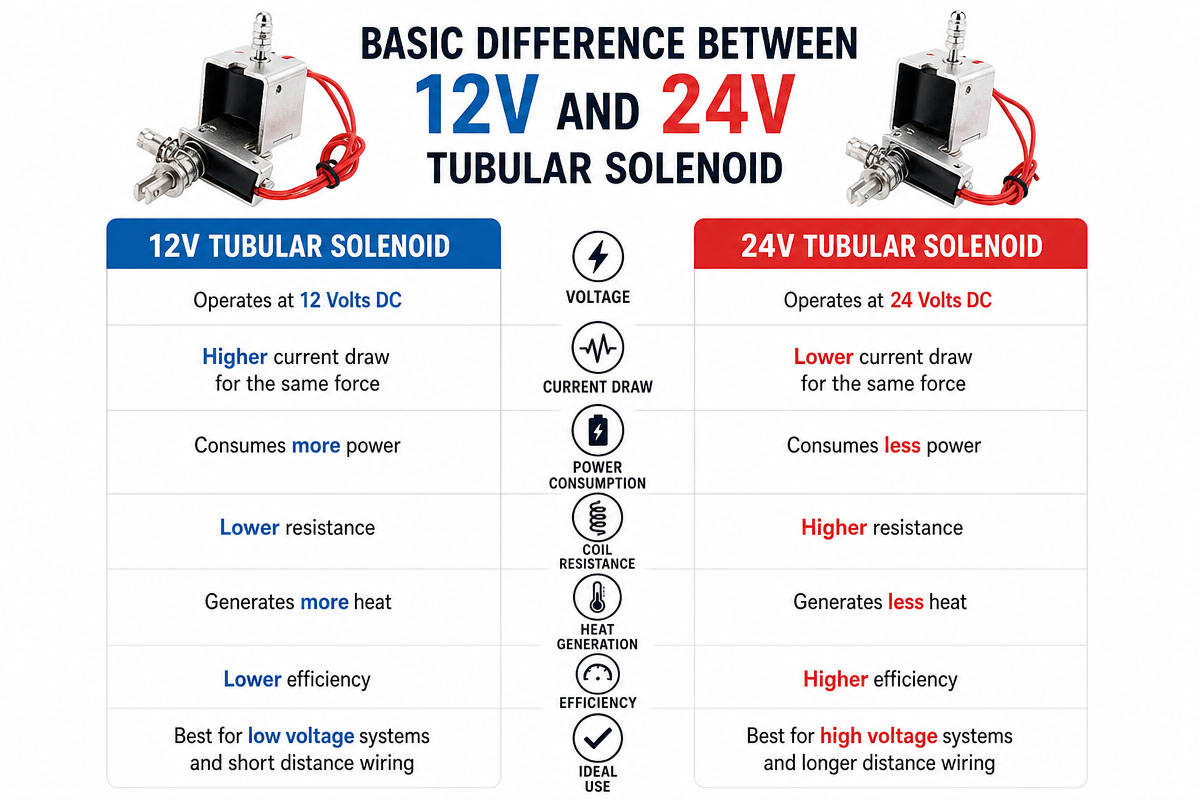
The fundamental distinction between a 12V and 24V tubular push-pull solenoid is the voltage necessary for powering the coil.
A 12V solenoid will use about twice as much current as a 24V solenoid to produce the same work.
For example, if a solenoid consumes 24 W:
Version 12 V ~2 A, Version 24 V ~1 A
The exact current will depend on the coil design and resistance, but this relationship will be useful for electrical system design.
Visualizing the density is useful for understanding the physical relationships between the materials. The choice of voltage is mainly an electrical design-related question. In this case, the relevant relation is as follows: with higher voltage, you can transmit the same power with lower current.
This may affect the wire, connector, switching component sizes, voltage drop, and the electrical system efficiency.
Chapter 4: When to Use a 12V Tubular Solenoid
If the machine is using a 12V DC power system, it is better to choose a 12V tubular solenoid push-pull.
4.1 Battery-powered equipment
Many portable and mobile devices use 12V electricity. Using a 12V solenoid, there will be no necessity to install an additional voltage converter.
Examples include mobile equipment, automobile mechanisms, battery-powered locks, and automation systems.
4.2 12V control system
If the control electronics are providing a stable 12V DC output, it will be easier to integrate the system with a 12V actuator.
You will not need an additional 24V power supply or a DC-DC converter just for the solenoid.
4.3 Wires with a short distance.
The 12V coil has high current, but this will not be a problem in machines with short wiring distance.
4.4 Small Form Factor
12V solenoids are very convenient for small devices with a 12V power system.
Anyhow, you should take into account the coil current according to the power supply and controller output.
Chapter 5: When to Select a 24V Tubular Solenoid?
A 24V push-pull solenoid is usually a tubular type used in industrial equipment.
5.1 Automation in industry
24V DC is widely used in PLC control systems, sensors, relays, and industrial control components. Thus, 24V tubular solenoids can be easily incorporated into the same control system.
5.2 Increased cable lengths
The 24V coil provides the same power with lower current than the 12V coil and therefore can be more advantageous in case of relatively long wiring distances.
Lower current helps reduce the voltage drop and allows using smaller wires.
5.3 Lower current requirements
Suppose the actuator requires 30W:
12V 30W ÷ 12V = 2.5A 24V 30W ÷ 24V = 1.25 A 24V version will use about half the current for the same power.
It will be helpful in selecting cables, connectors, switches, relays, and control electronics.
5.4 Control Cabinets for Industry
If the machine uses a 24V DC power supply, it will be easier to choose a 24V tubular solenoid push-pull.
Chapter 6: Does 24v have more power than 12v?
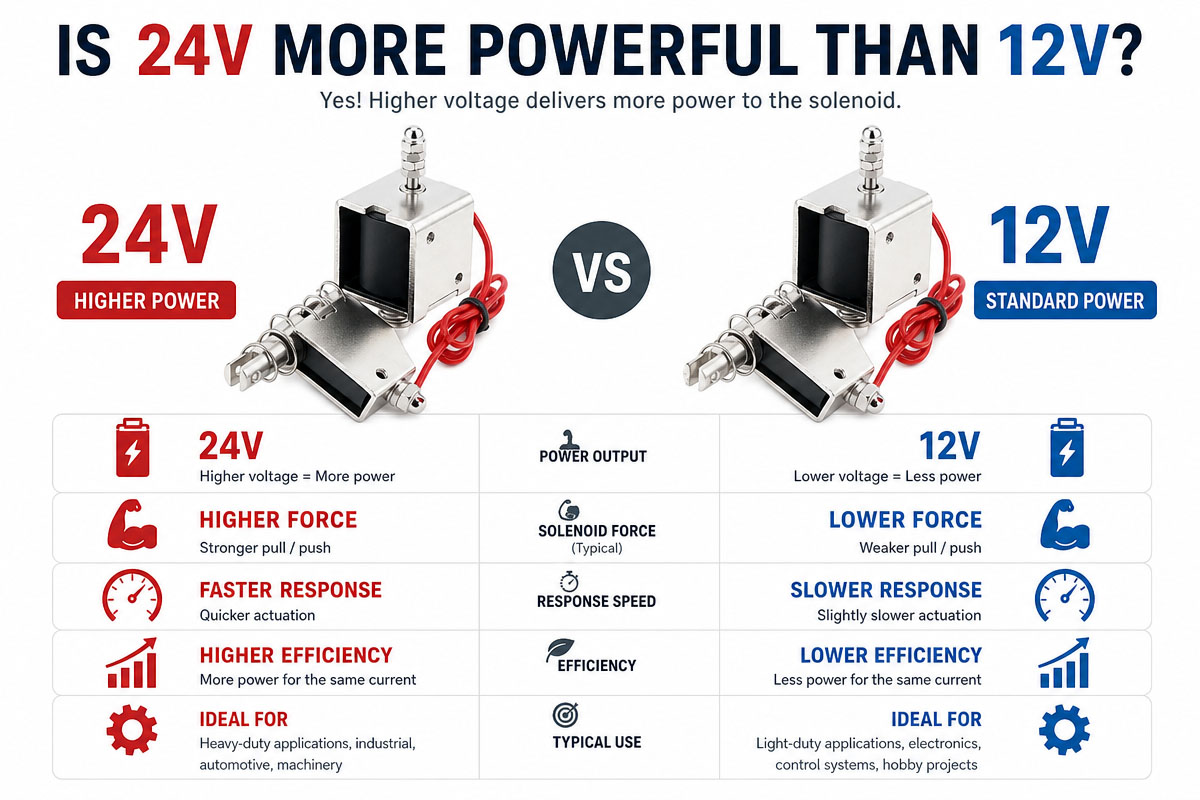
Nope. Not exactly.
This is one of the most important factors to consider when comparing solenoid voltages.
A 24V solenoid is not twice as strong as a 12V solenoid. The pull force depends on many factors, such as
Inductor Design
revolutions per minute (RPMS)
Coil resistance
And now the
Magnetic circuit
Plunger Material
Plunger Diameter
Airgap – Stroke
Body Design
Working Temperature
6.1 Applied Voltage
Therefore, a well-designed 12V tubular solenoid push-pull may have the same or higher pull force than a poorly designed 24V model.
Always compare the product of the manufacturer for voltage, force curve, stroke, current, power consumption, and duty cycle—not only voltage.
Voltage, Current, and Power
The basic relation of electricity is
6.2 Power = Voltage * Current, so Current = Power / Voltage
So if the power required is constant, then increasing the voltage will decrease the current.
Like this:
| Power | 12V Current | 24V Current |
| 6W | 0.50A | 0.25A |
| 12W | 1.00A | 0.50A |
| 24W | 2.00A | 1.00A |
| 36W | 3.00A | 1.50A |
Power 12V Current 24V Current
6W 0.50A 0.25A 12W 1.00A 0.50A 24W 2.00A 1.00A 36W 3.00A 1.50A
These are the simplified versions of the numbers. The current of the solenoid should always be referred to individual coil specifications.
This difference may be important in the design of high-volume automatic machines with many solenoids.
6.3 Work and heat duty
Another factor is the creation of heat.
The push-pull tubular solenoid is a conversion of the electrical energy into magnetic and mechanical energy. However, part of the electrical energy is converted into heat in the coil.
During continuous operation of the solenoid, the coil temperature can increase significantly.
Consider these aspects before you choose 12V or 24V:
Regular/intermittent service
Operation cycle
Environmental Temperature
Energy of coil
Maximum Temperature of the Coil “Required frequency of operation”
Cooling system
A solenoid with a 25% duty cycle should not be used in the continuous mode.
Some applications require a high pull force with a high starting current, followed by a low holding current. Such a design helps reduce heat and energy consumption.
Chapter 7: Check Your Power Supply
The most simple rule of selection could be stated this way:
Try to obtain a solenoid voltage that matches your DC power supply, if you can.
If your machine has a 12V DC power supply, then a 12V tubular solenoid push-pull is a good option.
For a machine with a standard 24V DC industrial power supply, a 24V solenoid is an easy choice.
Wrong voltage selection will result in poor performance.
If you try to feed 12V to a 24V solenoid, magnetic force may not be enough; it may move slowly, it may not travel the full stroke, or it may not even start moving.
Feeding 24V into a 12V coil in continuous mode will result in excess current and overheating.
So, the rated voltage must be checked before testing.
Chapter 8. Consider Wiring and Voltage Drop
As the cable length increases, the voltage drop increases.
The 12V system has less voltage margin than the 24V system. For example, a 1V drop is approximately
12V Power Supply 8.3%
24V supply 4.2%
In some industrial applications, a 24V tubular solenoid push-pull can be more tolerant of voltage drop issues.
It is especially beneficial if the solenoid is installed at a distance of several meters from the control cabinet.
But correct cable sizing is still important.
Chapter 9: 12V or 24V—A Quick Comparison
| Factor | 12V Tubular Solenoid | 24V Tubular Solenoid |
| Supply voltage | 12V DC | 24V DC |
| Current at the same power | Higher | Lower |
| Battery applications | Excellent | Requires suitable supply |
| Industrial automation | Good | Excellent |
| Long wiring | Less favorable | More favorable |
| Existing 12V system | Excellent | Requires conversion |
| Existing 24V PLC system | Requires conversion | Excellent |
| Wiring current | Higher | Lower |
| Voltage-drop tolerance | Lower | Higher |
| Typical use | Mobile/compact equipment | Industrial machinery |
Chapter 10: Selecting the Correct Voltage
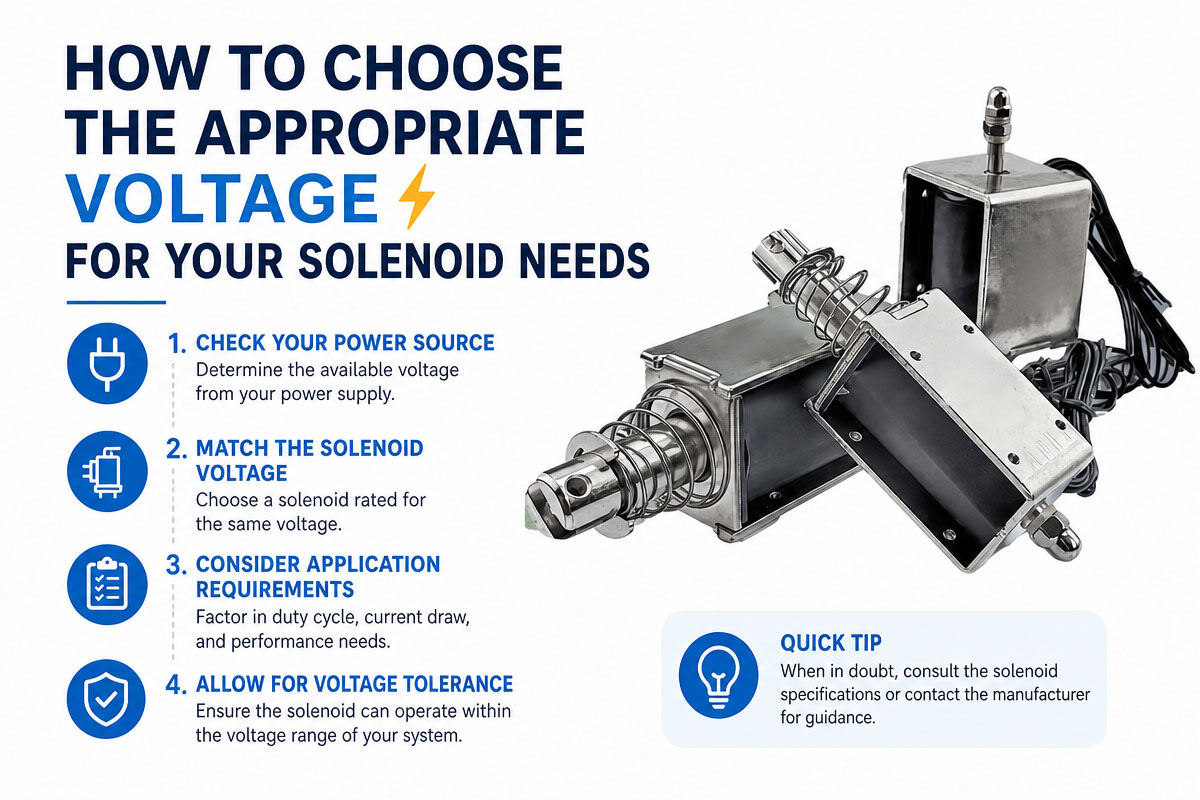
5 steps to select a tubular solenoid push-pull:
Step 1. Establish possible voltage.
Find out the output voltage of your machine (12V DC, 24V DC, etc.).
Step 2: Determine the force you need
Calculate the minimal resultant push-pull force during the working stroke.
Never select a solenoid based on its maximum force rating.
Step 3. Get ready for stroke.
Find out how much movement you require. The force of a solenoid is usually dependent on the position of the plunger.
Step 4: Duty Cycle Test
Is the solenoid operating continuously (on/off) or always (on)?
The coil design can vary significantly depending on the duty cycle (10%, 25%, 50%, or 100%).
Step 5: Full Specs Comparison
“Rated voltage
Stroke Power Now,
Push force
Pull Force
Duty cycle.
Temperature of the coil in operation
Frequency of operation
Mounting and sizes
Connector type
Average lifetime
The best push-pull tubular solenoid is the one that suits all requirements of your application.
Chapter 11. Can I run a 12V solenoid on a 24V system?
Yes, but not directly into 24V.
You will need a proper voltage driver or converter to reduce the supplied voltage to the coil.
A 24V tubular solenoid push-pull can also operate in a 12V system with the help of a proper voltage converter or driver in the electrical system.
But the additional voltage converter will complicate the system and increase its cost. Usually, if you can find a solenoid that fits the native voltage of the machine, it is better.
12V or 24V—Which Is Better?
No more voltage.
Choose 12V if:
The machine is powered by 12V DC.
The application is battery-powered.
Lengths of the cables are short.
The supplied controller provides the necessary current.
The main application is small mobile equipment.
Choose 24V if:
The machine is controlled by a 24V industrial control system.
The lengths of the cables are longer.
Current usage is less.
Multiple actuators are operating at the same time.
Industrial automation/PLC integration is required.
In most industrial automation applications, a 24V DC system is more convenient. 12V is the better choice for battery-powered and automotive applications.
Final Checklist for Selecting a Tubular Solenoid Push-Pull
Please check the specifications with your solenoid manufacturer before ordering:
Is the coil 12V or 24V DC?
What’s the operating current?
What is the power of the coil?
What is the power of pushing and pulling?
What is the stroke specified?
What is a duty cycle?
Operating temperature? What is the maximum?
What is the expected life time?
Is the force applied at the stroke?
Do you want to customize the coil for your power supply?
If you have demanding applications, request a sample and test the actuator under real-world conditions of load, voltage, temperature, stroke, and duty cycle.
Chapter 12: FAQs on 12V or 24V Tubular Solenoid Push-Pull
1. What is a 12V vs 24V tubular solenoid push-pull?
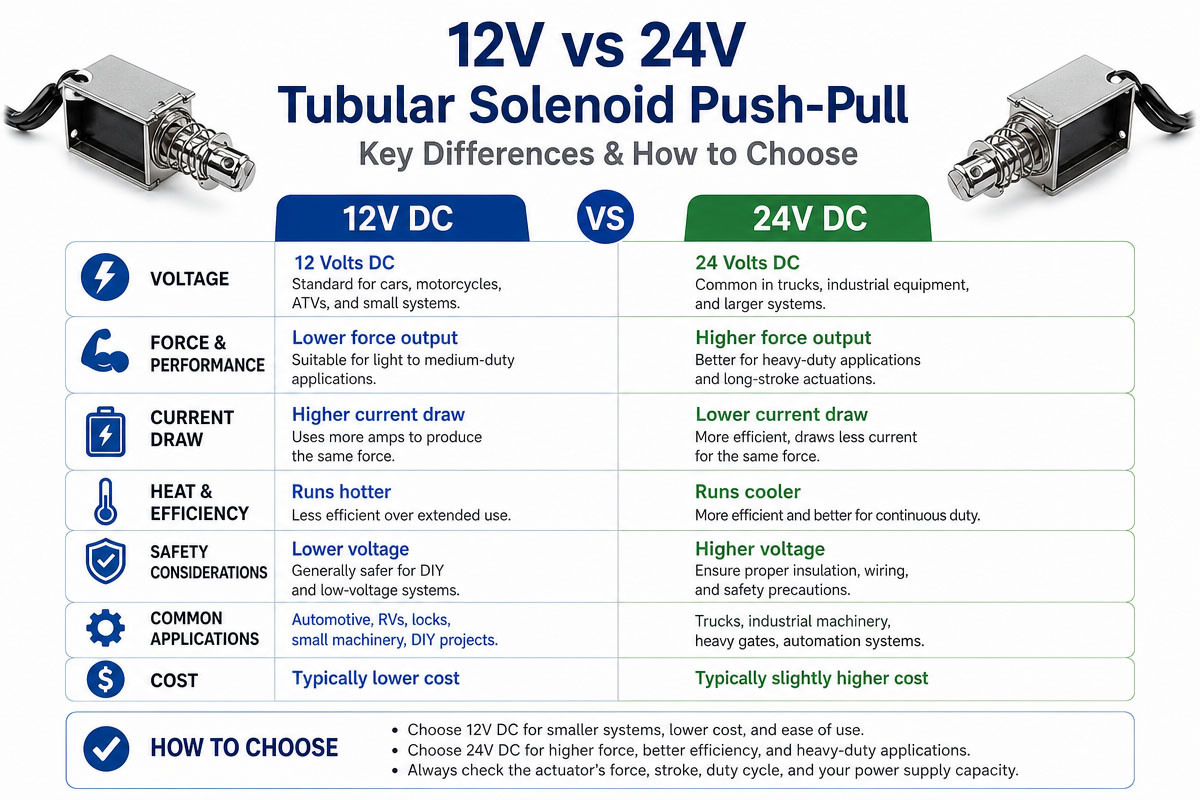
The main difference is the rated voltage at which it is going to operate. 12V tubular solenoid push-pull (12V DC power source) and 24V version (24V DC power source). The 24V version will draw half the current of the 12V version for the same power.
2. How much stronger is a 24V tubular solenoid than a 12V solenoid?
Maybe, not. The force of the solenoid is a function of coil design, current, magnetic circuit, plunger size, stroke, air gap, and many other parameters. A good 12V tubular solenoid push-pull can have equal or even greater force than a 24V model with a different coil design.
3. Why are 24V solenoids so popular in industrial automation?
24V DC is a standard voltage for industrial control systems. A 24V tubular push-pull solenoid can provide necessary power at a lower current than a similar 12V coil. It can decrease wiring, connectors, switching components, and PLC integration.
4. 12V vs 24V—Which is better for battery-operated equipment?
Another option that is often used where the equipment is already powered by a 12V battery or electrical system is 12V tubular solenoid push-pull. You can use a 24V solenoid with a power conversion system. It adds additional electrical components.
5. Does a 24V solenoid run cooler than a 12V solenoid?
No, not always. The heat is a function of the coil power, coil resistance, duty cycle, ambient temperature, and thermal design of the solenoid. A 24V coil will use less current for the same power, but you need to check the temperature performance of the specific solenoid design.
6. Is the cable length important between 12V and 24V?
Yes. Voltage drop caused by resistance of the cable. The same voltage drop is a greater percentage of the 12V supply than of the 24V supply. So the 24V tubular solenoid push-pull can be a more convenient electrical solution for longer wiring runs if the whole system is designed properly.
Chapter 13: Summary
Do not select a 12V or 24V tubular solenoid push-pull based only on voltage. The correct selection depends on the available power source, required force and stroke, duty cycle, cable length, operating temperature, control system, and the whole machine design.
The 12V model is suitable for battery-powered and smaller systems. The 24V model is better for industrial automation and PLC-controlled equipment, as it has less current for the same power level.
The most important point is that you should not assume that higher voltage always means higher force. All electrical & mechanical specifications of professionally designed tubular push-pull solenoids should be considered.
Selection of solenoid voltage, matching with the electrical architecture of the machine, as well as checking force, stroke, duty cycle, and thermal performance, will ensure reliable operation, longer service life, and easier system integration.
