Toroidal Core Coil Supplier for Industrial Projects
Toroidal Core Coil Improving System Efficiency
Toroidal Core Coil for EMI Noise Suppression Systems
Toroidal Core Coil Application in Smart Technology
Toroidal Core Coil for Automotive Electronics
Toroidal Core Coil Manufacturing and Technology Guide
Toroidal Core Coil Supplier for Industrial Projects
Toroidal Core Coil Improving System Efficiency
Toroidal Core Coil for EMI Noise Suppression Systems
Toroidal Core Coil Application in Smart Technology
Toroidal Core Coil for Automotive Electronics
Toroidal Core Coil Manufacturing and Technology Guide

WL270125 Toroidal Core Coil for Industrial Power Supplies

The Toroidal Core Coil is a high-performance magnetic component that consists of a circular magnetic core and wound wire. It has a closed magnetic path for inductance stability, low electromagnetic interference and high energy efficiency. Toroidal Core Coil is distinguished by decreased leakage flux, compact construction and good thermal performance compared to traditional coil construction. It is widely used in power supplies, transformers, renewable energy devices, automotive electronics, communication systems and industrial control devices. With the help of different core materials like ferrite, iron powder and nanocrystalline alloys, Toroidal Core Coil can be manufactured for diverse frequency range and power level.

Toroidal Core Coil Description

Toroidal Core Inductor is an electromagnet that consists of a circular magnetic core with conductive wire wound around it. Toroidal construction provides a continuous magnetic path, reducing magnetic leakage and increasing efficiency. The coil accumulates electrical energy in a magnetic field and controls the current in electronic circuits. The toroidal core coil can be used in different environments in terms of frequency and power level depending on the core material. Typical core materials are ferrite, powdered iron and nanocrystalline alloys. Toroidal Core Coil is widely used in industrial electronics, power conversion and filtering systems due to its compact structure, low-noise operation and high inductance performance.

How does a Toroidal Core Coil work?

A Toroidal Core Coil is a coil with a winding . When electric current passes through the winding , it induces a magnetic field . The current creates a magnetic flux in the circular core and closed-loop structure directs the flux effectively around the core.

The magnetic core concentrates the magnetic field, increasing the inductance, so the coil can accumulate and release electrical energy efficiently. While operating in AC, the coil resists the rapid change of current and controls the electrical signals.

The toroidal structure minimizes the flux leakage since the magnetic field remains inside the core. It improves the efficiency, reduces electromagnetic interference (EMI) and energy losses. Toroidal Core Coils are useful in system stabilization, noise reduction and voltage regulation in power applications.

Custom Toroidal Core Coil manufacturer for electronics Video

Toroidal Coil Detail Display

Toroidal Core Coil Data Sheet

Sendust Toroidal Coil Model Catalog 12

| Parameter | Typical Value |
| ——————— | ——————– |
| Core Material | Sendust (Fe-Si-Al) |
| Inductance Range | 3µH – 500 mH |
| Rated Current | 8A – 95A |
| Saturation Current | Up to 110A |
| Operating Frequency | 30 kHz – 125kHz |
| Operating Temperature | -40°C to +125°C |
| Insulation Type | Enameled Copper Wire |
| Core Shape | Toroidal |

Why Toroidal Core Coil Is So Popular?

Toroidal Core Coil becomes more and more popular, as modern electronic systems require higher efficiency, smaller size and lower electromagnetic interference.

The growing demand for renewable energy, electric vehicles, smart devices and advanced power electronics increases the need for efficient magnetic components.

Compact construction provides excellent performance. Closed magnetic structure decreases the energy loss and increases electrical stability.

Manufacturers and engineers prefer Toroidal Core Coil due to reliable operation, low noise and customizability options.

As the industries move towards energy savings and high-performance technologies, Toroidal Core Coil will become an important component in the future electrical and electronic systems.

Toroidal Core Inductor Applications

Toroidal Core Coil Magnetic Design Applications

Toroidal Core Inductor is a highly accurate magnetic component that allows to accumulate energy, filter and control current. It has a toroidal magnetic core and copper winding, optimized for different electrical requirements; Available in ferrite, iron powder and advanced magnetic materials it allows a wide range of frequency and power applications. Product has low loss, high reliability, high EMI reduction and stable inductance. Manufacturers can customize the dimensions, number of winding turns, wire diameter and electrical parameters to meet customer requirements. Toroidal Core Coil is widely used in power electronics, industrial equipment, automotive and renewable energy products.

Toroidal Core Coil Adv. & Disadv

Toroidal Core Coil Design Advantages Explained

Pros and Cons of Toroidal Core Coil

Pros

Toroidal Core Coil has several important advantages. The closed magnetic path decreases magnetic leakage and electromagnetic interference. This makes it efficient and suitable for sensitive electronic systems.

Compact circular construction provides high inductance in a compact size, saving installation space. The magnetic field remains in the Toroidal Core Coil providing low noise operation.

High energy efficiency, reliable electrical characteristics and long-term performance. Custom designs can be manufactured for various power, frequency and size requirements.

Disadvantage

Toroidal Core Inductor has several disadvantages despite its many advantages. The winding process is more complicated than conventional coils, which may increase the difficulty of manufacturing.

Automatic winding equipment may be required for high-volume production. The mounting process may differ from standard inductor and it may become more difficult.

At very high frequency applications, improper choice of core material may affect performance. Good design and material selection are required.

Toroidal Core Coil Core Material Selection Guide

Troubleshooting of Toroidal Core Coil

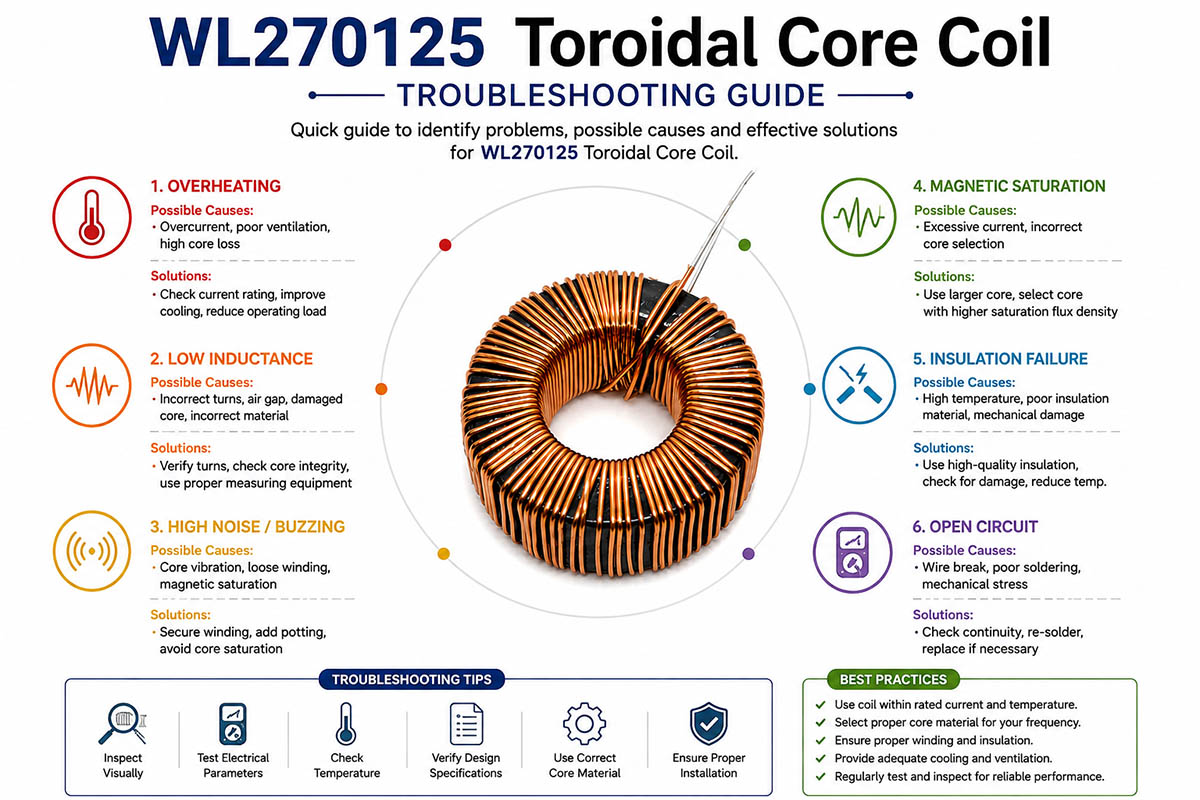
Most Common Toroidal Core Coil Problems . These are overheating, low inductance, noise or performance instability.

1.Overheated

Overcurrent, undersized wiring or poor heat dissipation can be the reasons. Estimate the operating current, optimize the cooling design.

2.Low inductance

Wrong winding turns, damaged cores or inappropriate materials can reduce the inductance. Estimate the specifications, quality of wind.

3.Loud Sound

Noise can be caused by core vibration, loose windings or electromagnetic interference. Improve the design of mechanical fixing and filtration.

4.Saturation in magnets

When the current exceeds the capabilities of the core, it will be saturated and the efficiency will decrease. Use a larger core or a material with a higher saturation level.

5.Insulation breakdown

Safety risks: high temperature or damaged insulation. Use suitable insulation materials and testing procedures.

Proper design, electrical testing and regular inspection can significantly improve the reliability of Toroidal Core Coil.

FAQ

1. What is a Toroidal Core Coil used for?

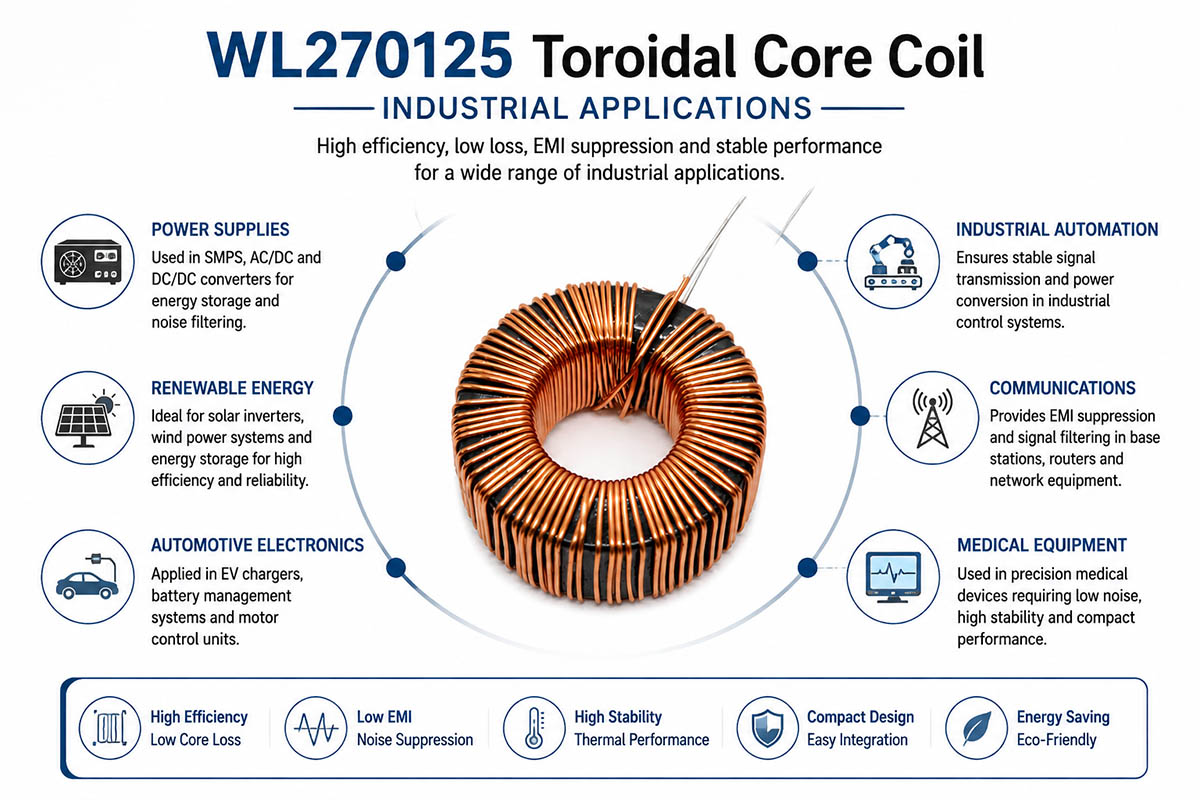
Toroidal Core Coils are used to store energy, filter current, regulate voltage and suppress EMI noise in electrical and electronic circuits. They are commonly used in power supplies, inverters, transformers, automotive electronics, renewable energy devices, communication devices and industrial control circuits.

2. What makes a Toroidal Core Inductor better than a normal coil?

There are some advantages of Toroidal Core Coil: low magnetic leakage, low electromagnetic interference (EMI), high efficiency, small size and inductance stability. In comparison with traditional open-core coil, Toroidal Core Coil has a closed magnetic circuit that increases energy transmission efficiency and minimizes undesired radiations.

3. How does a Toroidal Core Coil work?

Toroidal  Coil generates the magnetic field due to the current flowing through its winding. The magnetic flux is directed in a closed loop by the circular magnetic core which results in inductance increase and improved energy storage efficiency. This configuration provides control of current flow and reduces losses of power.

4. What are the Toroidal Coils common core materials?

There are common core materials such as ferrite, iron powder, nanocrystalline and silicon steel . The ferrite core is optimal for high frequency applications. The iron powder and nanocrystalline materials are mostly used for power applications where high current handling and magnetic characteristics are required.

5. How do I select the appropriate Toroidal Coil for my application?

When selecting a proper Toroidal  Coil, the inductance value, operating frequency, rated current, core material, temperature range, size, and installation requirements have to be taken into account. The coil has to be specially designed for the application conditions.

6 . Why Does My Toroidal Core Inductor Get Hot When I Use It?

The heating could be caused by overcurrent, incorrect core, small wire diameter, high power losses, poor ventilation. To minimize the operating temperature, the current rating check, heat dissipation improvement and selection of magnetic material can be effective.

7. Can Toroidal Core Inductor be custom made?

Yes. Custom Toroidal Coils are available in order to meet customer’s requirements. These are such parameters as core size, number of winding turns, wire diameter, inductance value, frequency range, terminals, insulation and mounting. Such coils are widely used for industrial and special electronic applications.

8. Which industries use Toroidal Core Coils?

There are many industries using Toroidal  coils including renewable energy, electric vehicles, industrial automation, telecommunications, medical devices, consumer electronics, audio and power conversion devices. They are characterized by high efficiency and low noise which makes them applicable for modern electronic systems.

How to Choose a Toroidal Core Inductor?

Choosing the right Toroidal Core Coil requires understanding of electrical requirements, operating conditions and application goals.

First, figure out what inductance you need. The performance of current control and filtering is directly related to inductance. Choose a coil with proper inductance for the frequency and power requirements of your circuit.

Second is the frequency of operation. You will need different core materials for different frequencies. Ferrite cores are used in high frequency applications and iron powder cores are used in energy storage and power applications.

Third, estimate the present capacity. The coil winding should withstand the maximum operating current without temperature rise. For high current systems, you may need a bigger wire diameter or better winding structure.

Fourth, estimate the core size and installation space. Toroidal Core Coil Compact performance, physical size should match the design of equipment.

Another important point is thermal performance. If you are going to operate it continuously under load, you should use coils with proper heat dissipation capability.

It is also necessary to estimate the environment of application. Machinery may need to withstand vibration, withstand high temperatures or operate for a long time.

Quality of manufacturing is crucial. Choose vendors with precise winding, uniform magnetic materials and tight quality control.

Lastly, estimate the requirements for customization. Depending on the application, you may need particular winding methods, terminals, insulation materials or mounting designs.

Engineers can estimate parameters such as inductance, frequency, current rating, size, thermal performance and reliability to choose the suitable Toroidal Core Coil.

Top Tips to Avoid Common Mistakes in Designing Toroidal Coils

Use the correct core materials for the operating frequency.

Do not neglect maximum current requirements. This can cause overheating.

Sufficient insulation between winding layers is required.

Do not over-tighten the wire or it may be damaged.

Think about thermal management during continuous operation.

While designing circuit do not make wrong inductance calculations.

Confirm EMI requirements before final production.

Test prototypes in real working conditions.

Choose the appropriate core size to avoid magnetic saturation.

Consistent performance through consistent manufacturing.

Get A Free Quote Now

Contact Form

Related Products

Related News

Scroll to Top

Get A Free Quote Now !

Contact Form
If you have any questions, please do not hesitate to contact us.
Weilong Solenoid Company Culture
