

Chapter 1. What is stainless steel CNC machining?
Stainless steel CNC machining is considered a subtractive manufacturing process where computer-controlled machines are used for the machining of stainless steel.
First, an engineer designs a digital 3D model. After that, CAM software is used for converting the design into machine-readable code. The cutting tools are then moved by the computer with an accuracy level of microns. The instructions given to machines are also digital, so repeated operations are done automatically, and the variation seen in machining is eliminated
Chapter 2. Three Main Stainless Steel CNC Machining Processes
CNC Milling
Rotary cutters are used in this process. Complex shapes, slots, and holes are created in the workpiece. The machining of non-cylindrical parts is done using this method.
CNC Turning
The workpiece is rotated, and the cutting tool is kept stationary. The cutting tool is then rotated against the workpiece, and the required shape is created. The machining done in this method is only for cylindrical parts.
CNC Drilling
Holes are drilled in the workpiece. This method is often combined with milling or turning
Chapter 3. Stainless Steel Grades for CNC Machining
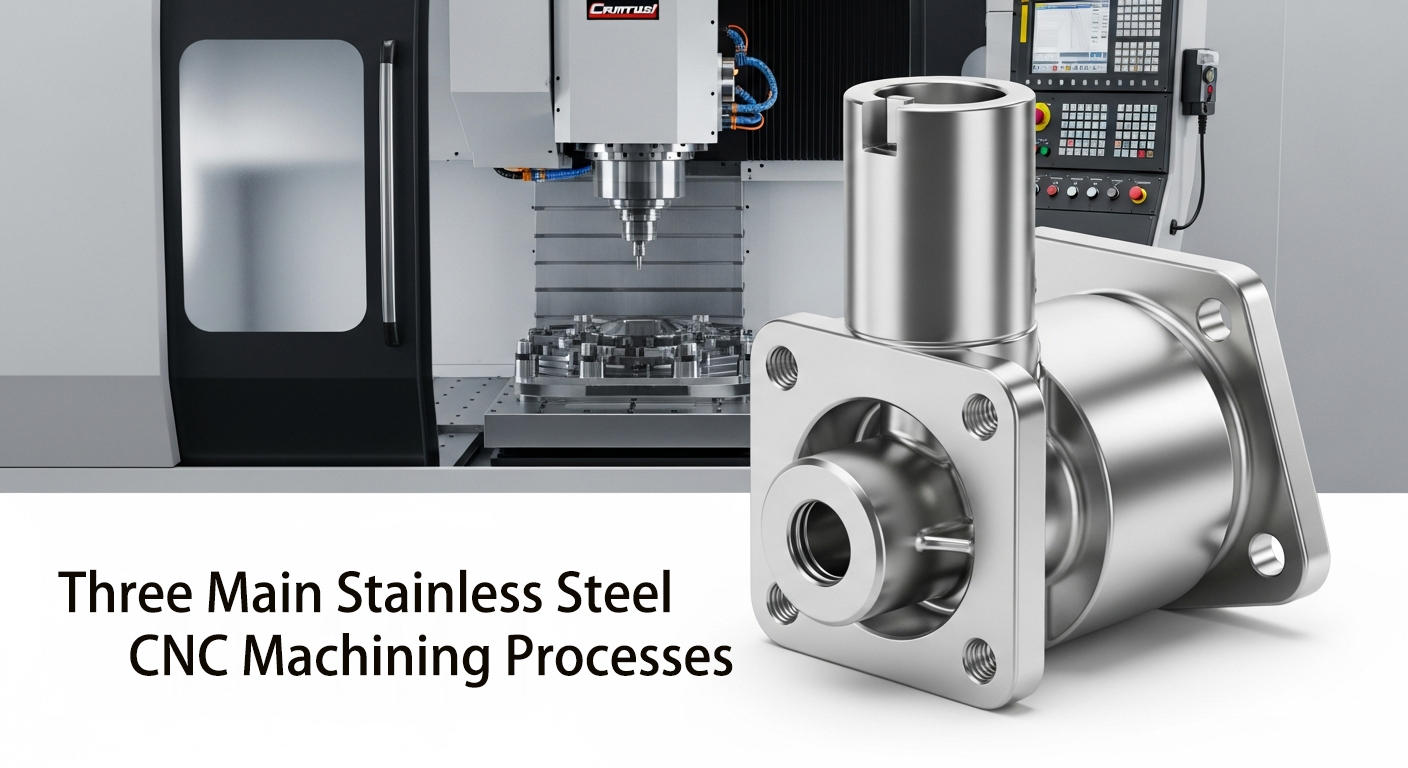
The selection of the grade is considered the most important aspect in any machining process, especially in stainless steel.
Five types of stainless steel are available, and each grade has its machinability.
3.1 Austenitic Stainless Steel
The family of austenitic stainless steel is characterized by its non-magnetic, high formability, and high corrosion resistance properties. About 70% of the total stainless steel produced is austenitic.
Primary alloying elements: Chromium, nickel, manganese, molybdenum
Key properties: weldability, formability, corrosion resistance
| Grade | Recommended Applications | Machinability Notes |
| 303 | High-volume, complex parts | Sulfur addition enables free machining; reduced corrosion resistance is accepted. |
| 304/304L | General-purpose components | Excellent balance of strength and corrosion resistance; 18/8 composition |
| 316 | Marine and chemical environments | Molybdenum provides superior pitting resistance |
| 321H | High-temperature engine parts | Titanium stabilization prevents carbide precipitation. |
| 309S | Continuous high-heat exposure | High chromium content resists oxidation |
3.2 Ferritic Stainless Steel
The magnetic properties, coupled with high thermal conductivity, make ferritic stainless steels attractive. Heat treatments are not applicable, so reduced toughness is expected compared to austenitic types. Machinability is relatively easy.
Common Grades – 405, 409, 430, 442
Typical Uses – Automotive trim, marine hardware, decorative parts
3.3 Duplex Stainless Steel
The combination of austenitic and ferritic phases in the microstructure is characteristic of these steels. Exceptional strength and superior corrosion resistance are offered.
Common Grades – 2205, 2507 (super duplex), 2304
Typical Uses – Chemical processing, offshore construction, high-stress applications
3.4 Martensitic & Precipitation-Hardening Stainless Steel
High strength and high wear resistance are provided by these steels, which are heat-treated. The PH and martensitic types contain low carbon and high carbon, respectively. PH steels have precipitation hardening; corrosion resistance is not sacrificed.
Martensitic Grades – 410, 420, 440A
PH Grades – 17-4 PH, 17-7 PH, A-286
Typical Uses – Cutlery, valves, surgical instruments, aerospace parts
Chapter 4. Advantages of Stainless Steel CNC Machining
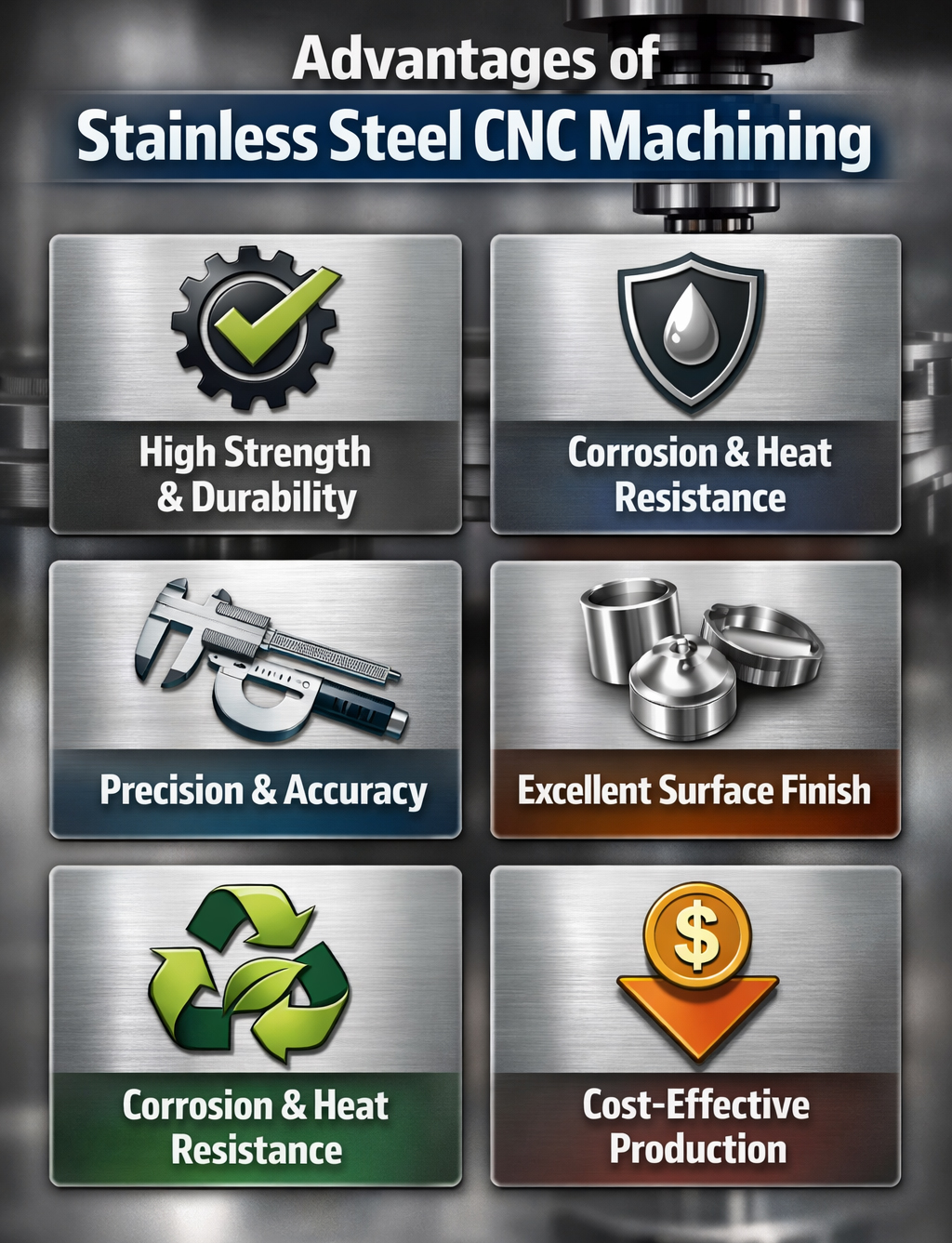
Corrosion resistance is assured. The chromium content will react with oxygen, and the surface will self-heal.
The ability to produce is versatile. There are many types that can be machined, so engineers may use whatever is most appropriate.
High tensile strength is achievable. The elements in these alloys, like chromium, nickel, titanium, and molybdenum, give these steels high mechanical properties.
The surface finish will remain attractive. The high chromium content will keep its shine forever. Plating is not required.
Cryogenic tolerance is maintained. Grades such as 304L have ductility and toughness properties at sub-zero temperatures. Brittle fracture is also minimized.
Chapter 5. Common Challenges and Engineering Solutions
Challenge 1: Heat Accumulation
Low thermal conductivity is a property of stainless steel. Heat is trapped at the cutting zone. As a result, tool wear or workpiece deformation occurs before the intended time.
✅ Solution: The use of oil-based coolants is recommended. In addition, moderate cutting speeds and sharp tool geometries are advised. As soon as overheating is observed, the machining is stopped, and the system is allowed to cool before investigation is performed.
Challenge 2: Chip Formation
During the machining of stainless steel parts via CNC machining, long and stringy chips are produced. As a result, there is a risk of tool entanglement, surface finish compromise, and tool overheating.
✅ Solution: The use of high-pressure coolant systems is recommended. In addition, chip breakers are advised. Sharp tool geometries are also recommended, which limit the volume of chips produced during machining.
Challenge 3: Work Hardening
During the machining of stainless steel parts via CNC machining, work hardening occurs. As a result, subsequent machining passes become difficult.
✅ Solution: Climb milling is recommended. In addition, a consistent feed rate is advised. The tool is also advised not to rub but instead cut the workpiece at all times.
Challenge 4: Tool Wear and Cost
During the machining of stainless steel parts via CNC machining, high-grade tooling is required. This is because of the hardness of stainless steel. As a result, tool costs are inevitably higher.
✅ Solution: The tool coating and geometry must match the type of stainless steel. In addition, tool sharpness is advised. The machining parameters must also be optimized, and adequate tool cooling is also advised.
[Other work-hardening prevention measures are also available.
Chapter 6. Industry Applications of Stainless Steel CNC Machining
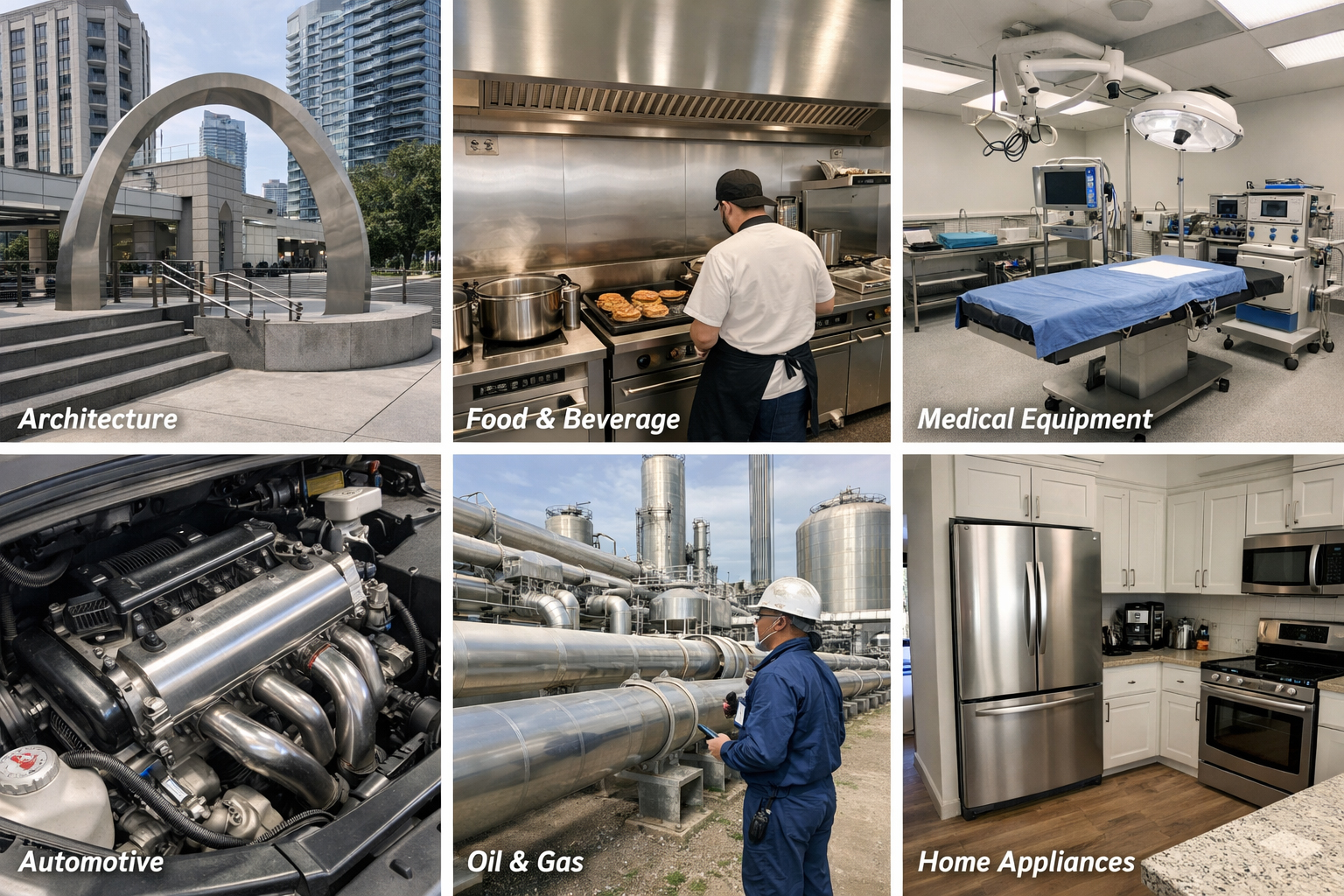
There are more than 150 grades of stainless steel available. Therefore, stainless steel CNC machining is used in every manufacturing industry.
Automotive Industry
Axles, shafts, exhaust systems, engine components, and brake lines are manufactured.
Hardware Industry
Hinges, fasteners, spacers, precision wheels, and mounting brackets are manufactured.
Aerospace Industry
Landing gears, bushes, clamps, and structural fittings are manufactured.
Marine Industry
Propellers, drive shafts, rigging hardware, and through-hull fittings are manufactured from corrosion-resistant alloys.
Medical Sector
Surgical instruments, forceps, ligation devices, catheters, and implantable devices are precision machined from biocompatible alloys.
Chapter 7. Frequently Asked Questions
Q1: What stainless steel grade is the easiest to machine?
A1: 303 stainless steel is the grade that is accepted to be the most machinable. Sulfur is added to enhance chip formation and reduce cutting forces. Corrosion resistance is somewhat compromised. However, for complex components in high-volume production, the trade-off is deemed to be worthwhile.
Q2: Is stainless steel suitable for heat treatment after CNC machining?
A2: Martensitic and precipitation-hardening grades may be subjected to a heat treatment process. However, austenitic and ferritic grades cannot be subjected to a heat treatment process. If a post-machining heat treatment process is a necessity, 17-4 PH, 410, and 420 grades should be selected.
Q3: Why are the costs of stainless steel CNC machining higher than aluminum machining?
A3: Three major factors contribute to the higher cost of machining stainless steel compared to aluminum. First, premium cutting tools are necessary. Second, slower speeds must be used. Third, increased tool wear is experienced. In addition to these factors, the cost of stainless steel alloys is significantly higher.
Q4: Is stainless steel CNC machining suitable for the manufacture of medical implants?
A4: Yes. 316L and 17-4 PH grades are regularly used for the manufacture of surgical instruments and other devices.
Q5: How is work hardening prevented during stainless steel machining?
Work hardening is avoided by maintaining a steady feed rate, sharp cutting tools, and climb milling. Cutting is continuous, with rubbing or dwelling strictly avoided.
Q6: What coolant is recommended for stainless steel CNC machining?
Oil-based coolants with high lubricity characteristics are recommended. They offer excellent heat evacuation and flushing of chips. Water-soluble coolants may also be used, but with a lower level of lubricity.
Q7: What surface finish can be achieved with stainless steel CNC machining?
Stainless steel machining offers an excellent finish, with an as-machined surface finish of between 32 and 64 Ra being routine. Finer surface finishes up to 16 Ra can also be obtained with optimal parameters and tooling.
Q8: When should duplex stainless steel be specified instead of 316?
Duplex grades such as 2205 and 2507 should be used where higher strength is a requirement or where stress corrosion cracking is a concern. _
Chapter 8. Conclusion
Stainless steel CNC machining is a function of careful attention to detail in four critical areas:
Stainless steel grade selection must be aligned with requirements and machinability.
Stainless steel CNC machining parameters must be optimized for the grade being machined.
Thermal management and chip control must be addressed.
The selection and maintenance of quality tooling must be sharp.
The role that manufacturing expertise plays cannot be overstated. The engineering community would benefit from a partnership with a company that has a strong background in machining, with a deep metallurgical and processing background.
Weilong’s manufacturing capacity and technology capability are fully matched with the requirements of stainless steel CNC machining. Precision parts are delivered reliably from prototype verification to volume production.
[Contact our engineering team →] for project evaluation and material selection help

