

Solenoid valves are common components found in fluid control systems. However, misuse or improper selection of these can result in various issues like fluid seepage, erratic flow, excessive heating, short lifespan, safety issues, as well as costly post-warranty problems.
This Solenoid Valve Buyer’s Guide defines what a solenoid valve is and how it works, its mechanics and construction, basic models and types, pros and cons, uses and applications, and troubleshooting steps to enable a well-informed buyer to purchase a solenoid valve with minimum risk.
EOC
Chapter 1. What Is a Solenoid Valve?
A solenoid valve is an electro-mechanically operated device that regulates the flow of liquids or gases. A solenoid valve works based on an electromagnetic solenoid coil that actuates a valve mechanism to open or close the fluid passage.
Examples of solenoid valves include:
– Industrial automation
– Medical & lab equipment
– Water treatment plants
– HVAC
– Coffee Machines & Appliances
– Automotive and Pneumatic Systems
They provide rapid, accurate, and remote-controlled fluid distribution and are critically important to current automated systems.
Chapter 2: How The Solenoid Valve Works
When the solenoid valve is power Off: The valve rests in its natural position (whether normally open or normally closed)
Energize: The flow of current in the coil leads to the production of a magnetic field.
Plunger Motion: The magnetic force raises/loweres the plunger against a restoring spring
Action in a Sealer: The movement of a plunger results in opening or closing a passage
Power Off Again: The plunger goes to its natural position when the power is turned off
Pilot Operation: In the indirect-acting types, the solenoid controls a small pilot flow, which in turn acts on the main valve.
Solenoid Valve Key Characteristics
Extremely fast response time (milliseconds)
Either full control on/off or proportional flow
Comes in NO (Normally Open) or NC (Normally Closed) variants- The power-off state influences safety actions
Chapter 3: Anatomy of A Typical Solenoid Valve
Standard Valve: It is constructed using the following key parts:
1. Solenoid
Copper windings with thermal insulation
Converting electrical energy to a magnetic force
Calculates voltage, power consumption, and heat rise
2. Plunger
Movable ferromagnetic core
Transmitting magnetic force into mechanical action
3. Valve Body Produced from brass, stainless steel, plastic, or aluminum Houses fluid channels and ports
4. Sealing Elements
Diaphragms O-rings
Materials: NBR, EPDM, FKM (V
5. Return Spring
Resets the valve to its normal state when power is turned off
6. Inlet and Outlet Ports
Connect the valve to the fluid system
Repeated
Chapter 4: The Types of Solenoid Valve
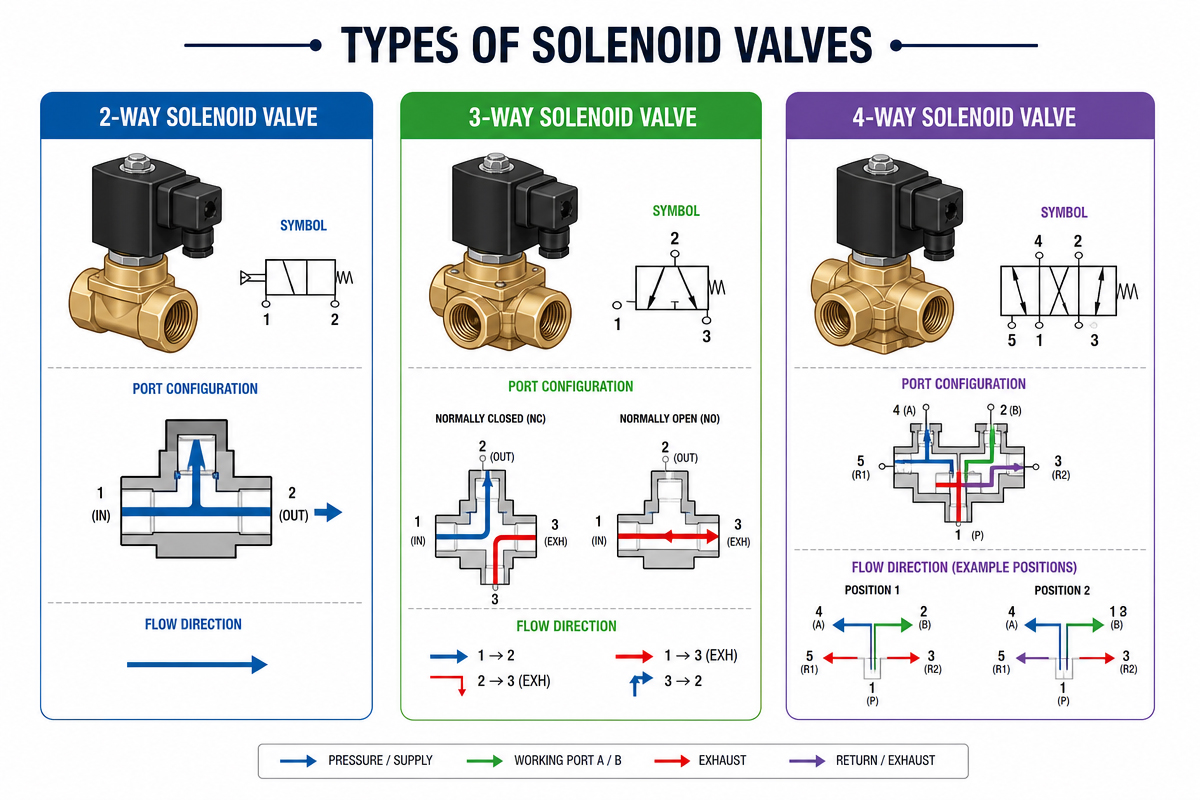
Determining the best valve to use begins with knowledge of the different kinds.
1. By Operation Mode
– Normally Closed (NC): Closed when not powered; opens when powered on
– Normally Open (NO) – Opens when unpowered; closes when energized
– Bi-stable (Latching): Retains its state even without constant power sources.
2. By Function
– Way Solenoid Valve: ON/OFF Control
– Way Solenoid valve: Bifurcate flow or D
– Way Solenoid Valve: Often used when controlling pneumatic cylinders
3. By Actuation Method
– Direct Acting: Does not use a pressure differential; used for low flow
– Pilot-Operated: Requires system pressure; used for high flow rates and pressures
– Semi-Direct (Assisted Lift): A combination of both approaches
4. By Media Type
– Water solenoid valves
–Gas solenoid valves
– Steam solenoid valves
– Oil and fuel solenoid valves
Chapter 5. Advantages & Disadvantages
Advantages
– Fast Response Time: usually 10–500 ms
– Remote Control: easy integration with PLCs and controllers
– Compact Design: Smaller size compared to manual valves
– Dependable Sealing: bubble-tight shutdown when properly specified
– Energy Efficient: Power consumption dominantly in state transition (except in latching)
– Versatile: Allows usage of diverse sizes, pressurized systems, and materials.
– Explosion Proof Options: For use in hazardous areas
Drawbacks
– Sensitive to Dirty Media: particulates can cause failures
– Continuous Power Requirement: For maintained position (except latching)
– Heat Generation: Continuous-duty coils require heat removal
– Pressure/Vacuum Limitations: Each type of valve will have its own pressure/vacuum
– Clicking Sound: potentially noisy in use
– Failure Mode: most often failed in the last position when power was lost
Chapter 6. Typical Applications of Solenoid Valve
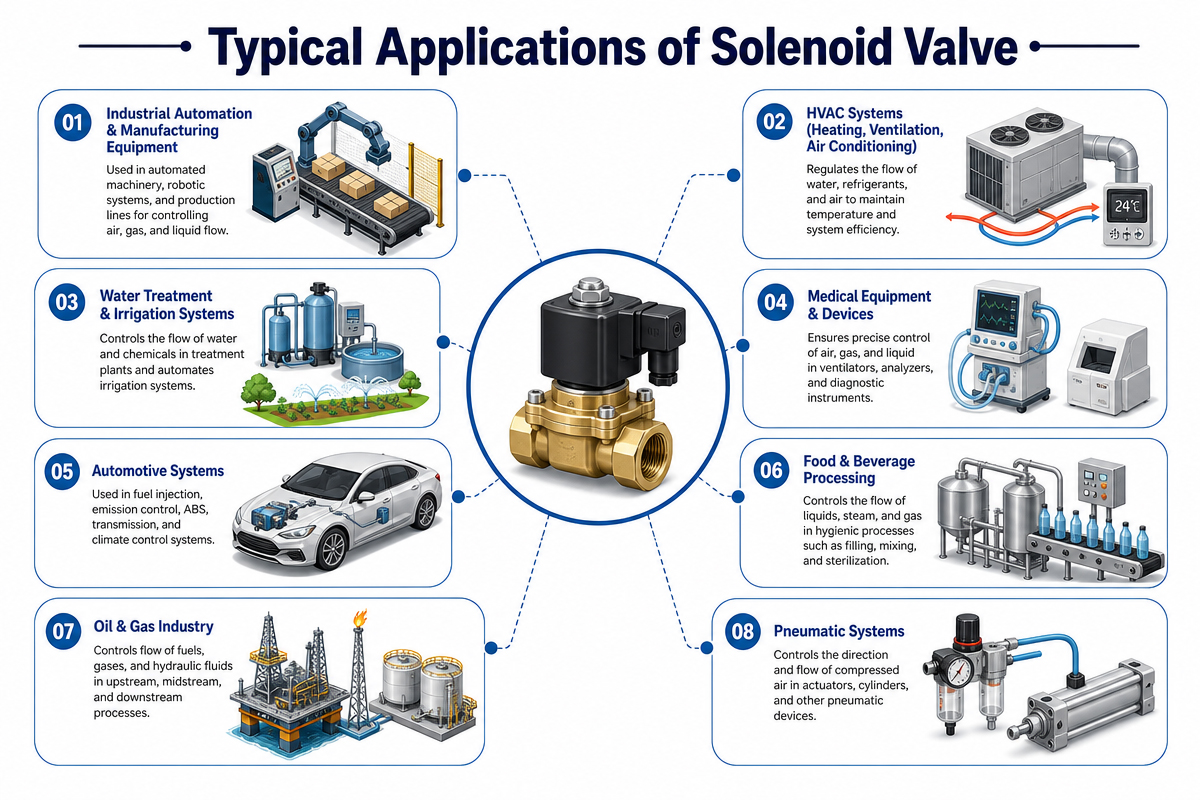
Control inlet and flow
– Medical Devices: accurate, hygienic fluid handling.
– Industrial Automation: pneumatic and hydraulic systems
– HVAC Systems: Control refrigerant and water flow
– Automobile Systems: Fuel/Air Systems and Emissions Control
– Smart Appliances: washing machines, dishwashers
Chapter 7: Solenoid Valve Buyer Checklist (Key Selection Factors)
Critical selection factors
– Media type: Liquid or gas, Viscosity, Temperature, Cleanliness
– Pressure range: Minimum operating pressure and Maximum rating
– Size of orifice: The Cv (flow coefficient) you require for your flow:
– Voltage and Power: AC/DC, voltage, frequency, and power usage
– Duty cycle: Continuous vs. Intermittent Operation
– “Material compatibility: The body, seals, and coil must be compatible with your media”
Environment
IP rating
Temperature range
Hazardous area rating
– Connection type: Either NPT, BSPP, flange, or quick
– Response time: how quickly the valve needs to open and close
– Red flags to look out forBuinctions/education
– Lack of datasheet or incomplete specs
– Materials not compatible with your media
– Close pressure ratings to the pressures at which you operate
– Unknown brand, without technical support
– Claims that apply generally without test results
Lack of warranty or terms and conditions confusing
Keywords
Quality indicators
– Certifications: CE, UL, RoHS
– Certified ISO 9001 manufacturer
Detailed Technical Documentation
– Availability of spare parts (seal kits)
– Easy pressure/temperature graphs
– Responsive technical support
FAQ (Frequently Asked Questions)
Q1: How do direct-acting valves differ from pilot-operated
A: Direct acting valves require no pressure but entail less flow; pilot-operated valves require pressure as well as higher flow.
Q2: Can a solenoid valve remain in continuous power?
A: Only valves for continuous use should be powered.
Q3: Ways for preventing leakage in valves.
A: Use proper seal materials, filters, and maintain media cleanliness.
Q4: What might be causing the buzz/vibration in my solenoid valve?
A: It may be due to unstable voltage, coil hum in AC, or internal.
Q5: Would latching solenoid valves be beneficial in a battery application?
A: Yes—they only use power when switching, which is great for power-saving scenarios.
Q6: Difference between normally closed and normally open?
A: NC valves remain closed when de-energized; NO valves remain open when de-energized. Select depending on application requirements.
Q7: Can the valve be used for air or gas?
A: Don’t. Seals, type of material, and design vary. It is always safest to use valves qualified for your fluid.
Q8: How do I determine what Cv value should be?
A: The formula is Cv = Q × SQRT(SG/ΔP), using flow rate GPM for Q, Specific Gravity for SG, and ΔP psi for differential pressure. Then add a safety marginal value of about 25%.
Q9: What would happen to the power?
A: That depends on what type of valve it is. It will close if it’s a normal close (NC) type. It will open if it’s a normal open (NO) type. It will remain in its state if it
Q 10: I hear a humming/buzzing noise in my solenoid valve. Why
A: This is characteristic of AC valves because the valves are subjected to the alternating magnetic field. If the buzzing is too pronounced, it might indicate low voltage, dust, or faulty parts.
Q 11: Can solenoid valves be installed in any orientation?
A: Generally, they can. But check the guidelines offered by the manufacturer. There may be some pilot-operated valves that have to be installed in a certain
Chapter 9 : Solenoid valve Troubleshooting Guide
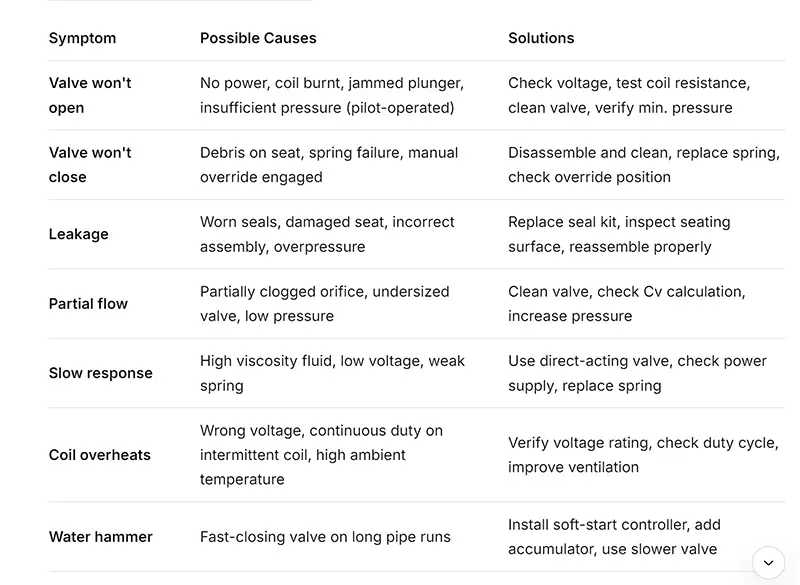
Chapter 10 : Maintenance Schedule
Daily: Check for leaks with a quick walk-through.
Monthly: Test the operation manually for actuation.
Every 6 months: Check for electric continuity.
Annually: Dismantle, clean, and replace seals.
As required: The coil resistance should be measured (it should correspond to the datasheet ±10%).
Chapter 11: Conclusion & Final Recommendations Summary:
Solenoid valves are critical in the automation process involving fluids. The reliability of the solenoid valves in the automation process is dependent on the selection process, installation, and maintenance. Always choose solenoid valves based on compatibility and pressure, rather than the price.
Top 5 Buyer’s Rules:
– “Never compromise on material compatibility— chemical resistance is non-negotiable.”
– Oversize Cv by 20-25% to retain the buffer as well as develop future requirements.
– Think about failure modes—use NC/NO depending upon the safe state with the loss of power.
– Quality demands an investment, and trust-worthy brands endure longer.
– Install properly—correct plumbing, filtration systems, or positioning fix most common problems.
When to Consult an Expert:
– Dangerous materials (corrosive, toxic, flammable
– Critical safety applications
– Extreme temperatures or pressures
– Complex multi-valve systems
– Whenever there are any technical specification issues.
Future Trends of Solenoid valve
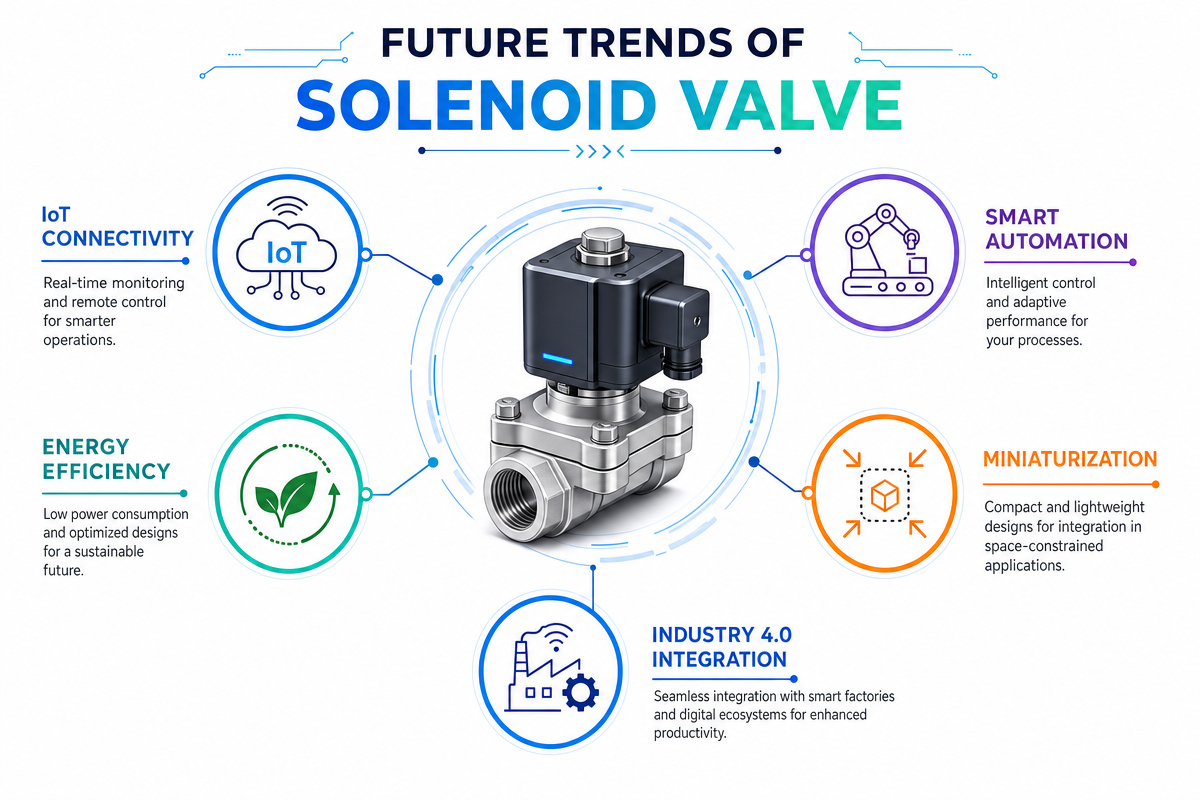
– Smart Valve: IoT Integration With Flow Sensors And Diagnosis
– Energy-Saving Designs: Less power consumption, energy-saving coils
– Universal compatibility: Resists different materials
– Quick Change Systems: Tool-less maintenance and coil replacement
Conclusion:
Document valve performance specifications, maintain spare seal kits on hand, and develop a routine maintenance schedule. A good solenoid valve will provide years of trouble-free performance with little maintenance. If unsure, contact the manufacturers’ application experts for information.
