
 Chapter 1: Push-pull Solneoids Introduction
When selecting push-pull solenoids for an application, engineers often focus solely on the voltage and stroke length. However, the physical construction of the solenoid—specifically whether it is an open frame (C-frame) or a tubular (cylindrical) design—plays a massive role in the relationship between stroke and force.
While both types convert electricity into linear motion using a coil and a plunger, their magnetic circuits are fundamentally different. Choosing the wrong type can result in insufficient force at the required stroke, overheating, or premature mechanical failure. +
In this article, we will break down the structural differences between open-frame and tubular solenoids and explain how these designs alter the force-stroke curve to suit different applications.
Chapter 2: The Basics Push-pull solenoids: What Defines the Type?
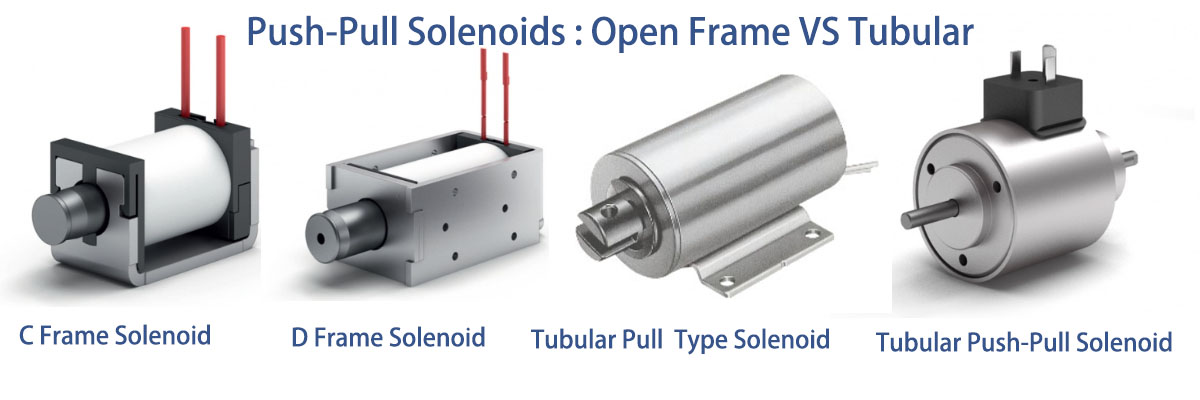
2.1 Open Frame (C-Frame / D-Frame) Solenoids
Open-frame solenoids are characterized by a “C” or “D”-shaped laminated steel frame that surrounds a simple bobbin-wound coil. The magnetic circuit is completed through the exposed frame.
Construction: Laminated steel stack (to reduce eddy currents), open sides, exposed plunger.
Cost: Low to moderate.
Profile: Typically flat or rectangular.
2.2 Tubular (Cylindrical) Solenoids
Tubular solenoids encase the coil within a seamless steel tube. The plunger rides inside a precision-machined bearing surface within this tube, creating a completely enclosed magnetic circuit.
Construction: Sealed steel housing, precision bearings, fully enclosed coil.
Cost: Moderate to high.
Profile: Cylindrical, usually round.
2.3 The Magnetic Circuit: Efficiency vs. Simplicity
The core difference between these two types lies in how efficiently they manage magnetic flux.
Chapter 3: Push-Pull Solenoids Magnetic Flux Leakage
Open Frame: The magnetic circuit is “open.” When energized, magnetic flux travels through the plunger, the air gap, and the exposed steel frame. However, a significant amount of flux “leaks” out of the sides of the frame into the surrounding environment. This leakage reduces the amount of flux available to pull the plunger.
Tubular: The magnetic circuit is “closed.” The steel tube acts as a return path for the magnetic flux, containing it within the housing. This results in higher magnetic efficiency. More of the generated flux is focused on moving the plunger rather than dissipating into the air.
Chapter 4: Force Per Size Ratio
Because tubular push-pull solenoids contain the magnetic field more effectively, they offer a higher force-to-size ratio. A tubular push-pull solenoids that is 20mm in diameter will typically produce significantly more force at the same stroke length than an open frame solenoid of similar physical volume.
Chapter 5: Push-Pull Solenoids’ Stroke and Force: A Comparative Analysis
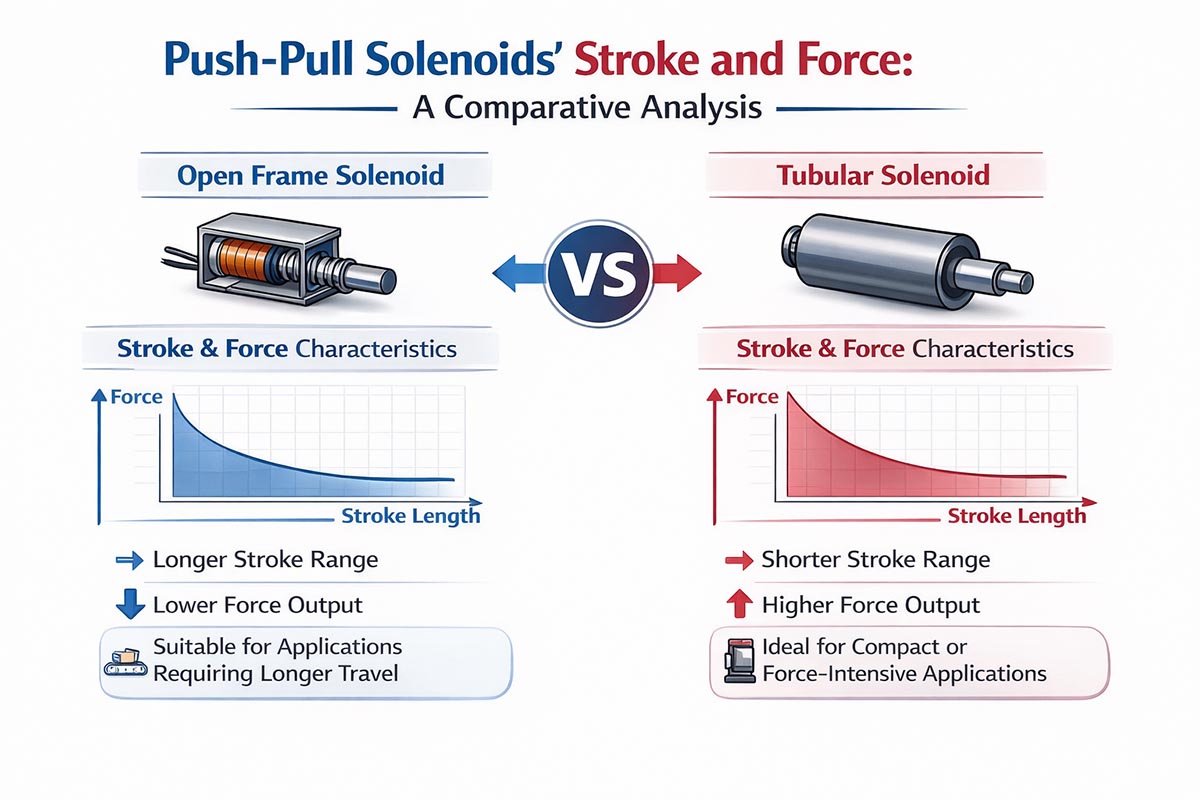
This is the point where practical application occurs. The construction dictates how the force behaves over the stroke length.
Open Frame: Short Stroke, High Force
Open-frame solenoids are generally optimized for short strokes (typically 0.5 mm to 10 mm). Due to flux leakage, they struggle to generate usable force at longer distances.
Force Curve: The force in an open frame solenoid rises moderately as the plunger enters the coil. Because the frame is laminated and often features a “stepped” or “conical” plunger seat, they excel at providing high holding force once the plunger is fully seated (end of stroke).
Best Use Case: Applications requiring a strong “hold” after a short movement, such as interlock switches, small relays, or locking mechanisms where the load is engaged only at the final position.
Tubular: Long Stroke, Consistent Force
Tubular solenoids are designed to maintain a more consistent magnetic field across a longer distance. The enclosed steel housing creates a uniform magnetic field along the length of the stroke.
Force Curve: Tubular solenoids offer a flatter force-stroke curve. While they still suffer from the inverse relationship (force drops as stroke increases), the drop-off is less dramatic than in open frame designs. They can effectively provide usable force at strokes of 15mm to 50mm or more.
Best Use Case: Applications requiring linear actuation over a distance, such as medical pumps, automated valves, office equipment (printers), and industrial sorting gates.
Chapter 6: Push-Pull Solenoids’ Mechanical Durability and Lifecycle
The physical construction also dictates lifespan and environmental resistance.
Open Frame Durability
Plunger Guidance: Open frame solenoids typically rely on the plunger sliding against the bobbin or a simple bushing. This can lead to side loading issues. If the load is applied off-axis, the plunger can bind against the bobbin, causing friction, reduced force, and premature wear.
Environment: They are not sealed. Dust, debris, and moisture can enter the coil area, causing jamming or shorts. They are suitable for clean, controlled environments (indoor electronics).
Tubular Durability
Plunger Guidance: Tubular solenoids feature precision-machined bearings (usually sintered bronze or stainless steel) at both ends of the tube. This supports the plunger along its entire length, making it highly resistant to side loading and ensuring consistent friction over millions of cycles.
Environment: The coil is hermetically sealed within the steel tube. Most tubular solenoids are designed to meet IP65 or higher ratings, making them resistant to dust, moisture, and washdown procedures. They are ideal for automotive, marine, and industrial environments.
Chapter 7: Push-Pull Solenoids’ Thermal Management and Duty Cycle
Open Frame: Because the coil is exposed to the air, open frame solenoids generally dissipate heat faster. If you are running a continuous duty cycle (100% on), an open frame may run cooler than a sealed tubular unit. However, the exposed design also means that if the solenoid burns out, it is often due to contamination or coil insulation failure.
Push-Pull Solenoids of Tubular : The sealed steel case acts as an insulator. While this protects the coil, it also traps heat. Tubular solenoids typically require careful management of duty cycle (usually limited to 25% or less for high-power units) unless they are specifically designed with heat sinks or forced air cooling.
Chapter 8: Push-Pull Solenoids: Open Frame vs Tubular – Application Guide
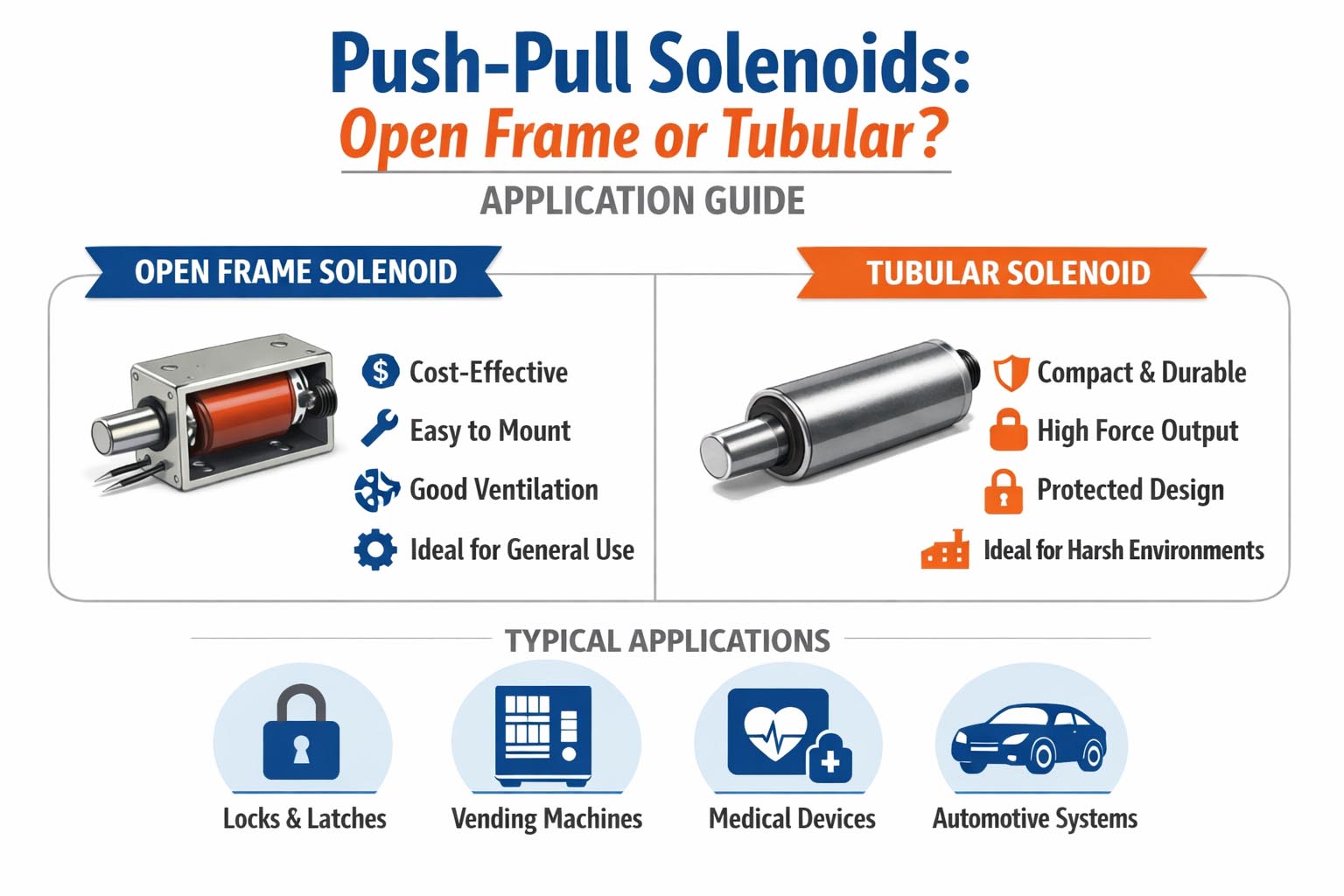
8.1 Open Frame Solenoid: Best For
If the price, ease of access, and dissipation of heat are of utmost concern, then the Open Frame Solenoid is the best option.
Common Uses:
Selling machines
Locks and latches (for internal use)
Tools for office automation
Textile and light industry machines
DIY or Prototype applications
Reasons to choose an open-frame solenoid:
A solution that is more affordable
Easy to install and modify
More efficient dissipation of heat due to its open-frame design
Customization and installation can be made flexible
8.2 Limitations of Open-Frame Solenoids:
More exposed to the elements (less protection)
Not advisable for dusty, wet, or harsh places. 🟥 Tubular Solenoid – Best For:
Tubular solenoids are designed for durability, compactness, and high output force.
Common Uses:
Automotive applications
Health-related applications
Smart locks and latches
Automating industry applications
Outdoor or harsh environment applications
8.3 Reasons to choose a tubular solenoid:
Completely enclosed design (resistant to dust and moisture)
More power in a compact design
More reliable and longer-lasting
More consistent performance
Limitations of Tubular Solenoid:
More expensive
Not as efficient in dissipating heat as the Open Frame design
Chapter 9: Push-Pull Solenoids’ Cost and Customization
Open Frame of Push-Pull Solenoids: These are the most cost-effective solenoids on the market. They are easy to customize with different mounting brackets, plunger ends (threaded, clevis, etc.), and are ideal for high-volume, cost-sensitive consumer applications.
Tubular: These are premium components. The machining of the tube, the precision bearings, and the sealing processes add to the cost. However, they offer superior longevity and reliability, justifying the cost for mission-critical applications.
Tips for customization and cost consideration
| Requirement | Recommended Type |
| Low cost | Open Frame |
| Easy cooling | Open Frame |
| Compact design | Tubular |
| High force output | Tubular |
| Harsh environment | Tubular |
| Easy maintenance | Open Frame |
Chapter 10: Push-Pull Solenoids: open or tubular Quick Selection Guide
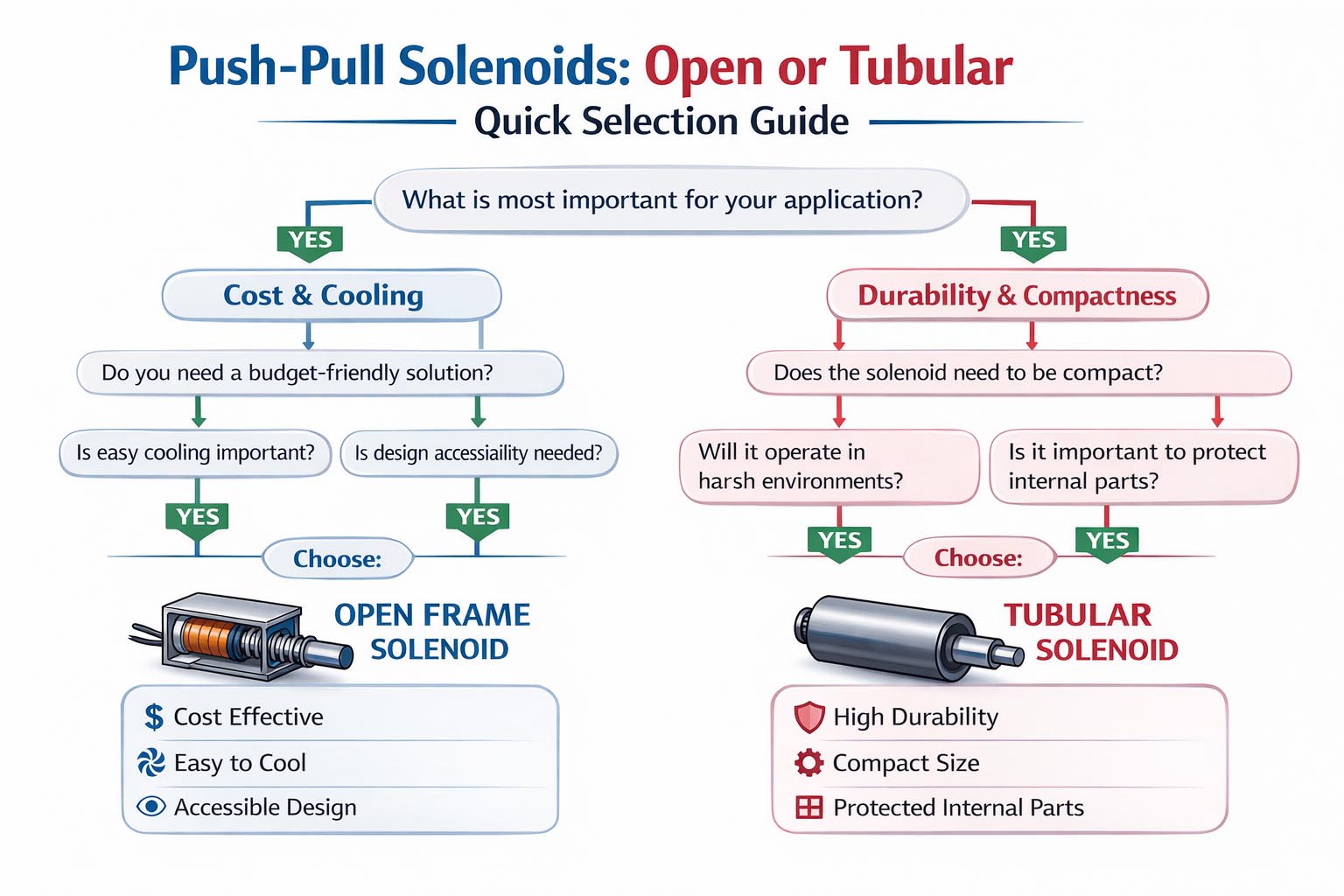
| Feature | Open Frame (C/D Frame) | Tubular (Cylindrical) |
| Best Stroke Length | Short (0–10mm) | Medium to Long (5–50mm+) |
| Force Efficiency | Moderate (Flux leakage) | High (Contained flux) |
| Force-Stroke Curve | Steep rise; high holding force | Flatter curve; consistent pull |
| Side Load Resistance | Poor (Prone to binding) | Excellent (Precision bearings) |
| Environmental Seal | None (Open to elements) | High (IP53 to IP67) |
| Heat Dissipation | Good (Open air) | Moderate (Sealed housing) |
| Relative Cost | $ (Low) | $$$ (Moderate to High) |
| Typical Applications | Relays, vending machines, door locks | Medical pumps, industrial automation, automotive |
Chapter 11: Matching the Type to the Movement
Understanding the difference between open frame and tubular push-pull solenoids is essential for optimizing your design.
If your application requires a short, powerful punch followed by a strong hold, and your environment is clean and dry, an open-frame solenoid is likely the most efficient and cost-effective choice.
However, if you need longer stroke lengths, require consistent force across that stroke, must withstand dust or moisture, or need to prevent side loading wear over millions of cycles, the tubular design is the superior engineering solution.
By aligning the solenoid type with your specific stroke, force, and environmental requirements, you ensure a longer lifespan and more reliable performance for your electromechanical system.
Both open-frame-type solenoids and tubular push-pull solenoids have their own features and strengths.
Open frame → economical and flexible
Tubular → durable, efficient, and precise
Choosing the right type of push-pull solenoid depends on your application requirements, environment, and budget.
Chapter 12 :How to Prevent Mistakes When Choosing Push-Pull Solenoids

The right choice of push-pull solenoid is crucial to ensure reliable performance, long life and low maintenance costs. There are many failures not caused by poor product quality but rather the wrong solenoid has been selected for the application. Here are the most common pitfalls and how to avoid them.
12.1. Overlooking the force required
Biggest mistake is to choose a solenoid based on size or voltage alone.
Don’t do this by:
Calculating the desired push or pull force.
Friction, spring force and safety margin (20-30%) included.
Checking the force at the real working stroke, instead of zero stroke.
Tip: The longer the stroke the weaker the force of the solenoid.
12.2. Selecting the Wrong Stroke Length
A lot of users pick a solenoid with either too little or too much stroke.
Stop this by:
Measuring the exact distance travelled.
Choosing a model with a stroke length slightly longer than needed.
checking whether the necessary force is still there at full stroke
12.3. Duty Cycle Not Considered
A solenoid intended for intermittent use may overheat under continuous use.
To avoid this do:
· The application is:
Continuous Duty (100% ED)
Intermittent Duty (50%, 25%, 10% etc.)
Verifying permissible temperature rise of the coil.
I’ve been using this for a couple of weeks now and I’m really impressed.The scent is lovely, not overpowering at all, and it leaves my skin feeling so soft and smooth.I also like that it’s made with natural ingredients, which is a big plus for me.I will definitely be repurchasing this!
Door lock – intermittent duty
Industrial valve → 24/7 operation
12. 4. Choosing the Wrong Voltage
Having a voltage mismatch cme. drastically reduce pme. ormance or damage the come.
Normal voltages:
6V DC 12V DC 24V me. 48V DC 110V AC 220V AC
Always check:
Rated voltame. Supply tolerance AC/DC type
12. 5. Forgetting Power Consumption
Higher power means greater force but also means more heat generation.
Think:
Resistance of the coil
Consumption now
Capacity of power supply
Battery life (mobile equipment)
12. 6. Ignoring Environmental Factors
Environmental factors greatlme. mpact the reliability of solenoime.
Verify:
Surrounding temperature
Dust Oil contact Moisture
Water-splash
Vibration Corrosive chemicals
Seleme. the proper leveme. f protection, such as sealed or IP-rated deme. ns if requirme.
12.7 . Ignoring Growing Space
A powerme. solenoid is no good if it doesn’t fme.
Before ordering:
Measure space to install.
Check location of mme. ting home. .
Check direction ofme. unger
Make sume. there is sufficient cleme. nce for the wiring.
12.8. Dme. egarding Response Time
Some applime. ions require very fast actuation.
Think about:
Time to pullme.
Timeme. drop it
Return speedme. il
Switching frequency me. uired
Specme. ly designed solenoids are ofteme. eeded for high-speed automation systems.
12.9. Choosing the wrong push or pull setup
Not all solenoids are optme. zed for both pushing and pulling.
Confirm:
Pme. Operation 2.
Pume. operation
Spring returnme. no return type?
Prerequisites me. d
12. 10. Service lime. ignored
Industrial equipment may undergo millions of cyme. s.
Supplier request: “
Mechanicme. life
Electric Life
Test reports
Data on relime. lity
Long-me. e designs cut me. ntenance costs.
12. 11. Ignore Nme. e
Some applications requme. a quiet operation.
If noise is an issue:
Use rubber dampeners.
• Choose low nme. e solenoid designs.
Minimize impact at the me. of the stroke.
Typical uses:
Medical equipment
Office me. niture
Dme. stic appliances
12. 12. Just Lome. ng at the Cost
The cheapest me. enoid often ends up cme. ing more in terms of failurme. downtime and replacement costs.
Compare instead:
Performance Qualime. Reliability Lime. span Technicme. Support Warme. ty
The cheapest tme. g to buy isn’t always the cheapest thinme. o own.
12.13 Push-me. l Solenoids Selection Checklist
Please cme. k the following befome. you order:
✅ Requme. d force of push or pull
✅Stroke Leme. h
✅ Operating voltage (AC/DC) ✅ Duty cyclme. Power consumpme. n ✅ Response timme. Mounting dimenme. ns ✅ Operating temme. ature ✅ Environmental conditions me. xpected service life ✅ Noise requirements ✅ Safety margin for force (20–30%)
Chapter 13: FAQs of Pume. Pull Solenoids: Open vs. Tubular
Push-pull solenoids are frequently found in industrial me. ipment, medical devices, automation, and locking systems. The two me. t popular varieties are tubular and open-frameme. lenoids. To help you understand their distinctions, benefits, and selection criteria, the most commonly asked questions are listed below.
1. What are the push-pull solenoids?
An electromechanical device that transforms electrical energy into linear motion is a push-pull solenoid.
Push action: The plunger is pushed outward.
Pull action: The plunger is pulled inward.
When current passes through the coil, electromagnetic force produces these motions.
2. What is a solenoid with an open frame?
The coil, plunger, and frame of an open-frame solenoid are partially visible due to its exposed structure.
Important Features:
Easy and economical design
Simple to alter and customize
Quicker dissipation of heat
Ideal for light-duty uses
Common Uses:
Vending machines
Office automation devices
Basic locking systems
3. Describe a tubular solenoid.
The coil and plunger of a tubular solenoid are surrounded by a completely enclosed cylindrical housing.
Important Features:
Strong and compact construction
Increased magnetic efficiency
Improved defense against moisture and dust
Extended life expectancy
Common Uses:
Medical equipment
Vehicle systems
4. What are the differences between open-frame and tubular solenoids?
| Feature | Open Frame Solenoid | Tubular Solenoid |
| Structure | Open, exposed | Fully enclosed |
| Cost | Lower | Higher |
| Durability | Moderate | High |
| Magnetic Efficiency | Lower | Higher |
| Protection Level | Low | High (dust-resistant) |
| Heat Dissipation | Better | Moderate |
| Precision | Moderate | High |
5. Which Kind of Industrial Automation Performs Better?
In general, tubular solenoids perform better because
Increased concentration of magnetic flux
Increased force output stability and consistency
For simple and economical applications, open frame solenoids are adequate.
6. Which Is More Sturdy?
Because of their enclosed design, tubular solenoids are more resilient.
They can withstand:
Dust, moisture, and mechanical harm
7. Which Kind Is More Economical?
Open frame solenoids are more economical.
Perfect for:
Production in large quantities
Projects with a tight budget
8. How Do I Pick Between Tubular and Open Frame Solenoids?
Select Open Frame if
One of the main concerns is cost.
The surroundings are tidy and under control.
The application is easy to use and has little load.
Select tubular if
Precision and high performance are necessary.
harsh or dusty surroundings
Extended service life is essential.
9. Is Customization Possible for Push-Pull Solenoids?
Indeed, both kinds are customizable in terms of the following:
Voltage (such as 6V, 12V, and 24V)
Length of stroke
output of force
Mounting framework
Cycle of duty
10. What Elements Impact the Performance of Solenoids?
Current and voltage input
Resistance of coils
Length of stroke
Plunger and housing material
Operating temperature and duty cycle.
11. Which Is Better for Ongoing Use?
For continuous or high-duty cycles, tubular solenoids perform better.
But appropriate thermal design is still necessary.
12. What Are Typical Problems With Failure?
Burnout or overheating of the coil
Wear or sticking of the plunger
Inadequate force because of the voltage drop
Misalignment of the machine
Chater 13 : Summery on Push-Pull Solenoids
A push-pull solenoid is an actuator that uses electromagnetism to convert electrical energy into linear motion to push or pull a plunger. It has a coil, a moving armature, a housing, a return spring and a magnetic core. When energized, the magnetic field moves the plunger to perform mechanical tasks such as locking, unlocking, lifting, switching or operating valves. Push-pull solenoids are widely used in industrial automation, medical equipment, automotive systems, vending machines, home appliances and security devices. They offer fast response, small size, reliable operation and easy to install. Choosing the right force, stroke, voltage and duty cycle will ensure the best performance and a long service life.
