
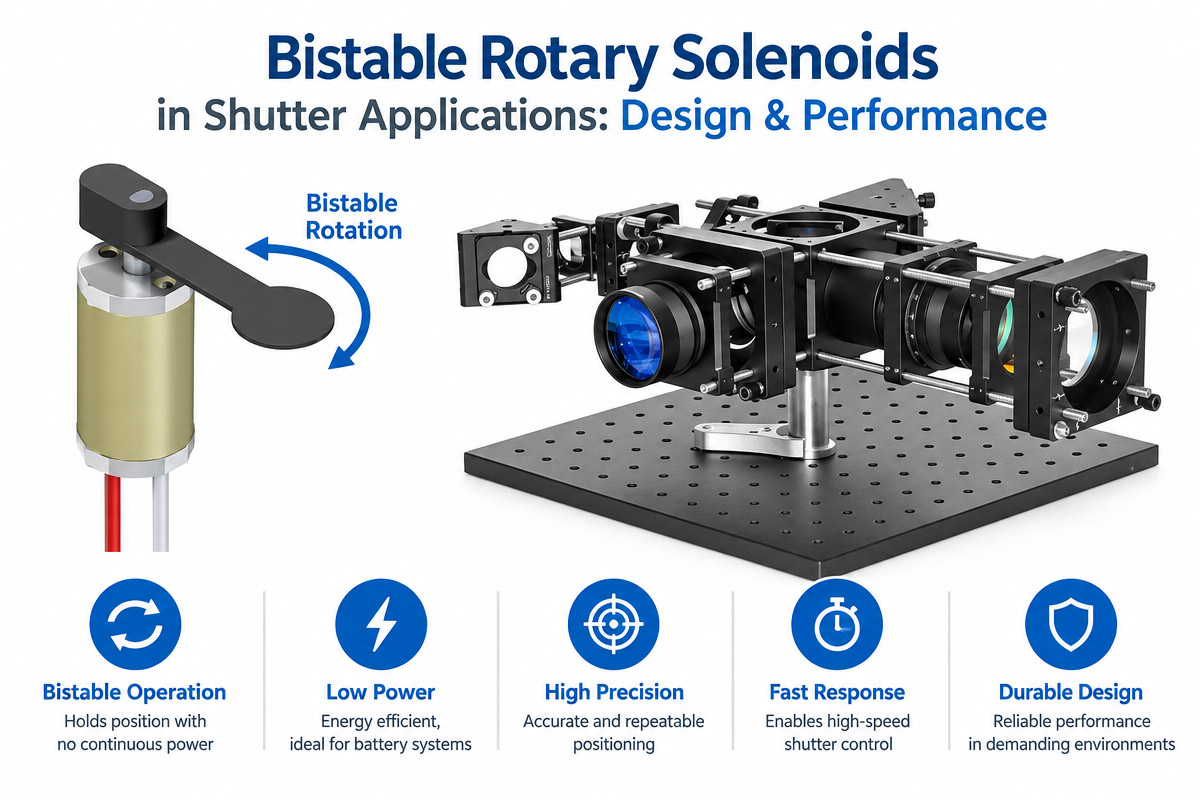
Introduction to Bistable Rotary Solenoids in Shutter Applications
Precision, efficient operation, and reliability—these factors determine consistent performance of equipment in modern industrial automation technologies. Reliable actuators that provide precise movement and energy-efficient operation are needed for various shutter mechanisms in optical instruments, imaging equipment, industrial machines, and automated control systems.
Bistable rotary solenoids meet the requirements of those applications perfectly. Unlike conventional actuators, which require electricity to maintain their position, bistable actuators have their position fixed by magnetic forces. This feature makes bistable actuators especially effective in the applications where there is frequent switching of the shutter.
Using compact constructions, bistable solenoids can provide effective solutions for shutter mechanism manufacturers.
This paper describes the basics of operation, mechanics, features, applications, and selection of bistable rotary solenoids in shutter systems, as well as questions that should be answered before purchasing.
1. What Is a Bistable Rotary Solenoid?
The bistable rotary solenoids are electromechanical actuators that rotate the output shaft to two predefined and magnetically stable positions.
The bistable nature means that the device can maintain any position independently of electricity supply.
In the case of conventional permanent-magnet latching actuator design, the change in polarity of the magnetic field is performed by a short pulse of electricity. This change shifts the rotor into the other stable position. Once the rotor reaches this position, the actuator holds it firmly in place using magnetic forces.
1.1 Bistable Rotary Solenoid Main Components
As a rule, the following main components comprise a bistable solenoid:
The coil is generating the magnetic field that switches the actuator.
Magnets create magnetic forces that hold the actuator.
The rotor and shaft translate the electromagnetic forces into rotation.
The stator or magnetic housing maintains the construction and directs magnetic lines of force.
Mechanical stops determine the limits of rotation and help define stable positions.
Depending on a particular design, the switching process is either provided by changing the polarity of the coil or some dedicated drives are used.
This feature is quite useful for shutter applications, as it makes the bistable solenoid stay in a closed or open position without electricity power consumption.
2. Bistable Rotary Solenoids: Why They Are Suitable for Shutter Applications?
The shutter mechanisms find wide applications in cases when the performance of the equipment is determined by the speed, precision, tight installation space, and energy efficiency.
Conventional actuators can produce excessive heat, need some additional mechanism to hold the position, or increase the complexity of equipment operation.
Bistable rotary solenoids solve all of these problems.
Low power consumption
One of the main advantages is the absence of coil power consumption when the actuator is magnetically latched.
The only requirement for electrical power appears to perform switching operations.
This property is particularly helpful in battery-operated units, optical devices, and those devices that have open/closed shutters for a long period.
Mechanical design, compact
The bistable actuators are actuators that perform rotary motion and hold it in a stable position by means of magnets.
The compact design may simplify the necessity to use dedicated motors, gears, or power-holding devices.
It makes easier the integration of the products for the manufacturers who have restricted space for installation.
Fast Switching Ability
There are bistable rotary actuators that are designed to perform quick rotation and therefore may be helpful in the applications where quick shutter switching is necessary.
The switching speed depends on such factors as coil design, supply voltage, load inertia, friction, angle of rotation, and driver.
“Steady Position Holding”
Magnetic locking allows removal of the electrical power without changing the actuator’s stable position.
It is convenient in case there is no need to energize the actuator continuously.
Though, it is important to mention that the holding torque should be sufficient to resist external forces, vibrations, and mechanical loads.
3. Operating Principle of Bistable Solenoids in Shutter Systems
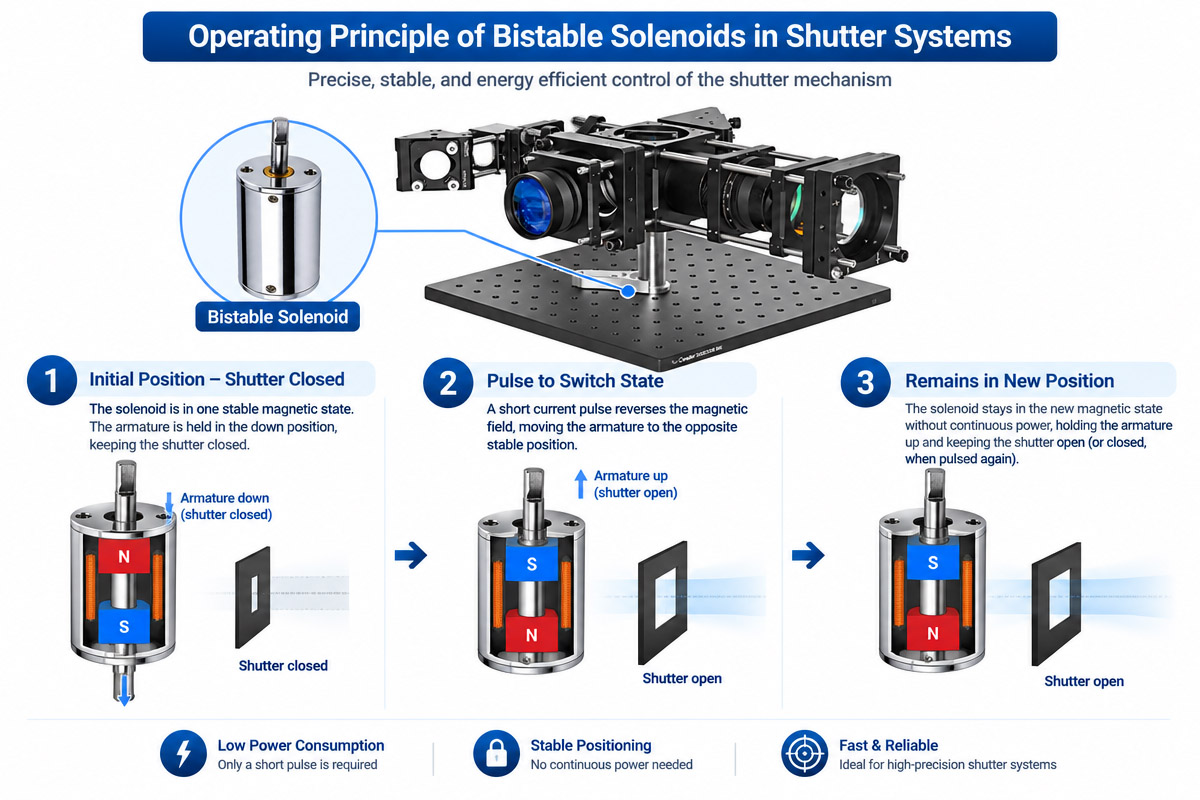
Knowledge of the operation sequence can help engineers in determining if the bistable rotary actuator can be used in a particular shutter design.
Shutter Operation Sequence
Defined.
Magnetic hold
Electric pulse
Position
Magnetic hold
The conceptual operation sequence of the bistable shutter actuator is as follows:
Step 1. Initial Stabilized Position
The bistable actuator is positioned in one of its two stable positions; let us say it is in a closed position.
The rotor is fixed by magnets without the necessity of current in the coil.
Step 2. Activation with Electric Pulse
The controller energizes the coil of the actuator with an electric pulse.
A change in magnetic field causes a change in torque and consequently in rotor position.
Step 3. Switching
The output shaft rotates with a defined angle of rotation, moving the shutter blade with the help of direct coupling or mechanical linkage.
The shape of the shutter defines how rotor rotation transforms into the shutter blade’s movement.
Step 4. Magnetic Latching
Permanent magnets fix the rotor when it reaches the stable position, and the actuator can be switched off.
Step 5. Making Change
Subsequent driving pulses (usually opposite polarity to the previous) switch back the actuator to the initial stable position.
4. Design Considerations for Shutter Application
Selection of the proper bistable rotary actuator requires taking into account several electrical and mechanical requirements.
4.1 Degree of Rotation
The actuator has to move the shutter enough to open and close it completely.
Depending on the blade configuration, different shutter mechanisms require different angles of rotation.
This angle must be sufficient to operate the mechanism without causing mechanical stress, which is well understood by engineers.
4.2 Torque (output)
The torque is the factor that determines whether the actuator can overcome the mechanical resistance of the shutter.
The required torque depends on many factors, such as blade inertia, bearing friction, linkage efficiency, and external forces and accelerations required.
The actuator has to provide sufficient dynamic torque during the whole rotation, not only at the initial position.
4.3 Torque (holding)
Holding torque is the measure of ability to maintain the position.
The ability to hold position is especially important for shutters subjected to vibrations, air flow, or mechanical impacts.
It is necessary to evaluate both open-position and closed-position torques.
4.4 Voltage and length of pulse
There are several electrical configurations of bistable actuators.
They have to provide enough electrical energy to perform the required movement without breaking electrical and thermal limitations.
The manufacturer has to specify voltage, current, pulse duration, polarity, and permissible conditions of pulse.
4.5 Mechanical integration
The actuator has to be compatible with the shutter mechanism in terms of shaft sizes, mounting arrangement, rotation direction, and overall dimensions.
A poorly aligned actuator causes additional friction, slowing operation and wearing.
5. Key Performance Attributes
Buyers of bistable rotary solenoids should consider not only the nominal parameters of the actuator but also its performance characteristics.
| Performance parameter | Importance in shutter applications |
| Switching time | Determines how quickly the shutter opens or closes |
| Dynamic torque | Ensures movement under actual load |
| Holding torque | Maintains position without continuous power |
| Angular travel | Defines available shutter movement |
| Pulse energy | Influences energy consumption per switching cycle |
| Cycle life | Indicates suitability for repetitive operation |
| Operating temperature | Affects coil resistance and magnetic performance |
| Vibration resistance | Helps maintain stable positions under disturbance |
5.1 Switching time
Quick movement of the shutter is very important in optical shutters, measuring devices, and industrial inspection systems.
But switching time has to be considered under real conditions.
Tested actuators without shutter blades can demonstrate completely different characteristics than mounted actuators.
5.2 Repeatability
The shutter position has to be consistent to control light exposure, air flow, or mechanical access.
Repeatability is influenced by the actuator, mechanical stops, linkage tolerance, bearing condition, and stiffness.
5.3 Heat Transfer
Bistable actuators don’t require continuous holding current, but they generate it during switching.
In case of high frequency, the coil can be heated, which influences resistance and switching.
Therefore, thermal validation is extremely important in case of demanding cyclic operation.
5.4 Cycles’ Life
Long-term performance depends on the quality of magnetic material, bearings, coil insulation, and mechanical construction.
Buyers have to ask for cycling life testing under application-specific conditions.
6. Common Shutter’s Applications
Bistable actuators may be used in many shutter mechanisms.
Optics and Laser-like Systems
Bistable actuators are applied to control the shutters, which block and provide passage of light.
This kind of actuator is effective for optical instruments due to its compact size and low holding-power requirements, provided that the mechanism is safe to use.
Imaging and Inspection Equipment
Bistable actuators may be integrated into automatic imaging systems to control exposure paths, protecting optical components or isolating sensing assemblies.
Analytical and Scientific Instruments
Repeatable movement and reduced heat generation are beneficial in measuring equipment.
Flow-Control Industrial Mechanisms
Small shutters or dampers may be actuated by bistable solenoids provided that available torque and angle of rotation are enough for the required mechanical load.
7. What is the difference between bistable and monostable rotary solenoids?
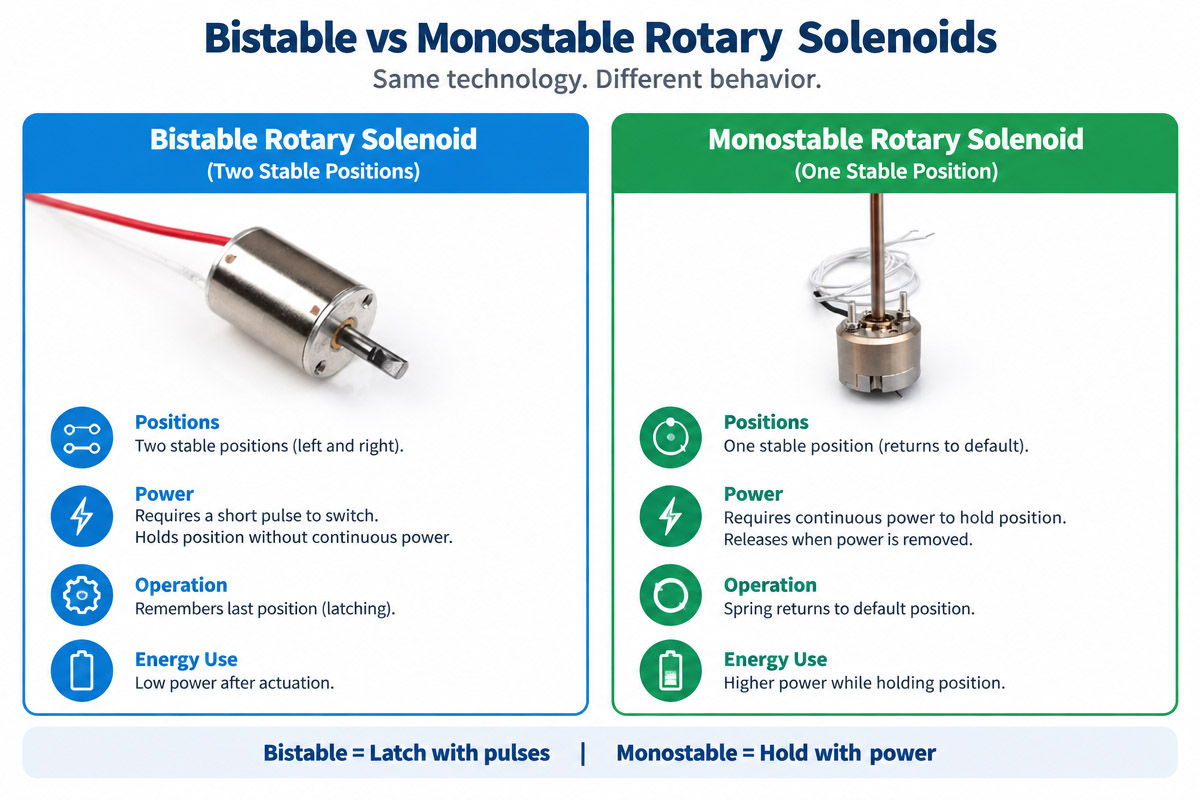
The manufacturer can choose the required operating principle, knowing the difference between bistable and monostable actuators.
| Feature | Bistable rotary solenoid | Monostable rotary solenoid |
| Stable positions | Two | One |
| Power for holding | Generally unnecessary | Often required to be away from the default position |
| Power-loss behavior | Typically retains the last latched position | Usually returns to the default position |
| Switching control | Often bidirectional pulse control | Commonly energize-and-release |
| Energy efficiency | Strong advantage for long holding periods | Depends on operating cycle |
| Suitable applications | Two-position, latching shutters | Return-to-default shutters |
Neither design is universally superior.
A bistable rotary solenoid is often preferable when the shutter must remain in either position for extended periods.
A monostable actuator may be more appropriate when the shutter must automatically return to a predetermined position after power loss.
For safety-critical applications, designers must evaluate the complete system’s failure behavior rather than assuming magnetic latching alone provides a safe state.
8. Improvement of the Shutter Operation by Proper Integration
Inconsistency in the operation may result from the poorly designed shutter mechanism even in case of high-quality actuator usage.
Manufacturers have to optimize the whole assembly.
Firstly, they should reduce the mechanical friction as much as possible with suitable bearings, accurate shaft alignment, and good linkage design.
Secondly, shutter blade inertia should be minimized. Lighter components consume smaller torque for acceleration, which improves switching performance.
Thirdly, the actuator has to match the electrical driver. Too small pulse energy leads to incomplete switching; too big energy consumes additional energy.
Four: Fit proper end stops and damping where necessary to prevent impact forces and noise creation.
Finally, the whole shutter assembly has to be tested over a wide range of temperatures, supply voltage variations, operation frequency, and cycle life.
9. Bistable Rotary Solenoids: Industrial Applications Case Studies
The bistable rotary solenoids have wide application possibilities in industrial machinery. Below you will see two examples of case studies that demonstrate how these actuators may improve the functioning of industrial equipment.
Example No. 1: Optical Shutters in Laser Instruments
Industry: Lasers and Optics Manufacturing
Application: Precise Optical Shutters in Industrial Laser Systems
Problem:
A company manufacturing the laser-based inspection equipment required a small-size actuator for operating the optical shutter device. The requirements for this actuator included fast switching, precise positioning, and minimal heat production near sensitive optical elements.
Ordinary actuators, which consume continuous holding current, have problems with power consumption and heat dissipation.
Solution:
As a solution, the company chose a bistable rotary solenoid powered by short electric pulses and latched by means of a permanent magnet.
Results and Benefits:
Minimized steady-state current consumption.
Reduction in heat dissipation during the stationary phase.
Optimization for miniature optical devices.
Two-position reliable optical shutter mechanism.
This example illustrates one more application of bistable rotary solenoids.
Example No. 2: Banknote Sorting Machines
Industry: Banking Automation Machinery
Application: Banknote Diverters in Currency Processing Systems
Problem:
In automated systems of banknote processing, the diverter gates should be switched quickly and precisely to change processing paths. The regular actuators might need some return springs or constant holding power.
Answer:
Using bistable rotary solenoids, one could make quick and bi-directional movement of a diverter gate from one position to another with short electric pulses. A permanent magnet holds the diverter in its new position without continuous current flow.
Results and Benefits:
Reduced holding power requirements.
Simplified Mechanical Design.
Rapid and accurate gate positioning.
Reduced heat generation on idle mode.
Compatibility with repeated processing tasks.
As indicated by the manufacturers, at present bistable rotary solenoids are widely applied in banknote sorting and paper transporting machines.
ACTRONIC SOLUTIONS
These two case studies provide insight into industrial applications of bistable rotary solenoids. Their compact design, bi-directional actuation, and no-power position locking give rise to a lot of benefits.
10. Selection of Suitable Bistable Rotary Solenoid Manufacturer
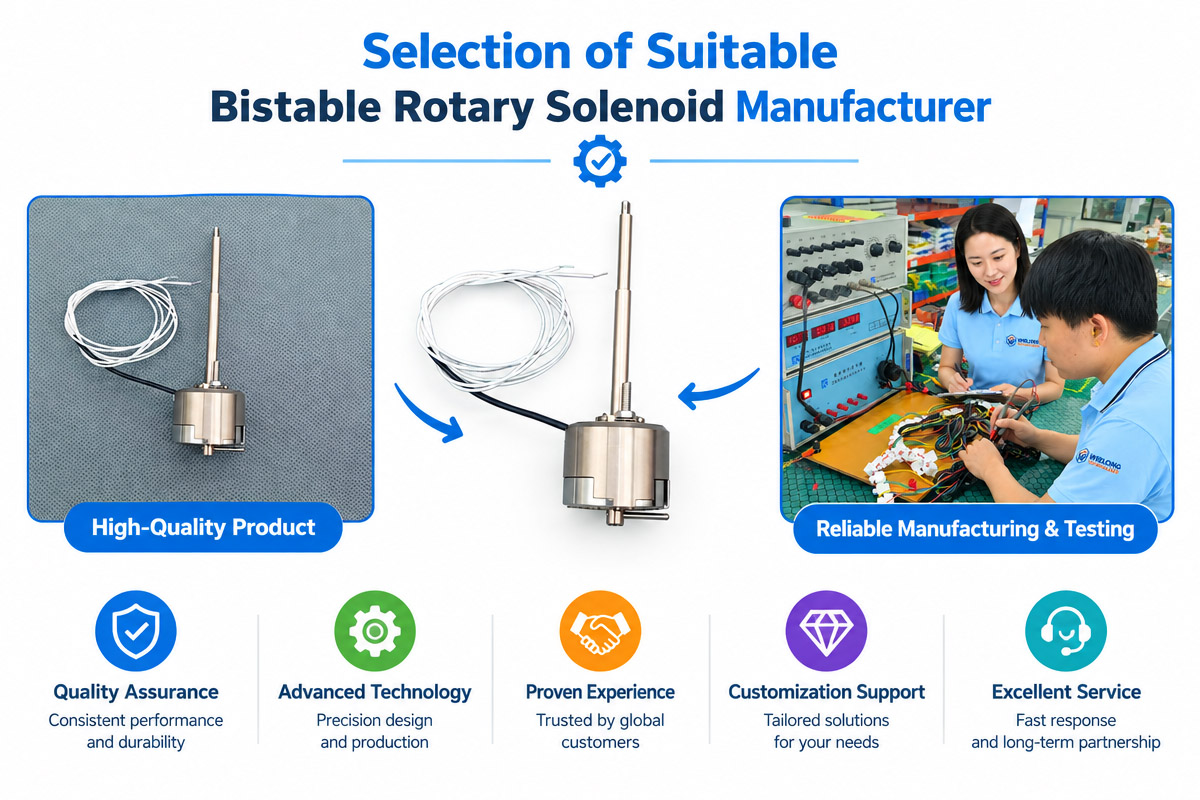
For OEM buyers and purchasing specialists, selection of an experienced manufacturer is as crucial as selection of a proper design.
An experienced supplier shall provide comprehensive technical information and engineering expertise.
Key evaluation criteria include:
Detailed torque vs. angle performance.
Proven hold torques for both stable positions.
Electrical performance data and conditions of pulse drive.
Shaft interface dimensions and mechanical drawings.
Life testing data, vibration, and temperature data.
Data on electrical, mechanical, and mounting interfaces.
* Consistency in batch-to-batch production * Quality control procedures in manufacture
Also, buyers should consider such issues as availability of prototypes, lead times, production capabilities, and long-term support for the products.
Custom-designed bistable rotary solenoids could integrate better into specific shutter systems than standard units.
A supplier offering support for prototype development and specific application testing could reduce potential redesign risks and accelerate product qualification.
11. Future Trends in Bistable Rotary Solenoids Design
With miniaturization and increasing efficiency of industrial equipment, the demand for energy-efficient electromagnetic actuators will most likely persist.
Several aspects are driving the development of bistable rotary solenoid design.
Miniaturization
Compact actuators are gaining importance in portable analytical devices, precise imaging equipment, and compact automation systems.
Energy efficiency
Energy consumption for switching can be reduced through improved magnetic circuit design and more efficient electronics for pulse drive.
Specific application adaptation
More and more buyers are requesting actuators specially designed for specific shaft interfaces, specific angles of rotation, switching speeds, and environments.
Advanced system monitoring
Position sensors and electronic feedback can be integrated into the shutter assemblies to ensure correct operation.
Such features are especially useful in those cases where the equipment has to confirm the shutter state and not simply command its actuation.
As these technologies evolve, bistable rotary solenoids will continue to be a viable choice for two-position shutter systems requiring energy-efficient mechanical motion.
12. Frequently Asked Questions about Bistable Rotary Solenoids
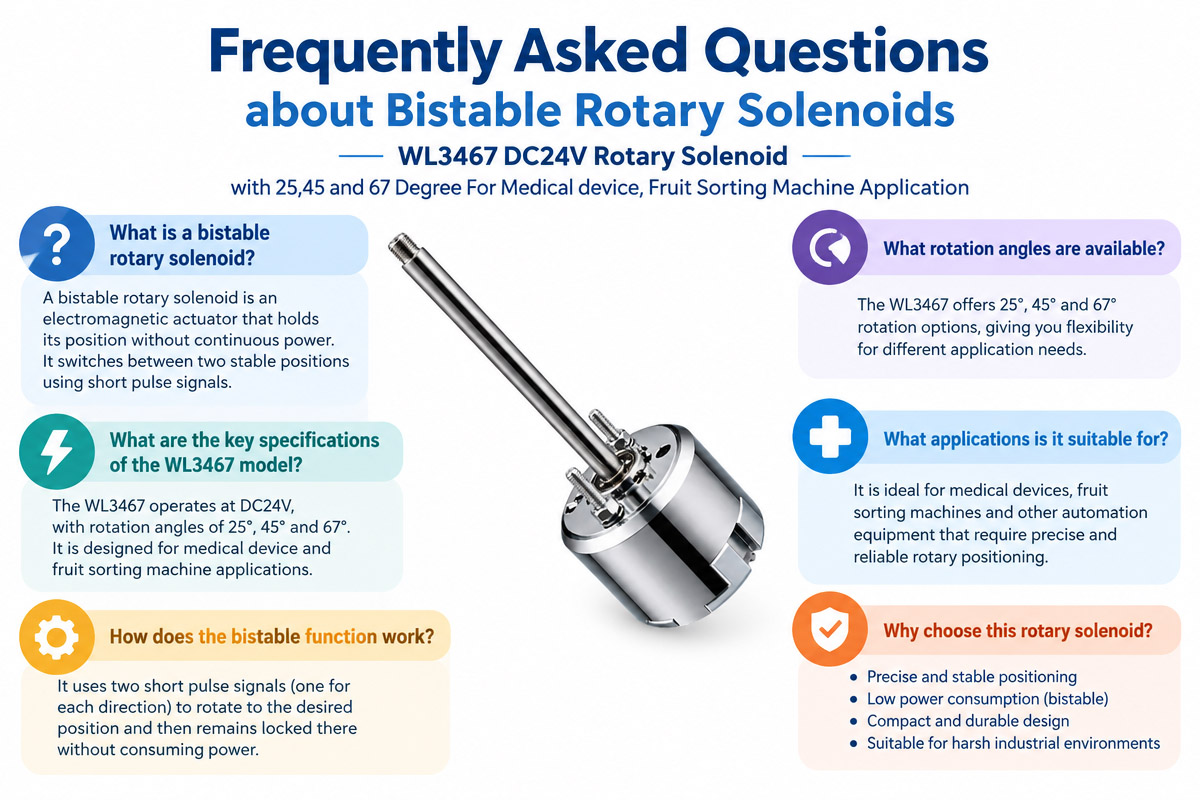
FAQ 1: What should I care about when selecting Bistable Rotary Solenoids for shutter applications?
Buyers should put emphasis on operating torque, hold torque, angle of rotation, switching speed, coil characteristics, size, and expected service life.
Request from the supplier detailed technical drawings and performance data. Before placing the order for production, try to test the prototype in a real shutter blade and real operating conditions.
FAQ 2: Is it true that bistable rotary solenoids are more efficient than regular rotary solenoids?
They can be much more energy efficient if the application includes long periods of position holding.
When latched, the permanent magnets maintain stable positions, so the coil does not need continuous electrical power. However, overall energy savings are dependent on switching frequency, pulse energy, and alternative actuator design.
FAQ 3: Can I design my own Bistable Rotary Solenoid for the shutter mechanism?
Yes. Many manufacturers offer customization of shaft geometry, angle of rotation, mounting configuration, coil voltage, shutter blade attachment, and electrical interface.
Additionally, some manufacturers can offer application-specific testing and integrated shutter assemblies.
For OEM projects, the buyer should provide mechanical drawings, load data, switching frequency, and environmental requirements.
FAQ 4: How fast can Bistable Rotary Solenoids open and close the shutter?
Switching time depends heavily on the actuator size, angle of rotation, moving inertia, and drive conditions.
These specialized miniature actuators can be extremely fast in certain conditions. Larger assemblies may need more time. Manufacturers provide specific model data on response time, which should be verified for the intended load.
Buyers should specify switching time measurements using the shutter assembly instead of unloaded actuator performance.
FAQ 5: How long do Bistable Rotary Solenoids last?
Service life depends on actuator design, bearing design, switching frequency, impact forces, and environment.
For example, some optical shutter actuators have been offered by manufacturers with specified endurance ratings in millions of switching cycles. These figures are valid only for specific products and test conditions, not all bistable rotary solenoid types.
Request endurance test reports from your suppliers and make sure that the test performed was relevant to your actual operating conditions.
FAQ 6: Can bistable rotary solenoids be used in battery-powered shutter systems?
Yes. This makes them especially attractive for battery-powered systems, because the coil does not need to be continuously energized as long as one of the stable positions is maintained.
However, the power source must be able to deliver necessary switching pulses. Buyers need to consider maximum current, efficiency of the driver, and battery performance in cold conditions.
FAQ 7: What is the difference between standard and custom bistable rotary solenoids?
Standard actuators are available in standard sizes, electrical ratings, angles of rotation, and performance characteristics. Generally, these actuators are appropriate where the shutter mechanism meets existing product specifications.
Neither design is universally superior.
A bistable rotary solenoid is often preferable when the shutter must remain in either position for extended periods.
A monostable actuator may be more appropriate when the shutter must automatically return to a predetermined position after power loss.
For safety-critical applications, designers must evaluate the complete system’s failure behavior rather than assuming that magnetic latching alone provides a safe state.
FAQ8: Do I need to provide it to get a quotation?
Buyers should specify the following information to get a proper quotation: required angle of rotation, shutter dimensions and mass, targeted switching time, supply voltage, hold torque requirements, operating temperature, and annual order volume.
It would also be helpful to specify installation restrictions, lifetime expectations, environmental conditions, and whether position feedback is required.
Complete technical specification means that suppliers can recommend the right actuator and identify any customization needs from the start.
13: Conclusion
For shutter applications that require accurate two-position actuation, low hold torque consumption, and reliable magnetic latching, bistable rotary solenoids provide an efficient solution.
They are especially effective in optical devices, imaging systems, scientific instruments, and automated machinery because they can remain open or closed without continuous use of electrical energy.
But selecting the right actuator is not just a matter of comparing voltage ratings or size. Engineers and procurement specialists need to take into account dynamic torque, holding capability, switching time, thermal behavior, mechanical integration, and durability.
Working with an experienced rotary solenoid manufacturer and testing the actuator in real operating conditions allows OEM buyers to develop shutter systems that are reliable and consume minimal energy and maintenance.
Looking for bistable rotary solenoids to supply for your shutter application? Contact the Weilong Technology manufacturer and share your technical specification today; the Weilong technical team will give feedback and offer you the solution within 2 days’ time.
