
Chapter 1: Introduce
With increasing public awareness of health and growing user expectations, modern water dispensers have long surpassed the basic function of a drinking device. Today’s water dispensers integrate heating, cooling, multi-stage filtration, sterilization, and intelligent electronic control, forming a complex mechatronic system. Within this system, the solenoid valve, as the core hydraulic control component, controls the water intake, distribution, isolation, and safety protection.
Since solenoid valves come into direct contact with drinking water, their design, selection, and application have a decisive impact on safety, hygiene, reliability, noise performance, and overall user experience. This article systematically analyzes the application of solenoid valves in water dispensers from an engineering perspective, covering application scenario requirements, solution design, testing and verification, advantages and disadvantages, and mature solutions for common operational problems.
Chapter 2: Scenario Requirements: Essential Specifications for Water Loop Control
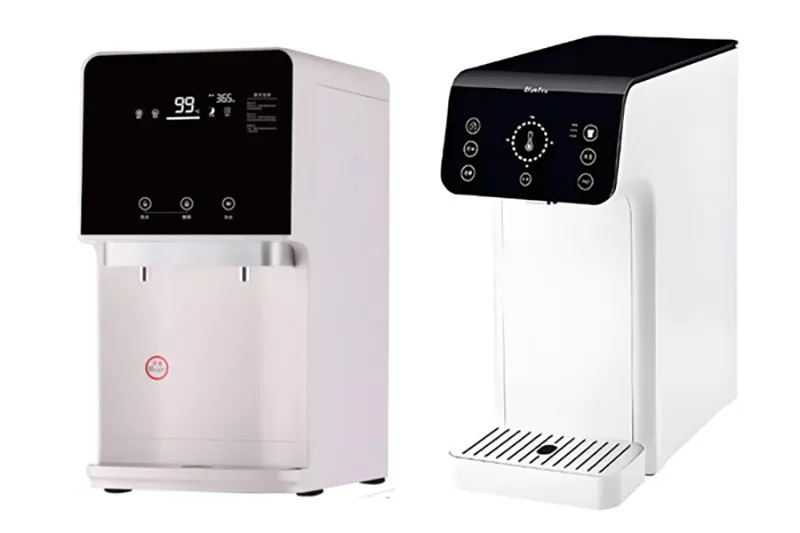
Water dispensers, prevalent in diverse environments including residences, workplaces, educational institutions, healthcare facilities, and public amenities, exhibit varying operational conditions and reliability demands. Notwithstanding these contextual disparities, several fundamental requirements are universally applicable.
2.1 Safety and hygiene are of utmost importance.
Given that solenoid valves interface directly with potable water, adherence to food-grade material standards is indispensable. All components in contact with water must be safeguarded against material leakage, the generation of unpleasant odors, bacterial proliferation, and secondary contamination throughout the product’s operational lifespan.
2.2 Precise control and a consistent flow rate are essential.
Precise switching control is critical in the following scenarios:
Water extraction from the municipal water supply.
The provision of both hot and cold water.
Tank filling and liquid level regulation.
Unstable valve performance can manifest as dripping, backflow, pressure variations, or incomplete sealing, thereby diminishing both user satisfaction and system dependability.
2.3 Adaptability to Multiple Conditions
The solenoid valve employed in the water dispenser must demonstrate dependable functionality across a spectrum of conditions:
A broad temperature spectrum encompassing cold, room temperature, and hot water
Fluctuating inlet pressures
Diverse data traffic demands for both residential and commercial applications.
2.4 Minimal Noise and Extended Lifespan
Valves utilized in both office and home settings necessitate quiet operation, while the frequent actuation cycles demand substantial mechanical and electrical resilience.
2.5 Fault-Tolerant Operation
In the event of a power interruption or system malfunction, the valves must revert to a secure state to mitigate the potential for leakage, overflow, or heater dry burning.
Chapter 3 : Solution Design: Selection and Structural Refinement
A systematic approach to solenoid valve selection is crucial for ensuring optimal compatibility within the entire water circuit and its electronic control system.
3.1 Functional Positioning within a Water Circulation System
Solenoid valves generally serve three primary functions:
The inlet control valve regulates the flow rate of incoming tap water into the filtration or storage system.
The water outlet control valve manages the outlet of hot, cold, or room temperature water.
The safety protection valve, in conjunction with a liquid level sensor and a temperature controller, interrupts the water supply in the event of malfunctions, such as overheating or low water levels.
Each of these locations presents distinct requirements concerning pressure, temperature, and response time.
3.2 Solenoid Valve Type Selection
Direct-acting solenoid valves are characterized by a rapid response time, measured in milliseconds, and they operate without the need for differential pressure.
Pilot-operated solenoid valves are a good fit for low-pressure or tank systems.
These valves are also suitable for applications requiring higher pressure and flow rates.
They are designed to be energy-efficient and are well-suited for continuous operation.
You often find them in direct-flow water dispensers.
Normally closed (NC) valves are the industry standard, automatically shutting when power is interrupted to enhance safety.
3.3 Key Parameter Design
Voltage: 12V or 24V DC is the norm for stable, low-noise intelligent control, though AC options are still used in some older designs.
Pressure rating: Generally, these valves are rated for 0.1–0.6 MPa, aligning with municipal water supply pressure standards.
Flow rate:
Household unit: 1–2 liters/minute
Commercial units: 3–5 liters/minute
Temperature range: Must be able to withstand cold water of 0–10°C and hot water of up to 95–100°C.
3.4 Materials and Sanitary Design
Valve body material: food-grade PP, ABS, or 304 stainless steel
Sealing material: High-temperature resistant, odorless food-grade silicone or EPDM rubber.
Flow path design: smooth internal geometry with no dead zones to minimize biofilm formation.
Chapter 4: Implementation and Debugging: From Prototype to System Integration
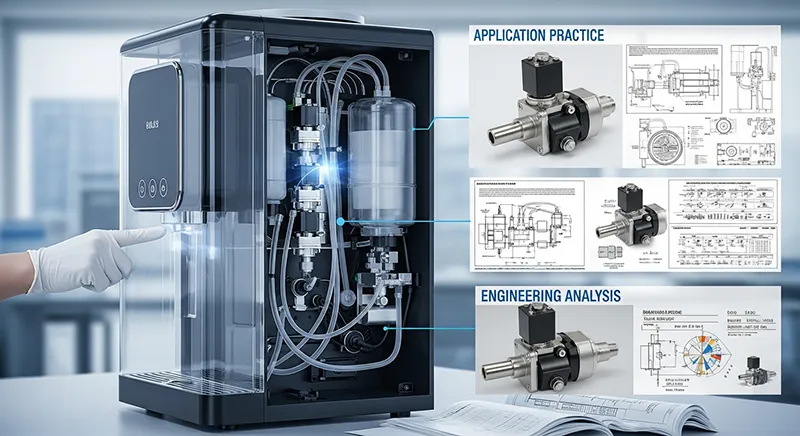
Proper integration during the prototyping stage directly impacts the stability and long-term reliability of mass production.
Leakage test: Pressure resistance test and long-term retention test at 1.2 times the rated pressure.
Noise and vibration control: Operating noise and vibration are ≤45 dB by using rubber vibration isolation pads, optimized mounting brackets and controllable airflow paths.
Response time adjustment: Ensure instantaneous start-up and complete shutdown, without dripping or water hammer.
Control logic integration necessitates the verification of interlock accuracy between sensors and the motherboard, thereby ensuring the functionality of low water level cutoff, overheat protection, and power failure safety mechanisms.
Chapter 5: Performance Verification: Performance and Reliability Testing
Solenoid valves require comprehensive verification prior to mass production.
Life cycle testing mandates a minimum of 500,000 on/off cycles under authentic operating conditions.
Safety simulation involves fault state testing, encompassing power outages, blockages, and idling scenarios.
Environmental testing includes exposure to high humidity, thermal cycling, and prolonged immersion in 95°C hot water.
Hygiene verification entails odor, soaking, and material leaching tests to confirm adherence to drinking water standards.
A design that has been thoroughly validated can reduce leakage rates to below 0.1%, thus substantially enhancing customer satisfaction.
Chapter 6: Core Advantages and Disadvantages of Solenoid Valves
6.1 Advantages
CNC design facilitates the achievement of high safety redundancy.
Quick and accurate on/off operation.
Superior hygiene management.
Space-saving design, facilitating system integration.
Straightforward electrical control.
6.2 Drawbacks:
Vulnerability to subpar water quality.
Seal degradation with extended exposure to high temperatures.
Potential for noise and water hammer.
Selecting the incorrect option will restrict the pressure range.
Open valve consumes power continuously.
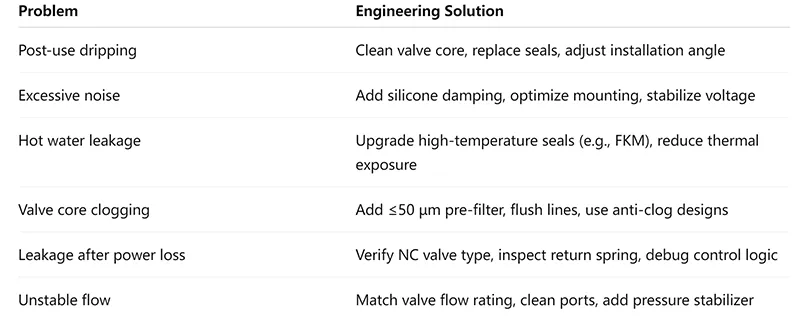
Chapter 7: Common Problems and Engineering Solutions
Chapter 8 : Summary of Experience: Key Application Points
All components that come into contact with liquids must be constructed from food-grade materials.
Normally closed valves are the foundation of safety design.
System compatibility is more important than individual specifications
Early and rigorous testing ensures production stability.
Water quality adaptability extends valve service life
Noise reduction measures must be designed as early as possible, rather than added afterward.
Chapter 8: In conclusion
In the water dispenser industry, safety, hygiene, and reliability are paramount. Solenoid valves are not only hydraulic control components but also crucial safety guarantees for the entire system. Through scientific needs analysis, precise valve selection, rigorous verification, and proactive problem-solving, solenoid valves can provide stable, safe, and efficient water circuit control.
As water dispensers continue to evolve towards a smarter, more energy-efficient, and more comfortable user experience, solenoid valve technology will also further develop towards lower noise, longer lifespan, lower energy consumption, and stronger resistance to contamination, thereby consolidating its indispensable role in modern home appliance engineering
Chapter 9: Frequently Asked Questions (FAQ): Solenoid Valves in Water Dispensers
1. What role does the solenoid valve play in a water dispenser?
The solenoid valve controls the on/off switching of drinking water in the water dispenser. It manages water intake, hot and cold water supply, water tank replenishment, and safety power-off, ensuring precise hydraulic control and preventing the risk of leakage or dry burning.
2. Why are normally closed (NC) solenoid valves used in water dispensers?
Normally closed solenoid valves automatically cut off water flow when power is lost, making them the safest choice for water dispensers. This fail-safe design prevents uncontrolled leaks, overflows, and heater dry burning in the event of a malfunction or power outage.
3. Are solenoid valves safe to use in drinking water systems?
Yes, if designed properly. Water dispenser solenoid valves use food-grade materials, such as PP, ABS, or 304 stainless steel valve bodies, and food-grade silicone or EPDM sealing rings. These materials prevent odors, leaks, and secondary contamination, meeting drinking water safety standards.
4. The optimal solenoid valve for a water dispenser is contingent upon the specific operational parameters.
Direct-acting solenoid valves, characterized by their rapid actuation and uncomplicated design, are ideally suited for applications involving low-pressure or tank-based systems.
Conversely, pilot-operated solenoid valves are more appropriate for water dispensers that operate under high-pressure and high-flow conditions.
Furthermore, for safety considerations, the majority of designs incorporate normally closed configurations.
5. The voltage specifications for a water dispenser’s solenoid valve typically fall within the range of 12V or 24V DC. This ensures consistent performance, minimizes acoustic emissions, and facilitates compatibility with sophisticated electronic control systems. AC solenoid valves, however, may still be employed in conventional designs or those with elevated cost constraints.
6. The pressure and flow rate ratings requisite for a water dispenser’s solenoid valve generally encompass:
Pressure: 0.1–0.6 MPa, which corresponds to the typical range of municipal water supply systems.
Flow rate:
- Home dispenser: 1–2 liters/minute
- Commercial dispensers: 3–5 liters/minute
- Matching flow rates correctly helps avoid unstable traffic, noise, and premature wear.
7. Why does the solenoid valve drip water after dispensing?
Water drips after use are typically due to:
- Debris or scale buildup in the valve seat
- Worn or old sealing materials
- An incorrect installation angle
Cleaning the valve core, replacing the seals, and adjusting the installation angle usually fix this issue.
8. What causes excessive noise when a solenoid valve operates?
The noise could stem from several factors:
- Water hammer, which results from abrupt valve actuation.
- A rigid installation lacking vibration isolation.
- Fluctuations in the power supply voltage.
Noise mitigation strategies include the incorporation of silicone damping pads, the optimization of flow channels, voltage stabilization, or the installation of throttling devices at the inlet and outlet.
