

Chapter 1 : Introduction
A solenoid is a high-precision electromagnetic actuator, which is widely used in various fields such as industrial automation, automotive, medical, vending machines, valves, lock, and many more. Electromagnetic coil, plunger material, magnetic circuit and mechanical structure are the main parameters affecting the solenoid performance, however, small structural details play a significant role here as well.
One of the important but often neglected parameter is the Solenoid Exhaust Hole Design.
Another name for vent hole or air release hole is exhaust hole. The exhaust hole serves for controlling the airflow when plunger moves inside the solenoid. During solenoid operation plunger moves fast inside the magnetic tube. Bad airflow leads to the slow movement, less force output, overheating and shortened lifetime because of the air resistance and vacuum effect.
A well-designed Solenoid Exhaust Hole allows for air escaping and ensures good mechanical performance, lower energy losses and stable work of electromagnetic actuator.
In this paper, the influence of exhaust hole design on solenoid force, response time, temperature control, durability and general performance reliability will be discussed.
Chapter 2 : What shape is the solenoid exhaust hole?
Solenoid Exhaust Hole Design is the engineering design of vent holes in a solenoid for controlling the internal air pressure when the plunger moves.
The volume in the solenoid chamber changes when plunger moves inside or out. The principle of pneumatic is that the air is trapped inside and resists moving.
For example:
The air must escape from the interior cavity as the plunger moves inward.
- The air from outside must go inside when the plunger moves outward.
- If the airflow is limited, the plunger will move with more resistance.
The exhaust hole provides a channel for the air flow.
A good Solenoid Exhaust Hole Design includes:
- Hole diameter
- Number of holes
- Hole Location
- Direction of air flow
- Requirements of dust protection
Waterproofing specifications
Manufacturing limitations
The goal is to be quick and green.
Chapter 3 : Influence of Exhaust Hole Design on Solenoid Force
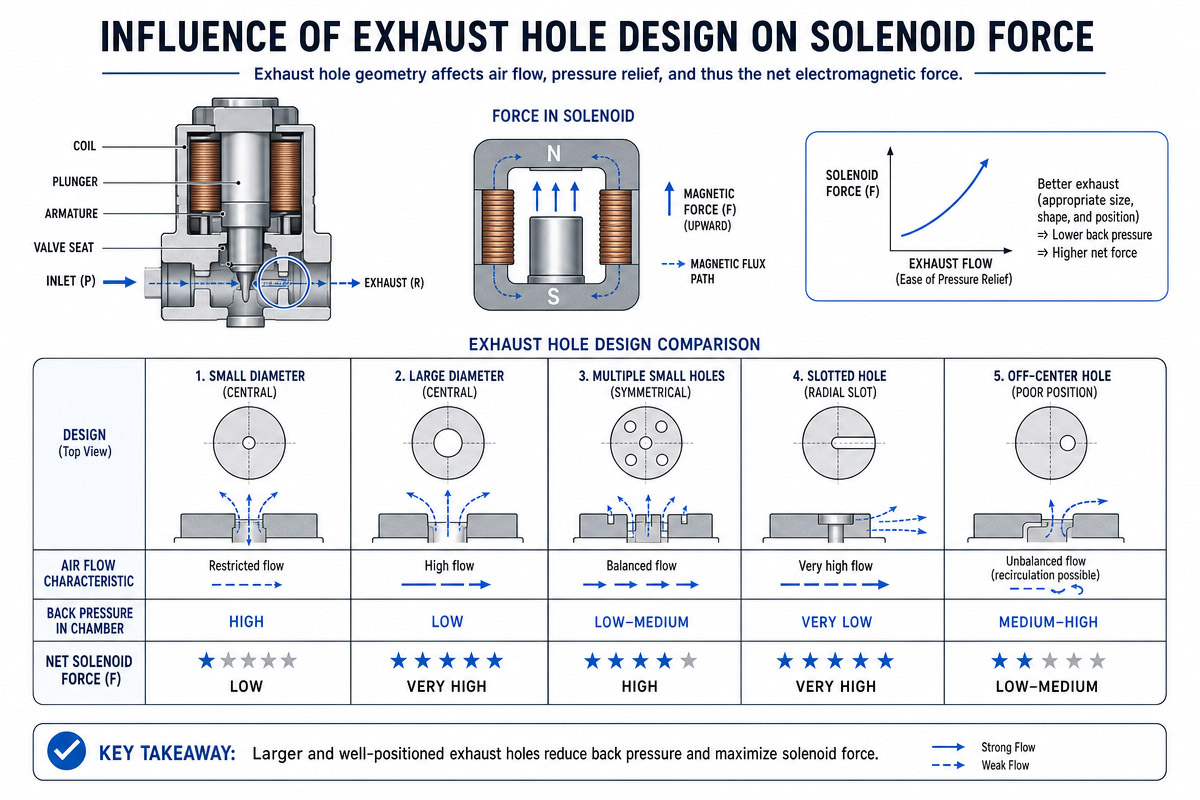
When designing a solenoid force, many engineers pay attention mostly to the coil power. Also mechanical resistance because of air resistance can reduce the force output.
The solenoid force output is dependent on magnetic parameters such as coil current, magnetic gap, plunger area. However, mechanical losses reduce the force output.
It can be represented as follows:
Effective Solenoid Force = Electro-Magnetic Force – Mechanical Resistance
Bad exhaust hole design leads to increased mechanical resistance due to:
- Air compression reduces plunger movement
- Stop of return movement because of vacuum pressure
- Increased internal pressure
- Loss of energy on overcoming the air resistance.
Proper exhaust aperture reduces these losses and allows more electromagnetic energy to be converted into mechanical force.
Thus, the optimal Solenoid Exhaust Hole Design can improve the force output in applications requiring high pulling force, such as industrial valve and locking system.
Chapter 4 : Effect of Exhaust Hole Size on Solenoid Performance
One of the main parameters of Solenoid Exhaust Hole Design is the exhaust hole size.
Small exhaust opening
If the exhaust hole is too tight:
- Cannot let the air out quickly
- Reduces the speed of plunger movement
- Increases response time
- Reduces the efficiency of solenoid
- Increases heat generation
Small exhaust hole can cause unstable operation of the solenoid in high speed applications, since plunger cannot complete its movement within the required period of time.
Big exhaust hole
Larger exhaust holes are not always better.
Big exhaust holes can be problematic.
Increased dust contamination
- Lower waterproofness
- Reduced environmental protection capability
- May produce noise during operation
Thus, the best Solenoid Exhaust Hole Design is the trade-off between the protection level and the performance.
The exhaust holes sizes are usually chosen by the engineers depending on such parameters as:
- Solenoid size
- Stroke length
- Operation frequency
- Cycle of duty
Operating environment
Chapter 5 : Correlation of Exhaust Hole Design and Solenoid Response Time
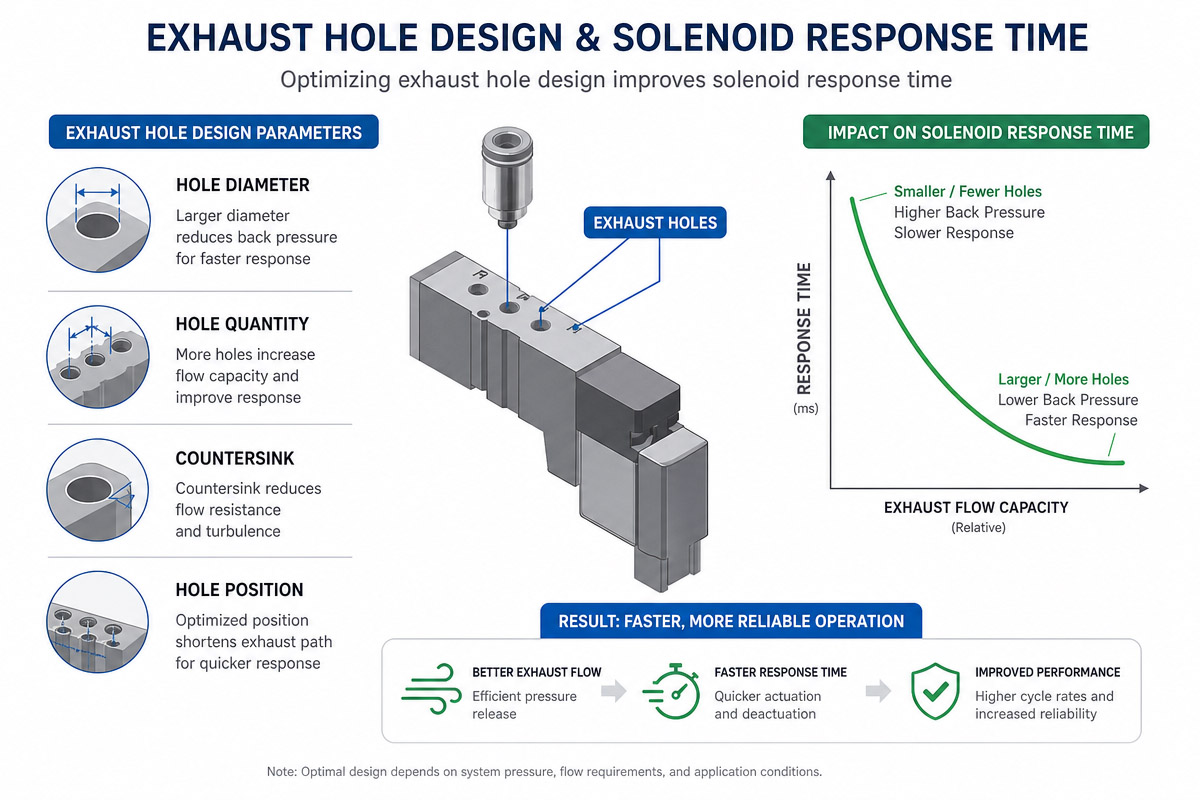
Response time is an important parameter for many solenoid applications.
Such applications are:
- Automatic control valves
- Robotics
- Medical devices
- Security locks
- Industry of automation devices
The plunger must move rapidly and precisely.
Good Solenoid Exhaust Hole Design increases response time by:
5.1 Minimizing Air Resistance
The exhaust hole allows the trapped air to quickly escape, reducing the pneumatic resistance.
5.2 Enhancing Plunger Acceleration
The electromagnetic force can accelerate the plunger more effectively with less internal resistance of the air pressure.
5.3 Improving Reproducibility
Stable air flow provides consistent flow thousands or millions times.
Chapter 6 : Effects of Solenoid Exhaust Hole Design on Heat Dissipation
Heat generation is another important parameter that affects the life of a solenoid.
During operation, electric energy is converted to electromagnetic energy. However, some energy is wasted as heat because of the coil resistance.
The high temperature can cause:
- Breakdown of coil insulation
- Decreasing magnetic performance
- Plastic deformation
- Reduced service life
The Solenoid Exhaust Hole Design is optimized for the thermal management.
The exhaust hole provides for:
- Hot air circulation
- Lower increase of internal temperature
- Quicker cooling after operation
For solenoids with the continuous duty, heat generation is especially important.
Generally speaking, the solenoid with a low temperature has:
Increased coil life
- Dependable insulation
- More stable force output
Chapter 7 : The lifetime of a solenoid is dependent on many parameters:
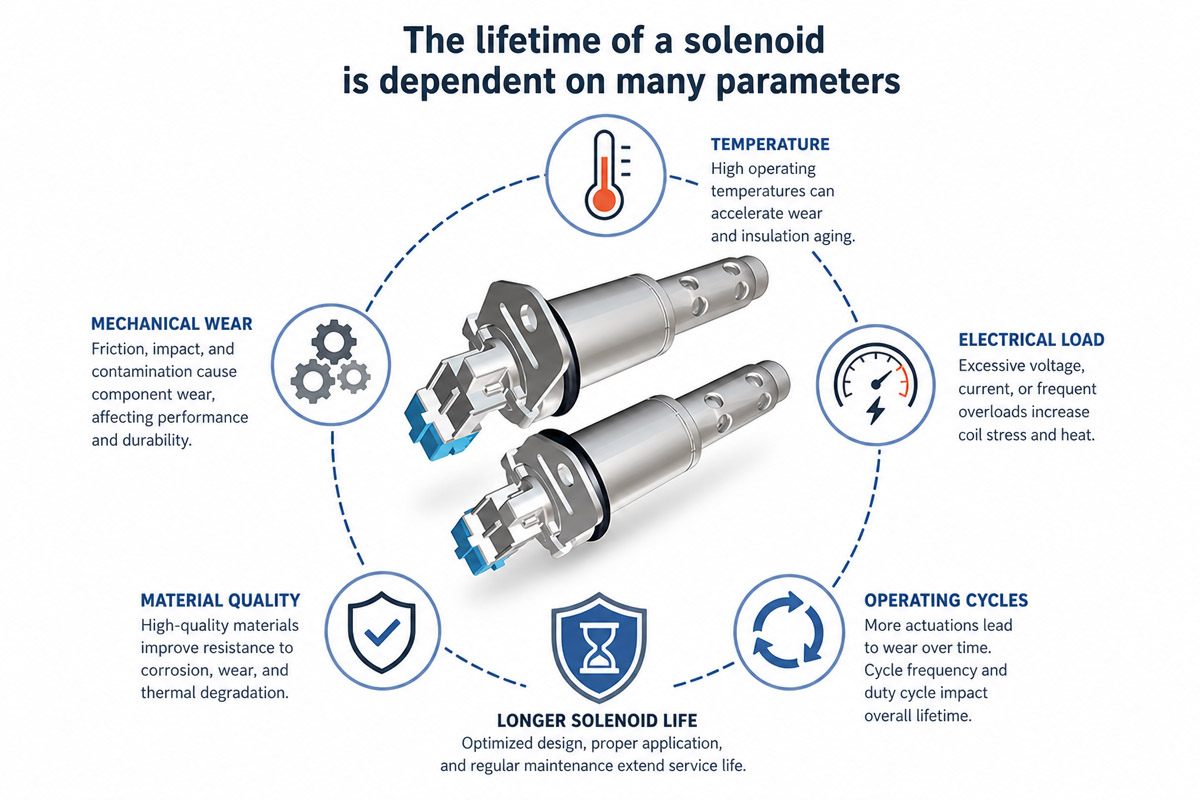
- Coil quality
- Choice of material
- Lubrication ·
- Mechanical Tolerance
- Operating temperature
- Environment
However, the design of the Solenoid Exhaust Hole is also important.
Poor exhaust hole design can lead to:
Increased Mechanical Wear
If the movement is slowed by the air resistance, the plunger has:
- Increased impact force
- Erratic movement
- Increased friction
Increased Operating Temperature
Less air flow causes overheating inside.
Reduced Reliability
Erratic operation may occur due to the repeated pressure imbalance.
Good Solenoid Exhaust Hole Design solves these issues and extends the life of a solenoid.
Chapter 8 :. Considerations for Solenoid Exhaust Hole
Several parameters should be considered when designing exhaust holes.
8.1 Position of exhaust hole
Position of the hole affects the efficiency of airflow.
Possible positions are:
- Rear part of the housing
- Magnetic tube side wall
- End cap area
This position should provide for the quick air flow without weakening the mechanical strength of the structure.
8.2 Diameter of Exhaust Hole
The diameter should be equal:
- Plunger size
- Stroke length
- Internal volume
- Rate of operation
The bigger ventilation design should be provided for a bigger solenoid.
8.3 No. of Exhaust Holes
One big hole is not always better than several smaller holes.
Advantages are:
- Better air flow
- Increased mechanical strength
- Simplicity of manufacturing
8.4 Environmental Protection
Industrial solenoids often should operate in difficult conditions.
The exhaust hole design should consider:
- Dust proof
- Water proof
- Oil contamination
- External usage only
Sometimes, a filter membrane or a guard mesh is used.
Chapter 9: The exhaust holes may seem simple, however, they should be correctly manufactured.
The typical problems are:
Stamping Precision
For stamped metal housing, the hole position should be controlled for providing the correct assembling.
CNC Machining Quality
Exhaust holes are machined for providing the precision of dimensions and surface finish.
Assembling Alignment
Restricted air flow, misalignment or other problems with the plunger movement.
The professional solenoid manufacturers should check the following parameters:
- Tolerance of hole size ·
Air flow performance
- Plunger velocity
- Force output
Temperature rise
through the test procedures
Chapter 10 : Optimization Techniques for Improved Solenoid Efficiency
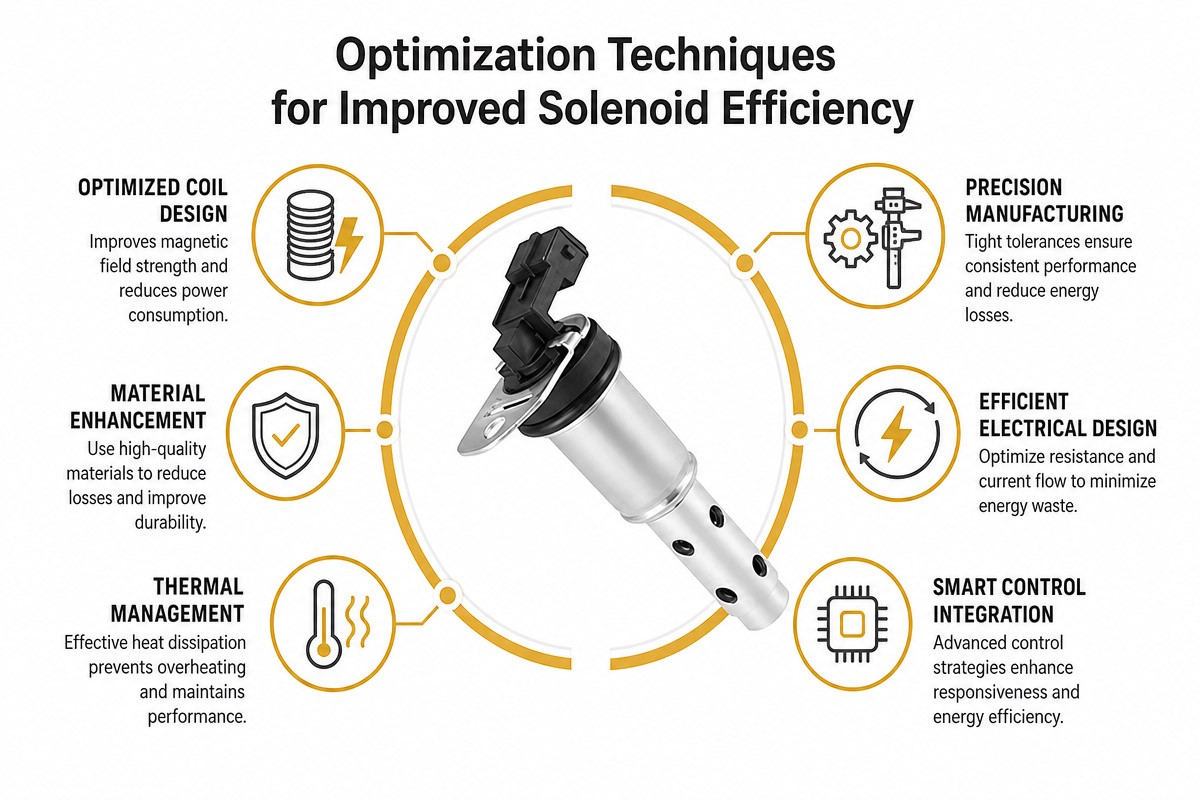
There are several ways for engineers to improve Solenoid Exhaust Hole Design.
Simulation Study
Airflow simulation allows predicting:
- Internal pressure changes
- Velocity of air flow
Potential points of resistance
Prototype Tests
Real tests to measure:
- Traction force
- Speed of stroke
Noise level
Temperature rise
Choice of Material
Correct materials and surface finish of the housing will improve durability.
For example:
- Corrosion resistance of stainless steel
- Zinc-plated steel for industrial applications
- Aluminum housing for lightweight applications
Chapter 11:. Applications that require optimization of the Solenoid Exhaust Hole Design
Especially important in: Advanced Solenoid Exhaust Hole Design
Industrial Automation
Applied in:
- Machinery controls
- Production lines automation
- Robotic devices
Solenoid Valves
Good airflow provides the valve with improved response and reliability.
Automotive System
Such applications are:
- Transmission system control
- Door locks systems
– Fuel system
Medical Devices
Reliable and accurate are:
- Pumps
- Diagnostic devices
- Medical safes
Security equipment
Fast response and long lifespan are required in electronic locking systems.
Chapter 12 : Typical problems that occur due to poor exhaust hole design
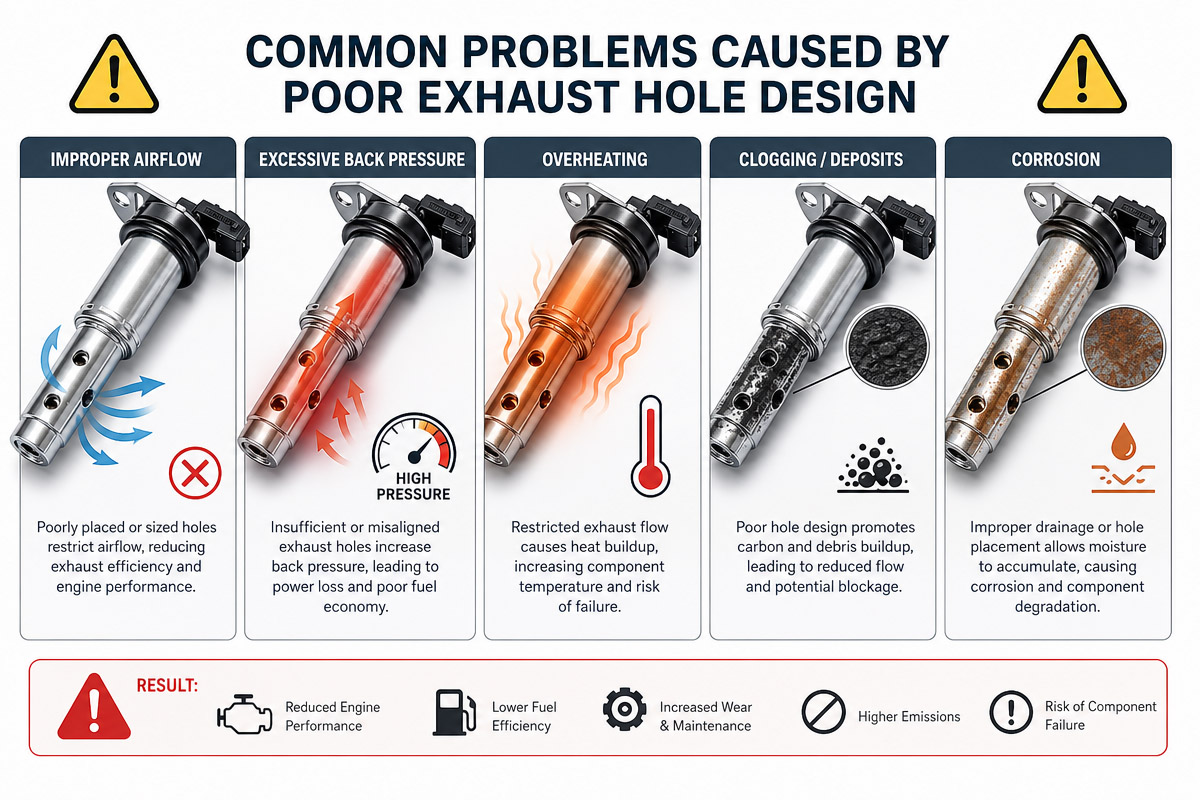
Poor design of the solenoid exhaust holes leads to:
Slow Operation
The air resistance slows the movement of the plunger.
Reduction of Force Output
Mechanical losses reduce the output force.
Overheating
Poor airflow causes overheating.
Shortened life expectancy
Continuous mechanical stress deteriorates the internal elements.
Unstable Performance
Results may not be consistent due to the repeated cycles.
Chapter 13 : Future Trends in Solenoid Exhaust Holes Design
With the increasing demand in small and efficient actuators, solenoid manufacturers continue improving the ventilation design.
Future trends are:
- Miniaturized air flow channels
- Simulation-based advanced designs
- Dust protection systems
- Advanced thermal management systems
- Monitoring of solenoid performance
The better Solenoid Exhaust Hole Design will be required for the next generation of solenoids that should have increased speed, reduced power consumption and increased operating life.
Chapter 1 4 : 8 FAQs About Solenoid Exhaust Hole Design
1. Why Solenoid Exhaust Hole Design is important for solenoid operation?
Answer:
The Solenoid Exhaust Hole Design is crucial parameter, it provides the balance of air pressure in the solenoid housing when the plunger moves. In the course of energizing, the trapped air can resist the movement of the plunger. A well-designed exhaust port provides for the smooth air escape and decreases the mechanical resistance and response time.
2. Can the increase in exhaust hole size improve solenoid performance?
Answer:
No. More is not always better, especially in the case of exhaust holes. Larger opening will help with the air flow, however, it will worsen protection from dust, moisture and contaminants. The perfect Solenoid Exhaust Hole Design is the compromise between the efficiency of the air flow and environmental protection. The appropriate size depends on the size of the solenoid, stroke length, operating frequency and operating conditions.
3. How Does Solenoid Exhaust Hole Design Impact Pulling Force?
A: Yes.
The exhaust hole does not affect the electro-magnetic force of the coil, but it improves the output force by decreasing the air resistance. Free movement of the plunger is provided and more electro-magnetic energy is converted into mechanical force when the internal pressure is well-controlled. Thus, the optimal Solenoid Exhaust Hole Design can improve the working performance.
4. Poor design of exhaust holes can shorten the lifespan of solenoids?
Answer:
Yes. Poor Solenoid Exhaust Hole Design can negatively affect the solenoid service life. If the air is not allowed to move freely in the housing, the solenoid may have increased mechanical stress, slower movement, increased impact forces, and overheating. With time, these issues can increase wear of the plunger, spring, coil insulation and other internal elements.
5. Where to place the exhaust hole in a solenoid?
Answer:
Where is the best position? It depends on the internal structure of the solenoid. The typical positions are rear housing, side wall of the magnetic tube, or end cap area. The good Solenoid Exhaust Hole Design is to place the hole in order to have good air flow without influencing the mechanical structure or the magnetic performance.
6. How to optimize Solenoid Exhaust Hole Design for high speed applications?
Response:
The engineer should design the size, position and number of exhaust holes in a high-speed solenoid according to the requirements of air flow. The best design can be determined using simulation analysis, prototype testing and cycle testing. Improved acceleration and quick response with less air resistance are the result of the optimal Solenoid Exhaust Hole Design.
7. Not all solenoids require exhaust holes.
Answer:
The exhaust holes structure of all the solenoids is not the same. Some other methods for pressure regulation may be used for special kinds of sealed solenoids, waterproof solenoids or special actuators. However, for many tubular solenoids, linear solenoids and high-cycle industrial solenoids, Solenoid Exhaust Hole Design is important for reliable operation.
8. What parameters should be considered in the design of solenoid exhaust holes?
Answer:
The engineer should consider the following factors:
- Size of the solenoid and internal volume.
- Plunger diameter and stroke length
- Response speed requirements
- Duty cycle of operation
- Operating environment
- Dust and moisture protection requirements
Manufacturing limitations
The good Solenoid Exhaust Hole Design should provide the right balance between air flow, performance, durability and manufacturability.
Chapter 1 5 : Wrap-up
The Solenoid Exhaust Hole Design is a simple but crucial parameter that has a direct influence on the performance of the solenoid. While the design of the coil and magnetic circuit mainly determine the electro-magnetic force, the air flow management in the solenoid housing is the important aspect for the force output, response time, temperature control and lifespan.
Well-designed exhaust hole decreases the air resistance, improves the efficiency of the movement, reduces overheating and increases reliability.
Solenoid Exhaust Hole Design for high performance and long service life in industrial solenoid applications engineers should consider as a part of the overall actuator design.
