

Chapter 1: Introduction of Pull Solenoid DC vs. Latching Solenoid
Solenoid are a cornerstone of automation, control, and electromechanical design. But, they’re not all created equal. When you’re picking Pull solenoid DC for battery-operated devices, energy-efficient systems, or applications where safety is paramount, the decision between standard DC-actuated solenoid valves and self-locking solenoid valves is a big one. The wrong choice can mean wasted power, overheating, or a system that just doesn’t work right.
This guide will explore the different of Pull Solenoid DC vs. Latching Solenoid aspects, how they work, their pros and cons, and where they’re best used. By the end, you’ll have the knowledge you need to make smart choices, ensuring your designs are both effective and dependable, and that they do what they’re supposed to do.
Chapter 2: Pull Solenoid DC vs. Latching Solenoid, Understanding Core Design and Working Principles
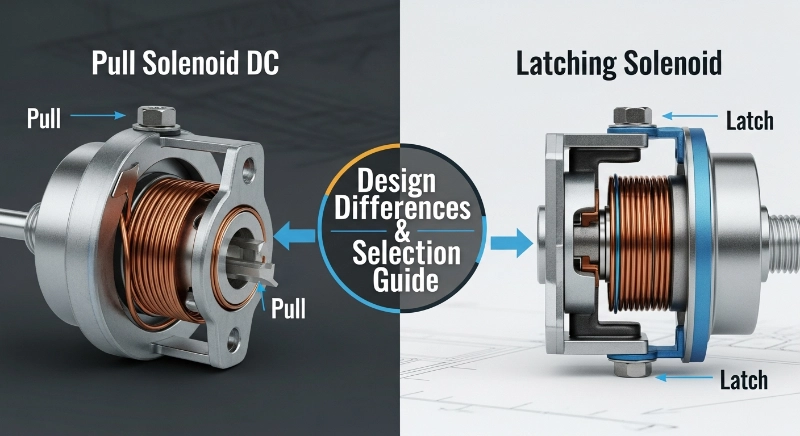
Pull solenoid DC also known as continuously operating solenoids, are fundamentally electromagnetic actuators. Their construction comprises a coil, which is wound around a ferromagnetic core, a movable steel plunger (or armature), a return spring, and a fixed housing or frame.
The operational principle of these valves is predicated on a fundamental electromagnetic law. Specifically, when a direct current voltage is applied to the coil, a magnetic field is established. This magnetic field then counteracts the resistance of the return spring, thereby drawing the plunger toward the coil’s center and generating linear motion, or a “pull.” Maintaining this pull-in state necessitates a continuous power supply. Conversely, when the power supply is interrupted, the magnetic field dissipates, and the return spring reverts the plunger to its initial, resting position.
Structure: The core components (coil, plunger, housing) are similar, but the key difference lies in the addition of a permanent magnet, usually integrated into the housing or pole piece. The return spring is typically omitted or its strength is greatly reduced.
Working Principle: This design cleverly combines electromagnetism and permanent magnetism. A short pulse of DC voltage (correct polarity) is applied to the coil. The resulting magnetic field interacts with the magnetic field of the permanent magnet, moving the plunger to the set position. The amazing thing is that once the plunger reaches this position, it is firmly held in place by the magnetic force of the permanent magnet alone, without any power consumption. To release the plunger, simply apply a short pulse of voltage with the opposite polarity to the coil. The resulting magnetic field cancels or overcomes the magnetic force of the permanent magnet, causing the spring or residual force to return the plunger to its original position
Part 3: Head-to-Head Comparison: Pull Solenoid DC vs. Latching Solenoid Advantages & Disadvantages
| Features | Pull Solenoid DC | Latching Solenoid |
| Power Consumption |
Disadvantage: High. It draws full power constantly to maintain its position, which generates heat and wastes energy.
|
Advantage: Exceptionally low power consumption. It only draws power during the brief pulse (<100ms) needed to change its state, making it perfect for devices running on batteries.
|
| Heat Generation | Disadvantage: Significant. The continuous current can overheat the coil, often necessitating duty cycle restrictions (like 10% on, 90% off). |
Advantage: Minimal heat generation. Because there’s no steady-state current, heat build-up is virtually nonexistent. This allows for sealed designs and continuous holding.
|
| Circuit Complexity |
Advantage: Simple. You only need a switch or transistor to apply or remove voltage. Polarity doesn’t matter.
|
Disadvantage: More complex to implement. An H-bridge or polarity-reversal circuit is necessary to create the positive and negative pulses for setting and resetting the device.
|
| Fail-Safe Behavior |
Advantage: Inherently fail-safe. A power loss always returns the plunger to its default (spring-return) position. This is critical for safety valves and emergency releases.
|
Disadvantage: Not fail-safe. If power is lost, the device stays in its last state (latched). This could be a safety issue if an automatic return is required.
|
| Response Speed |
Advantage: Generally faster initial pull-in, since full power is instantly available.
|
Slightly slower operation is a possibility, but the difference is often negligible.
|
| Cost |
Advantage: Lower initial cost, thanks to simpler construction and widespread manufacturing.
|
Disadvantage: Higher unit cost. Permanent magnets and more precise assembly contribute to this.
|
| Holding Force |
Force is proportional to current; it can be high, but at the expense of continuous power.
|
The holding force provided by the magnet is constant and not dependent on power, though it can be limited by the magnet’s strength.
|
Chapter 4: Application Selection Guide – How to Choose Pull Solenoid DC Vs Latching Solenoid?
When picking a Pull solenoid DC , consider these criteria:
Fail-safe operation is a must. Think fire safety systems, emergency shut-off valves, and brake release devices.
A very low or intermittent duty cycle is ideal. Examples include automotive starter solenoid valves, door locks, and vending machine actuators.
Cost is the main concern. Energy efficiency takes a back seat in non-battery-powered consumer appliances.
Simple control is key. Projects using basic microcontrollers don’t need complex drive circuits.
Rapid, repeated cycles are a requirement, as long as you stay within the thermal limits.
Opt for a self-locking solenoid valve when:
Energy efficiency is paramount. This applies to battery-powered IoT devices, wireless sensors, and portable medical devices.
No heat generation is necessary in sensitive environments, such as laboratory equipment, or in sealed devices where heat dissipation is impossible.
The “hold” state can be extended, with the main valve, electronic lock, or accessories in the irrigation system entering a “sleep” mode.
Limited backup power is provided; systems using supercapacitors or small batteries must remain operational during mains power outages.
Chapter 5:Professional Knowledge, Authority, and Trust: Lessons from Design Experience
In practical design, choices often go beyond the datasheet. The following are key considerations based on experience:
Inrush current and holding current (DC pull-in): Many DC solenoid valves use a higher “inrush” current for quick activation, followed by a lower “holding” current to save energy and reduce heat generation. This requires more complex “pull-in/hold” drive circuitry, which somewhat offsets the advantage of their simple structure.
Self-locking solenoids can lose their magnetic properties if not driven correctly. Precise pulse width and current limiting are crucial. Always follow the pulse duration settings in the manufacturer’s datasheet.
Position sensing is often necessary because self-locking solenoids don’t provide electrical feedback about their position. This requires adding end position sensors, like Hall effect or reed switches, which increases both cost and complexity.
Physical dimensions are another factor. A self-locking solenoid can often be smaller for the same holding force, because its holding force doesn’t depend on a large, power-hungry coil.
Chapter 6:Future Trends of Pull Solenoid DC vs. Latching Solenoid
The development of solenoid valves is closely linked to the growth of the Internet of Things and intelligent automation.
Integrated electronic components are increasingly prevalent in “smart solenoid valves,” which incorporate H-bridge drivers, current control mechanisms, and IoT connectivity (IO-Link) in both configurations, thereby streamlining integration processes.
The utilization of advanced materials, specifically stronger and higher-temperature-resistant permanent magnets like neodymium magnets, facilitates the development of smaller and more powerful self-locking solenoids.
Furthermore, hybrid designs that integrate latch efficiency with backup springs to enable conditionally fail-safe operation are becoming more common in specialized applications.
Consequently, sustainable development is a significant driver of market share for self-locking solenoid valve solutions, particularly as the home appliance and industrial sectors prioritize energy efficiency.
Chatpter 7 : How to avoid comment mistake when select Pull solenoid DC Vs Latching solenoid
7.1. Failure to Consider Power Usage
It is one of the major errors.
Incorrect Selection
The regular DC pull solenoid used in a battery-powered application.
Problems
Continuous coil activation will lead to:
Battery depletion
Increased heating
Premature parts deterioration
Correct Fix
Employ a latching solenoid if position retention is needed for long durations.
7.2. Misunderstanding “Holding Force” and “Pull Force”
Most customers assess only the maximum pull force.
But,
Pull force = pulling force during motion
Holding force = maintaining force after activation
Although a latching solenoid may exhibit reduced pull force, it has a superb holding force without using power.
Advice
Remember to consider:
Starting force
Ending force
Maintaining force
Stroking position force graph
7.3 Incorrect Duty Cycle Estimation
A pull solenoid DC produce heat during constant activation.
Failure to calculate the duty cycle leads to overheating and eventual coil damage.
Duty Cycles
Duty Cycle Description
10% ED Briefly repeated usage
25% ED Moderate intermittent usage
100% ED Consecutive usage
Error
Using a non-consecutively operated solenoid in an uninterrupted function.
Consequence
Overheating
Damage to coil
Reduced service life
Fix
To retain continuously,
Use a 100% duty Pull solenoid DC
Or utilize a latching solenoid
7.4 Ignoring Fail-Safe Requirements
It is very important in safety systems.
Pull Solenoid DC
Automatically returns upon deactivation
Suitable for fail-safe discharge purposes
Latching Solenoid
Retains previous status following deactivation
Potential to endanger safety if ignored
Example
Egress doors frequently demand automatic discharge during power failure.
The latching solenoid may not fit if safety measures are not incorporated.
7.5 Ignoring Heat Production
Heat generation occurs due to continuous electricity flow.
Common Challenges
Insulation of the coil ages
Reduction in magnetic force
Plastic bending
Unstable performance
Recommendation
Take note of:
Temperature rise of the coil
Surrounding temperature
Environmental ventilation
ON-time period
Generally, latching solenoids perform well at low temperatures.
7.6 Failing to Factor in Response Time Demands
Pull solenoid DC can offer:
Rapid response
Easy resetting
High cycling rate
Whereas, latching solenoids require:
Pulse activation
Reverse voltage polarity
More intricate drive circuitry
Prevent This Mistake
In instances of frequent switching, ensure that:
Frequency of switching
Resetting time
Controller compatibility
7.7 Basing Choice on Cost Alone
Though cheaper, a DC pull solenoid may incur higher system costs due to:
Increased power usage
Need for bigger power source
Cooling mechanism
Less lifespan
Despite the upfront cost being greater, a latching solenoid can be more economical in the long run.
Chapter 8: FAQs of Pull Solenoid DC vs. Latching Solenoid
Q1: Are these pull solenoid DC compatible with AC voltage?
A: This discussion primarily focuses on pull solenoid DC. Standard AC solenoid valves utilize a distinct design, incorporating a light-shielding coil to mitigate vibration.
Almost all self-locking solenoid valves use direct current.
Q2: Can the holding force of the self-locking solenoid valve be changed?
A: No, it can’t. The attraction force is determined by the magnetic field of the permanent magnet. In a DC pull solenoid, the attraction force can be changed somewhat by changing the voltage (but using a voltage lower than the rated “attract” voltage is not recommended).
Q3: Which type of solenoid valve lasts longer?
A: Both types of solenoid valves last a long time if used correctly. However, because self-locking solenoid valves don’t create heat, the coil’s insulation wears down more slowly, which could make them last longer.
Q4: Can I manually control the Pull Solenoid DC vs. Latching Solenoid?
A: Usually, yes. Most solenoid valves have a manual control feature, a button or function, that lets you move the plunger manually if the power goes out or for testing purposes. Check the datasheet for your specific model to be sure.
Q5: I’m working with a 12V battery system. Which is the better choice?
A: If your application needs the valve to stay open for hours on end—like a solar watering system—a self-locking solenoid valve is definitely the way to go. It prevents the battery from draining. But if you’re just using it to start a motor, which only takes a few seconds, a standard DC pull-type solenoid valve will work just fine and is simpler.
Chapter 9: Conclusion of Pull solenoid DC VS. Latching Solenoid
The choice between Pull solenoid DC-operated solenoid valves and self-locking solenoid valves hinges on the specific constraints of your application, rather than a simple “better or worse” comparison.
If you’re prioritizing user-friendliness, dependable performance, and cost-effectiveness, a pull solenoid dc valve is a dependable and potent option.
Conversely, if energy efficiency, minimal heat output, and extended battery life are paramount, self-locking solenoid valves present an ideal solution for precision-driven projects.
By carefully considering the factors discussed in this guide—power requirements, safety protocols, duty cycles, and control intricacies—you can identify the solenoid valve technology that will make your design both functional and efficient. It’s also wise to consult with a component specialist and build a prototype using the actual equipment to confirm your selection within the final system.


