
Solenoid coil assembling is a very critical process to be followed to attain electromagnetic stability and thermal reliability attained by high-accuracy processes. This page will give you a detailed explanation of our solenoid coil assembling process that involves spec reviewing, sample verification, tool preparation, pilot production, mass production, and several quality control processes to ensure that our solenoid coils have electrical stability, repeatability, and reliability to original equipment manufacturer standards.
Chapter 1: Why Solenoid Coil Assembling Quality Is Important
The coils are considered major functional elements of solenoids and inductors. Any slight error during manufacturing process would considerably affect magnetic and strength characteristics.
Critical Factors Influencing Coil Quality
WIRE DIAMETER T
Consistency of winding tension
INSULATION MATERIAL AND THICKNESS
“Lead Termination Accuracy”
Assembly alignment or the capacity to assemble
Consequences of Inadequate Control of Coil Assembly
Consequences of
Electrical Resistance Deviation
Inductance Inst
Lower magnetic force output
Production of excess heat may make the life of the product shorter.
The impacts which may emerge as a result of the absence of control are:
Deviations in electrical resistance values from the specified parameters
Instability in inductance in real-life situations
A reduction in the magnetic field generated by solenoids
Early product failure, resulting in shortened product life
Our assembly process, as well as the measures we take in controlling the quality, have been designed to eliminate factors which can pose risks, as discussed in the article.
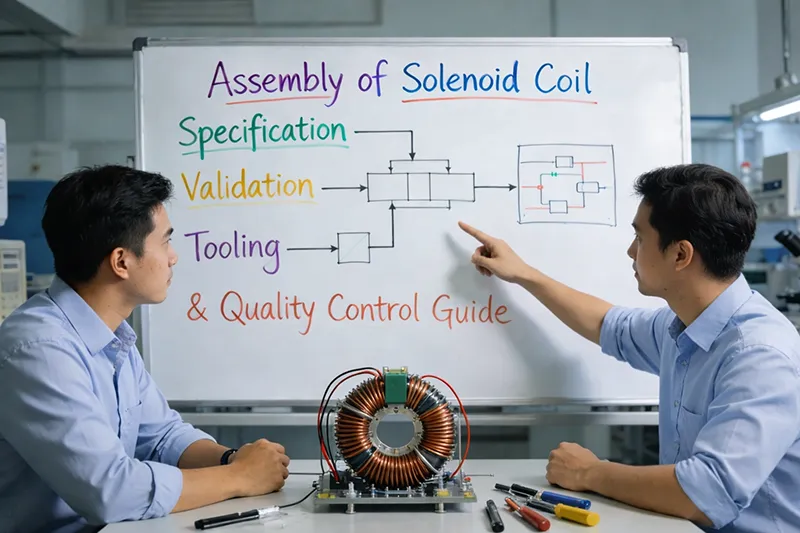
Chapter 2: Our standardized solenoid coil assembly and quality control techniques provide electromagnetic integrity and quality.
2.1 Specification Review and Requirements Analysis
Prior to the start of the coil process, the specification requirements are examined and verified, including the following:
Conductor Material (Copper
Wire size and insulation rating
The number of turns and turn form preferences.
Resistance and Inductance Values
Target Resistance:
Rated voltage and current ratings
The thermal rating and duty cycle of a component relate
This stage helps to ensure that everything is aligned correctly with the customer’s needs, the electrical needs, as well as the specific application, so that there will not be any problems in the future.
2.2 Validation of Sample & First Article Acceptance (FAI)
Before we engage in mass production, we create prototypes of the coils. This is to confirm the feasibility of the design as well as the manufacturing process.
The validation process comprises:
Resistances and Inductances Measurements
The Mechanical strength testing
Insulation Resistance Tests
Dielectric strength testing
Functional performance appraisal
Samples are approved to pilot or produce only if they fulfill the criteria.
2.3 Production Fixture and Tooling Preparation
For added quality and efficiency, design and validation for specialized production fixtures and tools is also offered.
The purposes of this preparation are:
Proper Coil Positioning
Uniform Winding Tension
Increased production efficiency
Less dimensional variations
Verification Protocol:
Every fixture and every tool is examined for size.
Alignment is verified in order to rule out any errors of winding geometry.
The tension mechanism offers a definite wire lay with a constant tension.
All the fixtures and tools used are checked for misalignment and dimensional inaccuracies prior to usage.
2.4 Checking & Verification of BOM
Prior to production, we also carefully assess and validate our Bill of Material (BOM).
Incoming Quality Control (IQC) includes the following
The specifications of magnet wire, the type of insulation, or material, essentially refer
Bobbins, terminals, & insulation parts
Adhesives, Varnish,
Only materials that satisfy approved specifications will be approved for production.
2.5 SOP for solenoid Coils Production & Quality Control
In manufacturing and quality assurance procedures, we conform to very tight Standard Operating Procedures or SOPs.
The scope of the SOP encompasses:
Winding factors and turns per winding
Assembly and lead termination operations
The standards regarding the inspection of products during the processing of these products determine the handling and storage of these products.
Quality Control SOPs are:
In process inspection criteria and frequency of inspection
Measurement Methods & Calibration Frequencies
* Way Rule Description
# How to Report probl
2.6 Pilot Run (Trial Production)
Prior to undertaking full production, we conduct pilot production to ensure the following:
The process works well and can easily be repeated.
“The equipment and fixtures are functioning properly”
The production process is efficient
Quality is consistent
Quality is
We monitor:
Resistance tolerance in a production lot
Inductance variation statistical analysis
*Visual inspection of winding uniformity*
Wind
Duration of processing and efficiency measures
2.7 Solenoid Coil Assembly and Manufacturing Process
The mass production processes control processes for carrying out each assembly stage, involving:
Coils Winding & Forming
Connecting Lead Wires and Finalizing the Connection
Application procedures of insulation or varnishing
Integration into Solenoid or Inductor Housing
Process Quality Control (IPQC): It is used in order to ensure that all the important parameters are within the specified limits.
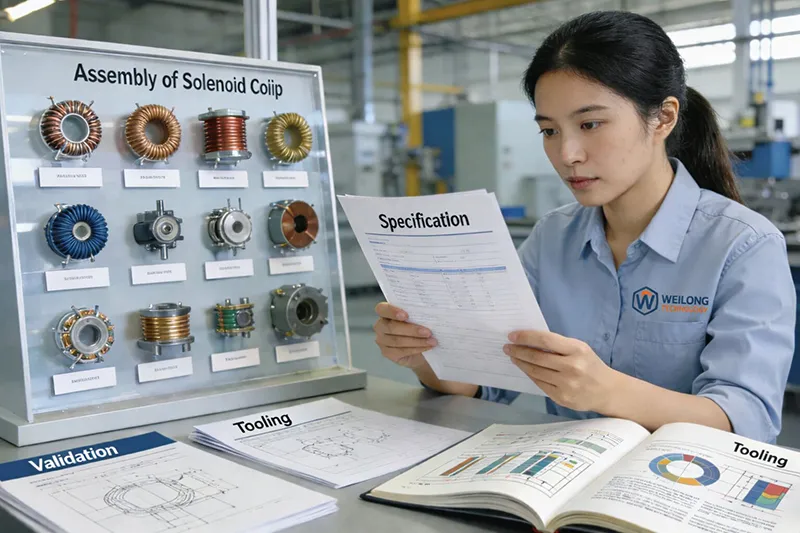
Chapter 3: Comprehensive Quality Assessment & Testing
Electrical Testing:
Within
Measurement of DC Resistance, using Four Wire Method for Accuracy
Verification of Inductance for Specific Frequencies
“Ratio turns testing,” to transformers
Insulation Integrity:
Insulation Resistance:
Typically greater than 100MΩ at
Dielectric withstanding test, with a requirement of 1500VAC or more
Partial discharge testing, particularly for high-voltage systems
Visual & Dimensional Inspections:
Evaluation of the winding uniformity and alignment
Termination quality, or the ability to stop the drill rod and
The coating/encapsulation step must also be finished.
The tasks of marking as well as identification require accuracy.
Chapter4: Functional Validation
It must test its performance under a loading scenario. The thermal performance shall be verified. Life cycle tests are necessary in cases of critical use. Documentation: “All the test results are documented in a meticulous manner, ensuring a complete tracing capability back to production batches.””All Final Inspection & Product Release: Prior to the items being packaged, the coil assembly undergoes the following inspections: Evaluation of Appearance & Workmanship. Electrical & Functional Verification. Evaluation of Quantity, Marking, & Identification. A Packaging & Protection Review. Only products meeting all the above criteria are cleared for shipment.”
Chapter 5: Conclusion
Reliable Coil Assembly for High-Performance Applications With engineering validation, precision tooling, development of SOPs, pilot production, and multiple stage quality control, we ensure: High-performance solenoid coils Reliable and durable inductor coil assemblies Consistent electromagnetic properties Keeping in mind the rigid specifications demanded by the OEMs, the environment in which it is to operate, and the volume of production output, we ensure the delivery of efficient solenoid coil assembly.
Chapter 6: Frequently Asked Questions (FAQ)
Q1: How is a solenoid coil assembly different from an inductor coil assembly?
Solenoids generate motion, which may be linear or rotational, while storage and filtering of energy is the function of an inductor coil. Although there are many similarities between solenoids and coils in terms of tolerancing of dimensions, solenoids are more precise regarding forces and motion.
Q2: What is the justification regarding sample validation before mass production?
The validation samples will also help to ensure that design, material, and work construction have compromised on necessary electrical, mechanical, and thermal requirements to prevent defects production.
Q3: What advantages do production fixtures provide in the assembly of coils?
Production fixtures include features such as accurate positioning, tension control during the winding process, as well as assembly. Production fixtures aid in decreasing variations in mass productions.
Q4: What kinds of quality inspections are performed during the assembly of the coil?
Such inspections include resistance and inductance test inspections, insulation and dielectric test inspections, visual inspections, and functional performance inspections.
Q5: Can coil details be customized to be used as OEM?
Yes. The variable such as size of the wire, turns, inscription quality, resistance, inductance, voltage level, and duty cycle can be tailored depending on the OEM requirement.
