
Chapter 1: Application Practice and Engineering Analysis of DC Pull Solenoids in Printers
In office automation and industrial printing equipment, printers are not only information output terminals but also highly integrated mechatronic systems. Whether it is inkjet printers, laser printers, label printers, or industrial barcode printing equipment, they all involve a large number of precise, fast, and repeatable mechanical actions. Solenoids, with the characteristics of simple structure, rapid response, and reliable control, assume key executive functions in printers. This article will systematically analyze the practical application process of solenoids in printers from an engineering perspective, supplement core advantages, disadvantages, and common problem solutions, providing comprehensive references for relevant engineering practices.
Chapter 2: Scenario Requirements: Core Demands for Actuators in Printers
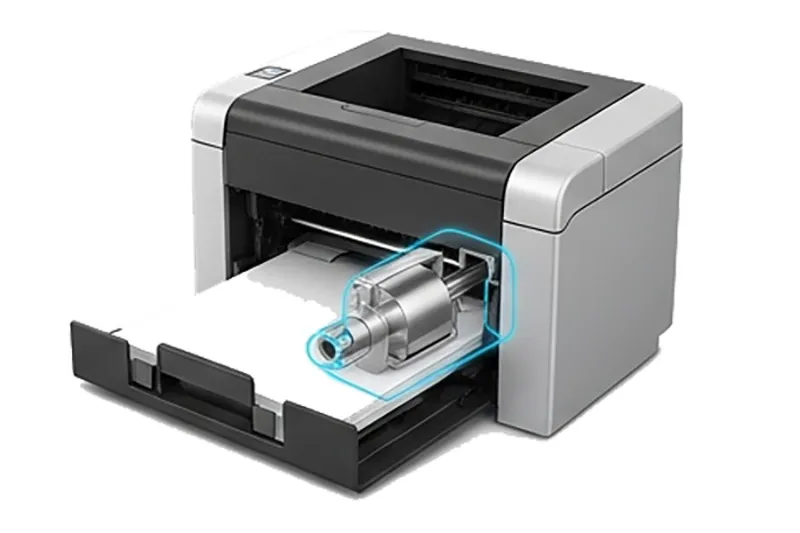
Printers contain various action scenarios such as paper feeding, positioning, locking, releasing, and switching, which put forward clear and stringent requirements for actuators:
- Fast and stable action response: Actions such as paper separation, clutch release, and print head locking are usually completed in an extremely short time, requiring millisecond-level response;
- Precise action and high repeatability: Printers need to maintain position consistency under high-frequency operation, and any deviation may lead to paper jams, ghosting, or printing misalignment;
- Compact structure and controllable cost: Desktop printers have limited internal space, and industrial printers also have strict requirements for cost and maintainability;
- Low noise and long service life: Office environments require low noise, and the whole machine needs to support hundreds of thousands or even millions of actions during its life cycle.
In these application scenarios, traditional motors or complex mechanisms are often difficult to balance cost, volume, and response speed, while solenoids can just meet these comprehensive needs, becoming one of the core executive components of printers.
Chapter 3: DC Pull Solenoids Solution Design: Functions and Selection of Solenoids for Printers
According to the needs of different functional modules inside the printer, the solution design of solenoids must have clear pertinence to ensure perfect adaptation to the whole machine system:
3.1. Typical Application Positions
Paper separation/paper stop control in the paper feeding mechanism: Separate a single sheet of paper through the instantaneous action of the solenoid to avoid multiple pages feeding at the same time, or quickly stop paper in case of paper jams to protect the mechanism safety;
Locking and releasing of the print head or paper pressing component: Lock the print head position during printing to ensure printing accuracy; release it after printing or maintenance to facilitate consumable replacement or fault cleaning;
Positioning and switching of toner cartridges, ink cartridges, or modules: Achieve precise positioning after consumable installation, or complete rapid switching in multi-consumable switching scenarios (such as multi-ink cartridges in color printers);
Instant drive in the automatic cutter mechanism: Drive the cutter to complete instantaneous cutting of paper/labels in label printers, receipt printers, etc., ensuring flat cuts.
3.2 Selection of DC Pull Solenoids Types
DC pull solenoids: Preferred in most scenarios, which can realize one-way instantaneous actions, with fast response speed, simple structure, and controllable cost, perfectly adapting to the instantaneous action needs such as paper separation and cutter drive;
Holding solenoids: For mechanisms that need to maintain state after power failure (such as long-term locking of print heads and fixed positioning of consumables), holding solenoids are selected, which can maintain state without continuous power supply, significantly reducing the power consumption of the whole machine.
3.3 Key Parameter Design
Working voltage: Matches the power supply system of the whole printer, commonly 12V or 24V DC voltage, ensuring stable power supply and compatibility with the control logic of the main control board;
Suction force and stroke: Precisely calculated according to the spring resistance, friction force, and motion inertia of the corresponding mechanism, ensuring sufficient suction force to complete the action and controlling the stroke accuracy to avoid overshoot or insufficient stroke;
Coil design: Adopt high-temperature resistant enameled wire, optimize the number of coil turns and wire diameter on the premise of ensuring suction force, balance suction force, temperature rise, and power consumption, and avoid coil overheating damage during long-term work.
Select armature materials with excellent wear resistance (such as stainless steel, alloy steel) to reduce wear caused by high-frequency attraction and release; adopt low-noise iron core structure with buffer pads to reduce impact noise; select flame-retardant and high-temperature resistant engineering plastics for the shell to improve use safety; at the same time, optimize the sealing design to prevent dust and paper debris from entering the coil or movement gap, affecting the stability of actions.
In the prototype stage of the printer, the implementation and commissioning of solenoids directly affect the operation stability and user experience of the whole machine. The following core work needs to be focused on:
These commissioning works are important foundations to ensure the long-term stable operation of the printer and reduce the probability of after-sales faults.
Before design freezing and mass production, solenoids must pass systematic and rigorous verification tests to ensure they meet the performance and reliability requirements of the whole printer:
Practice shows that reasonably designed and commissioned solenoids for printers can maintain stable actions during long-term operation, effectively reducing paper jam rates, printing deviation rates, and overall machine maintenance costs.
Chapter 4: Implementation and Commissioning: From Prototype to Overall Machine Matching
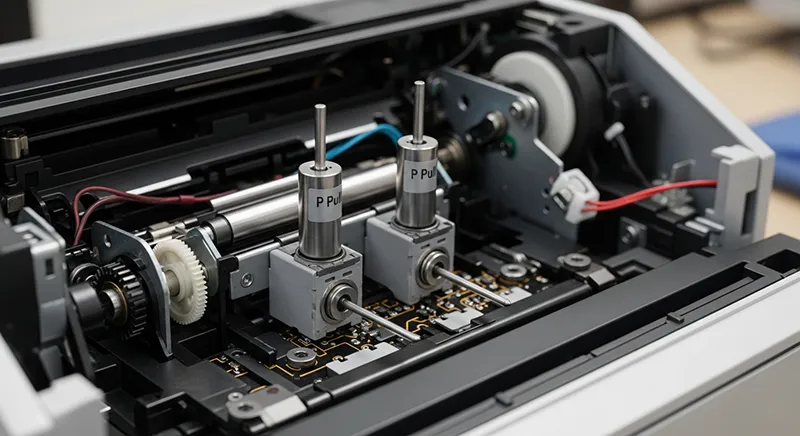
Mechanical matching commissioning: Precisely calibrate the installation position and stroke range of the solenoid to ensure that the push-pull action is in place, avoiding problems such as poor paper feeding, incomplete cutter cutting, or print head positioning deviation caused by stroke deviation; at the same time, check the fit gap between the armature and the mechanism to prevent jamming;
Noise control commissioning: Install silica gel buffer pads at the armature end and shell bottom of the solenoid, optimize the fit surface accuracy of the iron core and armature, reduce the impact noise during attraction and release; adjust the rigidity of the fixed bracket to avoid vibration transmission amplifying noise;
Action timing optimization: Collaborate with the main control board program for commissioning, optimize the energization pulse time and frequency of the solenoid, ensuring that it can reliably attract to complete the action, and avoid excessive coil temperature rise caused by long-term energization, extending the service life;
Continuous action test: Simulate the high-frequency working mode of the printer (such as continuous printing 1000 pages), verify the suction attenuation, action consistency, and temperature rise of the solenoid under high-frequency actions, and check for fatigue failure problems.
Chapter 5: Effect Verification: Performance and Reliability Testing
Service life test: Under simulated actual working conditions, conduct hundreds of thousands or even millions of on-off cycle tests (desktop printers usually require ≥500,000 times, industrial printers ≥1,000,000 times) to verify armature wear, coil aging, and sealing performance attenuation;
Overall machine linkage test: Simulate actual use scenarios such as continuous printing, frequent start-stop, abnormal paper jams, and consumable replacement, verify the linkage reliability between the solenoid and the paper feeding mechanism, print head, cutter, and other modules, and ensure rapid response under fault conditions (such as timely paper stop in case of paper jams);
Environmental adaptability test: Test the suction change, action response time, and coil temperature rise of the solenoid under high and low temperature (-10℃~45℃) and high humidity (relative humidity above 85%) environments, ensuring stable work in different office or industrial environments;
Power consumption and temperature rise test: Monitor the power consumption of the solenoid in different states such as standby, working, and high-frequency actions, and test the coil temperature rise after long-term work to ensure compliance with the overall machine power consumption and safety standards.
Chapter 6: Core Advantages and Disadvantages of DC Pull Solenoids Applications in Printers
6.1. Core Advantages
Combining the engineering practice experience of multiple printer projects, the following core application points are summarized to help the efficient implementation of the project:
Simple control logic: Action control can be realized only through power on/off or pulse signals, no complex drive circuit is needed, which is easy to integrate with the printer main control system and reduces development costs;
Fast response speed: Can achieve millisecond-level action response, perfectly adapting to the high-frequency instantaneous action needs such as printer paper feeding and cutter, ensuring printing efficiency;
High action reliability: Can maintain good repeatability in high-frequency action cycles, stable position accuracy, and effectively reduce printing faults;
Compact structure and controllable cost: Small size and light weight, adapting to the narrow internal space of the printer; few parts and low processing difficulty, with obvious mass production cost advantages;
Flexible power consumption adjustment: DC push-pull solenoids are selected for ordinary scenarios, and holding solenoids are selected for low-power consumption scenarios, which can be accurately matched according to needs to balance performance and power consumption.
6.2. Core Disadvantages
In printers, which are high-frequency, precise, and cost-sensitive mechatronic equipment, solenoids have become indispensable core executive components due to their advantages of rapid response, compact structure, simple control, and high cost performance. Through scientific demand analysis, precise selection and design, strict commissioning and verification, as well as advance prediction and solution of common problems, solenoids can provide stable and efficient action support for printer systems, helping to improve overall machine printing accuracy, operation reliability, and user experience. In the future, with the development of printers towards intelligence, high speed, and miniaturization, solenoids will also be upgraded towards low noise, long service life, low power consumption, and miniaturization, further adapting to the needs of higher-end printing equipment.
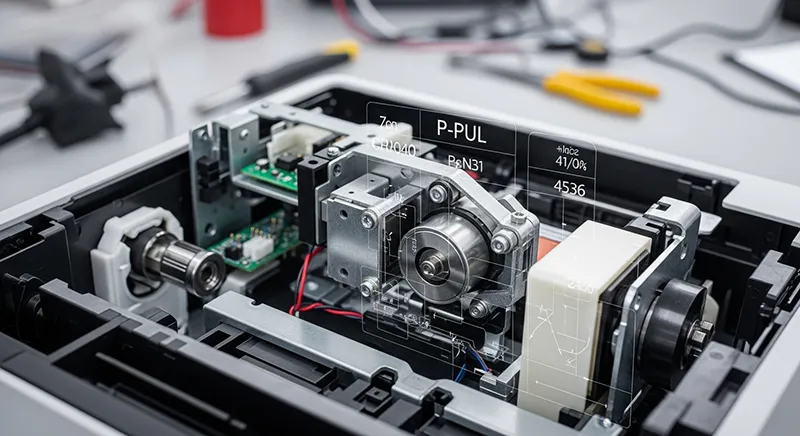
Limited action stroke: Most solenoids are designed with short strokes, only suitable for instantaneous push-pull actions, unable to meet long-distance drive needs, and the application scenarios are limited;
Easy wear under high-frequency actions: High-frequency attraction and release between the armature and the iron core will produce mechanical wear, which may lead to increased gaps and reduced suction after long-term use, affecting the service life;
Existing impact noise: Mechanical impact during attraction and release is easy to produce noise, which can be optimized through buffer design but is difficult to completely eliminate, and may be insufficient for scenarios with extremely high mute requirements;
Easy coil temperature rise: If the control logic is unreasonable, long-term energization will lead to excessive coil temperature rise, which not only consumes additional power but also may accelerate coil aging and even cause safety hazards;
High requirements for installation accuracy: Small deviations in installation position and stroke gap may lead to abnormal actions, increasing commissioning difficulty and production assembly costs.
Chapter 7: Common Problems and Solutions in Solenoid Applications for Printers
Problem 1: Suction attenuation after high-frequency work, resulting in poor paper feeding and weak cutter Solution: Check if the coil is overheated and aged; if aged, replace it with a high-temperature resistant coil; optimize the energization timing, adopt pulse power supply to reduce continuous energization time and lower temperature rise; check the wear of the armature and iron core; if severely worn, replace the armature assembly and adjust the fit gap
Problem 2: Excessive noise during action, affecting the office environment Solution: Install silica gel buffer pads at the armature end of the solenoid, add shock-absorbing washers between the shell and the fixed bracket; grind the fit surface of the iron core and armature to improve surface flatness and reduce impact gaps; adjust the solenoid power supply voltage to avoid excessive attraction impact caused by high voltage.
Problem 3: Solenoid jamming, unable to attract or release normally Solution: Disassemble the solenoid, clean internal dust, paper debris, and other impurities, and check if the movement gap is blocked; check if the armature is deformed; if deformed, correct or replace it; verify the stability of the power supply voltage and eliminate the problem of insufficient coil magnetic force caused by voltage fluctuation.
Problem 4: Holding solenoid cannot be released after power failure, affecting consumable replacement Solution: Check if the unlocking circuit of the holding solenoid is normal and troubleshoot the main control board’s unlocking signal output fault; check if the unlocking coil is open or short-circuited and replace the faulty coil; clean the magnetic impurities inside the solenoid to avoid affecting the magnetic circuit switching.
Problem 5: Positioning deviation and ghosting during printing Solution: Re-calibrate the solenoid installation position and stroke accuracy to ensure that the print head and paper pressing component are locked in place; check the coordination between the solenoid action timing and the print head movement timing and optimize the main control program parameters; replace the worn armature or positioning components to restore action repeatability.
Problem 6: Coil burnout after long-term work Solution: Optimize the coil design, select enameled wire with thicker wire diameter and higher temperature resistance; adjust the control logic, strictly control the single energization time to avoid long-term continuous energization; add overcurrent protection components in the circuit to prevent abnormal current increase from burning the coil.
Chapter 8: Experience Summary: Key Points for Solenoid Applications in Printers
Comprehensive parameter consideration for selection: Avoid simply pursuing suction force; comprehensively select parameters such as action stroke, response time, temperature rise, and power consumption to ensure precise matching with mechanism needs;
System coordination is better than individual performance: Solenoid design needs to be deeply coordinated with mechanical mechanisms, tolerance ranges, and main control logic, especially focusing on the matching of action timing, to avoid overall machine faults caused by excellent performance of a single component but insufficient coordination;
Strict control of energization time: Energization time is a key factor affecting the service life of the solenoid; shortening the energization time on the premise of ensuring reliable action through pulse power supply, timing optimization, etc., can significantly improve the service life;
Sufficient and comprehensive early testing: In the prototype stage, not only test normal working conditions but also simulate harsh working conditions such as high-frequency work, high and low temperatures, and dust to expose problems such as wear, temperature rise, and jamming in advance, avoiding troubles in mass production;
Attach importance to wear and protection design: For high-frequency action scenarios, select wear-resistant materials in advance and add buffer protection structures; at the same time, optimize the internal dust-proof design of the printer to reduce the impact of impurities on the moving parts of the solenoid;
Differentiated design to adapt to scenarios: Desktop printers prioritize balancing volume, noise, and cost; industrial printers need to strengthen service life and environmental adaptability, selecting high-wear and high-temperature resistant solenoid components.
Chapter 9: Conclusion
Solenoids have become indispensable actuators in modern printers due to their speed, reliability, compact size, and cost efficiency. Through scientific requirement analysis, precise selection, robust material design, strict commissioning, and comprehensive verification, solenoids significantly enhance printer accuracy, stability, and user experience.
As printers evolve toward higher speed, intelligence, miniaturization, and low noise, solenoid technology will continue advancing in low power consumption, extended service life, and ultra-compact design, supporting the next generation of high-end printing equipment.
